Top marketing tools for ecommerce in Australia 2026
. By Ads Daddy.

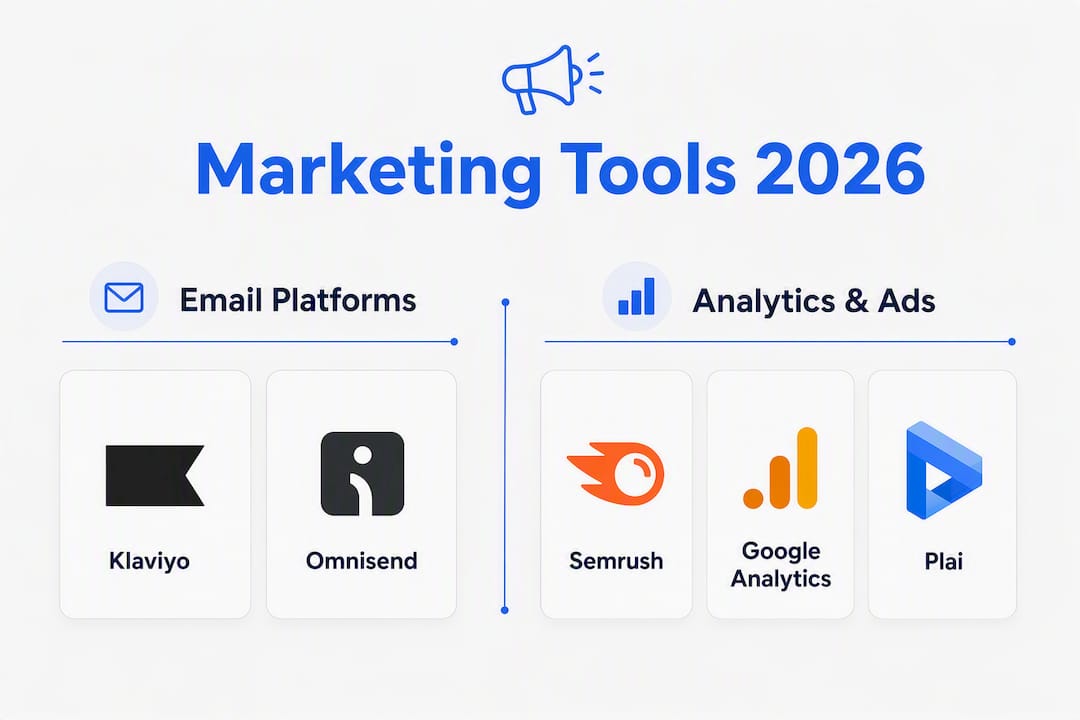
The six tools worth trialling first for Australian ecommerce stores are Klaviyo, Omnisend, Semrush, Google Analytics 4, Contentsquare, and Plai. Each one solves a specific bottleneck, and together they cover the four pillars that actually move revenue: email and SMS retention, organic traffic, conversion intelligence, and ad automation.
Here's the one-line case for each:
- Klaviyo — deep segmentation and AI-powered email/SMS flows; the go-to retention engine for stores doing serious volume, with full Australian availability and AUD billing.
- Omnisend — easier migration, lower cost, and 200+ integrations; the smarter pick for smaller teams who need email and SMS running fast without a big learning curve.
- Semrush — keyword research, technical SEO audits, and competitor PPC intelligence in one dashboard; available globally with no AU-specific restrictions.
- Google Analytics 4 (GA4) — free, non-negotiable baseline for traffic and conversion data; works natively with Shopify, BigCommerce, and Magento.
- Contentsquare — experience intelligence that shows exactly where users drop off and why; pairs with GA4 to fix conversion leaks before you pour more budget into ads.
- Plai — AI-driven ad autopilot for Facebook, Instagram, and Google; built for lean teams who want campaigns running without a full-time media buyer.
One caveat worth flagging upfront: Klaviyo's pricing scales with contact list size, so AU merchants with large lists should model costs carefully before committing. Omnisend's free tier is genuinely useful for early-stage stores. GA4 is free but requires proper event configuration to be meaningful.
Table of Contents
- Which tool should you pick for which job?
- Detailed profiles: what each tool actually does for your store
- How do you pick the right tool for your store right now?
- Recommended stacks by business size and priority
- Australian ecommerce brands putting these tools to work
- Key takeaways
- FAQ
Which tool should you pick for which job?
The table below maps each tool to its primary use case, pricing shape, key features, platform integrations, and AI capability. Use it to identify your immediate bottleneck, then pick the tool that solves it first.

| Tool | Best for | Pricing (AUD notes) | Key features | Integrations | Ease of use / team fit | AI / autopilot | AU support |
|---|---|---|---|---|---|---|---|
| Klaviyo | Retention, email/SMS, CDP | Free up to 250 contacts; paid scales with list size (AUD billing available) | Segmentation, flows, SMS, CDP, Composer AI | Shopify, BigCommerce, Magento, 350+ native | Medium; suits growth teams with a dedicated marketer | Composer AI for copy, predictive analytics | AU-based support hours; email and chat |
| Omnisend | SMB email/SMS, fast setup | Free tier (500 emails/month); Standard from ~AU$22/month | Email, SMS, push, automation, A/B testing | Shopify, BigCommerce, WooCommerce, 200+ | High; solo operators can self-serve | AI copy and send-time optimisation | Email support; no dedicated AU office |
| Semrush | SEO, keyword research, PPC intel | Pro from ~AU$170/month; 7-day free trial | Keyword research, site audit, competitor analysis, PPC gap | Shopify apps, Google Search Console | Medium; suits marketing managers | AI writing assistant, keyword clustering | Global support; English-language |
| GA4 | Traffic and conversion analytics | Free | Event tracking, funnel analysis, audience building, attribution | Shopify (via app), BigCommerce, Magento, Google Ads | Medium; needs configuration | Predictive audiences, anomaly detection | Google support docs; community forums |
| Contentsquare | UX/conversion intelligence | Enterprise pricing; contact for AUD quote | Session replay, heatmaps, journey analysis, frustration scoring | Shopify Plus, Magento, BigCommerce, GA4 | Medium-high; suits growth/enterprise teams | AI-powered frustration detection | Dedicated CSM; AU timezone coverage |
| Plai | Ad autopilot for lean teams | From ~AU$50/month; free trial available | AI campaign creation, budget optimisation, creative testing | Facebook, Instagram, Google Ads, TikTok | High; built for non-specialists | Full AI autopilot; real-time budget reallocation | Email support; English-language |
Quick "best for" summary:
- Klaviyo — growth-stage and enterprise merchants who want a unified B2C CRM with deep segmentation.
- Omnisend — early-stage stores and small teams migrating off a basic email tool.
- Semrush — any store investing in organic search or wanting to spy on competitor PPC spend.
- GA4 — every store, full stop. No exceptions.
- Contentsquare — stores with decent traffic (10,000+ monthly sessions) that want to fix conversion leaks before scaling ad spend.
- Plai — lean marketing teams or founders running their own paid social without a media buyer.
Detailed profiles: what each tool actually does for your store

Klaviyo
Klaviyo is a unified B2C CRM built specifically for ecommerce. It goes well beyond a basic email sender — it syncs real-time purchase, browse, and cart data to power flows that feel personal rather than blasted.
Key features:
- AI-powered Composer for email copy and subject lines
- Predictive analytics (next purchase date, churn risk, lifetime value)
- SMS and push notifications alongside email
- 350+ native integrations including Shopify, BigCommerce, and Magento
- CDP functionality: unified customer profiles with real-time data sync
- Advanced segmentation by behaviour, purchase history, and predicted value
- A/B testing across flows and campaigns
Pros: Deep segmentation that actually changes what you send. Real-time data sync means flows trigger on actual behaviour, not batch imports. The CDP layer reduces reliance on separate data tools.
Cons: Pricing scales steeply with list size — a 50,000-contact list gets expensive fast. The learning curve is real for solo operators. SMS in Australia requires compliance with the Spam Act 2003 and carrier opt-in rules, which adds setup time.
Pricing: Free up to 250 contacts and 500 email sends/month. AUD billing available. Paid plans scale by contact count.
Integrations: Shopify (native, real-time), BigCommerce, Magento, WooCommerce, and 350+ others.
AU note: Full Australian availability. AUD billing. Klaviyo's email marketing best practices for ecommerce are well-documented and worth reviewing before you build your first flow.
Omnisend
Omnisend is the accessible alternative to Klaviyo. It covers email, SMS, and push in one place, with a lower price point and a migration path that won't eat your whole week.
Key features:
- Drag-and-drop email builder with pre-built ecommerce templates
- SMS and push notifications
- Pre-built automation workflows (welcome, cart abandonment, win-back)
- A/B testing on subject lines and send times
- AI-assisted copy and send-time optimisation
- 200+ integrations including Shopify, BigCommerce, and WooCommerce
- Segmentation by purchase behaviour and engagement
Pros: Fast to set up — most teams are sending within a day. Lower cost than Klaviyo for comparable contact volumes. Migration support from other platforms is genuinely helpful.
Cons: Segmentation is less granular than Klaviyo. No native CDP layer. SMS coverage in Australia is available but worth verifying carrier reach before launch.
Pricing: Free tier includes 500 emails/month. Standard plans start from approximately AU$22/month. No AUD-specific pricing page, but USD pricing converts cleanly.
Integrations: Shopify, BigCommerce, WooCommerce, Magento, and 200+ others.
AU note: No dedicated Australian office, but email support is responsive. For SMB automation stacks, Omnisend pairs well with the SMB automation guide Adsdaddy publishes for AU merchants.
Semrush
Semrush is the Swiss Army knife of organic search and competitive intelligence. For ecommerce, it's most useful for finding keyword gaps your competitors are ranking for, auditing technical SEO health, and reverse-engineering competitor Google Ads strategies.
Key features:
- Keyword research with search volume, difficulty, and intent filters
- Site audit for technical SEO issues (crawl errors, Core Web Vitals, schema)
- Competitor traffic and PPC gap analysis
- Backlink analysis and link-building tools
- AI writing assistant and keyword clustering
- Position tracking for target keywords
Pros: One of the most complete SEO and PPC intelligence platforms available. The competitor PPC gap tool alone can surface profitable keywords you'd otherwise miss. Strong documentation and learning resources.
Cons: Pro plan is a meaningful monthly investment. The platform has a lot of features — new users often underuse it. Not a direct ad management tool; it informs strategy rather than executing campaigns.
Pricing: Pro plan from approximately AU$170/month. Seven-day free trial available. For an independent comparison of Semrush against other SEO tools for ecommerce, that roundup covers strengths and trade-offs in detail.
Integrations: Google Search Console, Google Analytics, Shopify apps, Trello, and others.
AU note: Full global availability. No AU-specific restrictions. English-language support.
Google Analytics 4
GA4 is the non-negotiable baseline. Every other tool in your stack should feed into or be validated against GA4 data. It's free, and there's no credible reason not to have it configured properly.
Key features:
- Event-based tracking (replaces the old session model)
- Funnel analysis and conversion path reporting
- Audience building for Google Ads remarketing
- Predictive metrics (purchase probability, churn probability)
- Cross-device and cross-platform attribution
- Integration with Google Ads, Search Console, and BigQuery
Pros: Free. Native Google Ads integration. Predictive audiences are genuinely useful for remarketing. The BigQuery export opens up custom analysis for data-savvy teams.
Cons: Requires proper event configuration to be meaningful — out-of-the-box data is often incomplete. The interface is less intuitive than Universal Analytics was. Sampling in the free tier can affect large-volume reports.
Pricing: Free.
Integrations: Shopify (via GA4 app or GTM), BigCommerce, Magento, Google Ads, Search Console.
AU note: No regional restrictions. GST reporting and AU currency settings work natively.
Contentsquare
Contentsquare sits in the experience intelligence category. It shows you not just what users do on your site, but why they leave — frustration clicks, rage taps, dead-end journeys. Fixing a 1% conversion issue often outperforms a 10% increase in ad spend, and Contentsquare is the tool that finds those issues.
Key features:
- Session replay with frustration scoring
- Heatmaps and click maps by device and segment
- Customer journey analysis (entry, exit, and loop detection)
- AI-powered frustration detection
- Zone-based analytics for product pages and checkout
- Integration with GA4 and major analytics platforms
Pros: Surfaces conversion leaks that GA4 alone won't show. The AI frustration detection flags issues before they become expensive. Dedicated customer success manager included at enterprise tier.
Cons: Enterprise pricing — not a tool for early-stage stores. Requires meaningful traffic volume to generate statistically useful heatmaps. Implementation takes time and technical resource.
Pricing: Enterprise pricing; contact Contentsquare for an AUD quote. No self-serve free tier.
Integrations: Shopify Plus, Magento, BigCommerce, GA4, Salesforce.
AU note: AU timezone coverage available through dedicated CSM. Best suited to stores with 10,000+ monthly sessions.
Plai
Plai is the ad autopilot for teams who don't have a full-time media buyer. It uses AI to create, launch, and optimise campaigns across Facebook, Instagram, Google, and TikTok — adjusting budgets and creatives in real time without daily manual intervention.
Key features:
- AI campaign creation from a brief or product feed
- Real-time budget reallocation across platforms
- Creative testing and winner identification
- Performance reporting in plain English
- Multi-platform management (Facebook, Instagram, Google, TikTok)
- Autopilot mode for hands-off campaign management
Pros: Dramatically reduces the time spent on daily campaign management. The plain-English reporting makes it accessible for non-specialists. Real-time budget reallocation means spend follows performance automatically.
Cons: Less control than a manual campaign setup for experienced media buyers. Creative quality still depends on your inputs. Not a replacement for a full paid media strategy.
Pricing: From approximately AU$50/month. Free trial available.
Integrations: Facebook Ads, Instagram, Google Ads, TikTok Ads.
AU note: Full Australian availability. English-language support. Works well alongside a multichannel ads strategy for stores running across multiple platforms.
How do you pick the right tool for your store right now?
Start with your bottleneck, not your wishlist. Three questions cut through the noise:
- Is your traffic problem or your conversion problem bigger? If you're getting sessions but not sales, fix conversion before spending more on acquisition. Contentsquare and GA4 go first.
- Do you have an email and SMS list you're not using well? If yes, Klaviyo or Omnisend should be your next install — retention revenue is the cheapest revenue you'll ever earn.
- Are you spending on paid ads without clear attribution? Plai and GA4 together give you a fast feedback loop without a media buyer on payroll.
Vendor due-diligence checklist
| Question | What to verify |
|---|---|
| Does it integrate natively with my platform? | Check the vendor's integration page for Shopify/BigCommerce/Magento — "native" beats "via Zapier" every time |
| Is AU support available in my timezone? | Ask for AEST support hours during the trial; test response time with a real question |
| Can I see AUD pricing or get a local quote? | Confirm billing currency and GST invoicing before signing |
| What does the free trial actually unlock? | Some trials limit features — confirm you can test the features you actually need |
| How does it handle Australian compliance? | SMS tools must comply with the Spam Act 2003; confirm opt-in and unsubscribe handling |
30/60/90-day implementation timeline
| Phase | Milestone |
|---|---|
| Days 1–30 | Install GA4 with full event tracking; connect your email tool (Klaviyo or Omnisend); set up welcome and cart abandonment flows |
| Days 31 to 60 | Launch Semrush audit; fix top-10 technical SEO issues; run first A/B test on a key email flow; activate Plai for one paid channel |
| Days 61 to 90 | Add Contentsquare (if traffic justifies it); review funnel data; kill underperforming creatives; document what's working for the next quarter |
Red flags to watch for: Any vendor that can't give you a straight answer on AU support hours is a risk. Avoid tools that require a 12-month lock-in before you've validated fit. If a platform's Shopify integration is "coming soon," treat that as a no for now.
Pro Tip: Before signing any annual contract, send a support ticket during your trial and time the response. A tool that takes 48 hours to reply during a free trial will not get faster once you're paying.
Australian-specific considerations
Peak retail events in Australia — EOFY (June), Black Friday/Cyber Week (November), and Boxing Day — require your email and ad tools to be fully configured at least four weeks before these events. GST invoicing from your SaaS vendors should be confirmed before EOFY reporting. Local payment gateways (Afterpay, Zip, eWAY) and shipping providers (Australia Post, Sendle) need native integrations or clean API connections to avoid breakages during traffic spikes.
How these tools were evaluated
Every tool in this shortlist was assessed against seven criteria: feature completeness for ecommerce use cases, native integrations with Shopify, BigCommerce, and Magento, Australian support availability and timezone coverage, ease of use for teams of one to ten people, pricing transparency and AUD availability, AI and autopilot capability, and realistic ROI potential for Australian merchants.
The evaluation process included hands-on trials where free tiers or trials were available, documentation review, pricing checks against publicly listed AUD or USD rates, AU availability verification, and cross-referencing with industry sources including Contentsquare's experience intelligence research, Klaviyo's official integration documentation, and Omnisend's migration and pricing pages.
Last updated: June 2026. Evaluated by: Adrian, Adsdaddy.
Recommended stacks by business size and priority
There's no universal starter pack. The right stack depends on where your store is bleeding revenue right now.
| Business profile | Recommended stack | First integration priority |
|---|---|---|
| Early-stage SMB (under AU$500K revenue) | GA4 + Omnisend + Plai | GA4 first, then Omnisend welcome flow, then Plai for one paid channel |
| Growth-stage merchant (AU$500K–AU$5M) | GA4 + Klaviyo + Semrush + Plai | Klaviyo flows → Semrush audit → Plai ad automation |
| Enterprise growth team (AU$5M+) | GA4 + Klaviyo + Semrush + Contentsquare + Plai | CDP/email → analytics → conversion intelligence → ad automation |
Why this order matters: Email and SMS flows generate revenue from your existing audience before you spend another dollar on acquisition. Analytics tells you what's actually working. Conversion intelligence (Contentsquare) fixes leaks. Ad automation (Plai) then scales what's already proven. Reversing this order — spending on ads before fixing retention and conversion — is the most common and most expensive mistake Australian ecommerce teams make.
Common Australian pitfalls:
- Integration tax: Prefer platforms with native, well-documented APIs for AU payment gateways (Afterpay, eWAY) and shipping providers (Australia Post). A Zapier workaround that breaks during a Black Friday traffic spike costs more than the tool you saved money on.
- Peak-season sync failures: Configure and test all integrations at least four weeks before EOFY and Black Friday. Don't discover your cart abandonment flow is broken on the first day of your sale.
- Timezone mismatches: AU merchants running global tools should confirm that send-time optimisation and ad scheduling account for AEST/AEDT, not US Eastern or UTC defaults.
For practical marketing automation examples that show how these stacks connect in real workflows, that guide covers the flows worth building first.
Pro Tip: AI tools for ecommerce — from Klaviyo's predictive analytics to Plai's ad autopilot — work best when your first-party data is clean. Before you activate any AI feature, audit your customer data for duplicates, missing fields, and consent gaps. Garbage in, garbage out applies twice as hard when an algorithm is making decisions at scale. For more on how AI in ecommerce is being applied beyond the hype, that breakdown is worth a read.
Australian ecommerce brands putting these tools to work
Australian ecommerce has a few patterns worth noting. Fashion and homewares brands with large email lists consistently report that Klaviyo's segmentation — particularly predictive churn and next-purchase-date modelling — lets them send fewer emails while generating more revenue per send. The logic is simple: stop emailing everyone the same thing and start emailing the right people the right offer at the right time.
Smaller AU direct-to-consumer brands in the health, beauty, and food categories have found Omnisend's pre-built automation workflows (welcome series, cart abandonment, post-purchase) get them to a functional retention stack in days rather than weeks. For a solo founder or a two-person team, that speed matters more than Klaviyo's depth.
On the SEO side, AU merchants using Semrush for competitor PPC analysis have surfaced Google Shopping gaps where competitors are spending heavily on branded terms but leaving category keywords wide open. That's free intelligence that changes where you put your next dollar.
Stores that added Contentsquare after hitting a conversion plateau consistently found the same culprits: checkout friction on mobile, confusing product page layouts, and form fields that caused rage-clicks. Fixing those issues before scaling ad spend is the difference between a leaky bucket and a full one.
Plai has gained traction with AU merchants who run lean teams and need paid social running across Facebook and Instagram without the overhead of a full agency retainer. The AI autopilot handles daily budget decisions; the human handles creative direction and strategy.
Key takeaways
The single most important move for most Australian ecommerce teams in 2026 is to fix retention and conversion before scaling acquisition spend — the tools that do that are Klaviyo or Omnisend (retention) and Contentsquare paired with GA4 (conversion).
| Point | Details |
|---|---|
| Fix retention before scaling ads | Email and SMS flows (Klaviyo or Omnisend) generate revenue from existing customers at a lower cost than new acquisition. |
| GA4 is non-negotiable | Every store needs GA4 properly configured before any other analytics or ad tool can be trusted. |
| Match tool to bottleneck | Traffic problem? Start with Semrush. Conversion problem? Start with Contentsquare. Ad efficiency problem? Start with Plai. |
| Build for AU-specific events | Configure and test all integrations four weeks before EOFY, Black Friday, and Boxing Day to avoid peak-season failures. |
| Adsdaddy as your agency option | If you'd rather outsource setup and optimisation, Adsdaddy handles multichannel campaign management, Klaviyo integration, and AU-specific ad strategy. |
A strategist's honest take on tool stacks
Here's what most tool roundups won't tell you: the stack isn't the strategy. You can have Klaviyo, Semrush, Contentsquare, and Plai all running simultaneously and still be losing money if your creative is weak, your offer is wrong, or your checkout is broken.
The brands that get the most out of these tools share one habit: they pick one bottleneck, fix it with one tool, measure the result, and then move to the next. They don't buy six tools in January and wonder why nothing improved by March.
The other thing worth saying plainly — AI autopilot features are genuinely useful for routine optimisation. Plai reallocating budgets in real time, Klaviyo predicting churn before it happens, GA4 flagging anomalies automatically. That's real leverage. But AI can't fix a bad product page or a confusing returns policy. It just spends your budget faster on a broken funnel.
The stack Adsdaddy most often recommends as a starting point for AU ecommerce clients: first-party data collection (GA4 + Klaviyo CDP), email and SMS flows, ad autopilot (Plai or a managed campaign), and landing page testing. In that order. Get the data right, get retention running, then scale with paid. Anything else is building on sand.
Adsdaddy: when you'd rather not do this alone
Running the tools is one thing. Running them well — with the right creative, the right segmentation, and the right campaign structure for the Australian market — is another job entirely.

Adsdaddy is a digital marketing agency that handles the full stack: Facebook, Instagram, Google, YouTube, Microsoft, and LinkedIn ad campaigns, Klaviyo email setup and flow builds, creative development, and performance optimisation. The difference from doing it yourself isn't just time saved — it's having someone who's already made the expensive mistakes on other people's budgets, not yours.
If you're heading into EOFY or Black Friday and your ad campaigns, email flows, or attribution aren't where they need to be, book a strategy call with the Adsdaddy team. AU-specific integrations, peak-season support, and a no-fluff audit of what your stack actually needs — that's the starting point.
Further reading worth bookmarking
These sources are worth checking directly for pricing updates, integration documentation, and case studies — vendor pricing changes frequently, and the primary source is always more reliable than a roundup.
- Klaviyo official site — for current pricing tiers, integration documentation, and Composer AI feature updates.
- Omnisend official site — for migration guides, free tier limits, and AU SMS carrier coverage.
- Semrush learning hub — for keyword research tutorials and ecommerce SEO playbooks.
- Google Analytics Help Centre — for GA4 event configuration guides and Shopify setup documentation.
- Contentsquare resource library — for experience intelligence case studies and conversion optimisation frameworks.
- Plai help centre — for autopilot setup guides and platform-specific campaign documentation.
- Adsdaddy AU blog — for ecommerce ad strategies and campaign setup guides specific to Australian merchants.
FAQ
What are the best marketing tools for ecommerce in Australia?
The strongest starting stack for most Australian ecommerce stores is GA4 (free analytics), Klaviyo or Omnisend (email and SMS retention), Semrush (SEO and competitor intelligence), and Plai (ad autopilot). Add Contentsquare once you have meaningful traffic and want to fix conversion leaks before scaling spend.
What is the best ecommerce tool for a small team?
Omnisend is the most accessible option for small teams — it has a free tier, pre-built automation workflows, and a fast setup that doesn't require a dedicated marketer. Plai handles paid ads with minimal daily management, making it a practical pair for lean operations.
What are the five marketing tools most ecommerce stores use?
The five most commonly used tools across ecommerce marketing stacks are Google Analytics 4, an email/SMS platform (Klaviyo or Omnisend), an SEO tool (Semrush or Ahrefs), a paid ad platform (Google Ads or Meta Ads), and a conversion optimisation tool (Contentsquare or AB Tasty). The exact mix depends on business size and primary growth bottleneck.
How do I choose between Klaviyo and Omnisend?
Choose Klaviyo if you have a large contact list, need deep behavioural segmentation, or want a unified CDP alongside email and SMS. Choose Omnisend if you're migrating from a basic tool, have a smaller list, or need to get retention flows running quickly at a lower cost.
Does Adsdaddy help with ecommerce marketing tool setup?
Yes. Adsdaddy sets up and manages multichannel ad campaigns across Facebook, Instagram, Google, and more, and handles Klaviyo integration and flow builds for Australian ecommerce clients. The agency also provides AU-specific strategy for peak retail events like EOFY and Black Friday.