SEO Trends in 2025: Impact on Aussie E-Commerce
. By Ads Daddy.

Staying visible online feels tougher each year for Australian e-commerce businesses. As Google’s influence grows and search behaviours shift locally, the old strategies just do not cut it anymore. In 2025, success comes down to mastering systemic SEO disciplines where mobile-first design, local optimisation, and brand interactions matter as much as keywords. This guide explains what truly drives organic growth for Australian brands now and how your strategy must evolve to keep attracting the right leads.
Table of Contents
- Defining SEO Trends and Shifts for 2025
- AI-Driven Search and User Experience Changes
- Evolving Local and Voice Search Strategies
- Content, E-E-A-T and Semantic Optimisation Updates
- Common SEO Mistakes and Costly Pitfalls
Key Takeaways
| Point | Details |
|---|---|
| SEO Evolution | In 2025, successful SEO strategies require a holistic approach, integrating local SEO, user experience, and mobile-first design to stay competitive in the Australian market. |
| AI Impact | The rise of AI-driven search necessitates a focus on high-quality, engaging content that answers user intent directly, as click-through rates are declining due to instant answers provided by AI. |
| Voice and Local Search | Optimising for voice search is crucial; Australian consumers use conversational queries and expect local context in results, making accurate Google Business Profiles essential. |
| E-E-A-T Framework | Compliance with the E-E-A-T framework is now mandatory for visibility, emphasising real experience and expertise to build trustworthiness and authority in content. |
Defining SEO Trends and Shifts for 2025
SEO in 2025 is not what it was in 2024. The game has shifted fundamentally, and Australian e-commerce businesses that don't adjust will lose momentum fast. This isn't about tweaking keywords anymore or chasing algorithm updates like a dog chasing its tail. Instead, mastering local SEO, user experience, and mobile-first strategies has become the foundation of digital survival in the Australian market. Google's dominance in Australia continues to shape these trends, but the way we approach search optimisation has matured dramatically. We're moving beyond simple ranking tactics into what amounts to a complete infrastructure overhaul.
Here's what's actually happening in 2025. SEO has evolved into a systemic discipline where crawl efficiency, content architecture, brand signals, and user behaviour all work together like gears in a watch. You can't just optimise one element anymore. If your website crawls inefficiently, great content won't matter. If your content architecture is a mess, Google struggles to understand your site structure. If you ignore brand signals and user behaviour patterns, you're leaving ranking power on the table. The integration of AI into search and the rise of voice search have forced this evolution. Australian businesses are recognising that SEO success now requires harmonising technological advancements with strategic brand positioning across all digital channels.
What's changed most critically is the emphasis on mobile-first indexing and user experience metrics. Australian consumers aren't patient. They expect websites to load fast, work flawlessly on their phones, and deliver exactly what they searched for without friction. Fast-loading pages aren't a bonus anymore; they're a baseline requirement. Data analytics tools are essential now too. You need to track not just traffic, but how users interact with your site, where they drop off, and what keeps them engaged. This shift from vanity metrics (page views) to behaviour metrics (engagement, time on page, scroll depth) separates successful Australian e-commerce operators from the rest.
The Australian market itself has specific quirks worth noting. Local search behaviours differ from global trends. Australians conduct searches differently than Americans or British users. They use different terminology, search at different times, and have distinct intent patterns. A multi-faceted SEO strategy that accounts for these local nuances, combined with broader technical excellence, is what drives results in 2025. This is why generic SEO advice fails for Australian businesses. You need strategies built for how Australians actually search and shop online.
Here's a comparison of traditional SEO tactics versus winning SEO strategies for Australian e-commerce in 2025:
| Aspect | Outdated SEO Tactic | Winning 2025 SEO Approach |
|---|---|---|
| Keyword Usage | Exact match keyword focus | Contextual, intent-driven phrasing |
| User Experience | Desktops prioritised | Mobile-first, frictionless design |
| Content Quality | Thin, generic descriptions | Original, expert-led, E-E-A-T proof |
| Technical SEO | Ignored, slow site speed | Fast-loading, crawlable architecture |
| Data Tracking | Pageview focus | Engagement and behavioural metrics |
Pro tip: Audit your entire site's crawl efficiency and content architecture right now using Google Search Console and tools like Screaming Frog to identify structural issues before they cost you rankings and traffic.
AI-Driven Search and User Experience Changes
AI has officially taken over search. Not metaphorically. Literally. Google's AI Overviews now sit at the top of search results, answering questions directly before users ever click through to a website. This changes everything for Australian e-commerce businesses. The old playbook of optimising for click-through rates is dead. Users get instant answers, personalised to their behaviour, conversational in nature, and increasingly contextual to their location and search history. The rise of AI-powered search reshapes how customers find products, forcing brands to rethink visibility strategies entirely. Your website now competes not just for rankings, but for being worthy of citation within AI summaries. If Google's AI decides to pull information from your competitor instead of you, your traffic vanishes.
Here's the brutal part. Click-through rates are dropping because users don't need to click anymore. They get the answer right there in the AI Overview. But visibility in these overviews is actually more valuable than a number one ranking used to be. Why? Because appearing in an AI Overview means Google trusts your content enough to feature it prominently, and users see your brand name and snippet before anything else. This is where quality and user experience become absolutely non-negotiable. AI systems prioritise content that directly answers user intent, loads fast, and engages users properly. A slow, poorly structured website won't make the cut, no matter how many keywords it contains. Your content needs to be scannable, authoritative, and genuinely useful. Listicles, data-driven articles, comparison guides, and structured information all perform better because AI can easily extract and summarise them.
Personalisation adds another layer of complexity. Users in Sydney searching for "summer dresses" get different results and different AI Overviews than users in Perth searching at midnight. The AI learns individual behaviour patterns and adjusts results accordingly. For e-commerce businesses, this means generic SEO approaches fail spectacularly. Your Australian audience isn't homogeneous. Regional preferences, seasonal variations, and localised search behaviour all matter now. You need to understand that optimising for AI search requires different tactics than traditional SEO, focusing on featured content quality and engagement rather than keyword density. The businesses winning in 2025 are those providing exceptional user experiences that AI algorithms recognise as worthy of promotion.
User experience signals have gone from "nice to have" to "make or break". Page speed, mobile responsiveness, core web vitals, and user engagement metrics now directly influence both AI visibility and traditional rankings. Australian consumers expect frictionless experiences. A checkout process that requires five steps instead of three costs conversions. A website that lags on 4G connection loses customers. AI systems monitor these behaviours and adjust visibility based on how real users interact with content. If your bounce rate is high, if users scroll past your content without engaging, if they abandon carts, AI takes note. Conversely, if users spend time on your pages, interact with your content, and convert, AI rewards you with better visibility.

Pro tip: Focus on creating AI-friendly content by using clear headers, structured data markup (Schema.org), concise answers to common questions, and ensuring your website delivers exceptional mobile and speed performance across all user touchpoints.
Evolving Local and Voice Search Strategies
Voice search is no longer the future. It's here, it's dominant, and Australian e-commerce businesses that ignore it are leaving money on the table. Smart speakers, voice assistants in cars, and voice commands on phones have normalised speaking searches instead of typing them. The difference matters because people speak differently than they type. When someone types, they might search "best leather jackets Sydney". When they speak, they ask "where can I buy leather jackets near me right now?" The conversational nature of voice search, combined with improved AI accuracy in understanding natural language and local dialects, means your SEO strategy needs to account for how real Australians actually talk. Slang, local accents, and regional terminology all matter now.
Local search has become inseparable from voice search success. Most voice searches include location intent. "Near me" queries are massive. "What's open now?" "Where's the closest coffee shop?" "Which plumber services my postcode?" These are voice searches with explicit local intent. For e-commerce businesses with physical locations, this is critical. Your Google Business Profile isn't optional anymore. It's the foundation of local visibility. You need your business hours accurate, your address correct, your phone number current, and your photos actually representing your store. Reviews matter too. A business with 4.8 stars and hundreds of reviews gets prioritised over one with ten reviews and a 4.2 rating. Voice assistants use this data to recommend businesses, and they trust established, well-reviewed operations. If your profile is outdated or incomplete, voice search will literally skip you and recommend a competitor.
Optimising for conversational keywords changes everything about content strategy. Traditional SEO focused on short, high-volume keywords like "leather jackets Sydney". Voice search optimisation focuses on question-based keywords and long-tail phrases because that's how people speak. "What are the best leather jacket brands for Australian winters?" "How much should I spend on a quality leather jacket?" "Where can I find ethically sourced leather jackets near me?" These conversational queries are longer, more specific, and often lower volume individually, but collectively they drive significant traffic. Your content needs to answer these questions directly. FAQ sections perform brilliantly for voice search. A simple Q and A format, with clear answers, makes it easy for voice assistants to extract information and read it aloud to users.
The strategy shifts focus from capturing broad keywords to capturing specific intent at scale. Create content answering the questions your Australian customers actually ask. Use conversational language in your headers and content. Include location-based terminology naturally. If you operate in Melbourne, Brisbane, Perth, Adelaide, or any regional area, mention these locations in your content and your local business listings. Structure your data properly using Schema.org markup so search engines and voice assistants understand what you're offering, where you're located, and what you specialise in. Regular customers searching by voice for "women's leather jackets near Southbank" should find you instantly. That requires clean data, well-optimised local listings, and content that matches conversational search intent exactly.
Pro tip: Update your Google Business Profile immediately with current hours, photos, and services, then audit your website content for conversational questions your customers actually ask and create FAQ sections answering them with natural, voice-friendly language.
Content, E-E-A-T and Semantic Optimisation Updates
Google's E-E-A-T framework has evolved from a nice-to-have ranking signal into a non-negotiable requirement for visibility in 2025. E-E-A-T stands for Experience, Expertise, Authoritativeness, and Trustworthiness. It's Google's way of saying "show me you know what you're talking about, and prove you're reliable". For Australian e-commerce businesses, this means generic product descriptions and thin content won't cut it anymore. Google's algorithms now actively measure whether your content demonstrates genuine experience and original value. If your product pages sound like every other retailer's product pages, Google will bury them. If your blog content regurgitates information everyone else has already published, it disappears. Leveraging original research and establishing verifiable author expertise has become the baseline for competitive visibility. You need to create content that couldn't have been written by just anyone.
Experience matters more than ever. This is the "first E" in E-E-A-T, and it's where most e-commerce businesses fail. Google wants to know if you've actually used your products. Have you tested them? Do you understand their real-world performance? A fitness equipment retailer that has personally tested every piece of gear they sell demonstrates experience. A skincare brand owned by dermatologists demonstrates experience. A fashion retailer whose team actually wears the clothes demonstrates experience. This doesn't mean you need to write a novel about every product. But your content should reflect genuine knowledge. Real product reviews with specific details about how items perform, what problems they solve, and who they're ideal for beat generic marketing speak every time. Customer testimonials and case studies work brilliantly because they demonstrate real-world experience. Your content needs to feel like it comes from someone who actually knows the product ecosystem, not someone writing from a corporate template.
Authority and trustworthiness build through consistency, transparency, and verifiable credentials. Who writes your content matters now. A product article written by someone with relevant expertise and a visible author bio outranks anonymous content. Your business should have clear team profiles, credentials listed, and expertise documented. If you're selling nutritional supplements, have a nutritionist on your team and credit them. If you're selling financial products, have a certified financial adviser. If you're selling business software, have someone with relevant industry experience. The barrier to entry for search visibility is rising because Google no longer accepts faceless, credential-less content. You also need to demonstrate trustworthiness through transparency. Clear return policies, customer service accessibility, security certifications, and honest product descriptions all build trust signals that Google recognises. Reviews, especially third-party reviews and ratings from established platforms, carry weight. A business with hundreds of verified customer reviews ranks higher than one with none, regardless of what that content says.
Semantic optimisation complements E-E-A-T by helping Google understand context and intent. Rather than stuffing keywords, semantic optimisation means using related terms, synonyms, and contextually relevant language that helps Google grasp what your content is actually about. If you're selling sustainable fashion, don't just repeat "sustainable fashion" 50 times. Use related terms like "ethically manufactured clothing", "environmentally responsible materials", "fair trade fashion", "carbon-neutral production". Google's semantic understanding has improved dramatically through AI. It now understands relationships between concepts. Structured data markup using Schema.org helps too. When you tell Google explicitly that a page is about "sustainable leather handbags made in Australia", it understands your relevance for related searches. The combination of E-E-A-T focused content, semantic richness, and original insight creates a protective moat around your search visibility. Generic competitors can't easily replicate expertise, experience, and trustworthiness that's built genuinely over time.
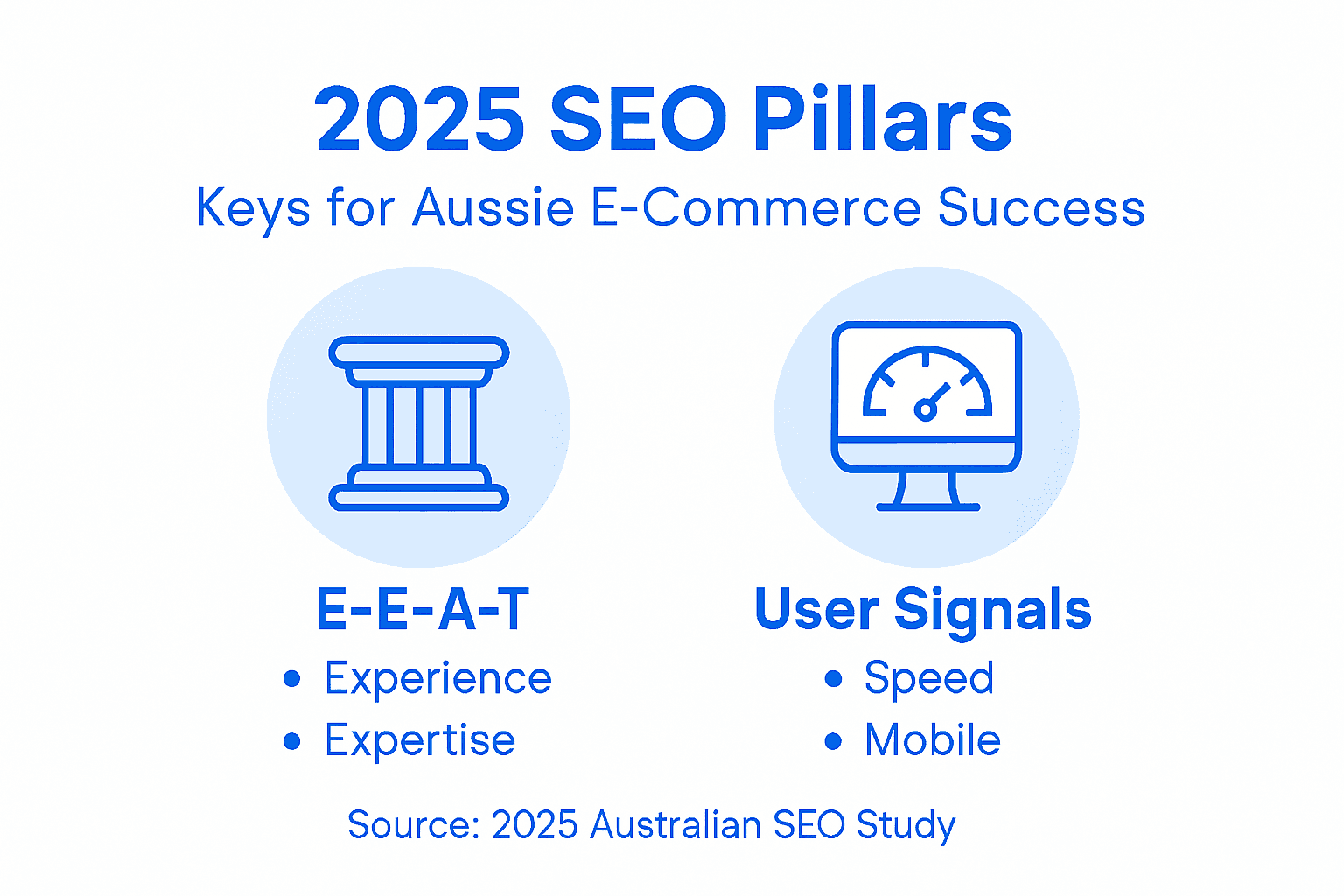
The following table summarises how E-E-A-T principles strengthen content for Australian e-commerce brands:
| E-E-A-T Pillar | Example in Practice | Advantage for SEO |
|---|---|---|
| Experience | In-house product testing reviews | Higher trust from Google and users |
| Expertise | Content authored by credentialled staff | Outranks anonymous competitors |
| Authoritativeness | Verified team profiles and credentials | Improves brand credibility |
| Trustworthiness | Display of policies and real reviews | Boosts rankings and conversion rates |
Pro tip: Audit your top 20 product pages and identify one unique angle per page that demonstrates genuine experience or expertise, then rewrite content to emphasise that unique perspective rather than copying competitor descriptions.
Common SEO Mistakes and Costly Pitfalls
Australian e-commerce businesses are making the same SEO mistakes over and over, and it's costing them rankings and revenue. The problem isn't that these mistakes are subtle. They're obvious once you know what to look for. Yet somehow, even experienced business owners trip up on them. The biggest culprit? Ignoring user intent entirely. You can optimise a page perfectly for keywords, but if that page doesn't actually answer what the user is searching for, Google buries it. Someone searching "best running shoes for flat feet" wants specific product recommendations for a specific problem, not a generic "top 10 running shoes" list. Your content needs to match intent exactly. Another massive mistake is relying on unedited AI-generated content. Google's algorithms now detect AI-generated fluff that doesn't provide real value. Overreliance on unedited artificial intelligence content results in rank drops and penalties, and it completely undermines your E-E-A-T signals. If you're using AI to draft content, you need to edit it heavily, add original insights, include real data, and ensure it reflects actual expertise. Generic AI output looks like generic AI output, and Google knows it.
Technical SEO fundamentals get overlooked constantly, and that's where easy wins sit untouched. Slow site speed, poor mobile optimisation, and duplicate content significantly reduce visibility and are completely fixable. A website that loads in five seconds instead of two loses conversions and rankings. A website that looks like garbage on mobile phones loses both users and search visibility because Google prioritises mobile-first indexing. Yet many Australian e-commerce sites still prioritise desktop performance and ignore mobile completely. Duplicate content is another silent killer. If you have multiple product pages showing essentially the same product with different SKUs, Google gets confused about which page to rank. Use canonical tags, consolidate variations properly, or use parameters correctly. The fix is straightforward, but the impact of ignoring it is massive.
Keyword stuffing is the equivalent of SEO from 2010, yet businesses still do it. Repeating a keyword 50 times on a page doesn't make you rank for that keyword. It makes your content unreadable and triggers spam filters. Natural keyword usage that reflects actual search intent performs infinitely better. If someone searches "sustainable clothing brands Australia", your content should naturally use those terms in context, not repeat "sustainable clothing brands Australia" in every sentence. Related keywords matter more than repetition. Use synonyms, variations, and contextually related terms. The same applies to outdated or stale content. A blog post published three years ago without updates signals to Google that your site isn't current. Maintaining fresh, relevant content aligned with SEO best practices is essential for sustained visibility. Update old articles with new data, refresh statistics, add recent examples, and remove information that's no longer accurate.
One more critical mistake: not tracking what's actually working. You can't fix problems you don't measure. Are users searching for your products but not finding you? Check Google Search Console to see what queries you're missing and what your current rankings are. Is traffic dropping? Investigate whether you've been hit by a core update, whether competitors have overtaken you, or whether your site speed has degraded. Are visitors bouncing immediately? Your content isn't matching intent or your user experience is terrible. Without data, you're flying blind. Use Google Analytics, Google Search Console, and rank tracking tools to understand exactly where your SEO is broken and what fixes will deliver the biggest impact.
Pro tip: Audit your top 50 landing pages right now using Google Search Console to identify pages ranking in positions 11-30, then rewrite those pages to directly answer user intent and watch them climb into the top 10.
Stay Ahead of Australian SEO Shifts with Expert Ad Campaigns
Australian e-commerce businesses face unprecedented challenges in 2025 from AI-driven search changes, mobile-first demands, and highly localised voice search behaviours. If you feel overwhelmed by evolving SEO trends like E-E-A-T, semantic optimisation, and behavioural engagement metrics it is critical to align your efforts with comprehensive digital marketing strategies. AdsDaddy.com specialises in optimising your visibility by combining targeted advertising with data-driven insights to capture exactly the Australian audience you want. Our expertise across platforms like Facebook, Google, and YouTube ensures your brand not only ranks but also converts clicks into customers.

Don’t let your competitors dominate AI overviews or voice search results while you lag behind. Visit AdsDaddy.com now to explore how our tailored campaign management and strategic ad placements complement cutting-edge SEO practices in Australia. Amplify your local search impact, boost engagement metrics, and turn user intent into measurable revenue growth today. Take control of your e-commerce success with expert digital marketing solutions designed for the modern Australian landscape.
Frequently Asked Questions
What are the key SEO trends for e-commerce businesses in 2025?
The key SEO trends for e-commerce businesses in 2025 include a focus on local SEO, mobile-first strategies, user experience metrics, and the integration of AI in search. Businesses need to enhance their website’s crawl efficiency, content architecture, and engage with user behaviour to maintain visibility.
How does AI influence search visibility for e-commerce websites?
AI dramatically influences search visibility as it determines how content is presented to users. With AI Overviews providing direct answers, it's essential for businesses to ensure their content is high-quality, trustworthy, and directly answers user intent to be featured prominently.
What does E-E-A-T mean, and why is it important for SEO in 2025?
E-E-A-T stands for Experience, Expertise, Authoritativeness, and Trustworthiness. It is crucial for SEO in 2025 as Google prioritises content that demonstrates genuine knowledge and reliability. This requires e-commerce businesses to provide original, detailed insights that reflect real-world experiences.
How can businesses optimise for voice search in 2025?
Businesses can optimise for voice search by using conversational keywords and phrasing, focusing on question-based queries, and ensuring their content directly addresses local intent. Additionally, updating Google Business Profiles and creating FAQ sections can enhance visibility in voice search results.