How to Scale Ad Campaigns for Australian E-commerce Success
. By Ads Daddy.

Growing an australian e-commerce brand demands smart ad strategies, especially when competition is fierce and every dollar counts. With over 80 percent of Australian consumers shopping online each year, efficient campaign scaling is no longer optional for those seeking higher visibility and consistent sales. Discover how clear, data-driven steps can make your Facebook and Google ads work harder and accelerate growth for your business.
Table of Contents
- Step 1: Audit Existing Campaign Performance
- Step 2: Identify Winning Ads and Target Audiences
- Step 3: Expand Budgets and Ad Placements Strategically
- Step 4: Implement Automated Optimisation Tools
- Step 5: Monitor Results and Refine Scaling Tactics
Quick Summary
| Key Point | Explanation |
|---|---|
| 1. Audit Performance Metrics Regularly | Systematic examination of metrics like CPA and ROAS helps identify areas for optimisation in ad campaigns. |
| 2. Identify High-Performing Ads and Audiences | Understanding which ads and audience segments yield the best results allows for targeted marketing strategies. |
| 3. Expand Budgets Based on Data | Incrementally increase ad budgets on high-performing platforms to maximise return on investment while managing risk. |
| 4. Utilise Automated Optimisation Tools | Leveraging AI tools can streamline ad management, making real-time adjustments for better campaign performance. |
| 5. Continuously Monitor and Adjust Campaigns | Ongoing analysis of campaign data ensures strategy adjustments align with market changes and improve effectiveness. |
Step 1: Audit Existing Campaign Performance
Auditing your e-commerce ad campaign performance is the strategic first move to understanding what's working and what needs improvement. By systematically reviewing your current advertising metrics, you'll identify opportunities to optimise your marketing spend and boost return on investment.
Start by gathering comprehensive performance data from your advertising platforms. Look beyond surface level metrics like impressions and clicks. Dive deep into conversion rates, cost per acquisition (CPA), return on ad spend (ROAS), and customer lifetime value. Australian online shopping trends indicate that consumer behaviour is rapidly evolving, so your audit must reflect these changing dynamics.
Key metrics to examine include click-through rates, conversion percentages, average order value, and customer acquisition costs. Compare these against your initial campaign objectives. Are you hitting your target cost per lead? Are certain ad creatives dramatically outperforming others? Segment your data by demographic, device type, and placement to uncover granular insights that can drive strategic adjustments.
Top Tip: When auditing campaigns, always export raw data into a spreadsheet for more detailed analysis and trend tracking.
To help compare key metrics for auditing e-commerce campaigns, see this structured summary:
| Metric | What It Measures | Business Impact |
|---|---|---|
| Click-through Rate (CTR) | Percentage clicking an ad | Indicates ad relevance and appeal |
| Conversion Rate | Percentage making a purchase | Shows ad effectiveness in driving sales |
| Cost Per Acquisition (CPA) | Average cost to gain one customer | Guides budget and profitability |
| Return on Ad Spend (ROAS) | Revenue earned per dollar spent | Assesses ad campaign efficiency |
| Customer Lifetime Value | Predicted long-term customer value | Informs targeting and retention strategies |
Step 2: Identify Winning Ads and Target Audiences
Identifying your most effective ad campaigns and pinpointing precise target audiences are critical steps in scaling your e-commerce marketing strategy. This process transforms raw data into actionable insights that can dramatically improve your advertising performance.

Social media shopping trends reveal that Australian consumers are highly responsive to targeted advertising, with 57% actively making purchases through social platforms. To capitalise on this opportunity, analyse your existing ad performance by comparing key metrics such as click-through rates, conversion rates, and return on ad spend across different audience segments. Look for patterns in demographics, interests, and behaviours that correlate with higher engagement and purchase rates.
Start by creating detailed audience personas that go beyond basic demographics. Consider psychographic elements like lifestyle, values, and purchasing motivations. Use tools like Facebook Audience Insights and Google Analytics to drill down into precise targeting options. Pay attention to which ad creatives resonate most with specific audience segments test different visual styles, messaging tones, and value propositions to understand what truly drives your potential customers to take action.
Top Tip: Create a spreadsheet comparing ad performance across different audience segments to quickly identify your most profitable targeting strategies.
Step 3: Expand Budgets and Ad Placements Strategically
Scaling your ad budgets and placements requires a calculated approach that balances potential growth with financial prudence. Your goal is to maximise return on investment while strategically expanding your digital marketing footprint across high performing channels.
Australian marketers are increasingly allocating media budgets towards commerce media platforms, with commerce media now representing approximately 30% of total media spend. This trend suggests a strategic shift towards more targeted and measurable advertising approaches. Begin by reviewing your current ad performance metrics and identifying channels delivering the most consistent and cost effective results. Focus on incrementally increasing budgets for platforms showing strong conversion rates and audience engagement.
Consider a phased budget expansion strategy that allows for controlled risk management. Start by allocating small percentage increases to top performing ad placements typically 10% to 15% increments. Monitor performance closely and be prepared to reallocate funds quickly if results do not meet expectations. Prioritise digital platforms with robust tracking capabilities that provide granular insights into audience behaviour and campaign effectiveness. Leverage tools like Google Analytics and Facebook Ads Manager to track key performance indicators and make data driven decisions about budget distribution.
Top Tip: Implement a monthly review process to assess ad performance and dynamically adjust budget allocations based on real time campaign data.
Step 4: Implement Automated Optimisation Tools
Automated optimisation tools represent a game changing approach for Australian e-commerce businesses looking to streamline their marketing efforts and boost campaign performance. These intelligent systems can transform how you manage and scale your digital advertising strategies.
AI-powered marketing tools now offer sophisticated capabilities that go beyond traditional campaign management. They can automatically adjust product recommendations, rank items dynamically, and make real-time campaign adjustments based on complex performance data. Start by exploring platforms that integrate machine learning algorithms to analyse your existing campaign metrics and provide actionable insights.
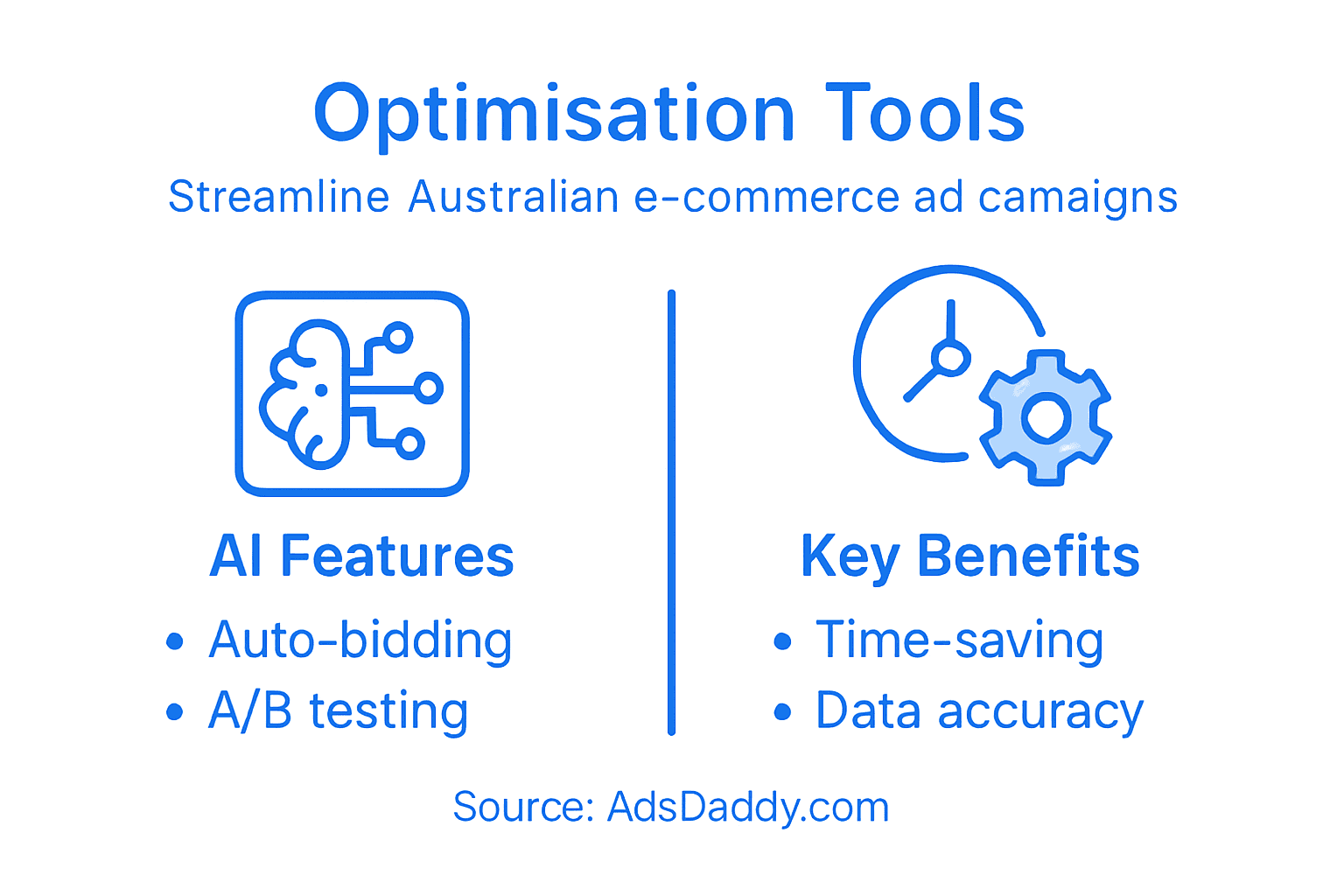
Begin implementing these tools by first connecting your advertising accounts and data sources. Look for solutions that offer comprehensive dashboards with predictive analytics and automated reporting. Select tools that can perform tasks like automatic bid adjustments, audience segmentation, and creative performance tracking. Pay special attention to platforms that provide transparent reporting and allow manual override capabilities so you maintain ultimate control over your marketing strategy. Integrate these tools progressively test small campaign segments first to understand their impact and refine your approach.
Top Tip: Choose automated optimisation tools with robust integration capabilities and clear performance reporting to ensure maximum transparency and control.
Below summarises features of leading automated optimisation tools available to Australian e-commerce marketers:
| Tool Feature | Typical Benefit | Practical Example |
|---|---|---|
| AI-driven Bid Adjustments | Maximises ad efficiency | Automatically raises/lowers bids for ROI |
| Automated Audience Segmentation | Targets profitable segments | Discovers high-value customers in real time |
| Creative Performance Tracking | Optimises ad content | Identifies top-performing visuals/messages |
| Predictive Analytics | Informs data-driven decisions | Forecasts campaign outcomes and trends |
| Manual Override Option | Maintains marketer control | Adjusts or pauses automation instantly |
Step 5: Monitor Results and Refine Scaling Tactics
Monitoring and refining your ad campaign performance is the critical final stage of strategic scaling for Australian e-commerce businesses. This ongoing process ensures your marketing efforts remain adaptive and responsive to changing market dynamics.
Continuous campaign performance tracking allows businesses to understand their true marketing effectiveness. Focus on key performance indicators such as conversion rates, average order value, customer acquisition costs, and return on ad spend. Create a comprehensive dashboard that consolidates data from all advertising platforms to give you a holistic view of your marketing performance.
Develop a systematic approach to performance analysis by establishing monthly review cycles. Compare your current metrics against baseline targets and identify trends or anomalies. Be prepared to make swift adjustments including reallocating budgets, modifying audience targeting, or pausing underperforming ad creatives. Implement a structured feedback loop where data insights directly inform your next marketing iteration. Remember that scaling is not a one time event but an ongoing process of incremental improvements and strategic refinements.
Top Tip: Create a standardised performance tracking template that allows quick visual comparison of campaign metrics across different periods and channels.
Unlock the Full Potential of Your Australian E-commerce Ad Campaigns
Scaling ad campaigns presents challenges that many Australian businesses face such as pinpointing winning ads, expanding budgets wisely, and implementing automated optimisation without losing control. This article highlights key goals like improving return on ad spend, identifying profitable target audiences, and continuously refining tactics to stay ahead of evolving market trends.
At AdsDaddy.com, we understand these pain points and offer expert campaign management across platforms like Facebook, Instagram, Google, and LinkedIn. Our data-driven strategies harness AI-powered optimisation tools and deep audience insights to elevate your ad efficiency and boost conversions. We specialise in helping businesses increase visibility, attract quality leads, and maximise sales through tailored advertising solutions.
Take the leap to transform your ecommerce growth journey today with Ads Daddy’s proven expertise. Explore how our comprehensive services can help you audit, optimise, and scale your campaigns effectively by visiting Ads Daddy. Don’t let budget or complexity hold you back from achieving your next level of success.
Discover how Ads Daddy can scale your campaigns now

Ready to scale your Australian ecommerce ads the smart way Visit Ads Daddy and partner with experts who turn data into growth. Start your journey towards higher ROI and lasting customer engagement today.
Frequently Asked Questions
How can I audit the performance of my e-commerce ad campaigns?
To audit your campaign performance, gather comprehensive data including conversion rates, cost per acquisition, and return on ad spend. Conduct this analysis by exporting raw data into a spreadsheet to track trends and identify areas for improvement.
What metrics should I focus on when identifying winning ads and audiences?
Concentrate on metrics like click-through rates, conversion rates, and return on ad spend. Analyse these metrics across different audience segments to pinpoint which demographics respond best to your ads.
What is the best way to scale my advertising budget and placements?
Adopt a phased approach by incrementally increasing ad budgets for high-performing placements, starting with 10% to 15% increments. Monitor performance closely to ensure that returns justify the increased spending, and adjust as needed within a few weeks of the changes.
How do I implement automated optimisation tools effectively?
Select automated optimisation tools that integrate well with your existing advertising platforms. Begin by connecting these tools to your data sources, and progressively automate tasks such as bid adjustments and audience segmentation for better control over campaign performance.
What should I include in my performance monitoring and refinement strategy?
Create a comprehensive dashboard that consolidates critical metrics from all advertising platforms. Establish a monthly review process to compare current performance against established targets and make necessary adjustments to campaigns based on the insights collected.
How often should I review my ad campaign performance?
Establish a systematic review cycle, ideally on a monthly basis, to track campaign performance metrics. Regularly assess these metrics against your baseline targets to identify trends and make adjustments to enhance effectiveness continually.
Recommended
- How to Create Ad Campaigns for Maximum Results Online - Ads Daddy. Advertise on All Plattforms.
- content Archives - Ads Daddy. Advertise on All Plattforms.
- Facebook Ads Archives - Ads Daddy. Advertise on All Plattforms.
- Digital Marketing Archives - Ads Daddy. Advertise on All Plattforms.
- Proven Ways to Increase Online Sales for Businesses - Jarrod Harman