How to advertise on multiple platforms without wasting your budget
. By Ads Daddy.

Run one coordinated cross-channel campaign, not five disconnected ones. One brief, one audience, platform-native creative, unified measurement. The single first technical move is server-side conversion tracking (conversion APIs) feeding a single source-of-truth audience. Get that right and everything else in this playbook, tools, creative, budget rules, launch checklist, actually works.
TL;DR:
- Focusing on a single KPI and unified measurement ensures cross-channel campaigns are aligned and reliable, avoiding conflicting platform reports.
- Using a shared audience seed and modular creatives tailored for each platform maximizes relevance and reduces wasted ad spend.
- Implementing server-side conversion tracking and standardized naming conventions is crucial for accurate measurement and effective budget allocation.
- Expanding to new channels should follow strict rules, ensuring the message and tracking are validated before adding platforms to prevent budget waste.
- Coordinated cross-channel campaigns outperform multichannel sprawl by maintaining shared audiences, consistent messaging, and unified data, especially when supported by disciplined governance.
Table of Contents
- How to advertise on multiple platforms: the topline approach
- What tools actually unify your campaigns and reporting?
- How do you build one creative brief for every platform?
- How do you measure results across platforms accurately?
- How should you split your budget across platforms?
- What's the launch checklist for the first 30 days?
- AdsDaddy's proof: how we actually run this
- Multichannel vs cross-channel: what's the real difference?
- What legal and privacy rules apply across platforms?
- How do you keep targeting consistent across platforms?
- What goes wrong when running ads on multiple platforms?
- What do successful multichannel campaigns actually look like?
- A quick high-leverage play to test this week
- Ready to run this without doing it all yourself?
- Further reading and authoritative docs
- FAQ
How to advertise on multiple platforms: the topline approach
Forget "post everywhere and pray." That's not a strategy, that's a hope. Here's the sequence that actually works when you're figuring out how to advertise on multiple platforms without setting fire to your budget.
- Pick one KPI, one conversion event. Leads, purchases, bookings, whatever moves your business. Every platform gets measured against it. Not five different "success" metrics that magically all look good in five different dashboards.
- Write one campaign brief. Core message, one proof point, one CTA. This brief is the parent. Every platform execution is a child of it.
- Push one audience seed everywhere. Your CRM or CDP (or, let's be honest, a well-kept spreadsheet if you're early stage) defines who you're chasing, then that same seed goes to Meta, Google, LinkedIn and the rest before a single dollar is spent.
- Install server-side conversion tracking first. Conversion APIs, Enhanced Conversions. Validate they're firing correctly before you touch ad spend.
- Start with one or two channels for 30 days. Prove the message works before you add a third platform. Expansion is a reward, not a default.
- Set a governance rhythm. Daily monitoring, weekly creative swaps, a 30-day measurement review. Campaigns die from neglect, not bad targeting.
That's the whole playbook in miniature. Everything below is how to execute each step without face-planting.
What tools actually unify your campaigns and reporting?
You don't need twelve tools. You need the right four or five, talking to each other properly.
Here's how the tech stack breaks down by job:
- Account connectors and dashboards pull raw platform data into one view. Supermetrics and Funnel-style connectors are the common picks for normalising spend, CPA and conversions across Meta, Google and LinkedIn without exporting spreadsheets by hand.
- Tag managers and server-side plumbing handle the conversion events. This is non-negotiable infrastructure, not a nice-to-have.
- CDPs or CRMs hold the audience truth. Your customer list, your lookalikes, your exclusions, all in one place.
- Attribution and analytics platforms (GA4 being the obvious one) stitch the customer journey together across touchpoints.
- Budget orchestration tools shift spend based on performance rather than gut feel.
- Creative production tools turn one brief into ten platform-native assets without ten separate briefings.
For a small or mid-size business, a full enterprise CDP is often overkill. A clean spreadsheet-fed audience list synced manually once a week can do the job until you're running six-figure monthly spend across four-plus platforms. That's when a CDP earns its cost.
When you're picking any tool for this stack, run it through a quick checklist: does it support conversion APIs natively, does it handle identity resolution across devices, does it report in near real time, and does it meet basic security and compliance standards? If a tool fails two of those four, keep shopping.
Pro Tip: Before you add a new tool to the stack, ask whether it replaces a spreadsheet or replaces a person. If it's the former, buy it later. If it's the latter, buy it now.
How do you build one creative brief for every platform?
Here's the mistake almost everyone makes: they build one ad, then shrink it to fit five platforms. That's not cross-channel creative, that's a Ford Falcon wearing five different number plates. Same engine, wrong fit for the road.
Your core brief needs exactly these five things:
- The problem your buyer actually has (in their words, not yours)
- Who that buyer is, specifically
- One belief you want them to walk away holding
- Your proof (a stat, a result, a guarantee)
- One clear call to action
From that single brief, you build modular components: hooks, a demo moment, proof beats, brand cues. Then you remix those components per platform.
- TikTok wants the hook in the first two seconds and zero polish.
- Instagram wants the same hook but with better lighting.
- LinkedIn wants the proof point leading, not the hook.
- Search wants your proof point as a headline, full stop.
- YouTube wants the demo front and centre before the pitch.
Same DNA, different outfit for the room it's walking into. That's a genuinely modular creative system, and it's the difference between multichannel and cross-channel at the creative layer.
On volume: plan for at least three to five variants per platform at launch, and swap underperformers weekly. Creative fatigue kills campaigns faster than bad targeting ever does, and creative velocity, not media buying skill, is usually the real bottleneck to scaling cross-platform.
Pro Tip: If your Instagram ad and your LinkedIn ad look identical, one of them is wrong. Platform-native isn't optional polish, it's the whole game.
Avoid these three traps: identical creative dropped across every platform, a different CTA on every channel (pick one action, stick to it), and creative refresh cycles slower than your audience's attention span. Check the ad creative formats guide before you brief your next batch.
How do you measure results across platforms accurately?
Every platform will tell you its own ads won the campaign. Facebook says Facebook drove it. Google says Google drove it. LinkedIn, bless it, will claim credit for a sale that closed via cold email. This is called "platform self-reporting bias," and it's why you need a measurement spine that sits above all of them.
Here's the build order:
- Install server-side tagging and conversion APIs before anything else. Clean event plumbing is the foundation of reliable cross-platform measurement, full stop. Validate your event match rate and check for latency issues before you trust a single number.
- Define one business KPI as your spine. Every platform metric gets normalised against it, not treated as its own scoreboard.
- Standardise UTMs and naming conventions across every campaign, every platform, every creative. If your naming is chaos, your reporting will be chaos with extra steps.
- Layer GA4's cross-channel reports and Data-Driven Attribution on top, but don't stop there. Verify what the models say with actual incrementality testing, geo holdouts or time-sliced experiments where you switch a channel off in one region and watch what happens to overall demand.
Statistic callout: Businesses that consolidate platform data into one unified view and apply dynamic budget allocation tend to see lower cost-per-acquisition and better click-through rates than campaigns run platform by platform with no shared measurement layer.
Run daily sanity checks: event match rate, conversion discrepancy between platform-reported and GA4-reported numbers, and a single dashboard everyone on the team actually looks at. If Meta claims 40 conversions and your CRM shows 12, you've got a tracking problem, not a performance problem. Fix the plumbing before you touch the budget. For the technical setup itself, conversion tracking done properly is worth the half-day it takes.
How should you split your budget across platforms?
It doesn't work. Different channels do different jobs.
The smarter play: master one channel first. Prove your message converts somewhere before you multiply the number of places it might fail. A single, coordinated budget spanning two or three well-chosen platforms consistently outperforms the same dollars spread thin and unmanaged across six.
Once you've got a validated message, use these rules to expand:
- Rebalance spend based on CPA or lifetime value, not vibes, using a rolling 30-day test window before you shift a single dollar.
- Treat each platform as answering a different question: Meta and Instagram for demand capture and retargeting, Google Search for intent already in motion, LinkedIn for B2B credibility and longer sales cycles, YouTube for demand creation and brand lift.
- Build explicit "not yet" rules before you launch. Don't add a new platform until creative cadence is sustainable, your landing page is converting at a proven rate, and your current channels have a validated message. These three constraints stop premature expansion dead, and premature expansion is the single most common way budgets get wasted.
Pro Tip: If you can't name which question a new platform answers that your current channels can't, you're not expanding strategically. You're just spending more to feel busy.
What's the launch checklist for the first 30 days?
Launch day chaos is avoidable. Most of it comes from skipping steps that take twenty minutes and cost nothing.
Pre-launch, tick every box:
- Campaign brief signed off by whoever owns the budget
- Audience seed pushed to every platform, not just the lead one
- Server-side conversions validated with live test events, not just "installed"
- UTM and naming conventions applied consistently across every asset
- Creatives uploaded, format-checked and previewed on-device per platform
Ownership matters more than people think. Someone specific checks tags daily. Someone specific owns the dashboard. Someone specific has the authority to swap underperforming creative without a four-person sign-off chain. Assign these before launch, not during a Tuesday panic.
First 30 days, run this rhythm: daily performance and tracking checks, weekly creative swaps based on real data, and a full 30-day measurement review where you decide whether to expand, hold, or kill. Build your incrementality test plan now, not after the campaign's already muddied the water. This governance loop is where most of the optimisation work actually happens, not in the initial setup.
AdsDaddy's proof: how we actually run this
Adsdaddy runs multi-platform campaigns across Facebook, Instagram, Google, YouTube, Microsoft Bing and LinkedIn, across image, video, carousel and text formats, with integrations into Meta for Business, Klaviyo and newCustomer.io for the engagement and lead-capture layer this playbook depends on.
The typical engagement follows the same audit, test, scale rhythm covered above: audit the current setup and tracking gaps, run a focused test window on one or two channels, then scale spend once the message is proven, aiming squarely at visibility, leads and sales.
If you've got the strategy but not the internal bandwidth to run daily tag checks, weekly creative swaps and a proper incrementality test, or your measurement needs have outgrown what one person can manage in spreadsheets, that's the exact gap Adsdaddy exists to close.
Multichannel vs cross-channel: what's the real difference?
Multichannel means you're on five platforms. Cross-channel means those five platforms are talking to each other. That's the whole distinction, and almost nobody treats it seriously enough.
Multichannel is coverage. You've got a presence on Meta, Google, LinkedIn, maybe TikTok. Each one runs its own targeting, its own creative, its own reporting. It looks busy. It looks thorough. It's often just five separate campaigns wearing a trench coat pretending to be one strategy.
Cross-channel is coordination. Three shared layers hold it together: one audience definition pushed everywhere, one creative system rendered natively per platform, and one measurement frame that sits above all of them. Miss any one of those layers and you're back to multichannel, no matter how many platforms you're technically "on."
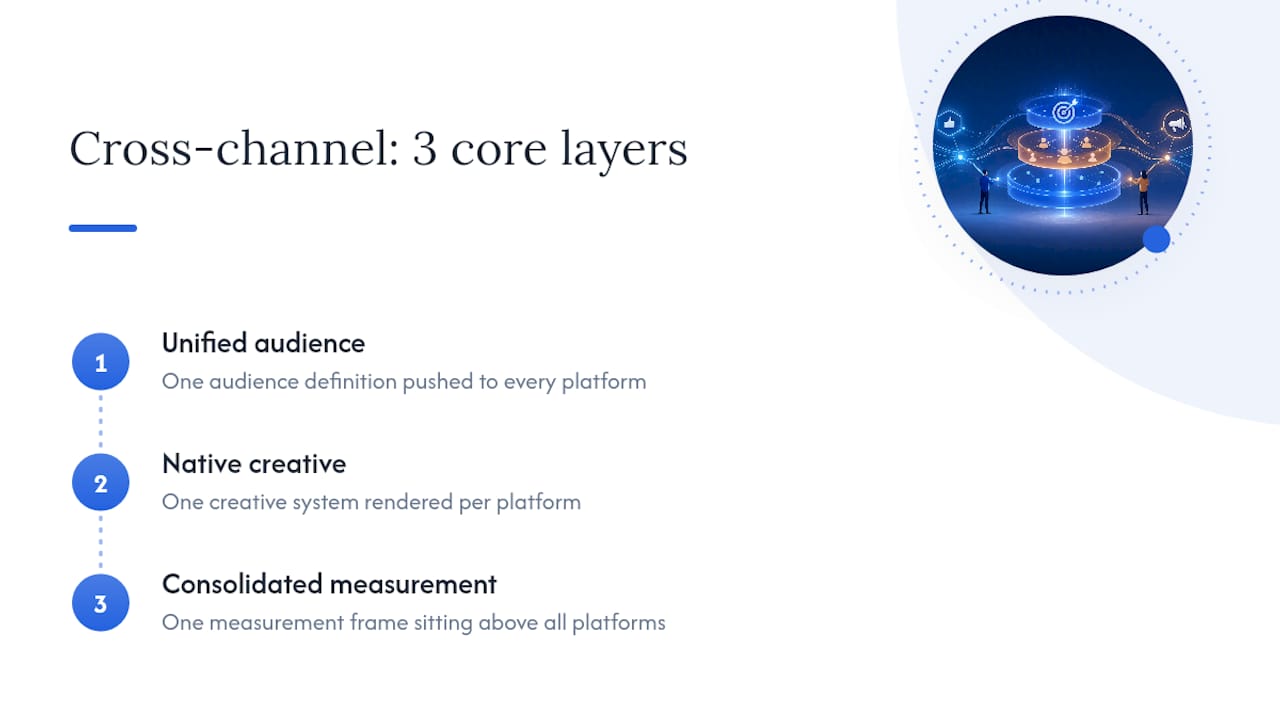
Here's why this matters for your budget specifically: platforms need to share audience and conversion signals, or adding channels just adds cost and friction without adding results. A fourth platform with no shared audience seed and no unified measurement isn't expansion. It's just a fourth invoice. Read more on why multi-platform campaigns only work when coordinated, not just deployed.
The fix isn't complicated, it's disciplined. Before adding platform number three, ask: does it share the same audience seed, does it run creative derived from the same brief, and does it report into the same measurement spine? If the answer to any of those is no, you've got multichannel sprawl, not cross-channel strategy.
What legal and privacy rules apply across platforms?
Running ads on five platforms means juggling five sets of privacy obligations, and they don't always agree with each other. This isn't the fun part of the job, but skip it and you'll find out the hard way.
If you're targeting audiences in the EU or UK, GDPR governs how you collect, store and use personal data for ad targeting, including consent requirements for tracking cookies and pixels. California's CCPA (and its expansion, CPRA) gives residents rights over how their data is sold or shared for advertising, with specific opt-out obligations for businesses that meet certain size or data-volume thresholds. Other jurisdictions have their own versions, and the requirements differ by where your audience sits, not where your business is registered.
Server-side conversion tracking actually helps here, ironically. Because it processes events on your server rather than relying purely on browser-based pixels, it gives you more control over what data gets collected and shared, and it's more resilient to the browser-level privacy restrictions (Safari's ITP, Chrome's cookie changes) that keep tightening year on year.
Practically, that means: get your consent management platform sorted before you scale spend, document what data flows to each ad platform, and treat "we'll sort compliance later" as a direct path to account suspensions or, worse, regulatory attention. Platform policy teams do check. This isn't optional homework, and getting it wrong doesn't just risk a fine, it risks the ad account itself.
How do you keep targeting consistent across platforms?
Audience drift is sneaky. You define a tight ideal customer profile on day one, and by week six, Meta's lookalikes have drifted one way, Google's audience signals have drifted another, and LinkedIn's still targeting the job titles from your original brief that nobody updated.
The fix starts with a single source of truth. Your CRM or CDP (or that well-maintained spreadsheet from earlier) defines the seed audience once, then that exact definition gets pushed to every platform, not reinterpreted per channel by whoever's setting up that day's campaign.
A few non-negotiables for keeping it consistent:
- Refresh your seed audience on a set schedule (monthly is reasonable for most businesses), not whenever someone remembers.
- Use consistent exclusion lists across platforms so existing customers aren't getting cold-acquisition messaging meant for new prospects.
- Name your audiences the same way everywhere ("Q1_HighIntent_Excl_Customers") so anyone on the team can audit them at a glance.
- Let each platform's algorithm optimise within your seed, don't fight the machine, but don't let it wander outside your defined boundaries either.
Consistency here isn't about being rigid. It's about making sure that when you compare Meta's cost-per-lead to Google's, you're actually comparing apples to apples, because both platforms are chasing the same person, defined the same way. Without that, your "optimisation" decisions are based on five different audiences pretending to be one.
What goes wrong when running ads on multiple platforms?
Here's the greatest hits of cross-platform advertising mistakes, the ones that show up in almost every account that hasn't nailed coordination yet.
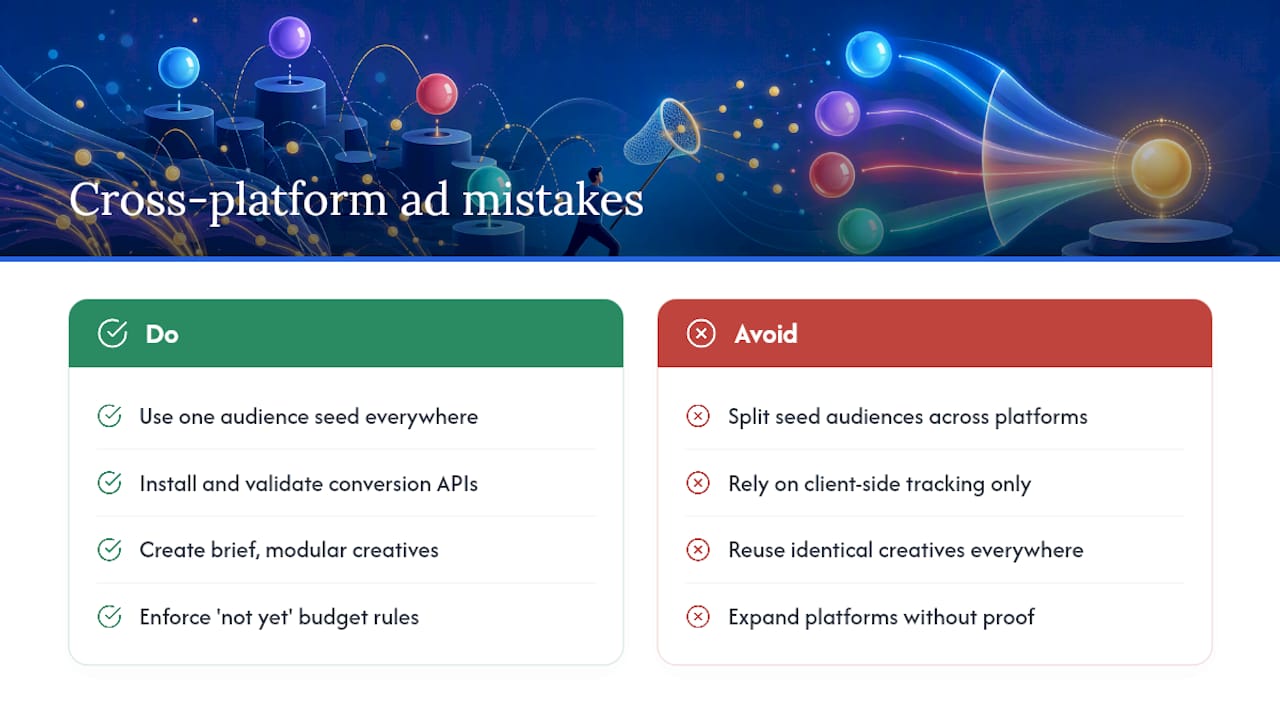
The audience mismatch. Different seed audiences on each platform, so your "cross-channel" campaign is actually five separate ones. Fix: one audience seed, pushed everywhere, refreshed on schedule.
The tracking gap. No server-side conversions, so every platform over-reports its own results and you end up allocating budget based on fiction. Fix: install and validate conversion APIs before spend, not after.
The creative clone. Same ad, same aspect ratio, same copy, dropped into five platforms that all behave differently. Fix: one brief, modular components, platform-native execution.
The premature expansion. Adding a fourth platform because a competitor's on it, not because the message is proven. Fix: your "not yet" rules from the budgeting section, enforced, not just written down.
The dashboard graveyard. Six different reporting tools, no one looking at any of them consistently, decisions made from memory instead of data. Fix: one dashboard, one owner, checked daily.
The naming chaos. UTMs that don't match, campaign names that mean something different to every team member. Fix: a naming convention doc, boring but essential, agreed before launch.
Troubleshooting any of these starts the same way: check the plumbing before you blame the strategy. Nine times out of ten, a "campaign that isn't working" is actually a "campaign that isn't being measured correctly."
What do successful multichannel campaigns actually look like?
Skip the vague success stories for a second and look at the pattern that shows up whenever cross-channel campaigns actually work.
The playbook is nearly identical every time: a business masters one channel first, usually Meta or Google Search, proves the core message converts, then expands to a second platform using the same audience seed and a creative system derived from the same brief, not a fresh one built from scratch. The measurement stays anchored to one business KPI throughout, so when LinkedIn gets added for a B2B push, it's judged against the same yardstick as the original channel, not its own separate scoreboard.
The pattern that separates the wins from the wheel-spinning isn't the number of platforms. It's the discipline of expanding only when the constraints allow it: creative cadence sustainable, landing page conversion proven, message validated. Businesses that add platforms as controlled experiments, one at a time, with a 30-day test window and a clear kill or scale decision at the end, consistently outperform businesses that launch on five platforms simultaneously and hope volume covers for a lack of coordination.
The unglamorous truth is that "successful multichannel campaigns" are rarely won on a brilliant creative insight alone. They're won on the boring stuff: shared audiences, server-side tracking, one brief, weekly discipline. The brilliant creative just performs better once that foundation is actually in place.
A quick high-leverage play to test this week
Here's my honest take: most businesses don't have a channel problem, they have a coordination problem, and they keep buying more channels to paper over it.
Run this experiment before you add anything new. Get one shared brief live on your current best-performing channel, install server-side conversion tracking if you haven't already, then run a geo holdout for two to four weeks, same message, one region gets the ads, a comparable region doesn't. Compare demand lift, not just platform-reported conversions.
That single test tells you more about whether your message actually works than three months of "let's just try TikTok too" ever will. If you want the structured version of this instead of building it from scratch, that's exactly what a discovery call with Adsdaddy is for.
— Adrian
Ready to run this without doing it all yourself?
You've now got the full playbook: one brief, one audience, server-side tracking, phased expansion. The honest bit? Running it properly across five platforms takes hours most business owners don't have lying around each week.

That's the exact gap Adsdaddy fills. Instead of hiring five freelancers or wrestling six dashboards yourself, you get one team running Facebook, Instagram, Google, YouTube, Microsoft Bing and LinkedIn as one coordinated campaign, not five disconnected ones competing for the same budget.
A first engagement with Adsdaddy typically covers:
- A full audit of your current tracking, audiences and creative setup
- Build-out of one shared campaign brief across every platform you run
- A 30-day proof test with real measurement, not platform self-reporting
If you're ready to stop juggling logins and start running one proper cross-channel campaign, book a discovery call with Adsdaddy and get a straight answer on what it'd take to run yours properly.
Further reading and authoritative docs
For technical setup, check Microsoft Advertising's own documentation for Bing conversion API configuration, GA4's cross-channel reporting for attribution modelling, and Adsdaddy's cross-platform ads breakdown for a deeper look at coordination benefits.
FAQ
Is there a way to post on multiple platforms at once?
Yes, scheduling tools like Buffer let you publish organic content across platforms from one dashboard, but paid campaigns need platform-native setup even when they share one brief and audience.
Is $20 a day good for Google Ads?
It's a reasonable starting test budget for low-competition keywords or a validated conversion event, but it's tight for competitive terms, treat it as a 30-day test window rather than a long-term spend level.
How much do 1,000 clicks cost on Facebook?
Cost per click varies heavily by industry, audience and creative quality, so there's no fixed figure. Track your own cost-per-click through server-side conversion data rather than relying on industry averages.
How do you advertise on streaming platforms?
Streaming ad buys typically run through the platform's own ad manager or a connected TV demand-side platform, and they should still derive from your one shared brief and feed the same measurement spine as your other channels.
Do I need an agency to run ads across multiple platforms?
Not always, but once you're managing server-side tracking, creative production and budget orchestration across four or more platforms, a managed service like Adsdaddy usually saves more in wasted spend than it costs.