Why use multivariate ad testing to improve results
. By Ads Daddy.

TL;DR:
- Multivariate ad testing analyzes multiple ad elements and their interactions to uncover what drives performance. It provides deeper insights than standard A/B testing by identifying specific element combinations that work best. This method requires high traffic volumes and modular creative assets to deliver reliable, actionable results.
Multivariate ad testing is defined as the simultaneous testing of multiple ad elements and their combinations to identify exactly which components drive performance. Unlike standard A/B testing, which tells you which ad won, multivariate testing (MVT) tells you why it won. That distinction is worth real money. MVT analyses headlines, images, calls to action, and colour schemes all at once, revealing interaction effects that sequential testing simply cannot surface. For marketers running campaigns on Facebook, Instagram, Google, or LinkedIn, this method turns creative guesswork into a documented, repeatable system for building better ads.
Why use multivariate ad testing over standard A/B testing?
A/B testing gives you a winner. MVT gives you a blueprint. That is the core difference, and it matters enormously when you are trying to scale creative output across multiple platforms.
Standard A/B testing compares two complete ads against each other. You learn that Ad A beat Ad B, but you have no idea whether the headline, the image, or the call to action made the difference. MVT isolates every element and tests combinations simultaneously, so you walk away knowing that "Headline A paired with Image C" outperforms every other combination. That is element-level insight that compounds over time.
The benefits of multivariate testing stack up fast:
- Granular creative intelligence. MVT identifies which individual elements drive clicks, conversions, and cost reductions. A real-world example: a June 2026 case study analysing 162 creatives and 141 attributes found that stylish outfits lifted CTR by 35%, monochromatic colours improved results by 17%, and certain accessories cut CPC by 43%. Those are not vague directional signals. Those are specific, repeatable creative rules.
- Interaction effect discovery. MVT exposes interaction effects such as "Headline A works only with Image B," a finding that sequential A/B testing can never produce. This is the insight that separates good campaigns from great ones.
- Reusable creative library. Every test builds a documented record of what works at the element level. Over time, this library acts as an antidote to the blank-page problem. Your creative team stops guessing and starts building from proven components.
- Faster scaling. When you know which elements perform, you can produce new ad variations faster and with more confidence. Creative volume demands on platforms like Meta and Google are only increasing.
Pro Tip: Run MVT only after you have exhausted your obvious A/B hypotheses. MVT is a depth tool, not a starting tool. Use A/B testing to find the rough direction, then use MVT to find the exact mechanism.
What traffic and technical requirements does MVT need?
MVT is not for every account. The traffic and time requirements are significantly higher than most marketers expect, and ignoring them produces unreliable data.
Here is what you need before launching a multivariate test:
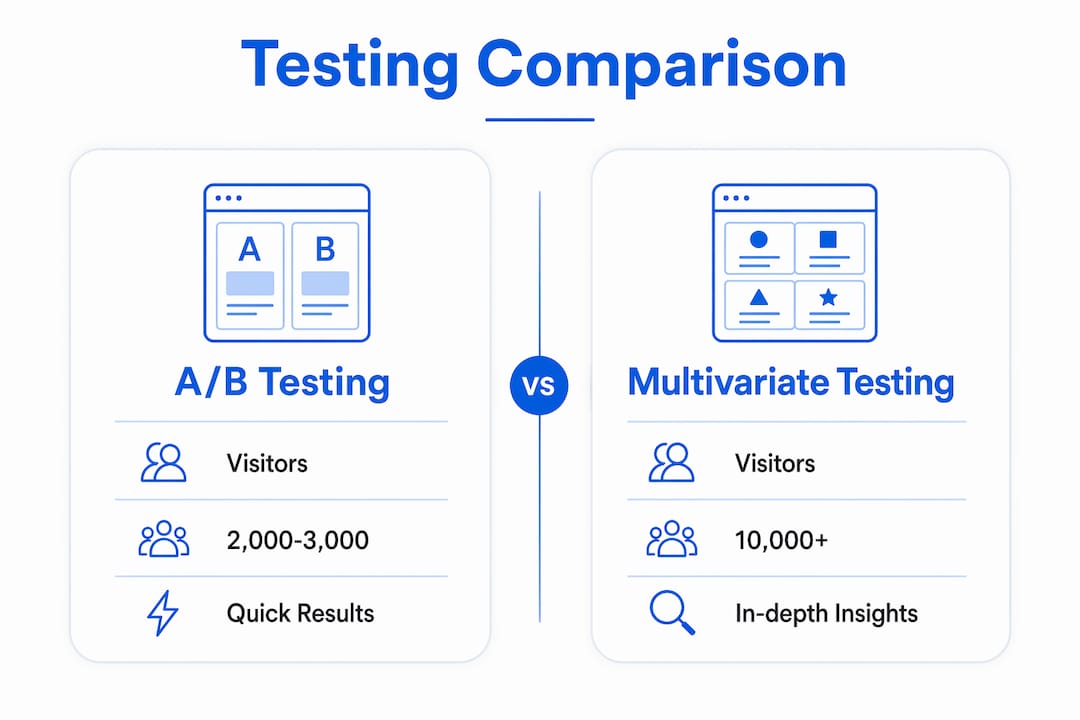
- High traffic volume. MVT requires 10,000+ weekly visitors for an 8-combination test. Standard A/B testing needs only 2,000–3,000 visitors for significance. If your account does not hit that threshold, MVT results will be statistically meaningless.
- Longer test duration. MVT typically runs for 4–12+ weeks, compared to 2–4 weeks for A/B testing. That is a significant commitment of time and budget before you see conclusive results.
- Modular creative design. Assets must be built in interchangeable modules. A headline must work with any image. A CTA must work with any colour scheme. Non-modular assets produce flawed data because incompatible combinations distort performance analysis.
- Tooling and automation. Manual tagging of creative elements slows analysis by 20+ hours weekly per brand. Automated AI tagging platforms address this bottleneck and make MVT analysis scalable.
| Requirement | A/B testing | Multivariate testing |
|---|---|---|
| Weekly visitors needed | 2,000–3,000 | 10,000+ |
| Typical test duration | 2–4 weeks | 4–12+ weeks |
| Creative design approach | Any format | Modular only |
| Analysis complexity | Low | High |
Pro Tip: Before building your MVT creative assets, map every element as a standalone module. If your designer cannot swap Headline A into any image without redesigning the ad, your test is already broken.
How does multivariate testing work in practice?
MVT works best in high-intent, high-volume environments where small improvements in click-through rate or cost per acquisition translate directly to meaningful revenue gains.
Typical elements tested in a multivariate ad campaign include:
- Headlines. Short versus long, question versus statement, benefit-led versus curiosity-led.
- Images or video thumbnails. Product shots versus lifestyle imagery, people versus objects, monochromatic versus vibrant colour schemes.
- Calls to action. "Shop now" versus "Learn more" versus "Get a quote."
- Colour schemes. Background colours, button colours, and overall visual tone.
The interaction effects insight is where MVT genuinely earns its place. Imagine running a campaign where Headline A performs poorly on average, but when paired specifically with Image B, it outperforms every other combination by a wide margin. Sequential A/B testing would have killed Headline A in round one. MVT keeps it alive long enough to find its perfect partner.
MVT is particularly well suited to landing pages, pricing pages, and email campaigns where traffic volume is high and the conversion event is clearly defined. For improving ad performance on platforms like Facebook and Google, MVT delivers the kind of granular data that informs not just the current campaign but every campaign that follows.

The best time to deploy MVT is after your A/B tests have exhausted the obvious hypotheses. You have already found that video outperforms static. Now you want to know whether it is the first three seconds, the text overlay, or the background music driving that result. That is an MVT question.
What pitfalls should you avoid with multivariate testing?
MVT is powerful, but it is also the most misused testing method in digital advertising. Only 12.4% of marketing teams use MVT as of mid-2026, and a significant portion of those teams are using it incorrectly.
The most common mistakes:
- Running MVT on low-traffic accounts. Without sufficient volume, results are statistically unreliable. You end up making creative decisions based on noise, not signal.
- Skipping modular design. Non-modular assets create incompatible combinations that distort your data. The test looks valid but the conclusions are wrong.
- Expecting faster results than A/B testing. MVT takes longer by design. Teams that pull results early and act on them waste the entire investment.
- Assuming MVT always beats sequential A/B tests. Growth expert Lars Lofgren highlights that slower MVT iteration can cost revenue compared to running multiple quicker A/B tests. For accounts with moderate traffic, fast sequenced A/B tests often produce greater overall gain.
- Ignoring the complexity of analysis. MVT generates far more data than A/B testing. Without the right tools or expertise, that data sits unused.
Pro Tip: Treat MVT and A/B testing as complementary, not competing. Use split testing for speed and direction, then deploy MVT for depth and creative intelligence once your account has the traffic to support it.
What organisational changes does MVT drive in marketing teams?
MVT does something that most testing methods do not. It forces creative and performance teams to work from the same data. That structural shift is as valuable as the test results themselves.
When your copywriter, designer, and media buyer all reference the same element-level performance data, the creative briefing process changes entirely. Decisions stop being based on opinion and start being based on evidence. MVT fosters collaboration between creative and performance teams by creating a single data-driven language and a continuous learning loop.
The organisational benefits compound over time:
- Documented creative history. Every test adds to a growing record of what works at the element level. New team members onboard faster because the knowledge is captured, not locked in someone's head.
- Smarter creative refresh cycles. Instead of replacing entire ads when performance drops, teams can swap out the underperforming element. That is faster and cheaper than starting from scratch.
- Reduced creative waste. When you know which elements drive results, you stop producing variations that have no chance of winning. Budget goes further.
- Better ad creative decisions. Teams build from proven components rather than intuition, which raises the floor on creative quality across every campaign.
The multichannel implications are significant too. Teams running campaigns across multiple marketing channels can apply element-level learnings from one platform to inform creative decisions on another, compressing the learning curve across the entire account.
Key takeaways
Multivariate ad testing delivers its greatest value when traffic thresholds are met, creative assets are modular, and teams use MVT to answer the "why" behind performance rather than simply to find a winner.
| Point | Details |
|---|---|
| MVT reveals the "why" | It identifies which specific elements and combinations drive performance, not just which ad won. |
| Traffic thresholds are non-negotiable | You need 10,000+ weekly visitors for an 8-combination test to reach statistical significance. |
| Modular design is mandatory | Non-modular creative assets produce flawed data that leads to wrong conclusions. |
| Sequence A/B testing first | Use A/B testing to find direction, then deploy MVT for depth once obvious hypotheses are exhausted. |
| MVT builds lasting creative intelligence | Every test adds to a reusable library of proven elements that improves every future campaign. |
Adrian's take: when MVT is worth the wait
I have seen marketing teams burn budget on MVT when they had no business running it. The traffic was too low, the test ran for six weeks, and the results were inconclusive. They walked away thinking MVT was overrated. It was not. The method was right. The timing was wrong.
MVT earns its place when you have already squeezed the obvious gains from A/B testing and you need to understand the mechanism behind your results. That is a specific moment in a campaign's maturity, not a starting point. The teams that get the most from MVT are the ones who treat it as a depth tool, not a replacement for faster methods.
The biggest missed opportunity I see is ignoring interaction effects. Most teams test elements in isolation and assume the results transfer. They do not. Headline A might be average on its own but exceptional with the right image. MVT is the only method that finds that pairing. That insight alone can change how you brief your creative team for the next 12 months.
If your account has the traffic, build modular assets, commit to the full test duration, and invest in proper analysis tooling. The creative intelligence you build will pay dividends well beyond the campaign you are running today.
— Adrian
How Ads Daddy helps you run smarter ad tests
Running multivariate tests across Facebook, Instagram, Google, and LinkedIn requires more than a good hypothesis. It requires the right setup, the right creative structure, and the right analysis process.

Ads Daddy manages the full cycle of ad creation, testing, and optimisation for small and medium-sized businesses that want results without the complexity. From building modular creative assets to interpreting element-level performance data, the team at Ads Daddy brings the expertise and platform access to make MVT work for your account. If you are ready to move beyond basic split testing and build a creative intelligence system that compounds over time, book a consultation with Ads Daddy today.
FAQ
What is multivariate ad testing?
Multivariate ad testing is a method that simultaneously tests multiple ad elements and their combinations to identify which specific components drive performance. It goes beyond A/B testing by revealing interaction effects between elements like headlines, images, and calls to action.
How much traffic do you need for multivariate testing?
MVT requires 10,000+ weekly visitors for an 8-combination test to reach statistical significance. Accounts with lower traffic volumes should use standard A/B testing instead to avoid unreliable results.
How long does a multivariate test take?
A multivariate test typically runs for 4–12+ weeks, compared to 2–4 weeks for a standard A/B test. Pulling results early produces inconclusive data and wastes the entire testing investment.
Is multivariate testing better than A/B testing?
Not always. For accounts with moderate traffic, fast sequenced A/B tests often produce greater overall gain. MVT is best reserved for high-traffic environments after A/B tests have exhausted obvious hypotheses.
What ad elements can you test with MVT?
Common elements include headlines, images, calls to action, and colour schemes. The key requirement is that all assets are designed in interchangeable modules so every combination can be tested without distorting the data.