What Is Search Advertising: Boosting Aussie Small Biz
. By Ads Daddy.

Over 80 percent of Australian consumers use search engines to find local products and services. For any Australian business trying to reach new customers, understanding search advertising is essential. With more shoppers turning to Google every day, the right strategies can help you get noticed by people who are ready to take action. This guide reveals how smart search advertising connects Australian businesses with active buyers and breaks down what actually works in today’s digital market.
Table of Contents
- Defining Search Advertising For Australian Businesses
- Key Types Of Search Ads Explained
- How Search Advertising Campaigns Work
- Costs, ROI, And Budgeting Insights
- Common Pitfalls And How To Avoid Them
Key Takeaways
| Point | Details |
|---|---|
| Effective Targeting | Search advertising enables precise targeting of potential customers actively searching for products, maximising return on investment. |
| Ad Types Variety | Different search ad formats like Text Ads, Shopping Ads, and Local Service Ads cater to unique business needs, enhancing marketing reach. |
| Continuous Optimisation | Ongoing performance monitoring and adjustments are essential for improving click-through and conversion rates. |
| Smart Budgeting | Allocate a modest initial budget for search advertising, focusing on performance insights to guide spending increases. |
Defining Search Advertising for Australian Businesses
Search advertising represents a powerful digital marketing strategy that allows businesses to capture potential customers precisely when they're hunting for specific products or services online. By leveraging strategic online ad placements, small businesses can position themselves directly in front of motivated buyers actively searching for solutions.
Search advertising works through a simple yet sophisticated mechanism. When users type keywords related to your business into search engines like Google, your targeted advertisements can appear alongside organic search results. These ads typically look similar to standard search listings but are marked with a small "Ad" tag, allowing businesses to gain prime real estate on search result pages.
The core advantage of search advertising lies in its laser-focused targeting capabilities. Unlike traditional advertising methods that broadcast messages broadly, search ads connect you with potential customers at the exact moment they demonstrate purchase intent. A local plumber in Sydney, for instance, can display an ad when someone searches "emergency plumber near me" - capturing high-conversion prospects precisely when they need immediate assistance. This hyper-targeted approach means every advertising dollar is spent reaching genuinely interested individuals, maximising return on investment for Australian small businesses.
Successful search advertising requires strategic keyword selection, compelling ad copy, and continuous performance monitoring. By understanding user search behaviours and crafting advertisements that directly address searchers' needs, businesses can transform online searches into tangible sales opportunities. Whether you're a retail shop, service provider, or digital entrepreneur, search advertising offers an accessible and measurable pathway to growing your customer base and driving business growth.
Key Types of Search Ads Explained
Search advertising offers multiple strategic approaches for Australian businesses to connect with potential customers, with Pay-Per-Click (PPC) advertising serving as the foundational model for most online marketing campaigns. These targeted advertising methods enable businesses to display ads across different digital platforms, each with unique characteristics and potential benefits.
Text Ads represent the most traditional search advertising format. These simple, text-based advertisements appear alongside organic search results, typically featuring a headline, brief description, and clickable link. For small businesses operating on tight budgets, text ads provide an accessible entry point into digital marketing, allowing precise targeting based on specific keywords and user search intent.
Another powerful search advertising format is Shopping Ads, particularly crucial for retail businesses. These visually engaging advertisements showcase product images, pricing, and key details directly within search results. A local clothing boutique in Melbourne, for example, can display product images when potential customers search for specific clothing items, dramatically increasing the likelihood of attracting interested buyers.
Local service businesses can leverage Local Service Ads, which appear at the very top of search results with additional credibility markers like verified badges and customer ratings. These ads are especially effective for trades and professional services like plumbers, electricians, and lawyers, enabling them to stand out in crowded markets and build immediate trust with potential customers. By understanding and strategically implementing these different search ad types, Australian small businesses can effectively expand their digital marketing reach and convert more online searches into tangible business opportunities.
How Search Advertising Campaigns Work
Search advertising campaigns operate through a sophisticated mechanism where businesses strategically bid on specific keywords to capture potential customer attention. This competitive digital marketplace allows advertisers to position their brand precisely where potential customers are actively searching for related products or services.
The bidding process forms the core of search advertising mechanics. Businesses select relevant keywords that potential customers might use when searching online, then set a maximum price they're willing to pay for each click. Search engines like Google use complex algorithms to determine ad placement, considering factors such as bid amount, ad relevance, and overall quality score. A local cafe in Sydney, for instance, might bid on keywords like "best coffee near me" or "cafe breakfast", ensuring their advertisement appears when users search these terms.

Once a search advertising campaign is live, real-time tracking becomes crucial. Businesses can monitor key performance metrics including click-through rates, conversion rates, and cost per acquisition. This allows for continuous campaign refinement, enabling advertisers to adjust their strategy, reallocate budget, and optimise their approach based on actual user interactions. The beauty of search advertising lies in its accountability - every dollar spent can be tracked and analysed, providing transparent insights into marketing effectiveness.
Successful search advertising campaigns require a strategic blend of keyword research, compelling ad copy, and ongoing performance analysis. By understanding user intent, crafting targeted messages, and continuously optimising their approach, Australian businesses can transform search advertising from a mere marketing expense into a powerful customer acquisition tool. Whether you're a small local service or an emerging e-commerce brand, mastering the nuances of search advertising campaigns can significantly amplify your digital marketing impact.
Costs, ROI, and Budgeting Insights
Search advertising requires a strategic approach to managing advertising expenditure, with costs varying significantly depending on industry, competition, and chosen platforms. Small businesses must understand that search advertising isn't about spending the most money, but investing smartly to maximise return on investment (ROI).
The cost structure of search advertising typically follows a pay-per-click (PPC) model, where businesses are charged each time a potential customer clicks their advertisement. Keyword costs can range dramatically, from less than a dollar to over $50 per click for highly competitive industries like legal services or insurance. A local bakery in Melbourne might spend $2-$5 per click for terms like "best birthday cakes", while a corporate law firm could pay $50 per click for "commercial litigation lawyer".
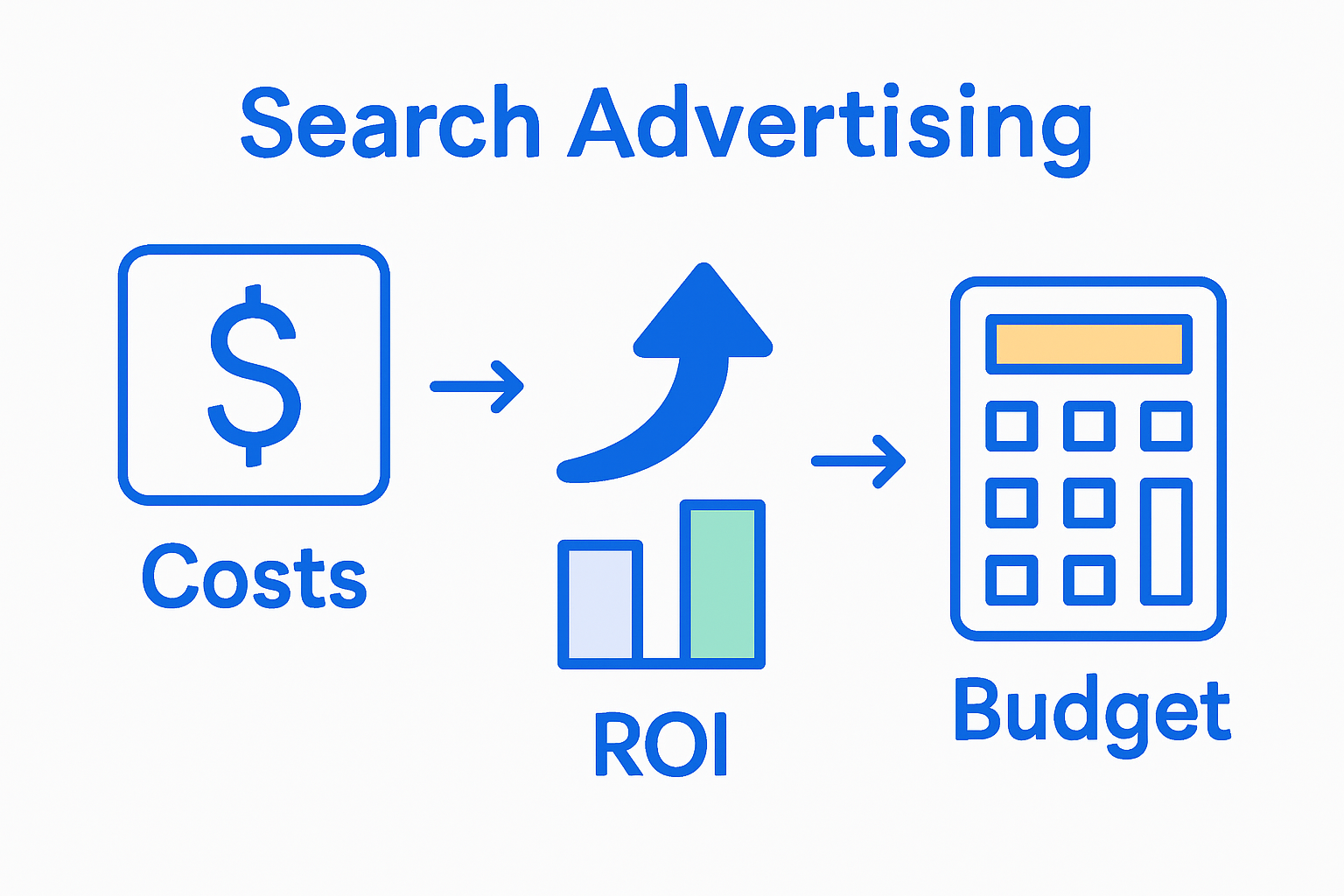
Calculating return on investment involves tracking more than just click costs. Successful advertisers measure conversion rates, average customer value, and lifetime customer worth. For instance, if a plumbing business spends $300 on ads and generates three new clients worth $1,500 each, the campaign represents an exceptional 400% return. Smart budgeting means continuously monitoring performance, testing different keywords, and adjusting spend to focus on the most profitable search terms.
Effective search advertising budgeting requires a nuanced approach. Small businesses should start conservatively, allocating a modest monthly budget of $500-$1,000, and gradually increase spending as they understand their campaign's performance. Crucial strategies include setting clear objectives, understanding your target audience's search behaviours, and remaining flexible enough to pivot when data suggests a change in approach. By treating search advertising as an investment rather than an expense, Australian businesses can transform their digital marketing from a cost centre to a powerful growth engine.
Common Pitfalls and How to Avoid Them
Search advertising can be a minefield for inexperienced businesses, with potential legal and financial risks that demand careful navigation. Ensuring advertising truthfulness becomes paramount to avoid costly mistakes that could damage both reputation and bottom line. Australian businesses must approach search advertising with a strategic and compliant mindset.
One of the most critical mistakes businesses make is targeting overly broad keywords that drain budgets without delivering quality leads. A local physiotherapy clinic might waste thousands by bidding on generic terms like "health treatment" instead of specific phrases such as "sports injury physio Melbourne". This scattergun approach results in irrelevant clicks from users who have no genuine interest in the specific service, burning through advertising budget with minimal return.
Another significant pitfall involves neglecting ongoing campaign management. Search advertising isn't a set-and-forget strategy; it requires constant refinement. Many small businesses create an initial campaign and then ignore performance metrics, failing to adjust keyword targeting, ad copy, or budget allocation. Successful advertisers continuously analyse click-through rates, conversion data, and cost per acquisition, making data-driven adjustments to optimise their advertising spend. A cafe owner might discover that morning coffee-related keywords perform better than all-day dining terms, and should be prepared to reallocate budget accordingly.
Legal compliance represents another crucial consideration for search advertising. Australian businesses must ensure their ad content makes no false claims, provides accurate representations of products or services, and adheres to consumer protection regulations. This means avoiding hyperbolic language, ensuring pricing information is transparent, and maintaining consistency between advertised offerings and actual business capabilities. By approaching search advertising with diligence, transparency, and a commitment to continuous improvement, Australian small businesses can transform potential pitfalls into opportunities for growth and customer engagement.
Unlock the Full Potential of Search Advertising for Your Small Business
You understand that search advertising is all about connecting with customers at the exact moment they need your products or services. Yet the challenge lies in navigating complex keyword bidding, crafting compelling ads, and continuously optimising campaigns to maximise your budget effectiveness. Don't let your advertising efforts drain resources without delivering results. With focused targeting, data-driven strategies, and ongoing campaign management, your business can truly turn online searches into loyal customers.
At AdsDaddy.com, we specialise in guiding Australian small businesses through every step of search advertising. Whether you need expert advice on keyword selection, creative ad formats, or real-time performance tracking, our team ensures your campaigns run efficiently and deliver measurable returns. Take control of your digital marketing today and partner with a trusted agency that helps you stand out and grow. Discover how we can help you dominate online advertising by visiting AdsDaddy.com now and start transforming clicks into customers.
Frequently Asked Questions
What is search advertising and how does it work?
Search advertising is a digital marketing strategy that allows businesses to display ads alongside organic search results based on specific keywords. When users search for products or services, these targeted ads appear, helping businesses connect with motivated buyers at the moment of intent.
What are the key types of search ads for small businesses?
The key types of search ads include Text Ads, which are simple, text-based ads; Shopping Ads, which feature images and details for retail products; and Local Service Ads, designed for service businesses with features that build trust, like verified badges and customer ratings.
How can I measure the success of my search advertising campaign?
Success can be measured by tracking key metrics such as click-through rates, conversion rates, and cost per acquisition. Analyzing these metrics helps businesses refine their strategies and optimize ad spending for better results.
What common pitfalls should I avoid in search advertising?
Common pitfalls include targeting overly broad keywords that attract irrelevant clicks, neglecting ongoing campaign management, and failing to ensure legal compliance in ad content. Businesses should focus on specific keywords, continuously monitor campaign performance, and adhere to advertising regulations.
Recommended
- Role of Video Ads: Complete Guide for Australian SMEs - Ads Daddy. Advertise on All Plattforms.
- Growth Hacking Archives - Ads Daddy. Advertise on All Plattforms.
- Conversions Rate Optimisation Archives - Ads Daddy. Advertise on All Plattforms.
- Lead Generation Archives - Ads Daddy. Advertise on All Plattforms.