Customer Lifetime Value for Marketers: Use CLV to Set Ad Bids and Retention
. By Ads Daddy.

Customer lifetime value is the total revenue (or profit) you can reasonably expect from one customer over the entire relationship, not just their first purchase. It's the number that tells you exactly how much you can afford to spend winning them. Get this wrong and you'll either underspend on ads and lose to competitors, or overspend chasing customers who churn before they pay you back. Multiple formulas exist depending on your business model, and we'll walk through them with real numbers below.
TL;DR:
- Most businesses should calculate net CLV to accurately determine customer value after subtracting costs and acquisition expenses.
- Improving retention and onboarding has a larger impact on CLV than focusing solely on reducing customer acquisition costs.
- Using predictive LTV models is most beneficial when margins are high, customer value varies significantly, and sufficient data exists.
- Setting a CAC target based on net CLV helps optimize bid strategies, allocating more budget to high-value segments.
- Regularly stress-testing CLV inputs ensures accurate calculations, preventing reliance on guesswork or outdated assumptions.
Table of Contents
- What is customer lifetime value? Terms and definitions marketers actually use
- Why CLV matters: the ROI case your CFO actually cares about
- How to calculate CLV: formulas, inputs, and which one to use
- Three worked examples: SaaS, ecommerce, and a coffee shop
- Using CLV in advertising: segments, CAC targets, and bidding signals
- How to increase CLV: your tactical playbook
- Data you need and the mistakes that quietly wreck your CLV
- Advanced modelling: when predictive LTV actually earns its keep
- The strategist's take on where CLV actually goes wrong
- How Adsdaddy turns your CLV number into an actual growth plan
- Key sources and further reading
- FAQ
What is customer lifetime value? Terms and definitions marketers actually use
Customer lifetime value (CLV) measures the total revenue a business expects from a single customer across the whole relationship, and it's the metric that should sit behind every acquisition decision you make. Some teams use it to mean revenue. Others mean profit. That distinction changes everything downstream.
You'll see it written a few different ways in the wild:
- LTV — the casual, shorthand version everyone in growth marketing uses in Slack
- CLTV — same thing, longer acronym, common in enterprise reporting decks
- Gross CLV — total revenue expected, before you subtract costs
- Net CLV — revenue minus cost-to-serve, margin, and acquisition cost (the number that actually matters for budgeting)
- Predictive LTV (pLTV) — a forecasted figure built from machine learning models rather than historical averages
Here's the trap: gross CLV looks impressive in a pitch deck. Net CLV is what pays your rent. If a customer generates $2,000 in revenue but costs you $1,400 in fulfilment, support tickets, and returns processing, your real CLV isn't $2,000. It's $600. Use present value discounting (adjusting future revenue for the fact that a dollar next year is worth less than a dollar today) if your customer lifespan stretches beyond 12 to 18 months. For anything shorter, simple totals do the job fine. Don't overcomplicate a coffee shop's numbers with finance-degree maths.
Why CLV matters: the ROI case your CFO actually cares about
Most business owners treat advertising like a grocery bill. Money goes out, hopefully something comes back. CLV flips that thinking. It reframes ad spend as an investment with a payback period, the same way you'd assess buying a delivery van or hiring a salesperson.
Retention beats acquisition on cost, consistently. Improving retention by even a few percentage points can lift profitability significantly, and retention-versus-acquisition research keeps landing on the same conclusion: keeping a customer is cheaper than winning a new one.
Once you know a customer is worth a net amount over their lifetime, a corresponding cost-per-acquisition stops looking scary. It looks like a strong return sitting on a shelf, waiting to be scaled. That's the entire pitch CLV makes to a nervous business owner staring at their ad spend.
CLV also reshapes three decisions most businesses make on gut feel alone:
- Channel mix — you can afford to pay more per click on channels that bring in customers who stick around and buy again
- CAC targets — instead of "spend less," the goal becomes "spend up to X, because we know the payback"
- Pricing and bundling — you can justify a loyalty discount because you're protecting a customer worth ten times the discount
Marketers who quote CLV in budget meetings get better outcomes than the ones who quote impressions. It's the difference between talking numbers and talking noise.
How to calculate CLV: formulas, inputs, and which one to use
Here's where most explainers get lazy and give you one formula. You need at least three, because your business model decides which one is honest.
Basic CLV (the quick version). CLV = average order value × purchase frequency × average customer lifespan. For example, if your average order is $80, customers buy multiple times a year, and stick around for several years, your CLV can be estimated by multiplying these factors. Simple, fast, and useful for a back-of-napkin gut check.
Net CLV (the honest version). Net CLV = total expected gross margin minus cost-to-serve minus customer acquisition cost. Say that same $960 customer generates 40% gross margin ($384), you spend $60 servicing them (support, returns, shipping overheads), and you paid $90 to acquire them. Net CLV = $384 − $60 − $90 = $234. That's the number that should set your CAC cap, not the flashy $960.
Subscription formula (for SaaS and memberships). CLV = (average revenue per account ÷ churn rate) × gross margin percentage. For instance, using average revenue per account, churn rate, and gross margin, you can calculate an estimated CLV suitable for subscription businesses.
Predictive or cohort-based CLV. Instead of averaging history, these models use machine learning to forecast individual customer value based on early behaviour signals. More accurate for targeting and bidding, but they need serious historical data and ongoing validation to stay trustworthy.
To calculate any of these reliably, you need to collect: transaction history per customer, purchase frequency and recency, average order value, gross margin by product line, cost-to-serve (support, shipping, returns), churn rate by cohort, and acquisition cost by channel. Missing even one of these turns your CLV into a guess dressed up as a metric.
Pro Tip: Start with basic CLV to get stakeholder buy-in fast, then move to net CLV within the first month. Skipping straight to predictive modelling before you've nailed the basics is like trying to run before you've worked out which leg goes first.
Three worked examples: SaaS, ecommerce, and a coffee shop
Numbers make this real. Here's how CLV plays out across three completely different business models.
- SaaS business: Using subscription price, churn rate, and gross margin, you can estimate CLV to understand customer value over time. Decreasing churn notably increases the value, illustrating why SaaS founders focus so much on this metric.
- Ecommerce store: By combining average order value, purchase frequency, and customer lifespan, you estimate gross CLV. Accounting for returns and fulfillment costs adjusts this down to net CLV, which is often significantly lower and crucial to model accurately.
- Coffee shop: Customers who spend a small amount frequently over a long period can generate substantial gross CLV. Though per-visit spend is low, the high purchase frequency means lifetime value can be significant once modeled properly.
Every one of these examples proves the same point: including cost-to-serve and returns changes the number enough to change your decisions. Skip that step and you're budgeting off a fantasy figure.
Using CLV in advertising: segments, CAC targets, and bidding signals
This is where CLV stops being a spreadsheet exercise and starts making your ad account smarter. Once you know what a customer is worth, you can tell your ad platforms to chase more of them.
Start by setting a CAC target from your net CLV and margin, not from a round number you picked because it felt safe. If net CLV is $234, a CAC cap of $100 leaves healthy room. A cap of $220 doesn't.
From there, use CLV to prioritise which audiences and channels get budget. High LTV segments earn premium bids. Low LTV segments get trimmed or excluded entirely. This is the same logic behind smarter audience segmentation — you're not spreading spend evenly, you're chasing the customers worth chasing.
Google Ads gives you three ways to feed LTV signals into bidding, in order of setup effort:
- Static conversion values — assign a fixed value per conversion type, the simplest starting point
- Conversion Value Rules — apply multipliers by segment (location, device, audience list) without building any predictive model
- Predictive LTV (pLTV) via Offline Conversion Import — feed per-customer ML predictions back into Smart Bidding for genuine per-customer optimisation
Pro Tip: *Don't jump straight to pLTV because it sounds impressive.
Pair this with lifecycle marketing, onboarding sequences that reduce early churn, retention flows that catch at-risk customers, and loyalty triggers that reward your highest-value segment. That's exactly the territory covered in lifecycle marketing tactics for growth.
How to increase CLV: your tactical playbook
CLV isn't fixed. It moves when you pull the right levers, and most businesses are only pulling one of them.
Fix onboarding first. A confused new customer churns faster than an unhappy one. Clear onboarding sequences, welcome emails, and first-purchase follow ups reduce early drop off before it ever shows up in your churn numbers.
Test pricing, bundles, and cross-sell paths. Small AOV lifts compound. A/B test a bundle offer at checkout, or a "customers also bought" prompt. Even a 10% AOV bump multiplies straight through your CLV formula.
Run winback campaigns before customers fully disappear. Catching a lapsing customer at 60 days is far cheaper than acquiring a brand new one at 100% cost. Subscription-style offers ("come back for 20% off your next three orders") extend lifespan without discounting your entire customer base.
Build a loyalty program that rewards behaviour, not just spend. Points for referrals, reviews, and repeat purchases all nudge lifespan upward.
Personalise your communications by segment. A high-CLV customer and a first-time buyer should never get the same email. Real engagement tactics that build loyalty treat these as two entirely different relationships.
Prioritise in this order: fix churn first, then lift AOV, then extend lifespan. Chasing AOV while ignoring a leaky churn bucket is like adding petrol to a car with a hole in the tank.
Data you need and the mistakes that quietly wreck your CLV
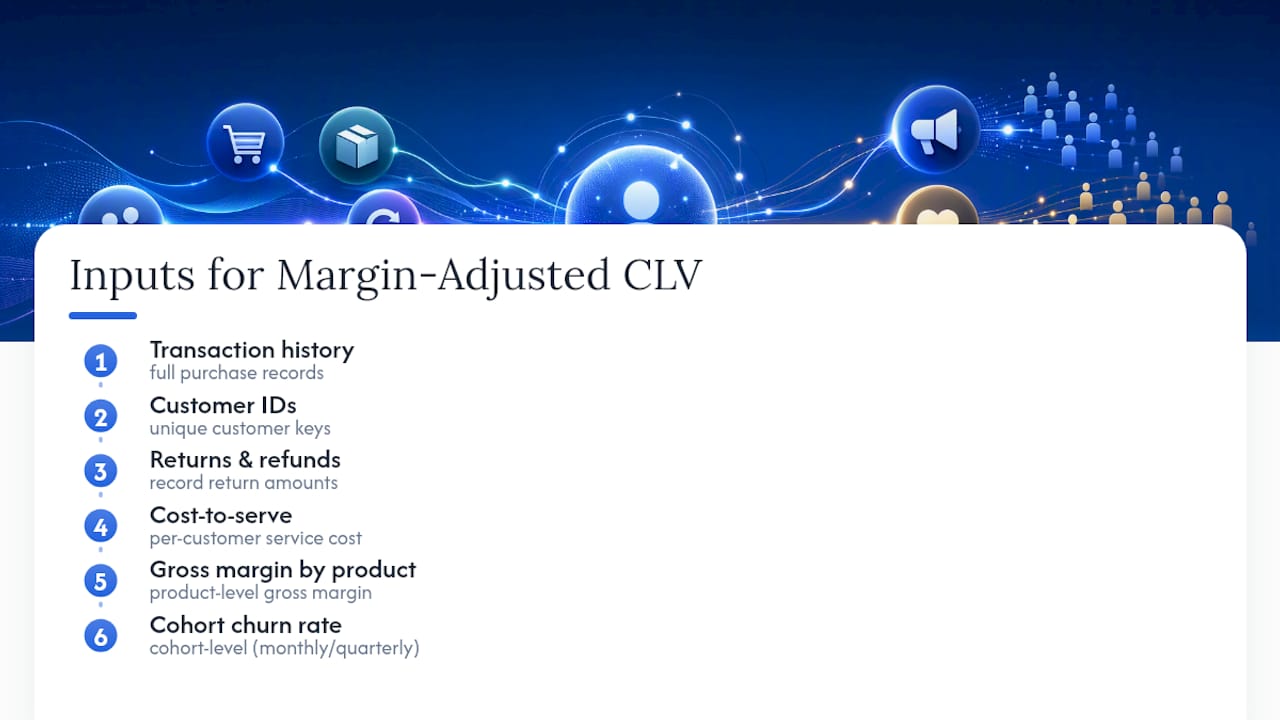
You don't need a data warehouse. You need six things: transaction history, customer IDs, returns and refunds, cost-to-serve, gross margin by product, and churn rate broken down by cohort.
The most common mistake is treating first purchase value as the whole story. This overvalues one-off buyers and undervalues your repeat customers, because it skips margin and cost-to-serve entirely. The second mistake is averaging across mismatched cohorts. A customer acquired through a Black Friday discount behaves completely differently to one acquired through organic referral, and blending them into one average CLV hides both.
The fix: use defined cohort windows (monthly or quarterly acquisition cohorts), calculate margin-adjusted CLV rather than raw revenue, and run sensitivity checks, testing what happens to CLV if churn shifts by 1% or returns rise by 5%.
Pro Tip: If your CLV number never changes when you stress-test the inputs, you're probably not calculating it properly, you're just repeating a number someone gave you in onboarding.
Advanced modelling: when predictive LTV actually earns its keep
Predictive LTV sounds like the sophisticated choice, and sometimes it is. Other times it's an expensive way to solve a problem Conversion Value Rules already solved for free.
The sensible path runs in three tiers: start with static conversion values for simplicity, move to Conversion Value Rules once you understand your segments, then graduate to pLTV via Offline Conversion Import only when you've got the data and the reason.
Predictive modelling earns its complexity when:
- Your margins are high enough that misallocated spend genuinely hurts
- Your customer value variance is wide, some customers are worth 10x others, not just 20% more
- You've got enough conversion volume for the model to actually learn patterns instead of guessing
- You have engineering resources to pair predictions with ad click identifiers and keep validating them
Each tier trades setup complexity for signal fidelity. Jump too early and you'll spend months building infrastructure for a signal your account isn't big enough to benefit from yet.
The strategist's take on where CLV actually goes wrong
The biggest mistake I see is businesses bidding on the cheapest possible clicks and celebrating a low CAC, while ignoring that those cheap-click customers churn in 30 days. Cheap acquisition and profitable acquisition are not the same thing, and most ad accounts are optimised for the wrong one.
The quick win almost nobody takes: you don't need a machine learning pipeline to start valuing customers differently. Segment multipliers through Conversion Value Rules get you most of the benefit in an afternoon, not a quarter.
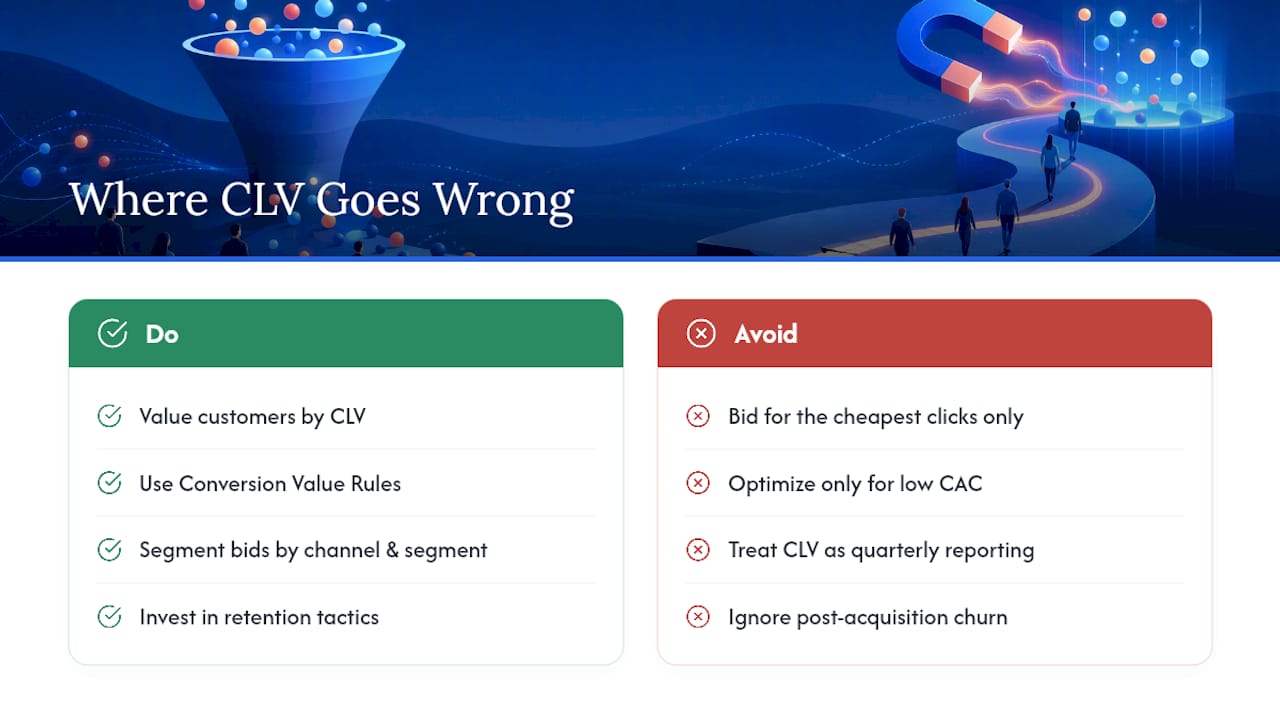
CLV isn't a reporting metric you check once a quarter. It's the input that should decide your entire acquisition strategy, channel by channel, segment by segment. Businesses that treat it that way outgrow the ones still asking "was that ad profitable?" one click at a time.
Retention tactics matter here too, and the fundamentals are covered well in this guide on proven customer retention strategies, worth a read alongside your own CLV numbers.
— Adrian
How Adsdaddy turns your CLV number into an actual growth plan
Knowing your CLV is step one. Turning it into a bidding strategy, a segmentation model, and a lifecycle program that actually lifts it, that's the part most businesses stall on. Specialized digital marketing agencies can help close that gap by setting up ad signals, building audience segments, and running lifecycle campaigns so CLV becomes a growth lever instead of a number in a spreadsheet nobody opens.

Here's what that looks like in practice: an audit of your current CAC-to-CLV ratio, a measurement plan that maps Conversion Value Rules to your actual customer segments, and a 90-day test to prove the model before you scale spend behind it. No guessing, no waiting a year to see if it worked.
If you're ready to stop treating every customer as equally valuable, book a CLV-driven growth audit with Adsdaddy and get your first 90-day test mapped out.
Key sources and further reading
Salesforce and Shopify both publish practical CLV breakdowns worth bookmarking for formula references. Twilio's analysis is useful for the ROI-and-stakeholder angle, and Google Ads' own support documentation is the definitive source for Conversion Value Rules and pLTV setup.
This article is general information, not a substitute for advice from a qualified financial advisor. Consult a qualified financial professional about your own circumstances before acting on anything here.
FAQ
What is a good customer LTV?
There's no universal number, a "good" CLV depends entirely on your margins and CAC. As a rule of thumb, aim for net CLV to be at least three times your customer acquisition cost.
How do I calculate customer lifetime value?
Use the basic formula first: average order value × purchase frequency × average customer lifespan. Then subtract cost-to-serve and acquisition cost to get net CLV, the figure that should actually guide your budget.
Can you give me an example of customer lifetime value?
A coffee shop customer spending a small amount frequently over a long period can generate substantial gross CLV. Once you factor in ingredient and labour costs, the net figure will sit meaningfully lower.
What's the difference between LTV and CAC?
CLV (or LTV) is what a customer is worth to you over time; CAC is what you paid to acquire them. The gap between the two, ideally CLV at three times CAC or higher, is what tells you whether your acquisition spend is actually working.
How does CLV feed into ad bidding?
You can pass value signals into platforms like Google Ads through static conversion values, Conversion Value Rules for segment based multipliers, or predictive LTV through Offline Conversion Import for per-customer bidding precision.