Lifecycle Marketing: Driving Loyalty and Growth
. By Ads Daddy.

Chasing quick sales often leaves Australian e-commerce businesses struggling to grow. The real opportunity hides in fostering genuine customer relationships from first click to repeat purchase. Lifecycle marketing nurtures every stage of the journey, turning new visitors into loyal advocates through personalised messaging and consistent engagement. By focusing on connected experiences and tailored communication, small online shops gain a competitive edge and lay the foundation for long-term sales growth.
Table of Contents
- What Is Lifecycle Marketing And Why Use It?
- The Stages Of The Customer Lifecycle
- Key Tactics, Tools And Real-World Examples
- Integrating Lifecycle Marketing With Paid Ads
- Common Mistakes And How To Avoid Them
Key Takeaways
| Point | Details |
|---|---|
| Lifecycle Marketing Builds Relationships | Instead of focusing solely on one-time transactions, nurture ongoing customer relationships through tailored communication. |
| Customer-Centric Approach Maximises Revenue | Target customers based on their journey stage to increase conversion rates and overall revenue. |
| Integration and Data Flow are Crucial | Connect your marketing tools to create a seamless customer experience, thus improving retention and engagement. |
| Personalisation Drives Engagement | Employ deep personalisation strategies that leverage behavioural data to enhance customer interactions and loyalty. |
What Is Lifecycle Marketing and Why Use It?
Here's the honest truth: if you're only chasing customers at the moment they land in your shop, you're leaving money on the table. Lots of it. Lifecycle marketing is fundamentally different from the spray-and-pray approach most Australian e-commerce businesses default to. Instead of treating customers as one-off transactions, lifecycle marketing nurtures relationships across the entire journey, from the first time someone hears about your brand all the way through to them becoming a repeat buyer who actually recommends you to their mates. The core difference is personalisation at scale. You're not sending the same generic email to everyone. You're meeting customers exactly where they are in their buying journey and giving them what they need right then.
Why should you care? Because it works. A lot. When you adopt a customer-centric approach that targets customers based on their stage in the journey, you stop wasting ad budget on people who aren't ready to buy. You build loyalty with the ones who have already bought from you. And crucially, you convert first-time buyers into repeat customers and brand advocates. Think of it like this: a one-time purchase from a new customer might net you £50 profit. But that same customer, nurtured properly over 12 months, could spend £500 and tell their friends about you. That's the difference between surviving and scaling.
The practical breakdown comes down to several connected touchpoints across the customer lifecycle:
- Awareness stage: potential customers discover your brand through ads, content, or word of mouth
- Consideration stage: they're comparing you to competitors and evaluating whether you solve their problem
- Purchase stage: they've decided to buy and complete a transaction
- Post-purchase stage: they've received their order and deciding whether to buy again
- Loyalty stage: repeat customers who trust your brand and become advocates
At each of these stages, you've got an opportunity to deliver something relevant. A new visitor needs different messaging than someone who abandoned their cart. Someone who just received their order needs different communication than someone shopping for the third time. When you map this out across email, SMS, retargeting ads, and your website itself, you create a connected experience that feels natural to the customer and drives measurable results. The data tells you who's where in that journey, and you adjust your approach accordingly.
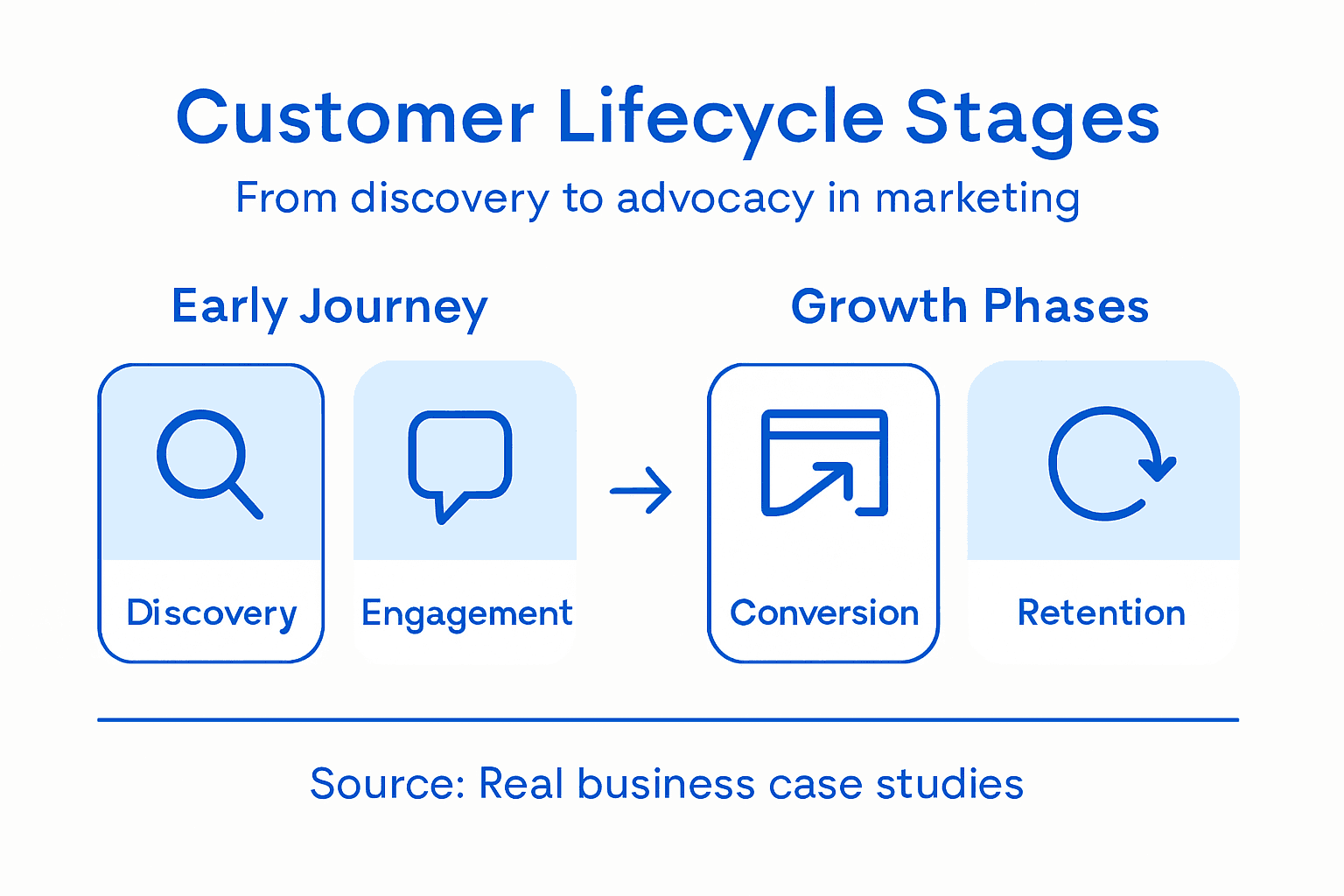
To clarify how lifecycle marketing transforms e-commerce growth, here is a summary of key business benefits by lifecycle stage:
| Lifecycle Stage | Business Benefit | Example Outcome |
|---|---|---|
| Awareness | Grow new visitor volume | Increased high-intent leads |
| Engagement | Boost conversion chances | Reduced cart abandonment |
| Conversion | Maximise revenue per sale | Higher average order value |
| Retention | Increase purchase frequency | More returning customers |
| Loyalty/Advocacy | Build referral momentum | Greater word-of-mouth and reviews |
For Australian e-commerce businesses specifically, lifecycle marketing solves a real problem: margins are tight and competition is brutal. You can't afford to acquire a customer and then hope they buy again. You need a system that keeps people engaged, that turns them into regulars, and that maximises the revenue from each person who finds you. When combined with proper ad management across platforms like Facebook and Instagram, lifecycle marketing becomes a revenue multiplier. You're not just running campaigns. You're building relationships that compound over time.
Pro tip: Start by mapping out your actual customer journey right now—from first click to their most recent purchase—then identify the biggest drop-off point. That's where your first lifecycle marketing effort should focus, because even small improvements at that stage will flow through to better retention and higher customer lifetime value.
The Stages of the Customer Lifecycle
Right. Let's break down what actually happens when a customer interacts with your business. The customer lifecycle describes the ongoing relationship a customer has with you, starting from that first moment they hear your name and stretching through multiple purchases over months or years. But here's the thing most e-commerce businesses get wrong: they treat each stage like it's separate. They spend huge amounts on discovery ads, then abandon people once they've bought. That's backwards. Each stage flows into the next, and if you mess up at stage two, you'll feel the pain at stage five. Understanding where your customers actually are in this journey is the difference between wasting money and building a thriving business.
Stage One: Discovery
This is where it all starts. Someone doesn't know your brand exists yet. They might be scrolling Instagram, searching Google, or chatting with a mate who mentions you. Your job at this stage is pure visibility. You're running ads, creating content, getting mentioned in the right places. For Australian e-commerce businesses, this often means Facebook and Instagram ads, Google search ads for high-intent keywords, or influencer mentions in your niche. The person doesn't know what they want from you yet. They just need to know you exist. The mistake? Trying to sell too hard at this stage. You're not convincing someone to buy your product. You're making them aware that you solve a problem they have.
Stage Two: Engagement
Now they know you exist, and they're curious. Maybe they've clicked through to your website, scrolled your Instagram feed, or watched a video. They're evaluating whether you're worth their time and money. This is where you need to show them you understand their problem and have a solution. Email sequences work brilliantly here. So do retargeting ads showing product benefits. Your website content needs to actually answer questions instead of just showing pretty pictures. This stage is crucial because it's where most people drop off. They saw you, got slightly interested, then forgot about you or got distracted by a competitor. If you can keep them engaged with valuable content and messaging during this phase, you've got a real shot at a sale.
Stage Three: Conversion
They've decided to buy. This stage is almost handled already if you've nailed stages one and two. Your job now is to remove friction. Make the checkout fast. Don't ask for unnecessary information. Offer multiple payment options. And here's the thing: this stage determines whether they become a one-time buyer or a repeat customer. If their first experience is smooth and the product delivers, they're primed for stage four. If checkout is painful or the product disappoints, you've lost them forever.
Stage Four: Retention
This is where most e-commerce businesses completely drop the ball. Someone just gave you money, and you ghost them. No follow-up email, no thank you, no check-in to see if everything arrived okay. Retention is about keeping them engaged after the purchase. Send them a confirmation email. Let them know when it ships. Ask if they're happy once it arrives. Suggest complementary products they might like. Create a loyalty program. Give them reasons to come back. The beautiful part? Retention is cheap compared to acquisition. Getting someone to buy again from you costs maybe a fifth of the money it takes to get a new customer. Yet most businesses ignore it.

Stage Five: Loyalty and Advocacy
When you've nurtured someone through all four previous stages, they become something rare and valuable: a loyal customer who actively recommends you. They're buying again. They're telling their friends. They're leaving positive reviews. They're your best marketing asset. Exceeding customer expectations and fostering long-term loyalty at this stage means treating them like they matter, because they do. Early access to new products, exclusive discounts, or personalised communication keeps them coming back. One loyal customer is worth ten one-time buyers.
Pro tip: Audit where you're currently strongest and weakest across these five stages, then pick one stage where you're bleeding customers and fix it first. Most Australian e-commerce businesses lose people at retention, so start there if you're unsure.
Key Tactics, Tools and Real-World Examples
Right, so you understand the stages. Now let's talk about what actually works. Lifecycle marketing combines strategies across awareness, engagement, evaluation, purchase, support, and loyalty stages, and the tactics you use need to shift at each point. Content marketing handles awareness beautifully. Social media keeps people engaged. Personalised offers move them toward purchase. But here's what separates winners from everyone else: they don't treat these tactics in isolation. They string them together into a coherent system. An Australian online retailer might run Facebook ads to build awareness, then use email sequences to nurture engagement, then retarget with a limited-time offer to push conversion. Each tactic flows into the next. Each one feeds data back into the system so you get smarter about who you're reaching.
The Tactical Breakdown
Let's get specific because vague advice is useless. At the awareness stage, you're spending most of your budget on paid ads. Facebook and Instagram ads work brilliantly for Australian businesses because targeting is tight and costs are reasonable. Google search ads capture high-intent people actively looking for what you sell. The key is messaging. Someone at awareness doesn't know you exist yet, so talk about problems they have, not your product features. Once they're aware, engagement tactics kick in. Email is still king here. A proper email sequence breaks down your offer, addresses objections, and builds desire. Retargeting ads remind them why they clicked in the first place. Content on your website answers their questions. You're building trust, not pushing for a sale yet.
When they're ready to convert, make it stupidly easy. Fast checkout. Clear shipping costs. Multiple payment options. Trust signals like customer reviews and security badges matter. Then comes the part most Australian e-commerce businesses mess up: support and retention. Post-purchase emails thanking them, updates on their order, and follow-ups asking if everything arrived okay. Then loyalty tactics. Exclusive discounts for repeat buyers. Early access to new products. A rewards program. SMS marketing works brilliantly here because loyal customers actually want to hear from you.
The Tools That Make It Possible
You can't run lifecycle marketing manually. You need systems. CRM systems and segmentation tools allow automation and performance optimisation across your campaigns. For Australian businesses, AI-driven advertising strategies now let you automate audience targeting and bid management, which means your ads become more efficient over time without manual tweaking. Email marketing platforms like Klaviyo or Mailchimp segment your audience based on behaviour and automatically send the right message at the right time. Analytics tools like Google Analytics track where customers drop off so you know exactly where to focus. Customer data platforms unify information across channels so you're not treating someone as a stranger when they email you after browsing your site.
Here's the thing though. Most Australian businesses have all these tools. They just don't connect them. Your email platform doesn't talk to your ads manager. Your CRM doesn't feed customer behaviour back into your website. You end up with siloed data and disconnected campaigns. That's where integration becomes critical. When tools talk to each other, magic happens. Someone abandons their cart, your email platform picks it up automatically, and an hour later they see a retargeting ad with their exact abandoned items. No manual work. No guessing. Just systems working together.
A quick comparison of popular lifecycle marketing tools and their main functions:
| Tool/Platform | Key Function | Typical Use in Lifecycle |
|---|---|---|
| Klaviyo | Automated, segmented email flows | Engagement, retention |
| Mailchimp | Basic automation and analytics | Engagement, post-sale |
| Google Analytics | Track web visitor behaviour | Identify drop-off points |
| Facebook Ads | Targeted reach and retargeting | Awareness, conversion |
| Customer Data Platform | Data unification across channels | Consistent experience |
Real-World Examples That Actually Moved the Needle
Talk is cheap. Let's look at what works. An Australian fashion retailer noticed that 40 percent of their first-time buyers never returned. They implemented a post-purchase sequence: day one, a thank you email with care instructions. Day three, a follow-up asking how the fit was. Day seven, a "here's what other people bought" email featuring complementary items. Day 14, a limited-time 15 percent discount for next purchase. Within three months, repeat purchase rate jumped from 18 percent to 31 percent. Same traffic. Same marketing spend. Better systems. Or consider an Australian home goods e-commerce business that used segmentation. They split their email list based on purchase frequency and sent different messages. New buyers got educational content about product care. Regular buyers got loyalty rewards. Inactive buyers got win-back offers. That segmentation alone increased email revenue by 44 percent because they stopped sending the same generic email to everyone.
The pattern is clear. Businesses that win at lifecycle marketing do three things right. First, they map their actual customer journey and identify where they're losing people. Second, they implement tools that automate the tedious work and create data connections. Third, they test constantly and refine based on results. They don't guess. They measure.
Pro tip: Pick one tactic at one stage of your lifecycle and measure it properly for 30 days before adding more complexity. Most Australian businesses fail at lifecycle marketing because they try to do everything at once and can't tell what's actually working.
Integrating Lifecycle Marketing With Paid Ads
Here's where most Australian e-commerce businesses get stuck. They run lifecycle marketing in one corner and paid ads in another, never realising these two should be best mates. Paid ads and lifecycle marketing aren't competing strategies. They're complementary. One powers the other. When you integrate them properly, something shifts. Your ad spend becomes more efficient. Your conversion rates climb. Your customers stick around longer. Lifecycle marketing strategies enhanced by paid ads amplify reach during key stages like awareness and acquisition, while tailored ads support engagement, conversion, and retention. The trick is understanding where paid ads fit into each lifecycle stage and how to use them to push people forward.
Think of it this way. At the awareness stage, you're running brand awareness ads on Facebook and Instagram. Cold traffic. People don't know you exist. Paid ads are your megaphone here. But here's where most businesses stop thinking. Once someone clicks your ad and lands on your site, the lifecycle marketing starts. They browse. They leave. Now retargeting ads bring them back. But they're not just any retargeting ads. They're personalised based on what they viewed. Someone who looked at your navy blue runner gets ads featuring that exact shoe. Someone who added something to cart but didn't buy sees a different ad with a gentle reminder plus a discount code. That's not random. That's lifecycle marketing powered by paid ads.
Mapping Paid Ads Across Your Lifecycle
At each stage, your paid ads need to do something different. Here's the breakdown:
- Awareness stage: Run broad-targeting ads focusing on pain points and value propositions. Facebook and Instagram ads work beautifully here. Budget allocation matters. You might spend 30 percent of your total ad budget here because volume is everything.
- Engagement stage: Deploy retargeting ads to people who've visited your site but haven't converted. Show them product benefits, customer testimonials, or educational content. These ads cost less because the audience is smaller and warm. Maybe 25 percent of budget here.
- Conversion stage: Use dynamic retargeting ads showing exact products they viewed. Add urgency with limited-time offers or low-stock messaging. Google Shopping ads capture high-intent searchers at this stage too. Around 30 percent of budget.
- Retention and loyalty stage: Run exclusive offers for past customers. Use email sequences alongside ads. Loyalty ads on Facebook showing VIP-only access or early product launches. The smallest budget allocation, maybe 15 percent, but incredibly profitable because cost per acquisition is near zero.
How Data Integration Makes This Work
This doesn't work without data flowing between systems. Your CRM needs to feed customer information to your ads platform. Someone who purchased shouldn't see acquisition ads. Someone inactive for 90 days should see a win-back campaign. Your email platform should know which customers clicked which ads so follow-up emails match the message they saw. Combining data-driven insights with multi-channel paid campaigns delivers consistent messaging across touchpoints and improves targeting precision dramatically. When your analytics show customers dropping off at the consideration stage, your paid ads budget automatically shifts to engagement ads at that point. When you notice that customers from Instagram outperform those from Google, your lifecycle strategy adjusts channel mix accordingly.
Most Australian businesses don't have this integration. They're flying blind. Email goes one direction. Ads go another. Nobody talks to anybody. That's why their customer acquisition costs stay high and retention stays low. Strategic client acquisition through targeted advertising combined with proper lifecycle nurturing is where the leverage sits. The moment you connect these dots, efficiency explodes.
Real Execution: Putting It Together
Let's say you're a beauty e-commerce brand. Month one, you run awareness ads on Facebook targeting women aged 25 to 45 interested in skincare. Budget is two thousand dollars. Videos show transformation results and pain points. Click-through rate sits around three percent. Five hundred people land on site. Only sixty convert at a four percent conversion rate. Now lifecycle marketing takes over. Those 440 who didn't convert get retargeting ads for two weeks. Fifteen percent of them return and buy within the fortnight. That's another 66 customers from the same cold traffic. Your paid ads amplified your lifecycle funnel.
For those sixty who converted initially, they get a post-purchase sequence. Day one, shipping confirmation plus a follow-up email. Day five, a review request plus a related product recommendation. Day twenty, a loyalty offer for their next purchase. Three weeks later, you run Facebook ads specifically to past customers showing new products. Conversion rate here is 12 percent because they trust you already. Cost per acquisition is a quarter of what you paid to acquire them the first time. That's integration working.
Pro tip: Start by identifying which lifecycle stage has your biggest drop-off, then allocate your paid ad budget to push people through that exact bottleneck. Don't try to optimise everything at once. Fix one stage, measure results for 30 days, then move to the next.
Common Mistakes and How to Avoid Them
Right. Let's talk about where things go wrong. Most Australian e-commerce businesses know lifecycle marketing is important. They've read the articles. They understand the concept. But then they implement it and wonder why the results are disappointing. It's usually because they're making one or more fundamental errors that sabotage the whole system. The good news is these mistakes are predictable and fixable. Once you know what to avoid, you can leap ahead of competitors still flailing around.
Mistake One: Treating the Customer Journey as Linear
This is the big one. Most businesses assume customers move in a straight line from awareness to loyalty. They don't. Real customers bounce around. Someone discovers you on Instagram, then finds you via Google search two weeks later. Another person researches you for three months before buying. Someone else buys once, disappears for six months, then comes back. The customer journey isn't linear, and companies that misunderstand this make critical errors in their lifecycle strategy. They build sequences assuming everyone progresses at the same speed. Then they get frustrated when people don't convert on schedule.
The fix is mapping your actual customer journey, not the theoretical one. Look at your analytics. See where people actually come from. Track how long they actually take to buy. Notice how many convert on first visit versus fifth visit. Some of your customers will follow a predictable path. Others won't. Your lifecycle strategy needs to account for both. Use dynamic segmentation that responds to behaviour, not assumptions. Someone who visits weekly gets different messaging than someone who visits once every three months. Someone who abandoned cart gets different treatment than someone browsing product pages for the first time.
Mistake Two: Insufficient Post-Purchase Engagement
This is where Australian e-commerce businesses absolutely destroy their own profits. Someone buys. The transaction completes. Silence. Radio silence. Maybe a shipping notification if they're lucky. But no follow-up. No check-in. No loyalty building. Failing to tailor marketing approaches to specific stages and neglecting post-purchase engagement destroys repeat business. You've spent money acquiring this customer. You've finally converted them. Now you abandon them right when the relationship should deepen.
The fix is obvious but requires discipline. Build a post-purchase sequence. Day one: shipping confirmation and thank you. Day three: asking if everything arrived okay. Day seven: customer review request. Day fourteen: related product suggestions. Day thirty: a loyalty offer for their next purchase. This costs nearly nothing to automate, yet most businesses don't do it. The result is one-time buyers instead of repeat customers. Your customer lifetime value stays flat. Your acquisition costs never improve because you're constantly hunting new people instead of nurturing existing ones.
Mistake Three: Siloed Marketing Efforts
Your email platform doesn't talk to your ads manager. Your CRM doesn't feed into your website. Your Instagram strategy exists separately from your email strategy. This siloed approach means you're creating disjointed experiences. Someone sees an email about a product, clicks through, then three hours later sees an ad for something completely different because your systems don't know they just engaged with that product. Companies that integrate cross-channel marketing and use comprehensive data across touchpoints provide unified experiences that drive higher retention and engagement. Those that don't stay stuck with mediocre results.
The fix requires a shift in how you think. You need a central customer data platform or at least systems that can talk to each other. Someone's behaviour on your website should inform what ads they see. Someone who clicked an email should know not to receive that same email again. Someone who bought a product shouldn't see acquisition ads for entry-level items. This coordination sounds complicated but it's actually the minimum requirement for decent lifecycle marketing. Without it, you're essentially running separate campaigns that occasionally happen to reach the same person.
Mistake Four: Lack of Deep Personalisation
Many Australian e-commerce businesses think personalisation means putting someone's name in an email subject line. That's not personalisation. That's a gimmick. Using deep personalization with behavioural and transactional data drives significantly better results than generic messaging. Real personalisation means knowing that someone bought running shoes two months ago, so showing them socks or shoe care products, not winter jackets. It means knowing someone abandoned a cart with three items, so your retargeting ad shows those exact three items, not random products.
The fix is gathering and using the right data. Track purchase history. Monitor browsing behaviour. Note abandoned carts. Segment by product category, price point, and purchase frequency. Then use this intelligence in every communication. Someone who's purchased five times gets different treatment than a first-time buyer. Someone who spent five hundred dollars gets different offers than someone who spent fifty. This level of personalisation requires better tools and processes, but the ROI justifies the investment immediately.
Mistake Five: Overlooking Genuine Relationships
This one's less tactical and more philosophical. Some Australian e-commerce businesses view lifecycle marketing as purely transactional. How do we extract more money from this person? How do we increase their lifetime value? Customers sense that. They feel like numbers, not people. The result is mediocre engagement and short-lived loyalty. Emphasising genuine connection helps foster repeat business and advocacy. When you actually care about solving customer problems, when your communication feels human instead of automated, people come back.
The fix is remembering that customers are people. Your follow-up emails shouldn't just ask for a review. They should actually ask if the product solved their problem. Your loyalty offers should feel generous, not gimmicky. Your customer service should be fast and personal. When someone has an issue, fix it without making them jump through hoops. These things cost money. They also generate disproportionate returns in loyalty and word-of-mouth referrals.
Pro tip: Audit your last ten customer touchpoints and map where each interaction felt personalised versus generic, where systems were connected versus siloed, and where you over-focused on transactions versus relationship-building. That audit will reveal your biggest leverage point for improvement.
Transform Your Customer Relationships with Expert Lifecycle Marketing
Many Australian e-commerce businesses struggle with turning one-time buyers into loyal advocates because they lack an integrated system that connects paid ads with personalised post-purchase engagement and retention strategies. This article highlights how lifecycle marketing, when done right, nurtures customers across every stage from awareness to loyalty — reducing drop-offs and maximising lifetime value. Common challenges such as siloed marketing efforts and insufficient post-purchase follow-up leave businesses missing out on repeat revenue and deeper customer connections.
At AdsDaddy, we specialise in harnessing data-driven advertising strategies across platforms like Facebook, Instagram, and Google combined with advanced automation tools such as Klaviyo and newCustomer.io to craft seamless lifecycle campaigns. Our approach ensures your ads not only attract high-intent leads but also integrate smoothly with personalised retention efforts that build genuine loyalty and boost repeat sales.

Ready to eliminate costly drop-offs and turn visitors into lifelong customers? Discover how our strategic, multi-channel ad management and lifecycle marketing expertise can unlock sustained growth for your business today. Visit AdsDaddy.com and start scaling your marketing the smart way.
Frequently Asked Questions
What is lifecycle marketing?
Lifecycle marketing is a strategy that focuses on nurturing customer relationships at every stage of their journey, from initial awareness to repeat purchasing and advocacy. It involves personalisation at scale to meet customers where they are in their buying process.
Why is post-purchase engagement important in lifecycle marketing?
Post-purchase engagement is crucial because it fosters loyalty and encourages repeat purchases. By following up with customers after a purchase, businesses can improve their retention rates, leading to increased customer lifetime value and more referrals.
How can businesses effectively implement lifecycle marketing?
Businesses can effectively implement lifecycle marketing by mapping out the customer journey, identifying key touchpoints, and using automated tools to personalise communication at each stage. This allows for seamless transitions from engagement to conversion, and ultimately to retention and advocacy.
What are common mistakes to avoid in lifecycle marketing?
Common mistakes to avoid include treating the customer journey as linear, neglecting post-purchase engagement, maintaining siloed marketing efforts, failing to personalise communication adequately, and overlooking the importance of building genuine relationships with customers.
Recommended
- AI Advertising Strategies: Insights & Trends - Ads Daddy
- Dr. Squatch: Viral Marketing and Brand Building - Ads Daddy.
- SEO Insights and Strategies for 2025: Ads Daddy.
- How do I generate leads for my service business? - Ads Daddy. Advertise on All Plattforms.
- 10 Effective Lead Generation Strategies for Businesses - Jarrod Harman