What is audience overlap and why it's costing you money
. By Ads Daddy.

What is audience overlap, exactly?
Audience overlap is what happens when the same person sits inside multiple ad sets at once. Your prospecting campaign targets them. Your retargeting campaign targets them. Maybe your lookalike audience does too. Meta's auction sees three of your ad sets bidding against each other for the same eyeball, and you pay the premium for that self-competition.
The result? Inflated cost-per-mille (CPM), erratic frequency, and a budget that decreases faster than it should.
Here's what makes it genuinely painful:
- CPM spikes because your ad sets outbid each other in the same auction
- Frequency caps break down, so users see your ads far more than intended
- Attribution gets messy, making it hard to know which ad set actually drove the conversion
- Budget splits across overlapping sets mean you pay multiple times to reach the same person
Meta Business Tools includes an Audience Overlap feature precisely because this problem is so common. Select 2–5 saved audiences, and it generates a percentage matrix showing how much each audience shares with the others. That number is your starting point for a structural audit.
Fixing overlap typically reduces CPM significantly and restores frequency to target ranges without touching your target audience budget. That's not a minor tweak. That's found money.
Table of Contents
- Audience overlap vs audience loyalty: what's the difference?
- Why understanding audience overlap is worth your time
- How to measure audience overlap with the right tools
- How to use overlap insights to sharpen your ad campaigns
- What website audience loyalty tells you that overlap data can't
- Real-world examples of audience overlap in action
- The real challenges in measuring audience overlap
- Key takeaways
- FAQ
Audience overlap vs audience loyalty: what's the difference?
These two terms get tangled up constantly, so let's untangle them fast.
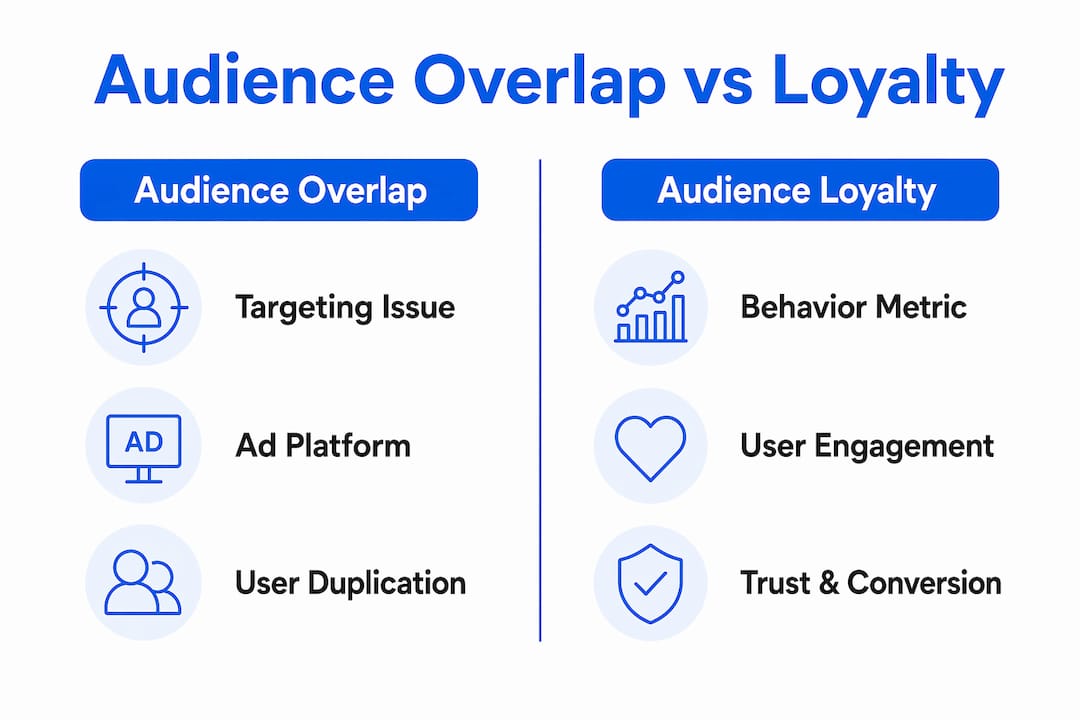
Audience overlap is a targeting problem. It lives inside your ad platform. It describes how many of the same users appear across multiple ad sets or audiences you've built.

Audience loyalty is a behaviour metric. It describes how often the same users return to engage with your content, website, or brand over time. Platforms like Similarweb measure loyalty through repeat visit rates and engagement depth. Mailchimp tracks it through open rates, click-through patterns, and subscriber retention across campaigns.
Why the distinction matters
Loyal audiences are gold. They already trust you, they convert at higher rates, and they cost less to re-engage. But if your ad sets overlap heavily, even your most loyal users get hammered with repetitive ads, which burns goodwill fast.
Think of it this way: loyalty is the relationship you've built. Overlap is accidentally texting the same person from three different numbers. One is an asset. The other is just annoying.
Similarweb's audience overlap analysis goes further, showing you where your audience intersects with competitor websites. Mailchimp's overlap tool flags when subscribers exist across multiple lists, which matters enormously for email deliverability and suppression logic. Both tools approach the same core question from different angles: who are you reaching more than once, and is that intentional?
Why understanding audience overlap is worth your time
Overlap analysis isn't just a housekeeping task. Done well, it's a competitive intelligence exercise.
- Reduce wasted spend. Every dollar chasing a user already in your funnel is a dollar not finding a new customer.
- Fix attribution. When ad sets overlap, conversion credit gets split unpredictably. Cleaner audiences mean cleaner data.
- Spot competitor audiences. Overlap tools like Similarweb reveal which audiences engage with your competitors but haven't converted with you yet. That's a warm prospecting list hiding in plain sight.
- Manage frequency properly. Unmanaged overlap is the fastest route to audience fatigue. Users who see your ad seven times in a day don't buy. They hide your page.
- Uncover new market segments. Overlap data shows you where audiences cluster, which often reveals niches you hadn't deliberately targeted.
- Protect your retargeting funnel. Prospecting sets bleeding into retargeting windows inflate spend and confuse the algorithm about where users sit in the funnel.
The importance of audience overlap analysis compounds as your account matures. Small accounts with three ad sets might not feel it. Accounts running fifteen campaigns across multiple objectives absolutely will.
How to measure audience overlap with the right tools

The mechanics of audience overlap analysis differ by platform, but the logic is consistent: identify shared users, quantify the intersection, then decide what to do about it.
Using Meta Business Tools
- Open Audiences inside Meta Business Manager
- Select 2–5 audiences using the checkbox on the left
- Click Actions, then Show Audience Overlap
- Read the percentage matrix in both directions — Audience A's overlap with B, and B's overlap with A
The directional read matters. If 80% of Audience A is inside Audience B, but only 20% of Audience B is inside Audience A, Audience B "owns" the overlap. That tells you which set to consolidate or exclude from.
Key metrics to track
- Overlap count: the raw number of shared users between two audiences
- Overlap percentage: shared users divided by the total of either audience
- Jaccard similarity: a more precise measure that divides shared users by the combined unique users across both sets. Useful for comparing audiences of very different sizes.
Using Similarweb and Mailchimp
Similarweb's audience overlap tool compares website visitor profiles across domains, showing you which competitor sites share your visitors. Mailchimp's overlap detection flags subscribers who appear across multiple lists, which is critical for suppression and deliverability management.
Pro Tip: Meta's Audience Overlap tool has privacy thresholds. Very small audiences or those with limited data may return hidden results. Treat overlap percentages as directional signals, not precise counts, and always audit them as part of a broader account structure review rather than in isolation.
Limitations to keep in mind
- Small audiences (typically under a few thousand) may not return overlap data due to privacy protections
- Overlap snapshots are point-in-time; audiences shift as users enter and exit
- Cross-platform overlap (e.g., between your Meta and Google audiences) isn't measurable natively. You'd need a customer data platform or first-party data matching to get there.
How to use overlap insights to sharpen your ad campaigns
Knowing you have overlap is step one. Knowing what to do about it is where the ROI lives.
Here's the playbook:
- Add exclusions thoughtfully. Exclude your retargeting list from prospecting campaigns. Exclude purchasers from lead-gen sets. But don't go exclusion-crazy — over-exclusion shrinks reach and kills frequency balance.
- Consolidate overlapping audiences. If two audiences share more than 60–70% of their users, they're probably better off merged into one ad set with a combined budget.
- Assign audience ownership. When overlap is unavoidable, decide which ad set "owns" that user segment and pause the other. The owner is usually the set with the lower CPA or the more relevant creative.
- Audit retargeting window bleed. Prospecting ad sets reaching users already in your retargeting funnel is one of the most common and expensive forms of overlap. Set your retargeting window exclusions explicitly.
- Use campaign budget optimisation (CBO) carefully. CBO can mask overlap problems by shifting budget dynamically, but it doesn't fix the underlying structural issue.
Pro Tip: Run an overlap audit every time you launch a new campaign or add a new audience. Accounts drift. What was clean in January can be a mess by March. Build the audit into your monthly account health check.
Controlled overlap isn't always the enemy. Retargeting sequences often need a user to appear in multiple stages of your funnel. The goal isn't zero overlap. It's smarter audience segmentation so that overlap is intentional, not accidental.
What website audience loyalty tells you that overlap data can't
Audience loyalty in the web analytics sense measures how often the same users return to your site. It's tracked through metrics like:
- Return visitor rate: the percentage of sessions from users who've visited before
- Visit frequency: how many times a user visits within a set period
- Session depth: pages per visit and time on site, which signal genuine engagement
Platforms like Similarweb surface loyalty scores by domain, letting you benchmark your return visitor rate against competitors. A high loyalty score means your content or product is pulling people back without paid prompting. That's organic retention, and it's a signal worth building on.
Where loyalty data complements overlap analysis: if your loyal returning visitors are also inside your retargeting audiences, you're spending paid budget on people who'd come back anyway. That's a budget leak worth plugging. Cross-referencing loyalty data with your retargeting lists can reveal exactly which users you can safely exclude from paid retargeting without losing conversions.
Real-world examples of audience overlap in action
The e-commerce brand burning budget on itself
A mid-sized Australian e-commerce brand running Facebook ads had three active campaigns: a broad prospecting set, a lookalike audience based on purchasers, and a retargeting set for cart abandoners. Overlap analysis revealed the lookalike and prospecting sets shared over 65% of their users. The brand was effectively bidding against itself in every auction, driving CPMs up and muddying which campaign deserved conversion credit.
The fix was straightforward: merge the two overlapping sets into one prospecting campaign, exclude existing customers and cart abandoners explicitly, and let the retargeting set work cleanly on its own. CPM dropped, frequency normalised, and attribution became readable again.
Using overlap for competitive intelligence
Overlap analysis via Similarweb showed one SaaS marketer that a significant portion of their website visitors also regularly visited two competitor domains. Rather than treating this as a threat, they used it as a targeting signal. They built a custom audience from their own site visitors and layered interest targeting that mirrored the competitor's content themes. The result was a prospecting campaign aimed squarely at users already in the category but not yet committed to a vendor.
This is the audience targeting strategy most marketers miss: overlap data doesn't just show you where you're wasting money. It shows you where your next customer is already spending time.
The real challenges in measuring audience overlap
Overlap analysis sounds clean in theory. In practice, it gets complicated fast.
Privacy restrictions are the biggest wall. Meta's tool hides overlap data for small or sensitive audiences. Apple's App Tracking Transparency framework has reduced the signal quality of iOS-derived audiences significantly, meaning overlap percentages are often underestimates.
Cross-platform blindness is the second problem. Your Meta audiences and your Google audiences don't talk to each other natively. A user who's in your Facebook retargeting set and your Google remarketing list is overlapping across platforms, but you can't see it without first-party data matching or a customer data platform like Segment or Klaviyo.
Audience drift means any overlap snapshot goes stale quickly. Users enter and exit audiences constantly based on behaviour, recency windows, and platform signals. An audit from last month may not reflect today's reality.
The over-exclusion trap catches a lot of marketers who fix overlap aggressively. Strip too many users out of too many ad sets and you starve your campaigns of reach. The algorithm needs volume to optimise. Understanding why audience segmentation matters means knowing when to separate audiences and when to let them breathe.
Finally, attribution complexity doesn't disappear just because you reduce overlap. Multi-touch attribution across overlapping audiences is still a modelling problem, not a solved one. Overlap reduction makes attribution cleaner, but it doesn't make it perfect.
Key takeaways
Audience overlap is a structural account problem that inflates CPM, breaks frequency caps, and muddies attribution — fixing it is one of the highest-ROI audits a media buyer can run.
| Point | Details |
|---|---|
| Overlap inflates CPM | Self-competing ad sets drive up costs and push frequency beyond target caps. |
| Meta's tool is your starting point | Select 2–5 audiences in Meta Business Manager to see a directional overlap percentage matrix. |
| Overlap vs loyalty | Overlap is a targeting structure issue; loyalty measures repeat engagement behaviour — both inform campaign planning. |
| Controlled overlap is fine | Retargeting sequences need some overlap; the goal is intentional overlap, not zero intersection. |
| Over-exclusion is a real risk | Aggressive exclusions shrink reach and starve the algorithm — audit CPA data before cutting audiences. |
FAQ
What does "overlapping audience" mean?
An overlapping audience is a group of users who appear in two or more of your ad sets or marketing lists at the same time. This causes your campaigns to compete against each other in ad auctions, raising costs and distorting frequency.
How do you check audience overlap?
In Meta Business Manager, go to Audiences, select 2–5 audiences, click Actions, then Show Audience Overlap. For website audiences, Similarweb's overlap tool compares visitor profiles across domains. For email lists, Mailchimp flags subscribers who appear across multiple audiences.
How do you avoid audience overlap?
Add explicit exclusions between ad sets, consolidate audiences that share more than 60–70% of users, and audit your account structure whenever you launch a new campaign. Avoid over-excluding, as that reduces reach and can harm campaign performance.
What affects audience overlap the most?
Broad targeting, large lookalike audiences, and retargeting windows that aren't properly excluded from prospecting sets are the biggest drivers. Account age also matters — mature accounts with many saved audiences accumulate overlap over time if they aren't regularly audited.