Audience Insights: Boosting Aussie Ad Campaign ROI
. By Ads Daddy.

Running digital ads without a clear picture of your customer is like setting sail with no map. For marketing managers at small to medium-sized Australian e-commerce businesses, the stakes are high and every dollar matters. The real advantage comes from using audience insights that reveal not just who is engaging with your ads, but why they act the way they do, allowing you to tailor campaigns for better engagement and stronger ROI.
Table of Contents
- Core Concepts Of Audience Insights In Ads
- Key Types Of Audience Data Explained
- How Audience Insights Drive Roi
- Leading Tools For Audience Analysis In Australia
- Privacy, Compliance, And Common Pitfalls
Key Takeaways
| Point | Details |
|---|---|
| Audience Insights Improve Ad Effectiveness | By understanding audience characteristics, businesses can create targeted campaigns that resonate more effectively, leading to higher engagement and ROI. |
| Data-Driven Decision Making | Combining quantitative and qualitative data allows marketers to refine targeting strategies and personalize creative content for better outcomes. |
| Continuous Optimisation is Key | Regularly analysing audience behaviour and recalibrating campaigns ensures that marketing efforts remain relevant and cost-effective. |
| Privacy Compliance is Crucial | Adhering to Australia's Privacy Act is essential to maintain customer trust and avoid regulatory repercussions. |
Core Concepts Of Audience Insights In Ads
Audience insights are the raw intelligence that transforms your ad spend from random shots in the dark into calculated, profitable moves. They reveal who actually engages with your ads, what makes them tick, and why they convert (or don't). Understanding user characteristics and behaviours helps you build audience segments that work, refine your creative direction, and identify which audience groups deliver real ROI.
Here's what we're talking about. Audience insights pull together three critical layers of information about the people seeing your ads. First, there's the demographic data – age, gender, location, income level. Second is psychographic profiling – values, interests, lifestyle choices, what your audience actually cares about beyond the basics. Third is behavioural patterns – purchase history, browsing habits, how they interact with your brand or competitors. When you combine these three, you get a complete picture of who's clicking, who's buying, and who's just wasting your budget.
Why does this matter for your e-commerce business? Because audience analysis helps develop customised creatives and promotions that actually speak to the people you're trying to reach. Instead of blasting the same message to everyone, you're crafting campaigns aligned with what your audience genuinely wants. A high-performing segment might be 25-35 year old women interested in sustainable fashion who browse mobile at night. Another might be 40-55 year old men researching tech gadgets on weekends. You talk to each group differently, show them different products, use different angles. The result? Higher click-through rates, better conversion rates, and significantly improved ROI.
Audience insights also work as your early warning system. When a particular segment stops converting like it used to, the data shows you immediately. You can pause that audience, shift budget to what's working, or refresh your creative before you haemorrhage cash. When combined with targeted audience segmentation strategies, this intelligence becomes your competitive advantage. You're not guessing anymore – you're operating with evidence.
Pro tip: Start by auditing your existing customer base using these three layers – pull your demographic data, map out what interests they share, and track their buying patterns. This becomes your "golden audience" baseline. Use it to build lookalike audiences and refine your targeting from day one.
Key Types Of Audience Data Explained
When you're building ads, you're essentially making bets on human behaviour. To win those bets consistently, you need to understand the different types of data that reveal what your audience actually does and why they do it. There are two fundamental categories: quantitative data and qualitative data. Quantitative data gives you the measurable stuff – click counts, conversion rates, age ranges, geographic locations, purchase frequency. It's the numbers game. Qualitative data tells you the "why" behind those numbers – what motivates someone to buy, what frustrates them, what values they hold dear. Combining both types of data is essential for understanding your audience completely and making decisions that actually stick.
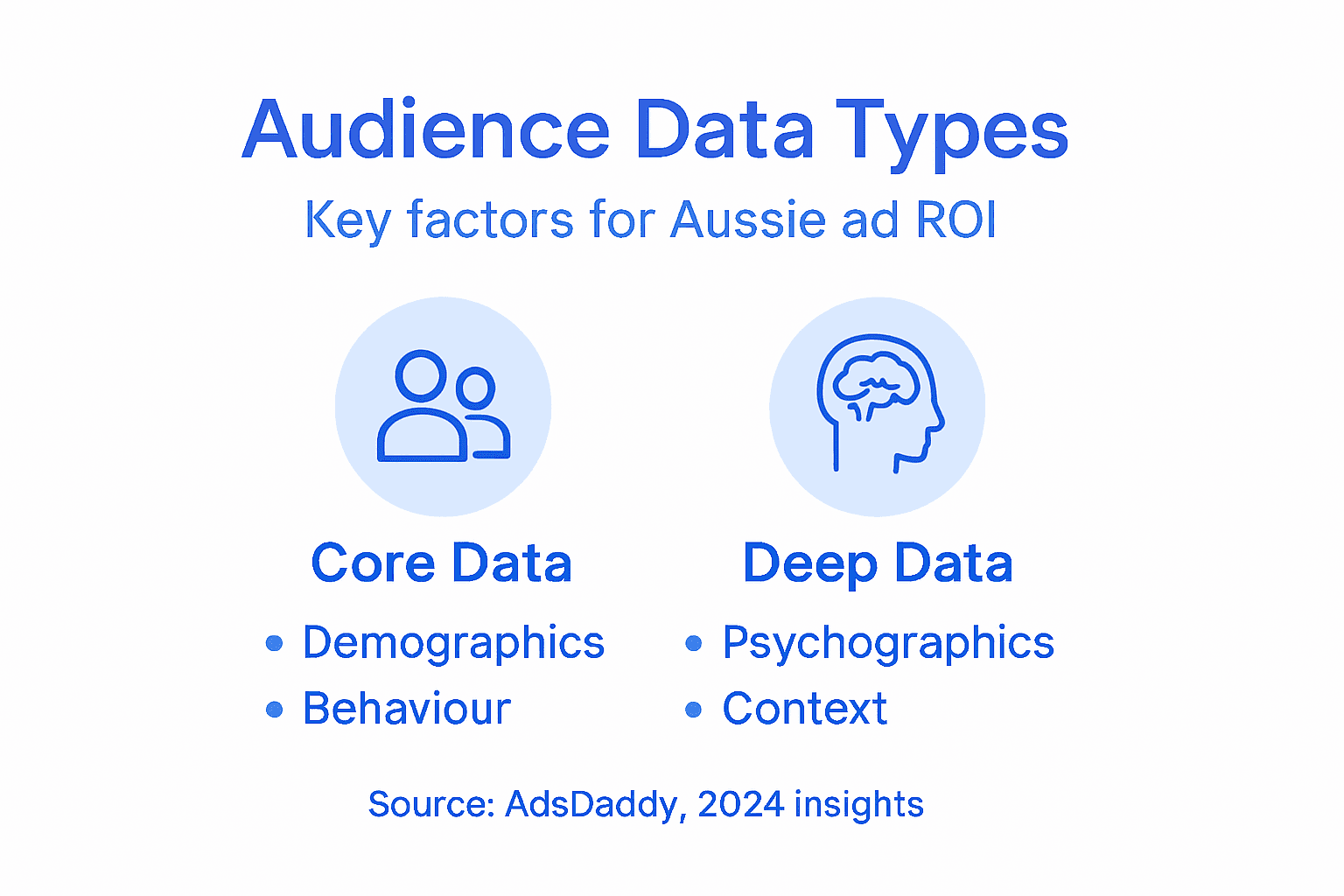
Let's break down the specific types of audience data you'll encounter in your Australian ad campaigns. First, there's demographic data – your audience's age, gender, location, household income, education level, family status. This is the foundation layer. Second is behavioural data – what they buy, how often they browse, what time of day they're active, which devices they prefer, whether they're repeat customers or one-time shoppers. Third is psychographic data – their interests, values, lifestyle choices, hobbies, aspirations. A 35-year-old woman in Melbourne earning $80,000 annually tells you something useful. But knowing she's also an eco-conscious fitness enthusiast who values sustainable fashion? That's gold. Fourth is contextual data – where and how they encounter your ads, what they were doing when they saw your ad, what season or event triggered interest. During winter, your heating products sell differently than in summer. Understanding engagement, motivations, and barriers across these categories helps you craft messaging that resonates at exactly the right moment.
Here's where it gets practical for your e-commerce business. You might track that customers aged 25–40 in Sydney spend the most money (quantitative), but qualitative insights reveal they value free shipping and fast delivery above all else. So you adjust your ad copy to emphasise "Arrives in 2 days" rather than "Premium quality." You notice your Brisbane audience clicks high but converts low (behavioural red flag). Investigation shows they're price-sensitive (psychographic insight), so you create separate campaigns highlighting discounts for that region. The magic happens when you layer these data types together. Quantitative data tells you "what's happening," qualitative tells you "why it's happening," and contextual data shows you "when to strike."

Most e-commerce marketers make the mistake of relying on one data type and missing the complete picture. They see conversion numbers dropping and blame the creative, when the real issue is they're targeting the wrong psychographic profile at the wrong time of day. Others obsess over demographic targets and ignore behavioural signals that someone's about to buy. The winning approach is collecting all these data types, then using them together to refine your audiences and personalise your creative. Test different messaging angles with demographic segments, track behavioural response, and adjust based on what the data shows you.
Here's how the main audience data types compare in purpose and impact:
| Data Type | Key Example | Main Use in Campaigns | Practical Impact |
|---|---|---|---|
| Demographic | Age, gender, income | Target broad audience groups | Sets initial audience segmentation |
| Behavioural | Purchase history | Identify buying triggers | Refines messaging and timing |
| Psychographic | Interests, values | Personalise creative content | Boosts relevance and emotional connection |
| Contextual | Device, time, place | Adjust for environment | Optimises ad delivery and responsiveness |
Pro tip: Audit your existing customer data across all four types – demographics, behaviour, psychographics, and context – then build a detailed profile of your top 20% of customers by revenue. Use that as your template for lookalike audiences and campaign refinement.
How Audience Insights Drive ROI
Here's the brutal truth: throwing money at ads without audience insights is like throwing darts blindfolded. You might hit the board occasionally, but most of your budget disappears into wasted impressions, clicks from people who will never buy, and campaigns that look good on paper but convert like a broken website. Audience insights change that equation entirely. When you understand who your customers actually are, what they care about, and why they buy, every dollar you spend works harder. Creating data strategies and applying insights optimises targeting and improves customer understanding, which directly translates to increased ROI and measurable business growth. This isn't theoretical. This is how successful e-commerce businesses separate themselves from the noise.
The connection between audience insights and ROI happens through three mechanisms. First, precision targeting reduces wasted spend. Instead of showing ads to everyone aged 20-50 in Australia, you're showing them only to people who match your ideal customer profile – the ones with the highest probability of converting. Your cost per acquisition drops. Your conversion rate climbs. Second, creative relevance increases engagement. When you know your audience values sustainability, you don't lead with "cheapest price." You lead with "made from recycled materials." When you know they're busy parents juggling work and family, you emphasise "saves you 2 hours per week." Blending authenticity, creativity, and measurability with clear audience personas creates content that resonates, driving higher engagement and measurable impact. Third, continuous optimisation based on audience behaviour means you're always improving. You see which audience segment performs best, which messaging angle converts highest, which device or time of day generates the best results, then you amplify what works and pause what doesn't.
Let's get specific about what this looks like in your Australian e-commerce business. You're running a campaign targeting "women interested in fitness." Broad. Generic. Expensive. Now you layer in audience insights. You discover that women aged 28-38 earning over $70,000 who follow sustainable lifestyle accounts and engage with wellness content convert at 4.2 percent, while women aged 50+ interested in general fitness convert at 1.1 percent. You immediately shift 70 percent of your budget to the first group. That single decision could increase your overall ROI by 200 percent or more. You also notice your Brisbane audience clicks your ads but rarely buys, whilst Sydney and Melbourne audiences show strong purchase intent. Investigation reveals your Brisbane segment is primarily price-sensitive, so you create a separate Brisbane campaign emphasising discounts and free shipping, whilst your Sydney and Melbourne campaigns focus on premium positioning and exclusivity. Same product, different messaging, dramatically different results.
The real magic happens when you combine audience insights with systematic ad optimisation. You're not just learning about your audience once. You're constantly feeding new performance data back into your audience understanding, then using that to refine targeting, creative, and placement. A/B testing different messages within your best-performing segment. Testing new lookalike audiences based on your high-value customers. Pausing underperforming demographics instantly. Reallocating budget to what's winning. This feedback loop is what separates businesses seeing 2-3x ROI from those seeing 500 percent plus ROI.
Pro tip: Set up custom dashboards tracking ROI by audience segment, not just by campaign. Watch which demographic, behavioural, and psychographic combinations deliver the highest ROAS (return on ad spend), then systematically build more budget and campaigns around those winning combinations.
Leading Tools For Audience Analysis In Australia
You don't need to be a data scientist to understand your audience. Australia has excellent resources and tools designed specifically to help businesses and marketers decode what their customers actually want. The trick is knowing which tools exist, what they measure, and how to translate their output into actionable campaign decisions. Some are free. Some require investment. All of them beat guessing.
Start with Google Analytics and Meta Insights, the foundational tools most Australian e-commerce businesses already use. Google Analytics shows you behavioural data: which pages people visit, how long they stay, what they click, where they drop off. Meta Insights (Facebook and Instagram) reveals demographic breakdowns, engagement patterns, and audience composition. Neither tool costs extra if you're already advertising. Beyond these, audience research toolkits like those offered by Creative Victoria provide guides and templates for conducting surveys, focus groups, and data analysis, supporting both experienced researchers and newcomers in gaining actionable audience insights. If you're serious about understanding your specific market segment, these structured approaches beat random A/B testing.
For tracking broader Australian audience trends, the Audience Outlook Monitor provides periodic surveys and dashboards showing evolving audience behaviours and sentiments across Australia. It's particularly useful if you're selling cultural products, experiences, or lifestyle goods. You see what's trending nationally, which segments are growing or shrinking, and how consumer priorities are shifting. Combine that with your own customer data, and you're operating with competitive advantage. Beyond government resources, paid platforms like Klaviyo (if you're using email marketing), Hotjar (for user behaviour recording), and Mixpanel (for advanced analytics) give you deeper insight into individual customer journeys. They cost money, but they answer specific questions: Why are people abandoning their carts? What messaging converts best? Which audience segment spends most?
Here's the reality though. Tools are useless without a strategy. You can access all these resources and still waste time collecting data that doesn't matter. The winning move is starting with your business questions: "Which geographic region should I focus on?" "What messaging angle converts best?" "Why is my Brisbane audience clicking but not buying?" Then pick the tools that answer those specific questions. Google Analytics answers regional and behavioural questions. Meta Insights shows you demographic and engagement patterns. Surveys and focus groups reveal psychographic insights and motivations. Targeted audience strategies combined with these insights are what turn casual browsers into customers. Don't collect data for the sake of collecting data. Collect data that directly informs campaign decisions.
Pro tip: Start with free tools (Google Analytics, Meta Insights) and map out your top 3 business questions, then layer in paid tools only when free options can't answer those specific questions. Most Australian SMEs waste money on tools they don't actually use.
The following table outlines leading audience analysis tools for Australian businesses:
| Tool/Resource | Main Focus | Cost to Access | Business Application |
|---|---|---|---|
| Google Analytics | Behavioural data | Free | Track user journeys, website drops |
| Meta Insights | Demographic insights | Free with ads | Discover audience composition |
| Audience Outlook Monitor | National audience trends | Free/public reports | Spot emerging market shifts |
| Klaviyo, Hotjar, Mixpanel | Advanced segmentation | Paid subscription | Deep-dive into funnel behaviour |
Privacy, Compliance, And Common Pitfalls
Listen. The fastest way to torpedo your ad campaign and destroy customer trust is to mishandle privacy or ignore compliance requirements. Australia's privacy landscape has teeth, and Australians are increasingly concerned about privacy with many experiencing unwanted marketing and data misuse. Your audience notices when brands are sloppy with their data. They notice when they get spammed. They notice when their information feels unsafe. One privacy breach or compliance slip-up can cost you customers, invite regulatory action, and tank your brand reputation for years. This isn't paranoia. This is business reality.
Australia's primary privacy framework is the Privacy Act 1988, which includes the Australian Privacy Principles (APPs). Here's what matters for your ad campaigns. You must have clear consent before collecting personal data. You must tell people what you're doing with their information. You must let them access and correct their data. You must protect it from misuse and unauthorised access. When you're collecting email addresses through landing pages, running retargeting campaigns, or building customer lists, you're handling personal information. Get it wrong and you're breaking the law. The Australian Information Commissioner's Office (OAIC) enforces this. They investigate complaints. They issue fines. The best part? Your customers can report you. Compliance isn't optional.
Common pitfalls Australian e-commerce businesses hit repeatedly. First, inadequate consent processes. You can't just assume people want marketing emails because they bought once. Second, poor data security. Storing customer data in unencrypted spreadsheets or using weak passwords is negligent. Third, ignoring privacy impact assessments. Before launching a new audience tracking or data collection method, you should assess the privacy risks. Fourth, mixing data sources carelessly. Combining customer data from different platforms without tracking consent creates compliance nightmares. Fifth, lack of transparency. Your privacy policy should clearly explain what data you collect, why, and what you do with it. Not hidden in legal jargon. Clear language. Deficiencies in risk management, data matching, and privacy impact assessments have been identified in major organisations, highlighting why these gaps matter across all business sizes.
Practically speaking, here's what to do. Document your data collection practices. Map where customer data comes from, how it's stored, who accesses it, and how long you keep it. Review your consent mechanisms. Are you getting explicit permission before adding people to marketing lists? Audit your platforms. Facebook, Google, and email marketing tools have built-in privacy controls. Use them. Train your team. Privacy compliance isn't just IT's job. Your marketing team needs to understand the rules. Finally, keep a paper trail. When privacy regulators ask questions, evidence of your good-faith compliance efforts matters.
Pro tip: Implement a simple consent audit quarterly: pull random samples of your audience, verify they actually consented to marketing contact, and document it. This single practice catches compliance gaps before they become expensive problems.
Unlock the Full Potential of Audience Insights with AdsDaddy
Struggling to turn your audience data into real advertising ROI is a common challenge for Australian businesses. As the article highlights, without precise targeting, meaningful psychographic understanding, and continuous optimisation, your ad budget can easily slip away on unengaged or mismatched segments. AdsDaddy understands these pain points and specialises in transforming those complex audience insights into campaigns that speak directly to your ideal customers across platforms like Facebook, Instagram, Google, YouTube, Microsoft Bing, and LinkedIn.
Stop wasting budget on guesswork and start leveraging the power of data-backed strategy tailored for your audience’s unique behaviour, interests, and context. At AdsDaddy, we combine expert campaign management with cutting-edge tools such as Meta for Business and Klaviyo to deliver personalised ads that truly resonate. Using proven audience segmentation methods and continuous performance feedback, we help Australian businesses increase both visibility and sales while carefully maintaining privacy compliance.
Discover how your business can benefit from targeted ads crafted by professionals who understand the crucial role of demographic, behavioural, and psychographic data in boosting conversions. Visit AdsDaddy for a comprehensive approach to digital advertising.
Ready to amplify your Australian ad campaigns with insights that drive measurable results?

Explore expert campaign solutions at AdsDaddy, harness powerful audience insights and start scaling your business today. Connect with us to build tailored strategies that maximise your ROI and keep your marketing compliant and competitive.
Frequently Asked Questions
What are audience insights in advertising?
Audience insights refer to the data collected about the demographics, interests, behaviors, and preferences of the audience engaging with your ads. These insights help marketers make informed decisions to improve targeting and boost campaign effectiveness.
How can audience insights improve my ad campaign ROI?
By leveraging audience insights, you can target specific segments of your audience, tailor your messaging to align with their interests and behaviors, and continuously optimize your campaigns based on performance data. This precision reduces wasted ad spend and increases conversion rates, leading to a better return on investment.
What types of data should I consider when analyzing my audience?
You should consider demographic data (age, gender, income), behavioral data (purchase history, browsing habits), psychographic data (interests, values), and contextual data (device and timing of ad encounters) to develop a comprehensive understanding of your audience.
How can I ensure compliance with privacy laws when using audience insights?
To ensure compliance, obtain clear consent before collecting personal data, explain how you will use that data, provide access for users to correct their information, and implement strong data security measures to protect customer information.
Recommended
- Role of Video Ads: Complete Guide for Australian SMEs - Ads Daddy. Advertise on All Plattforms.
- Why Use Targeted Ads: Complete Guide for Australia 2026 - Ads Daddy. Advertise on All Plattforms.
- What Is Cross-Platform Advertising? Complete Breakdown - Ads Daddy. Advertise on All Plattforms.
- business growth Archives - Ads Daddy. Advertise on All Plattforms.
- Campagne Pay per click Adwords Teramo Abruzzo