What is ad sequencing? A practical guide for marketers
. By Ads Daddy.

Ad sequencing is the controlled, ordered delivery of multiple ads to the same person, one after another, in a sequence you define. Instead of letting the algorithm pick whichever creative it fancies, you tell it: show this person Ad 1 first, then Ad 2, then Ad 3. It's the difference between a random playlist and a three-act film. Meta Ads Manager rolled out ad sequencing to standard auction campaigns for Awareness and Engagement objectives in early 2026. Google Ads has supported video ad sequencing for longer. Meta reports a notable conversion lift for sequenced exposure versus unordered delivery. That's not a rounding error.
Use it when: you're telling a brand story, educating buyers through a high-consideration funnel, running a product launch, or warming cold audiences before a hard offer.
Table of Contents
- How does ad sequencing actually work?
- What you need to set up before you enable sequencing
- Step-by-step setup and templates you can copy
- How budgets and bidding work differently in a sequence
- How to build a story arc that actually converts
- What to measure and how to read the results
- Common problems and how to fix them fast
- Your Australian launch checklist
- Key takeaways
- Why sequencing is the most underused tactic in Australian paid media
- Adsdaddy runs sequencing campaigns for Australian businesses
- Useful sources
- FAQ
How does ad sequencing actually work?
The core model is simple: step → trigger → next step. The platform records that a specific user experienced Ad 1 (via an impression, a minimum view threshold, or a click), then unlocks Ad 2 for that same user. No trigger, no progression.
Common triggers across platforms include when an impression is recorded, a user watches a significant portion of a video, a click through to a landing page occurs, or a custom event fires to indicate engagement.

Google Ads defines video ad sequencing as a series of video ads shown in the exact order you define, with viewers progressing by impression or interaction. Sequences can also track progress across compatible campaigns, so a viewer who sees Step 1 in one campaign can still receive Step 2 in a separate campaign, as long as targeting aligns.

Here's what a three-step funnel looks like in practice:
| Step | Ad type | Trigger to advance | Goal |
|---|---|---|---|
| 1 — Awareness | 15s hook video | Impression recorded | Stop the scroll, introduce the brand |
| 2 — Consideration | 30s demo or explainer | 50% video view | Build desire, answer objections |
| 3 — Action | 60s testimonial + offer | Click or impression | Drive conversion |
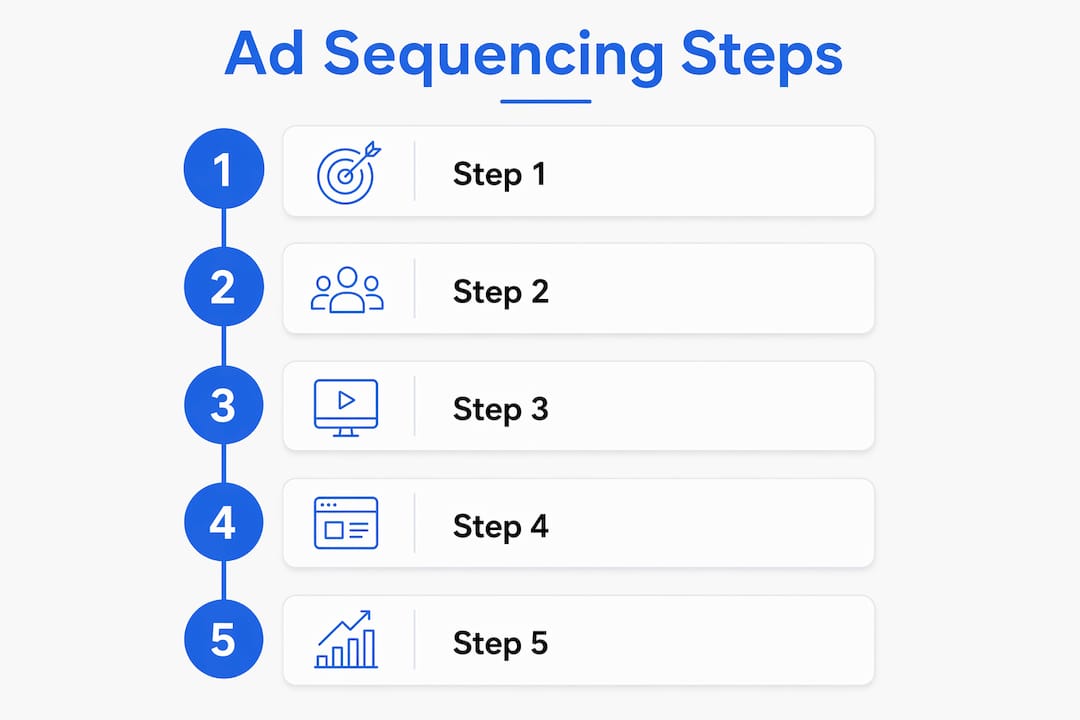
Expect natural drop-off between steps. Not everyone who sees Step 1 will qualify for Step 2, and that's fine. You're filtering for the most engaged segment of your audience with every step.
What you need to set up before you enable sequencing
Get these right before you touch the sequencing toggle, or you'll waste budget and wonder why nothing's working.
Meta Ads Manager requirements:
- Campaign objective must be Awareness or Engagement (sequencing is not available for all objectives)
- Use a lifetime budget, not a daily budget — daily budgets are incompatible with sequencing
- Target frequency must be enabled; Advantage Campaign Budget must be switched off
- Campaign duration should be sufficient to allow progression through the sequence
- Each ad set needs multiple creatives to form a sequence
Google Ads requirements:
- Use a video campaign with the video sequencing subtype selected
- Each step requires its own video asset uploaded to YouTube
- Sequence steps can be ordered by impression or skip behaviour depending on the sequence type you choose
Pro Tip: Check your account's campaign objectives before building assets. If your account doesn't yet have access to Meta's sequencing toggle (it rolled out progressively in early 2026), you won't see the option until it's available in your region.
Step-by-step setup and templates you can copy
Setting up on Meta Ads Manager
- Create your campaign with the Awareness or Engagement objective and set a lifetime budget.
- Build your ad sets and upload all creative assets.
- Publish the campaign first. This is the step most people miss.
- Return to the ad set settings after publishing and look for the sequencing option.
- Enable sequencing, then drag creatives into the order you want.
- Set your target frequency and confirm the sequence window.
That publish-first workflow trips up even experienced buyers. The sequencing toggle doesn't appear during initial campaign creation on Meta — it only surfaces after the campaign is live.
Setting up on Google Ads
- Create a new video campaign and select the Video sequence subtype.
- Add each video asset as a separate sequence step.
- Choose the trigger for each step (impression or interaction).
- Set your bid strategy and targeting, then publish.
Three templates to steal
Template 1: Two-step hook + offer (best for retargeting)
- Step 1: 15s brand hook (impression trigger)
- Step 2: 30s direct offer with CTA
Template 2: Three-step story arc (best for cold audiences)
- Step 1: 15s problem/hook (impression trigger)
- Step 2: 30s solution demo (50% view trigger)
- Step 3: 60s social proof + offer (impression trigger)
Template 3: Four-step education funnel (best for high-consideration products)
- Step 1: 15s awareness hook
- Step 2: 45s explainer
- Step 3: 60s case study or testimonial
- Step 4: 30s urgency offer with CTA
Meta recommends starting with a small number of ads per sequence, as longer sequences tend to see significant drop-off, so focus on a well-structured story arc before building anything more complex.
Pro Tip: Run an A/B test in weeks 1–2 by swapping the order of Steps 2 and 3. Sometimes social proof before the demo converts better. Let the data decide.
How budgets and bidding work differently in a sequence
Sequencing changes how the algorithm optimises. Normally, Meta and Google pick the best-performing creative per impression. With sequencing, you override that. You're trading short-term algorithmic efficiency for narrative control. Expect your cost per result to look different from a standard campaign, especially in the first week.
Recommended settings:
| Setting | Recommended range | Why |
|---|---|---|
| Budget type | Lifetime only | Required for sequencing on Meta |
| Sequence window | 7–30 days | Gives users time to progress through steps |
| Target frequency | 1 per 7–14 days | Prevents fatigue without killing reach |
| Ads per sequence | 2–3 | Balances story depth with drop-off risk |
| Minimum campaign duration | 7 days | Needed for the algorithm to pace delivery |
The "winner-takes-all" problem is real. Without sequencing, one creative dominates budget. With sequencing, the platform must serve each step in order, which spreads spend more evenly but removes some optimisation freedom. For brand-building and product launches, that trade-off is worth it. For pure ROAS campaigns, it's not the right tool.
Pro Tip: Set your lifetime budget based on your target frequency multiplied by your estimated CPM, not your daily spend habits. A 14-day sequence at 1 impression per 7 days per user means each person sees your sequence twice — plan your budget around that reach goal.
How to build a story arc that actually converts
Think of your sequence like a short film. Every step needs a job.
- Step 1 (Exposition): Grab attention fast. 15 seconds max. Introduce the problem or the brand. No hard sell.
- Step 2 (Build): Go deeper. Show the product in action, explain the value, handle the obvious objection. 30–45 seconds works well here.
- Step 3 (Proof + CTA): Social proof, testimonial, or case study, followed by a clear, specific offer. This is where you ask for the click.
Arc-based sequencing outperforms random creative rotations because each ad assumes the viewer already saw the previous one. You can reference Step 1 in Step 2 ("Remember that problem we mentioned?"). You can build urgency progressively rather than screaming it from the first frame.
For CTA progression, think of it this way: Step 1 CTA is "Learn more," Step 2 is "See how it works," Step 3 is "Get started today." The ask escalates with trust. Crafting effective CTAs for each step is worth the extra planning time.
Creative refresh cadence: plan to refresh assets every 3–6 months. Audiences who've seen your sequence multiple times stop responding, and fatigue hits sequenced campaigns harder than standard ones because the same people see the same order repeatedly.
Pro Tip: Write a one-line brief for each step before you brief your creative team: "This ad assumes the viewer has already seen [Step 1 description] and needs to [desired action]." That single constraint produces sharper scripts every time.
What to measure and how to read the results
Standard last-click attribution will undercount sequencing's contribution. A user who saw all three steps but converted a week later via organic search won't show up in your campaign report. That's a measurement gap you need to plan for.
Key metrics to track:
- Step completion rate — what percentage of Step 1 viewers progressed to Step 2 (and Step 2 to Step 3)
- Cost per sequence completion — total spend divided by users who saw all steps
- View-through conversions — conversions attributed to ad views, not clicks
- Assisted conversions — conversions where the sequence played a role but wasn't the last touch
Set up custom columns in Meta Ads Manager or Google Ads to surface these. Standard campaign views won't show step-level progression by default.
To get the full picture, combine sequence metrics with funnel metrics: revenue per customer, lifetime value, and repeat purchase rate. Sequencing is a brand-to-response tactic, so its ROI often shows up downstream, not in the first attribution window. For a structured approach to optimising ad performance across these metrics, build your reporting dashboard before the campaign goes live.
Common problems and how to fix them fast
One creative eating all the budget. This usually means sequencing isn't enabled correctly, or the campaign is running in standard delivery mode. Check that the sequencing toggle is active at the ad set level, not just the campaign level.
Sequencing not triggering. The most common cause is a mismatch between your campaign objective and the sequencing requirement. Confirm you're using Awareness or Engagement on Meta, and that your lifetime budget is set.
Frequency overspend. If your target frequency is set too high, users see the same step repeatedly before progressing. Drop the frequency target and widen the sequence window.
Cross-campaign misalignment. If you're running sequences across multiple campaigns, targeting must overlap for the platform to track progression. Audience overlap is a feature here, not a bug.
Pro Tip: The publish-then-enable workflow on Meta is the single biggest setup trap. If you can't find the sequencing toggle, you probably haven't published the campaign yet. Publish first, then go back into ad set settings to enable it.
Your Australian launch checklist
Ready to run your first sequence? Here's what to lock in before you go live.
Pre-launch checklist:
- Define your sequence objective (awareness, consideration, or conversion funnel)
- Confirm platform eligibility (Meta: Awareness/Engagement objective; Google: video campaign)
- Produce 2–3 video assets with a clear story arc
- Set lifetime budget and target frequency
- Publish the campaign, then enable sequencing in ad set settings
- Set up custom reporting columns for step completion and view-through conversions
- Schedule a creative review at the 3-month mark
Sample AUD budget bands:
| Test size | Suggested budget | Minimum duration | Notes |
|---|---|---|---|
| Small test | Moderate budget | Two-week duration | 2-step sequence, single audience |
| Medium test | Larger budget | Three-week duration | 3-step sequence, multiple audience variants |
| Scaled campaign | Substantial budget | Around one month duration | Full funnel, includes A/B creative testing |
Weeks 1–3 A/B tests to run:
- Swap Step 2 and Step 3 to test whether proof before demo converts better
- Test two different hook videos in Step 1 to find the stronger entry point
- Compare a 7-day sequence window against a 14-day window for the same audience
Key takeaways
Ad sequencing works because it replaces random creative delivery with a controlled story arc, and Meta's own data shows that sequenced exposure can lift conversions by 14–17x versus unordered ads.
| Point | Details |
|---|---|
| Use sequencing for stories, not ROAS sprints | It suits brand-building, launches, and education funnels — not pure conversion volume plays. |
| Lifetime budgets are non-negotiable on Meta | Daily budgets are incompatible; set a lifetime budget and enable target frequency before anything else. |
| Publish first, then enable sequencing | The sequencing toggle only appears in ad set settings after the campaign is published — not during creation. |
| Measure step completion, not just conversions | Last-click attribution undercounts sequencing's value; track progression rates and view-through conversions. |
| Adsdaddy builds and manages sequences | Adsdaddy handles creative development, campaign setup, and optimisation for Australian advertisers running sequenced campaigns. |
Why sequencing is the most underused tactic in Australian paid media
Most Australian advertisers are still running the same three creatives in rotation and calling it a strategy. Sequencing flips that. It's not about showing more ads — it's about showing the right ad at the right moment in a person's awareness journey.
The brands that get this right treat their ad sequence like a Netflix mini-series. Each episode assumes you've watched the last one. The story builds. The viewer gets invested. By the time the offer lands, it doesn't feel like an ad — it feels like a logical next step.
What most guides miss is the measurement gap. Sequencing's value often shows up two or three weeks after the campaign ends, in repeat purchases and higher lifetime value, not in the first attribution window. If you're judging a sequenced campaign by week-one ROAS, you're reading the wrong scoreboard.
The other thing worth saying plainly: sequencing isn't for every campaign. If you need volume fast, standard delivery with strong creative will outperform it. Sequencing earns its place when the product needs explanation, when trust needs building, or when you're launching something new into a cold market. Use it deliberately, not by default.
Adsdaddy runs sequencing campaigns for Australian businesses
Sequencing takes more planning than a standard campaign — the creative arc, the platform setup, the custom reporting, the refresh cycle. That's where Adsdaddy comes in. Rather than spending weeks figuring out Meta's publish-first workflow or Google's video sequence subtypes, you hand the whole thing to a team that's already built these funnels for Australian product launches, course creators, and e-commerce brands.
Adsdaddy handles everything: creative strategy, video ad production briefs, campaign setup across Meta and Google, frequency and budget configuration, and ongoing optimisation. You get a sequenced campaign that's built to convert, not just to run. If you want to see what a properly structured sequence looks like for your business, book a strategy call with the Adsdaddy team today.
Useful sources
- Google Ads Help — About video ad sequencing: The official Google documentation covering sequence types, step triggers, and cross-campaign tracking. Start here before building any Google video sequence.
- Meta Business Help — Ad sequencing setup: Meta's platform guide covering objective requirements, lifetime budget rules, and the publish-first workflow. Essential reading before you touch the toggle.
- Adsdaddy AU (adsdaddy.com/au): Adsdaddy's Australian landing page for campaign management, sequencing setup, and creative development services.
- Video SEO guide: Useful for marketers producing video assets for sequences who also want to extend organic reach from the same content.
FAQ
What is an ad sequence?
An ad sequence is a series of ads delivered to the same person in a fixed order you define, with each step unlocking only after the previous one has been seen or interacted with.
How is ad sequencing different from normal ad delivery?
Standard delivery lets the algorithm choose which creative to show each person. Ad sequencing overrides that, forcing a specific order so you control the narrative rather than the platform's optimisation logic.
Which platforms support ad sequencing?
Meta Ads Manager supports ad sequencing for Awareness and Engagement objectives (rolled out to auction campaigns in early 2026), and Google Ads supports video ad sequencing for video campaign types.
Do you need a big budget to run a sequenced campaign?
Not necessarily. Australian advertisers can test a two-step sequence with a moderate budget over a two-week duration. The key requirement is a lifetime budget, not a large one.
Can Adsdaddy set up a sequenced campaign for my business?
Yes. Adsdaddy builds and manages sequenced campaigns across Meta and Google for Australian businesses, covering creative strategy, setup, and performance reporting.