What is ad incrementality: the marketer's real guide
. By Ads Daddy.

TL;DR:
- Most ad platforms overstate campaign success by counting sales that would have happened naturally.
- Ad incrementality accurately measures conversions directly caused by advertising, revealing true campaign impact.
Most ad platforms will tell you your campaigns are crushing it. Spoiler: they're lying. Not maliciously, but the numbers they show you count sales that would have happened anyway, with or without your ads. Ad incrementality is the measurement that cuts through that noise. It tells you exactly how many conversions your ads actually caused, not just touched.
Here's what that means in practice:
- Ad incrementality measures the causal lift attributable directly to your advertising. Strip away the organic buyers, the brand loyalists who were already going to convert, and the people who saw your ad but would have purchased anyway. What's left is your true incremental impact.
- Incremental ROAS (iROAS) is the metric that comes out of this. It's calculated as incremental revenue divided by campaign cost, and it's a far more honest number than the ROAS your ad platform reports.
- The gold standard for measuring it is a randomised controlled trial (RCT): split your audience into a test group (exposed to ads) and a control group (held out), then compare conversion rates between the two.
- Without this kind of scientific rigour, you're flying blind, spending budget on people who were already going to buy.
Adsdaddy works with clients across Facebook, Google, Instagram, YouTube, and LinkedIn to run exactly these kinds of experiments, because knowing your real numbers is the only way to make decisions that actually grow a business.
Table of Contents
- How do you actually measure ad incrementality?
- Attribution vs incrementality: what's the actual difference?
- Why incrementality measurement is worth the effort
- Common pitfalls in incrementality testing and how to avoid them
- Key takeaways
- FAQ
How do you actually measure ad incrementality?
The core framework is simpler than it sounds. You split your audience into two groups: a test group that sees your ads, and a control (holdout) group that doesn't. After the campaign runs, you compare their conversion rates. The difference is your incremental lift.

The formula looks like this:
Incremental Lift = (Test conversion rate – Control conversion rate) ÷ Control conversion rate
And iROAS = Incremental revenue ÷ Campaign cost.
Types of incrementality experiments
There are three main experiment types worth knowing:
- Holdout tests — the most common. A percentage of your audience is withheld from seeing ads entirely. Clean, direct, and reliable when set up correctly.
- Scale tests — you vary spend levels across different audience segments to measure how conversion rates respond to increased or decreased investment.
- Multi-treatment experiments — you test several ad variants or channels simultaneously against a shared control group, useful when you need to compare tactics head to head.
Audience split methods
How you split the audience matters as much as the experiment type itself.
- CRM-based user splits — randomly assign individual users from your customer database into test and control buckets. Works well for addressable channels like email, Facebook, and Google.
- Geo splits — divide by geography instead of by user. Useful for channels where individual user targeting isn't possible, like out-of-home or broad digital buys.
- Matched controls — pair test regions or segments with statistically similar control counterparts based on historical behaviour.
Pro Tip: Always randomise at the individual user level when the channel allows it. Geo splits introduce more variables and require longer run times to reach statistical significance.
Randomisation is non-negotiable. Non-random control groups produce biased lift estimates, and biased estimates lead to bad budget decisions. Most marketers shortcut this by using "similar audience" segments as controls rather than true random holdouts. That approach invalidates the whole experiment.

One more thing people miss: conversion lag. There's always a delay between when someone sees an ad and when they actually buy. If you end your experiment too early, you'll undercount the incremental conversions and underestimate your true lift. Build enough runway into your study duration to capture the full purchase cycle.
Attribution vs incrementality: what's the actual difference?
These two concepts get lumped together constantly. They answer completely different questions.
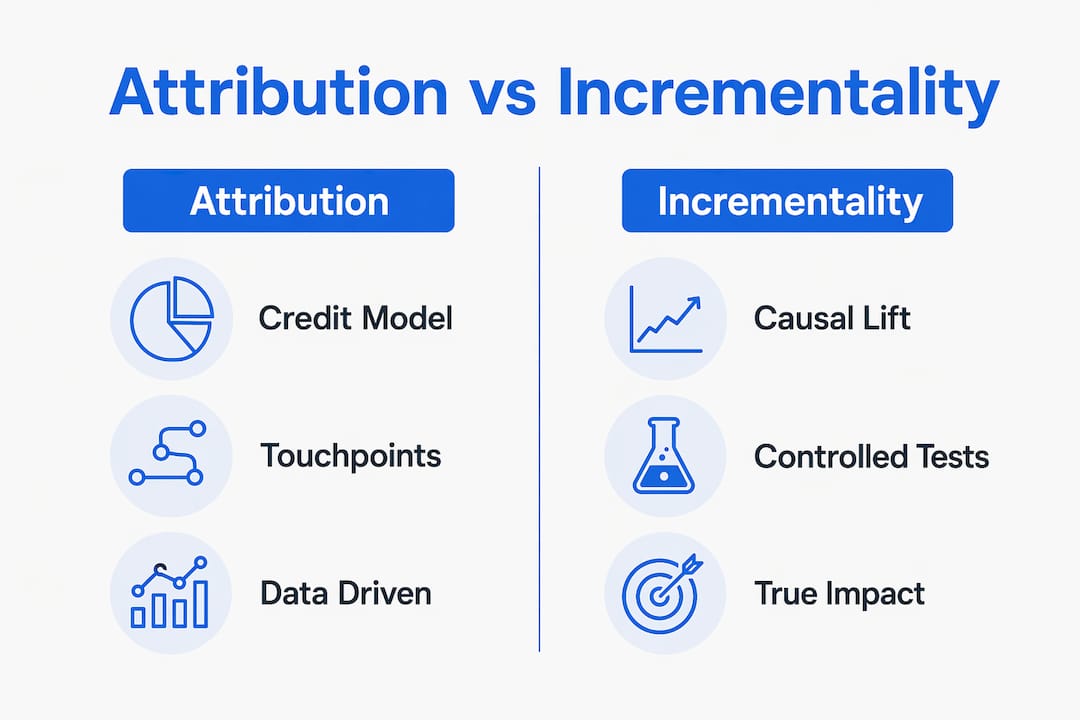
Attribution asks: who gets credit for this conversion that already happened? It's a credit-assignment model. Last-click, first-click, linear, data-driven, they're all just different ways of distributing credit across the touchpoints in a customer's journey.
Incrementality asks: did the ad cause this conversion, or would it have happened anyway? It's a causality question, not a credit question.
Here's why that distinction matters in dollar terms:
- Attribution models count every conversion that touched an ad, including people who were already going to buy.
- Platform-reported ROAS is built on attribution logic, so it almost always overstates your true ad impact.
- Incremental ROAS strips out the organic conversions and shows you only the net new revenue your ads generated.
A quick comparison of where each metric belongs:
| Metric | Best used for |
|---|---|
| Attribution | In-channel optimisation, creative testing, bid strategy |
| Incrementality | Budget allocation, channel mix decisions, CFO reporting |
Pro Tip: Never use platform ROAS to justify budget increases. Use iROAS from a controlled experiment instead. The gap between the two numbers is often the size of your wasted spend.
Attribution and incrementality aren't competitors. You need both. Use attribution modelling to optimise within a channel day to day, and use incrementality to decide how much budget that channel deserves in the first place. Keep the metrics separate and never conflate them in a single report.
Why incrementality measurement is worth the effort
The business case for measuring incremental lift is straightforward: you stop paying for conversions that were going to happen anyway.
Here's what that unlocks in practice:
- Accurate ROI calculations. iROAS gives you a defensible number that reflects net new revenue, not recycled organic demand.
- Smarter budget allocation. When you know which channels are genuinely driving new customers versus just claiming credit for existing intent, you can shift spend toward what's actually working.
- Reduced wasted spend. Channels that look great on platform dashboards often perform far worse in holdout tests. Incrementality testing exposes that gap before it costs you more.
- CFO-ready reporting. Finance teams don't trust marketing dashboards, and honestly, they're right not to. Incrementality results from controlled experiments are the kind of evidence that earns budget approval.
- Future-proofing against signal loss. Privacy changes across iOS, Chrome, and third-party data sources have eroded the reliability of pixel-based attribution. Incrementality testing is the most defensible way to prove marketing drives business outcomes when tracking signals are degraded.
That last point is especially relevant heading into 2026. As marketing analytics becomes harder to rely on through traditional tracking methods, experiment-based measurement fills the gap that cookies and pixels used to cover.
Incrementality also integrates directly with your campaign ROI optimisation process. Once you know your iROAS by channel, you have a clear basis for scaling what works and cutting what doesn't.
Common pitfalls in incrementality testing and how to avoid them
Getting incrementality wrong is worse than not measuring it at all, because bad results lead to confident bad decisions. Here are the mistakes that trip up even experienced marketers.
Non-random control groups
Using "similar" audiences or lookalikes as your control group is the most common error. These groups are pre-selected to resemble your buyers, which means they're already more likely to convert organically. Your lift estimate ends up inflated, and you think your ads are doing more than they are.
Fix it: Randomise at the individual user level. Every person in your addressable audience should have an equal chance of landing in test or control.
Ignoring conversion lag
Cutting an experiment short before the full purchase cycle plays out means you're measuring a fraction of the actual incremental effect. A campaign targeting considered purchases like software subscriptions or high-ticket products needs weeks, not days, of measurement window.
Fix it: Map your typical customer journey length before you design the experiment. Build that duration into your study timeline.
Channel collinearity
When multiple channels run simultaneously, their effects overlap. A customer might see a Facebook ad, a Google search ad, and a YouTube pre-roll in the same week. Attributing lift to any single channel in that environment is genuinely hard.
Fix it: Run channel-specific holdout tests where you pause one channel entirely for the control group, rather than trying to measure all channels at once.
Premature conclusions
Peeking at results before statistical significance is reached and acting on them is a classic mistake. Early data is noisy. A lift that looks strong at day three often disappears by day fourteen.
Fix it: Set your sample size and significance threshold before the experiment starts. Don't touch the results until you hit them.
Treating incrementality as a one-off exercise
Running a single holdout test and calling it done misses the point. Incrementality needs to be integrated into your ongoing measurement framework, not treated as an episodic validation exercise. Markets shift, creative changes, and audiences evolve. Your lift estimates need to keep pace.
Adsdaddy builds incrementality testing into ongoing campaign management across platforms, so clients aren't making budget calls based on data that's six months stale.
Key takeaways
Ad incrementality is the only measurement that tells you what your ads genuinely caused, and in 2026, with tracking signals degrading and budgets under pressure, it's the metric every serious marketer needs in their toolkit.
| Point | Details |
|---|---|
| Incrementality measures true causal lift | It isolates conversions caused by ads, excluding organic sales that would have happened anyway. |
| iROAS is the honest metric | Incremental ROAS equals incremental revenue divided by campaign cost, not platform-reported figures. |
| Randomisation is non-negotiable | Non-random control groups produce biased results that lead directly to bad budget decisions. |
| Attribution and incrementality serve different purposes | Use attribution for in-channel optimisation; use incrementality for budget allocation and CFO reporting. |
| Conversion lag must be built into experiment design | Ending a study too early undercounts incremental conversions and underestimates true lift. |
FAQ
What is ad incrementality in simple terms?
Ad incrementality measures how many conversions your ads actually caused, compared to how many would have happened without them. It separates genuine ad-driven sales from organic demand.
What is the difference between attribution and incrementality?
Attribution assigns credit for conversions that already occurred across touchpoints. Incrementality tests whether those conversions would have happened without the ad at all, making it a causality measure rather than a credit model.
How do you calculate incremental lift?
Subtract the control group's conversion rate from the test group's conversion rate, then divide by the control group's conversion rate. Incremental ROAS is then calculated as incremental revenue divided by campaign cost.
Is incrementality the same as correlation?
No. Correlation shows that two things move together. Incrementality uses controlled experiments to prove that one thing (your ad) caused the other (the conversion), which is a much stronger and more useful claim for budget decisions.
Why does platform ROAS differ from incremental ROAS?
Platform ROAS counts all conversions that touched an ad, including people who would have converted organically. Incremental ROAS counts only the net new conversions your ads caused, making it consistently lower but far more accurate.
Ready to find out what your ads are actually doing? Adsdaddy runs incrementality experiments across Facebook, Google, Instagram, YouTube, and LinkedIn so you can make budget decisions based on real causal data, not platform spin. Book a strategy call and let's find your real numbers.
