30 Day Kill Rules: Social Media Marketing and Advertising for SMEs
. By Ads Daddy.
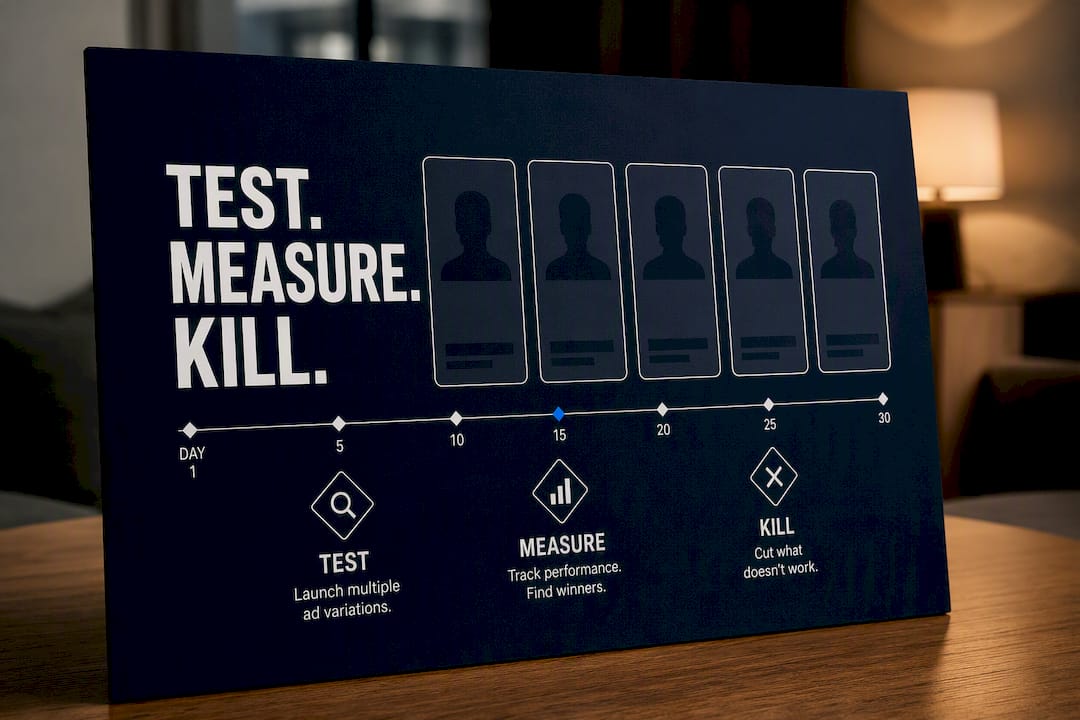
The fastest way to grow on social is to treat organic as your test lab and paid as your amplifier. Post first, watch what your audience actually engages with, then put money behind the winners as short-form vertical video, ideally fronted by a creator. Give every test 30 days and a real budget before you judge it. That's the whole game, minus the excuses.
TL;DR:
- Focusing solely on paid social ads without organic testing increases lead costs and reduces campaign efficiency.
- Short-form vertical videos under 30 seconds are the most effective format, and native content outperforms polished, repurposed videos.
- Spending $5–$20 daily per ad set and allocating $300–$500 per platform for testing over 30 days yields clearer insights and better results.
- Linking your ad platforms to your CRM and tracking conversions accurately is crucial for making data-driven decisions and scaling profitable campaigns.
- Creative testing should prioritize creator-led content and frequent refreshes to avoid ad fatigue and maintain high engagement.
Table of Contents
- What's the difference between social media marketing and advertising?
- Which platform and format should you actually use?
- How much should you spend testing social ads?
- How do you make ad creative that doesn't feel like an ad?
- Which metrics actually prove your ads are working?
- What should you actually do this week?
- What does agency-grade execution actually look like?
- Why the "set and forget" approach to social ads is a myth
- Want this running without lifting a finger?
- Useful sources for going deeper
- FAQ
What's the difference between social media marketing and advertising?
Here's where most business owners get tangled up: they think "social media marketing" and "social media advertising" are the same job wearing different pants. They're not.
Social media marketing is your organic content: the posts, Reels, and captions you publish for free. It builds trust, tests your messaging, and shows you what your audience actually wants before you spend a cent chasing it. Social media advertising is the paid layer sitting on top: the boosted posts, the targeted campaigns, the stuff you pay a platform to shove in front of strangers who've never heard of you.
Run ads without organic groundwork first, and you're basically speed-dating with no idea what you're into. You'll pay more per lead because you're guessing at creative instead of scaling what's already proven to work.
The seven-step loop that actually works
Treat this as a cycle, not a one-off campaign:
- Set a goal. Leads, sales, or brand awareness, pick one per campaign, not all three.
- Define the audience. Who buys, who follows, who comments, they're not always the same people.
- Build content pillars. Three or four themes you can post about without running dry by March.
- Choose your platform. Match the platform to the objective, not your personal preference.
- Test organically first. Publish, watch engagement, let the algorithm do free market research for you.
- Measure the winners. Which posts got saves, shares, comments, not just likes?
- Amplify with paid. Put budget behind the top 10 to 20% of organic performers.
That last step is where most businesses skip a beat. Your best-performing organic post isn't just a nice vanity metric; it's a paid ad candidate with a free performance guarantee attached. High engagement organically usually means lower cost-per-click when you boost it, because the algorithm already knows people like it. Running ads without that organic proof first tends to push your lead costs up, because you're paying to find out what a bit of organic testing would have told you for nothing.
Which platform and format should you actually use?
Stop treating every platform like it's the same audience with a different logo. It's not.
Here's the blunt mapping:
- TikTok and Instagram Reels — best for discovery and direct sales, especially for products with visual appeal.
- LinkedIn — your B2B workhorse, where a slightly more polished, value-led opener performs better than raw hooks.
- YouTube — the upper-funnel and consideration platform, where longer explainer content earns trust before the sell.
Statistic callout: CPMs for small business social ads typically run in the moderate range in 2026, though the exact cost varies with your industry and audience competitiveness. Budget accordingly and don't panic if your first week looks pricier than that; averages smooth out over the test window, not the first three days.
Why short-form vertical video wins almost every time
Short-form vertical video, 9:16 ratio, 15 to 30 seconds, hook in the first two seconds, consistently delivers lower CPMs and higher engagement across every major platform. It's not a trend, it's the format the algorithms are actively rewarding right now.
The mistake most brands make is filming horizontal, polished, brand-safe content and then squeezing it into a vertical frame with black bars. Native beats polished every time on social. If it looks like an ad, the platform treats it like an ad, and the algorithm punishes reach accordingly.
Adapt your creative per placement too. What hooks fast on a TikTok For You feed will feel jarring dropped straight into a LinkedIn feed without adjusting pacing and tone. Our Instagram advertising workflow breaks down how to adapt Reels creative for feed placements without reshooting everything from scratch.
How much should you spend testing social ads?
Small budgets don't mean small results, they mean disciplined testing. Here's the framework:
- Start at $5 to $20 per day, per ad set. Enough to generate real signal, not enough to bankrupt you if it flops.
- Allocate $300 to $500 per platform for your initial test. That's your learning budget, not your scaling budget.
- Run every test for a full 30 days. No cutting it at day 6 because the CTR looked soft, algorithms need time to optimise delivery.
- Define what "actionable data" looks like before you start. That means enough conversions or leads to draw a real conclusion, not two clicks and a shrug.
- Kill the losers, scale the winners. If a test hasn't produced a usable signal by day 30, cut it. Don't fund a dud out of sunk-cost guilt.
Once you find a winner, scale it by increasing budget in increments (roughly 20% every few days) rather than doubling overnight, which tends to reset the algorithm's learning phase and spike your costs again.
Pro Tip: Set your kill criteria in writing before you launch the test. Deciding "we'll cut it if CPA is above $X" while you're emotionally invested in a campaign that "just needs a bit longer" is how businesses burn through Q1 budgets on hope instead of data.
For a deeper breakdown of allocation across funnel stages, our ROI playbook for small business ads walks through the maths.
How do you make ad creative that doesn't feel like an ad?
Here's an uncomfortable truth for anyone still commissioning studio-shot brand videos: UGC and creator-led content typically beats polished production on social, because audiences have developed an internal ad-detector that fires the second something looks too clean.
The fix isn't spending less on creative, it's spending it differently.
- Fund creator collaborations directly from your paid ad budget, not a separate "influencer" line item.
- Whitelist creator handles so their posts can run as paid ads under your targeting, keeping the creator's face and trust signal intact.
- Brief creators on the outcome you want, not the exact script, their audience trusts them because they don't sound scripted.
- Treat every collaboration as a paid media asset from day one, not a one-off favour.
Whitelisting works because it preserves the creator's credibility while giving you the targeting precision of a paid campaign. It's the best of both worlds: their trust, your data. Our guide to social proof in ads digs into why audiences respond so differently to creator endorsement versus brand messaging, and the research on social proof and engagement backs up just how much visibility a well-placed endorsement can generate.
Creative cadence matters as much as creative quality. Run 5 to 10 initial variations per campaign, then refresh every two to three weeks. Ad fatigue is real, and you'll see it coming in the data before your audience even notices, watch for frequency climbing and CTR dropping as your cue to swap creative.
Pro Tip: Don't wait for a creative to completely die before refreshing it. Reactive creative refreshes always cost more than planned ones.
Which metrics actually prove your ads are working?
Match your KPI to your campaign objective, not your ego. Vanity metrics feel good in a Monday meeting; they don't pay rent.
- Awareness campaigns — track CPM and reach. You're buying eyeballs, not conversions, so judge it accordingly.
- Consideration campaigns — track CTR and engagement rate. Are people curious enough to click or comment?
- Conversion campaigns — track CPA, ROAS, and CPL. This is where the business case for your ad spend actually lives.
Statistic callout: platform usage and ad spend data, tracked by sources like Statista, consistently show that audience size and CPM ranges vary sharply by platform and industry, which is exactly why comparing your LinkedIn CPA to your TikTok CPA without adjusting for funnel stage is comparing apples to a completely different fruit bowl.
Before you spend a dollar, get your CRM and a conversion API connected. Without that, you're flying on platform-reported numbers alone, which have a habit of flattering themselves. Connecting ad leads to your CRM also lets you build lookalike audiences from your actual best customers, not just anyone who clicked once. That single move tends to lift ROAS meaningfully because you're targeting people who resemble buyers, not browsers.
Report weekly during a test, monthly once it's scaled, and always compare platforms by outcome (CPA, ROAS) rather than raw cost, since a "cheap" click on one platform that never converts is worse than a "pricier" click that does.
What should you actually do this week?
If you've read this far and still haven't launched a test, here's your no-excuses checklist.
- Pick one objective. Leads, sales, or awareness. One.
- Pull your top 3 to 5 organic posts from the last 90 days by saves, shares, and comments.
- Confirm your tracking is live. Pixel, conversion API, and CRM integration, all connected before spend goes out.
- Set your budget and audience. Start at $5 to $20 per day per ad set, with a 30-day runway.
- Launch 5 to 10 creative variations, weighted toward short-form vertical video and any creator content you can whitelist.
- Set a baseline reporting rhythm. Weekly check-ins, no daily panic-refreshing of the ads dashboard.
- On day 30, make the call. Kill anything without actionable signal, scale anything that hit target CPA or ROAS, and refresh creative regardless.
Our guide on optimising social campaigns for better leads expands on steps 3 and 5 if your tracking setup needs a rebuild.
What does agency-grade execution actually look like?
Some agencies run campaigns across Facebook, Instagram, Google, YouTube, Microsoft Bing, and LinkedIn, covering image, video, carousel, and text formats for small and medium businesses that don't have an in-house media buying team. The work can include integrated lead capture through tools like Klaviyo and newCustomer.io, so leads generated from ad spend don't just sit in a spreadsheet, they flow into a system built to convert them.
Some clients working with digital marketing agencies have reported revenue growth and expanded lead pipelines from campaigns built on similar frameworks: organic validation, disciplined 30-day testing, and creative built for the platform it runs on, not repurposed from a brand deck.
The point isn't that every business needs an agency. It's that the framework above works whether you run it yourself or hand it to a team that runs it daily across dozens of accounts.
Why the "set and forget" approach to social ads is a myth
Most advice on social advertising treats it like a slot machine: put money in, pull the lever, hope for ROAS. That's backwards. The businesses winning in 2026 treat organic content as a research function, not a branding exercise, and paid as a scaling mechanism for things already proven to work.
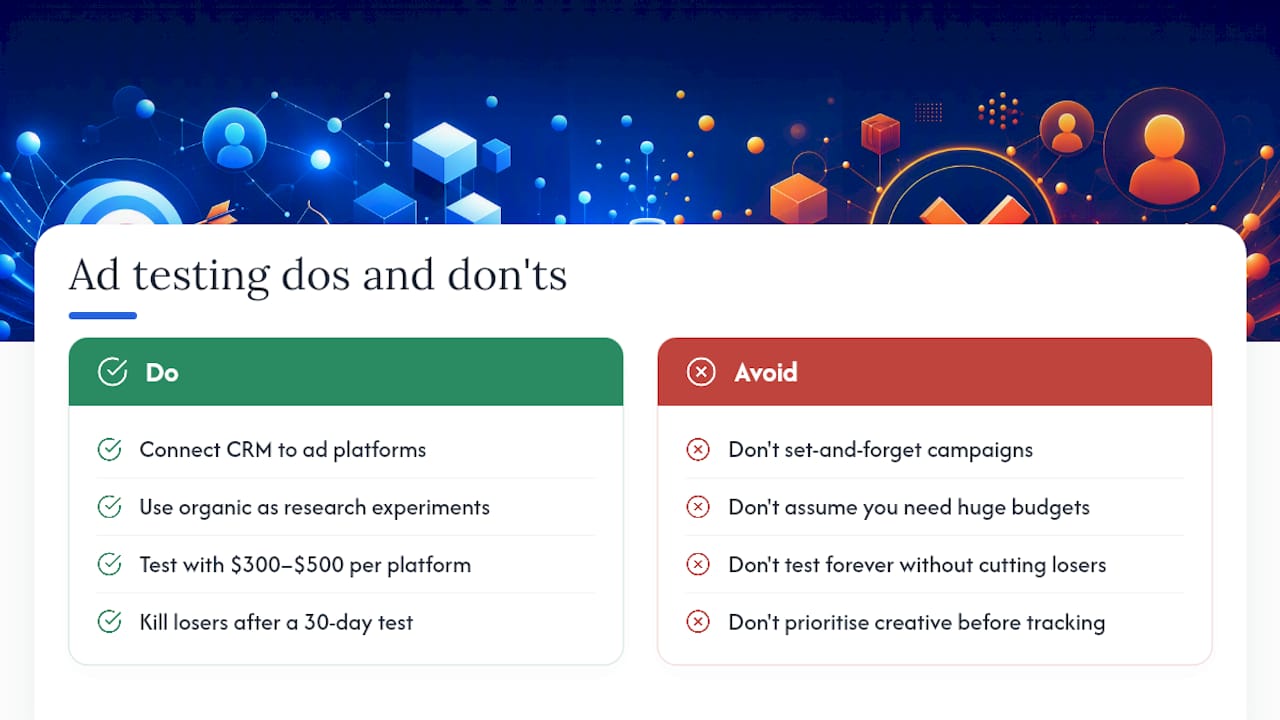
The conventional wisdom that "you need a huge budget to test social ads properly" is largely nonsense for most SMEs. $300 to $500 per platform is enough to get a real signal if you're disciplined about the 30-day window and honest about your kill criteria. The businesses that burn cash aren't the ones testing small, they're the ones testing forever without ever cutting a loser.
What I'd prioritise first, before creative, before budget, before platform choice, is tracking. If your CRM isn't talking to your ad platform, every other decision in this article is built on guesswork dressed up as data. Fix that first. Everything downstream gets easier and cheaper.
— Adrian
Want this running without lifting a finger?
Everything above works. It also takes time most business owners don't have between running the actual business and trying to become a part-time media buyer. Adsdaddy builds and manages campaigns across Facebook, Instagram, Google, YouTube, Microsoft Bing, and LinkedIn, handling the creative testing, the 30-day cycles, and the CRM integration so your leads don't disappear into a black hole.

Two ways to get moving:
- Book a call to walk through your current setup and where the gaps are.
- Request a campaign audit and get a clear read on what's costing you money right now.
Start at the Adsdaddy landing page and see what a done-for-you setup looks like for your industry.
Useful sources for going deeper
- business.gov.au — official guidance on using social media for business, including promotion rules.
- The ACCC — compliance guidance for advertising and sponsored content.
- Statista — platform usage, audience demographics, and ad spend benchmarks.
- Our 2026 social advertising guide for a deeper breakdown of budgets and funnels.
FAQ
Are social media marketing and advertising the same thing?
No. Social media marketing is organic content you post for free; social media advertising is paid campaigns you run to amplify proven content or reach new audiences with targeting.
What is the 5:5:5 rule for social media?
It's a content-mix guideline suggesting you engage with 5 posts, comment meaningfully on 5 accounts, and share or create 5 pieces of content daily to stay consistently active without burning out on production.
What is the 3:3:3 rule in marketing?
Definitions vary across marketers, but a common version suggests spending no more than 3 minutes deciding on a post, testing across 3 formats, and reviewing performance within 3 days to keep content cycles fast and iterative.
What are the 7 types of social media?
Common categories include social networking (Facebook), photo/video sharing (Instagram, TikTok), professional networking (LinkedIn), video hosting (YouTube), messaging apps, discussion forums (Reddit), and community/review platforms.
How do I know if my paid social campaign is actually working?
Match your KPI to your objective: track CPM for awareness, CTR for consideration, and CPA or ROAS for conversion campaigns, and always give a test the full 30-day window before judging it.