Social media ad management: what SMBs actually get for their money
. By Ads Daddy.

Managed social media ad management gets you predictable leads or sales without you having to become a full time media buyer. That's it. That's the whole promise.
You hand over the budget and the brief. A team runs campaigns across Meta Ads, Google Ads, YouTube, LinkedIn, and Microsoft Advertising, testing creative and audiences until the numbers behave. Adsdaddy does exactly this for small and medium businesses that don't have three months to learn Ads Manager the hard way.
Two types of business owner get the most out of it:
- The "I tried it myself and torched $2,000" owner. You boosted a post, prayed, and got nothing but likes from your mum's friends.
- The "I'm too busy running the business to run ads" owner. You know ads work. You just don't have eight hours a week to babysit them.
Here's the reason this matters right now: platforms reward advertisers who can operate across channels, not just one. An agency running Meta, Google, YouTube, LinkedIn, and Bing in parallel can shift budget to whatever's converting that week. A solo operator stuck on one platform can't.
Ready to stop guessing? Book a free audit with Adsdaddy and find out exactly where your ad dollars should be going.
Key Takeaways
Managed social media ad management works when audience intent, creative testing, and weekly optimisation are treated as one connected system, not separate tasks.
| Point | Details |
|---|---|
| Match creative to platform intent | Meta suits broad testing, LinkedIn suits B2B decision-makers, YouTube builds awareness with video. |
| Start budget small | Test with US$5–20 per day per platform before committing to bigger spend. |
| Give it 4–8 weeks minimum | Early data before this window rarely reflects true campaign performance. |
| Track the right KPI per goal | Use CPM for awareness, CTR/CPC for traffic, CPA/ROAS for leads and sales. |
| Adsdaddy runs it as one system | Manages Meta, Google, YouTube, LinkedIn, and Microsoft Advertising under one team with weekly optimisation. |
Authoritative sources and further reading
- Facebook Ads Manager — official platform tool documentation.
- Smartly's automated campaign management — cross-platform automation reference.
- Adsdaddy's guide to campaign analytics — reporting and performance tracking.
Table of Contents
- What do you get when you hire a managed social ad team?
- Where should you spend your budget? Platform strengths explained
- How does Adsdaddy build campaigns that actually scale?
- What KPIs matter and how often should you get reports?
- How much does it cost and when will you see results?
- How does managed campaign setup actually work day to day?
- Why trust Adsdaddy with your ad spend?
- Book a call or get a free audit with Adsdaddy
- FAQ
What do you get when you hire a managed social ad team?
Think of it like hiring a personal trainer instead of guessing your way through the gym. You could figure it out. You'll just waste a lot of reps first.
Here's what's actually included in proper managed social media ad management:
- Campaign setup — objective mapping (leads vs sales vs awareness), plus tracking and conversion event setup so you're measuring the right thing from day one.
- Creative production — a brief goes in, and image, video, and carousel variants come out, built specifically for testing, not just for looking pretty.
- Audience building — first-party data (your existing customers), lookalike audiences built from them, and intent-based segments layered on top.
- Account management — daily and weekly optimisation, budget control, and someone actually watching the dashboard instead of checking it once a month.
- Compliance and governance — keeping your ad account in line with platform policies so you don't get randomly shut down mid-campaign.
Pro Tip: Ask any provider exactly who touches your account week to week. "A team" is not an answer. You want a name and a cadence.
That's the difference between "running ads" and ad campaign management that actually compounds over time.
Where should you spend your budget? Platform strengths explained
Not every platform wants the same thing from you. Treat them like different dates. Same charm, different approach.
- Meta (Facebook and Instagram): the best sandbox for creative testing. Broad reach, cheap data, and Meta's Ads Manager runs placements across Facebook, Instagram, Messenger, and WhatsApp from one dashboard.
- LinkedIn: built for B2B intent. Slower and pricier per click, but the audience is there to make decisions, not scroll mindlessly.
- YouTube: video reach at scale, brilliant for building awareness with people who skip static ads entirely.
- Google Search: high-intent discovery. Someone typing "book social media agency near me" is basically raising their hand.
- Microsoft Advertising (Bing): the quiet achiever. Smaller audience, less competition, often cheaper conversions as a search complement to Google.
Format matters as much as platform. Image ads test fast and cheap. Video builds trust before someone's ready to buy. Carousels work when you've got a product range to show off. The mistake most businesses make is running one creative everywhere, then wondering why it flops on LinkedIn but crushes on Instagram. A LinkedIn user is in "professional research mode." An Instagram user is in "kill five minutes on the couch mode." Same offer, completely different pitch required.
How does Adsdaddy build campaigns that actually scale?
Here's the process, stripped of jargon.
- Map the audience by temperature. Cold audiences don't know you exist yet. Warm audiences have engaged with your content or site. Hot audiences have added to cart or booked a call. Each gets a different message, not the same ad blasted at everyone.
- Build campaign architecture around funnel stage. Awareness campaigns feed traffic and engagement campaigns, which feed conversion campaigns. Skip a stage and you're asking a stranger to marry you on the first date.
- Run a structured creative testing plan. Start with your best organic post performance. Content that already got engagement organically tends to convert better as paid too. Test one variable at a time, hooks first, then offers, then formats.
- Set up measurement properly. Pixels, server-side event tracking, and consistent UTM naming conventions so every dollar can be traced back to a result, not just vibes.
- Put governance in place. Budget guardrails, pause rules when cost-per-result blows out, and an approval workflow before anything major changes.
Pro Tip: If a provider can't tell you their pause rule (the cost-per-result threshold that triggers a review), they don't have one. That's how budgets quietly bleed out over a long weekend.
This audience-first approach beats "post and pray" because it treats each platform as a different behavioural stage, not a copy-paste job. Automated rules engines exist to handle a lot of this mechanically, and tools like Wevion's multi-platform ads management show how automation can scale cross-account rules fast. But automation without human judgement on creative and audience nuance is like autopilot without a pilot. It's fine until it isn't.

What KPIs matter and how often should you get reports?
Different goals need different scoreboards. If you're judging a lead-gen campaign by likes, you're reading the wrong stat entirely.
- Awareness campaigns: watch CPM (cost per thousand impressions) and reach.
- Traffic campaigns: watch CTR (click-through rate) and CPC (cost per click).
- Lead or sales campaigns: watch CPA (cost per acquisition) and ROAS (return on ad spend).
Weekly optimisation isn't optional. It's the whole job. That means checking frequency (are the same people seeing your ad too often?), pausing underperforming ad sets, and reallocating budget toward winners.
A/B testing runs on a lifecycle: launch two or three variants with equal budget, let them gather enough data to be meaningful (not two days, not two clicks), then kill the loser and scale the winner. Rinse and repeat.
A practical starting budget for testing is typically set in a modest range per day per platform, which is enough to generate real data before you commit serious spend to scaling. That's the number that separates "informed decision" from "expensive guess."
Reporting should land weekly at minimum, with a deeper monthly review covering trend direction, not just snapshot numbers. If your current setup only shows you a dashboard you don't understand, that's not reporting — that's decoration. Adsdaddy's approach to improving ad performance leans on exactly this cadence: weekly action, monthly strategy.
How much does it cost and when will you see results?
Straight answer: budget a modest daily amount per platform while testing, and expect to spend several weeks minimum before the data means anything. Anyone promising overnight miracles is selling you a fairy tale, not a campaign.
Common pricing models you'll encounter:
- Flat monthly retainer — fixed management fee, ad spend on top.
- Percentage of ad spend — management fee scales with what you're spending.
- Project-based setup fee plus ongoing optimisation cost.
Onboarding typically runs one to two weeks: brief, account audit, tracking setup, and creative brief before the first ad goes live. That's not slow. That's the difference between launching properly and launching blind.
How does managed campaign setup actually work day to day?
This is the part most business owners never see, and it's where the value actually lives.
Setup starts with objective mapping. Are you chasing leads, sales, or brand awareness? That single decision changes the entire campaign structure underneath it, from bidding strategy to which platform gets priority budget.
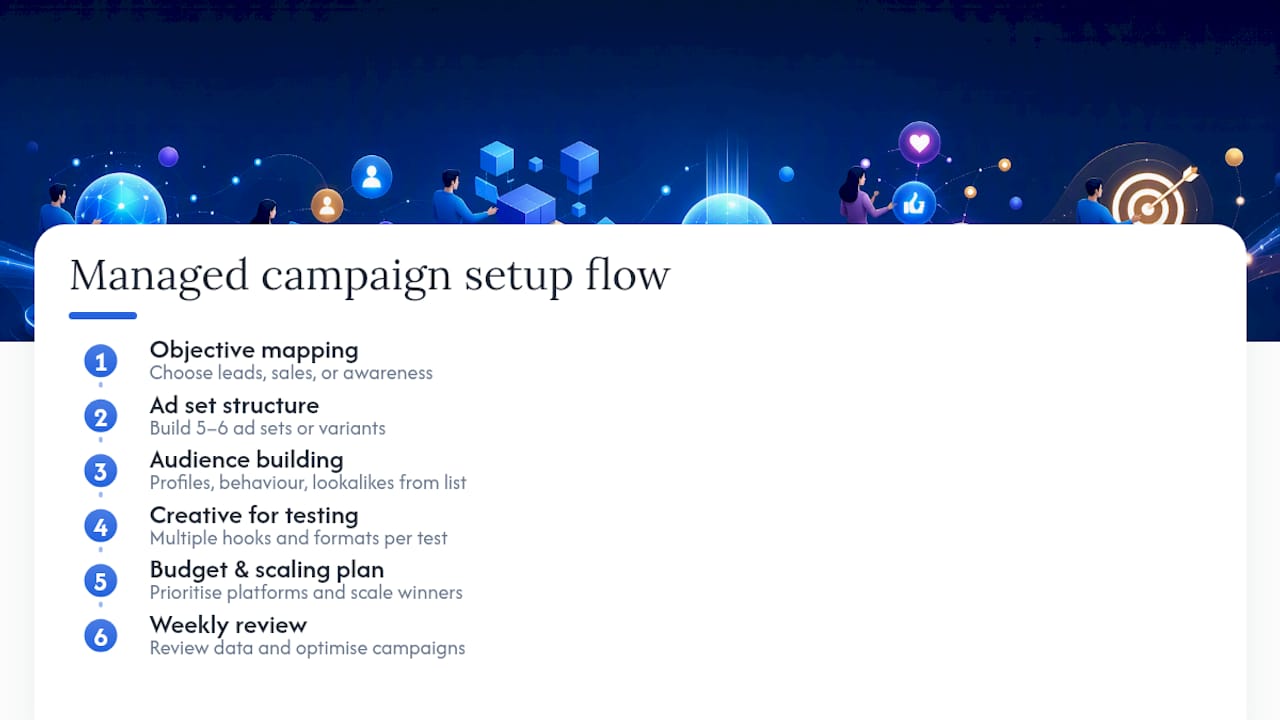
Ad sets get built around specific audience segments, not one giant blob targeting "everyone in Australia aged 25 to 54." A well-built account might run five or six ad sets testing different audiences against the same creative, or the reverse: one audience against several creative variants. This is how you find out what's actually working instead of guessing.
Targeting draws on profile data, behavioural signals like page follows and engagement history, and lookalike modelling from your existing customer list. Platforms are genuinely good at finding people who resemble your best customers. The job is feeding them clean data to work from.
Creative gets built for testing, not just for looking good on a moodboard. That means multiple hooks, multiple formats, and a clear plan for which variant gets scaled once the data comes in. Ongoing management means someone reviewing this weekly. Learn more about optimising campaign ads for better leads to see what that weekly rhythm actually looks like in practice.

Why trust Adsdaddy with your ad spend?
This section is written from Adrian's perspective as an editorial contributor to Adsdaddy.
Multi-platform expertise isn't a slogan here. It's the operating model. Running Meta, Google, YouTube, LinkedIn, and Microsoft Advertising from one team means budget moves to whatever's working, not whatever the account manager happens to know best.
Client results back this up. The services outlined above, from audience mapping to weekly optimisation, aren't theory. They're the exact process behind those results.
Book a call or get a free audit with Adsdaddy
Adsdaddy is the alternative to hiring a full-time media buyer or muddling through Ads Manager solo: one team, five platforms, no separate contracts to juggle. Instead of piecing together a Meta specialist here and a Google contractor there, you get campaign setup, creative, targeting, and reporting under one roof.

Booking a call starts with a free audit of your current ads (or your market, if you're starting from zero), followed by a brief and an onboarding call to map objectives before anything goes live. No guessing which platform to try first. No cobbling together freelancers.
Head to Adsdaddy's homepage and book that audit. Worst case, you get clarity on your ad account for free. Best case, it's the campaign that finally pays for itself.
FAQ
What is the 5-3-1 rule on social media?
It's a content-mix rule of thumb: for every nine posts, five should be from others (curated), three should be original content you created, and one should be promotional. It applies more to organic posting than paid ad management, though the underlying idea, don't make every post a sales pitch, still applies to ad creative variety.
Is $10 a day enough for Facebook ads?
Yes, as a starting test budget. A practical range for testing is US$5 to US$20 per day per platform, enough to gather meaningful data before scaling spend toward what's actually converting.
What is the 5-5-5 rule for social media?
Definitions vary across marketers, but a common version suggests spending 5 minutes engaging with others' content, 5 minutes responding to your own comments, and 5 minutes reviewing performance data daily. It's an organic engagement habit, not a paid ad framework.
What is the 5-3-2 rule on Instagram?
This is another content-ratio guideline: five posts that entertain or educate, three that build engagement or community, and two that promote your product or service directly. Like the 5-3-1 rule, it's about balance so your feed doesn't read like a constant sales pitch.
How long before I see results from managed ad campaigns?
Give it 4 to 8 weeks minimum. That's the window needed to gather enough data across creative and audience tests to make confident scaling decisions, rather than reacting to early noise.