Role of ad feedback loops: your 2026 campaign guide
. By Ads Daddy.

TL;DR:
- Ad feedback loops connect audience signals directly to ad algorithms, shaping delivery and costs in real time. Managing negative comments and early engagement signals improves ad relevance, lowers CPMs, and boosts return on ad spend. Regular review and audience exploration prevent algorithmic bias and creative fatigue, enhancing overall campaign performance.
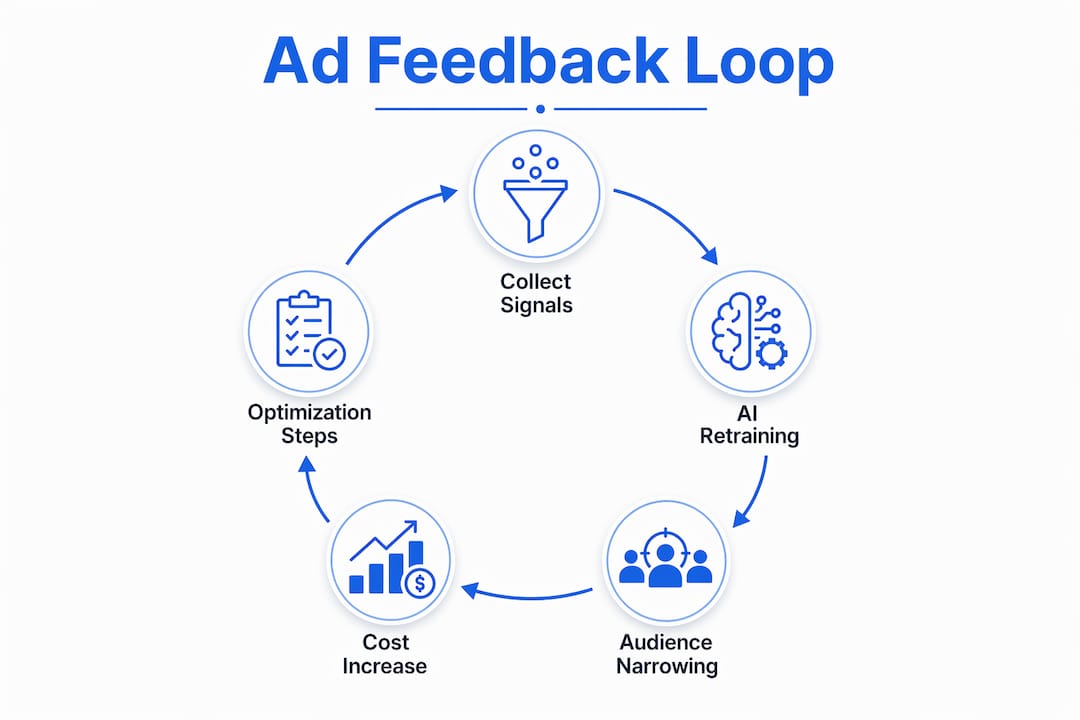
Ad feedback loops are iterative systems that connect audience behaviour signals directly to algorithmic ad delivery, reshaping reach, cost, and conversion in real time. Every comment, reaction, dwell time, and "Not Interested" click feeds the platform's AI, which then decides who sees your ad next and at what cost. Ignore these signals and your CPMs climb, your relevance scores tank, and your budget bleeds quietly. The role of ad feedback loops is not a background process. It is the engine running your entire campaign. Adsdaddy builds every client strategy around this reality, and the results speak for themselves.
How do ad feedback loops work in ad delivery algorithms?
Ad feedback loops function by collecting user response signals and feeding them back into the platform's AI to retrain delivery decisions. Meta's Reels recommendation system is a clear example. It uses dwell time and "Not Interested" clicks as key training signals, meaning every viewer interaction either rewards or penalises your ad's future reach.
The signals split into two categories: explicit and implicit.
Explicit signals include:
- Comments, reactions, and shares
- "Not Interested" and "Hide Ad" clicks
- Direct messages triggered by an ad
Implicit signals include:
- Dwell time on video or static creative
- Scroll speed past the ad
- Click-through behaviour after viewing
The first three seconds of a video ad carry disproportionate weight. High abandonment within the first 3 seconds flags the ad as low relevance, cutting delivery and raising CPM. That is why your hook is not just a creative choice. It is an algorithmic one.
When negative signals accumulate, the algorithm narrows your audience and increases your cost per thousand impressions. Ads with higher engagement on comments and reactions achieve 20–50% lower CPM due to better algorithmic quality scores. That gap is not trivial. It is the difference between a profitable campaign and one that quietly drains your budget.
Pro Tip: Set a frequency cap early in any new campaign. Overexposure accelerates negative feedback signals, which trains the algorithm to restrict your delivery before you have gathered enough data to optimise.
Advertising feedback mechanisms also include ad relevance diagnostics, which Meta breaks into quality ranking, engagement rate ranking, and conversion rate ranking. A poor score in any one of these feeds back into the loop and compounds over time. Understanding this is the first step toward improving ad performance before costs spiral.
What is the impact of managing ad feedback on campaign performance?
Active comment management is one of the highest-ROI activities a marketer can do. 30% of all comments under brand ads are negative, and unmanaged negative comments increase CPMs by 30–40%. That is not a social media problem. That is a budget problem.
The good news is that the fix is measurable. Active comment management increases ROAS by up to 109% and reduces cost per action by 26%. Those numbers come from real campaign data, and they reflect a simple truth: the comment section is part of your ad creative.
Here is how to handle different comment types:
- Reply publicly to genuine questions, complaints, and purchase-intent comments. Speed matters. Campaigns that respond to purchase-intent comments see an 11% conversion rate boost and a 26% drop in cost per action.
- Hide strategically for spam, trolls, and off-topic negativity. Active hiding of spam and troll comments can increase conversion rates by up to 34% without public backlash. Hiding keeps the comment visible to the author but invisible to everyone else.
- Block and report for hate speech, competitor sabotage, or policy violations.
The trust argument is equally compelling. 80% of consumers trust brands more when they respond to criticism. A replied complaint increases willingness to recommend by 25%. That is social proof working in your favour, not against you.
| Comment type | Recommended action | Expected outcome |
|---|---|---|
| Genuine complaint | Public reply within 1 hour | Trust increase, conversion lift |
| Purchase-intent question | Public reply with CTA | 11% conversion rate boost |
| Spam or troll | Hide (not delete) | Up to 34% conversion rate increase |
| Hate speech or policy breach | Block and report | Protects ad quality score |
Pro Tip: Assign a team member to monitor comments during the first 48 hours of any new ad launch. The algorithm weighs early engagement signals most heavily, so fast responses compound your quality score gains.
Transparency in the comment section also feeds the broader advertising feedback mechanism. When potential buyers see real questions answered professionally, the ad's social proof grows organically. This is a core part of ad creative strategy that most marketers overlook entirely.
How can marketers prevent algorithmic bias and feedback loop traps?
Feedback loops can work against you just as powerfully as they work for you. AI optimisation systems drift toward narrow outcomes by reinforcing their own past choices rather than learning from unbiased data. This is called positive feedback loop bias, and it causes audience narrowing and creative fatigue.

The mechanism is straightforward. The algorithm shows your ad to people who engage. It then shows it to more people like them. Over time, your audience shrinks to a thin slice of your potential market, CPMs rise, and performance plateaus. You did not change anything. The loop did.
The solution is an exploration policy. This means deliberately allocating a portion of your budget or traffic to audiences and creatives the algorithm has not yet tested. A B2B client that reduced topic category concentration from 73% to 51% via an exploration policy increased engagement per session by 8%. The process involved allocating 15% of traffic to non-recommended content and retraining the algorithm over three months.
Audience seeding is the other critical lever. Poor initial audience seeds create bad hypotheses that worsen feedback loops over time, requiring full audience rebuilds. Starting with a well-defined seed audience, such as a customer list or high-intent lookalike, gives the algorithm accurate data to learn from from day one.
Pro Tip: If a campaign has been running for more than six weeks and CPMs are climbing without a change in creative, reset the audience seed entirely. Do not pause and resume. Create a new ad set with a fresh audience signal.
Feedback loops differ fundamentally from A/B testing. A/B tests seek a single winner and stop. Feedback loops continually generate new hypotheses and refine learning over time. The implication is that marketers who treat campaigns as static experiments will always underperform those who treat them as living systems. You can read more about content engagement using feedback loops to see how this principle applies across channels.
How to use customer feedback to sharpen ad creative
Customer feedback is raw material for better ads. Reviews, support tickets, and social media comments contain the exact language your audience uses to describe their problems, desires, and objections. Aligning feedback with funnel stages enables tailored messaging that improves click-through rates, conversion rates, and engagement.
The process works in four steps:
- Collect feedback by channel. Pull one-star reviews, support ticket themes, and ad comment threads into a single document. Look for recurring phrases, not individual opinions.
- Map feedback to funnel stage. Awareness-stage feedback reveals how people describe their problem. Consideration-stage feedback reveals what objections block purchase. Conversion-stage feedback reveals what finally tipped the decision.
- Apply a creative framework. The Problem-Agitation-Solution structure works well for cold audiences. Use the exact words customers use to describe the problem in your ad headline. This is not copywriting theory. It is mirroring, and it converts.
- Test and measure. Run the feedback-informed creative against your control. Track CTR, cost per lead, and conversion rate. Feed those results back into the loop.
The role of data in advertising feedback is most visible at this stage. When you replace assumed messaging with language pulled directly from customer reviews, the ad feels personal. That perception drives engagement, which feeds the algorithm, which lowers your CPM. The whole system tightens. For a practical walkthrough of this process, the ad creatives optimisation guide from Adsdaddy covers the mechanics in detail.
Key takeaways
Ad feedback loops are the most underused performance lever in digital advertising, and managing them actively is the fastest path to lower CPMs and higher ROAS.
| Point | Details |
|---|---|
| Feedback signals drive delivery | Dwell time, comments, and "Not Interested" clicks directly control algorithmic reach and CPM. |
| Comment management lifts ROAS | Active replies and strategic hiding can increase ROAS by up to 109% and cut cost per action by 26%. |
| Exploration prevents bias | Allocating 15% of traffic to untested audiences counters algorithmic narrowing and creative fatigue. |
| Customer language sharpens creative | Mapping review language to funnel stages produces ad copy that converts because it mirrors real buyer thinking. |
| Feedback loops outlast A/B tests | Unlike static split tests, feedback loops continuously refine hypotheses and improve campaign performance over time. |
Why I think most marketers are sleeping on feedback loop management
Most marketers treat the comment section like a footnote. They check it occasionally, delete the obvious spam, and move on. That is a costly mistake, and I have seen it burn through budgets that should have been profitable.
The uncomfortable truth is that feedback loop management is not a social media task. It is a media buying task. When you ignore a flood of "Not Interested" clicks or leave a troll comment sitting under your ad for 72 hours, you are actively training the algorithm to deliver your ad to worse audiences at higher cost. The platform does not care about your intentions. It reads the signals.
What I have found actually works is treating the first 48 hours of any campaign launch like a live event. Someone is watching the comment section, responding fast, and hiding the noise. That window is when the algorithm is most receptive to positive signals, and the compounding effect on quality scores is real.
The other thing worth saying plainly: feedback loops are not a set-and-forget system. The AI drifts. Audiences narrow. Creative gets stale. The marketers who win in 2026 are the ones who build proactive review cycles into their workflow, not the ones who check in when performance drops. Monitoring ad performance continuously is not optional. It is the job.
— Adrian
How Adsdaddy puts feedback loops to work for your campaigns
Knowing how feedback loops work is one thing. Having a team that manages them daily is another.

Adsdaddy builds and manages ad campaigns across Facebook, Instagram, Google, YouTube, LinkedIn, and Microsoft Bing with feedback management baked into every workflow. That means active comment monitoring, creative refresh cycles timed to algorithmic signals, and audience seed rebuilds before performance plateaus. The team uses real customer feedback from reviews and support data to write ad copy that mirrors buyer language at every funnel stage. If your campaigns are leaking budget through unmanaged feedback signals, the Adsdaddy digital marketing solutions page is the right next step. Book a consultation and get a campaign audit built around your actual data.
FAQ
What are ad feedback loops in digital advertising?
Ad feedback loops are systems where audience behaviour signals, such as comments, dwell time, and "Not Interested" clicks, feed back into the platform's AI to adjust ad delivery, relevance scores, and CPM in real time.
How does negative feedback affect my ad costs?
Unmanaged negative comments and high early video drop-offs signal low relevance to the algorithm. This reduces delivery and raises CPMs by 30–40%, directly increasing your cost per result.
What is the benefit of hiding comments instead of deleting them?
Hiding keeps the comment visible to the author but removes it from public view, preserving your ad's quality score. Active hiding of spam and troll comments can increase conversion rates by up to 34%.
How do feedback loops differ from A/B testing?
A/B tests find a single winner and stop. Feedback loops continuously generate new hypotheses and refine campaign learning over time, making them a more adaptive and durable performance tool.
How can I stop my ad audience from narrowing over time?
Use an exploration policy by allocating a portion of your budget, around 15%, to audiences the algorithm has not yet tested. Rebuilding your audience seed every six to eight weeks also prevents the algorithm from reinforcing a shrinking target group.