What Is ROI in Marketing and Why It Matters
. By Ads Daddy.
Pouring money into Facebook or Google campaigns without knowing the real return is a common pain point for many Australian e-commerce businesses. Understanding what ROI actually means is more than a number on a dashboard—it guides your decisions, helps you allocate budget smartly, and keeps your business growing in a competitive space. This guide explains how measuring metrics such as conversions, traffic, and sales relative to spend turns every campaign into a tool for profit rather than just a marketing expense.
Table of Contents
- What ROI Means in Digital Marketing
- Types of ROI: Campaigns, Channels, Lifetime Value
- How to Calculate Marketing ROI Effectively
- Common ROI Challenges for Aussie SMBs
- Maximising ROI Across Facebook and Google Ads
Key Takeaways
| Point | Details |
|---|---|
| Understanding ROI is Essential | Accurately calculating ROI helps e-commerce businesses identify which digital marketing channels yield the best returns. It requires clear definitions and proper tracking setups. |
| Multiple ROI Types Offer Insights | Focusing solely on campaign ROI can obscure long-term profitability. Evaluating channel efficiency and customer lifetime value is crucial for strategic budget allocation. |
| Daily Monitoring Improves Outcomes | Regularly tracking ROI across campaigns allows businesses to quickly adjust strategies and reduce wasted ad spend. Real-time data is key to identifying successful and underperforming campaigns. |
| Combine Insights from Different Channels | Using Facebook and Google Ads together can enhance campaigns, with Facebook driving awareness and Google capturing demand. Adjusting budgets based on performance is essential for optimal ROI. |
What ROI Means in Digital Marketing
ROI in digital marketing is straightforward but often misunderstood. It's the financial return you generate from every dollar spent on digital campaigns. Unlike traditional marketing where measurement is fuzzy, digital ROI is precise. You invest money into Facebook ads, Google search campaigns, or email marketing, then track exactly how much revenue those channels produce. The calculation is simple: (Revenue from Campaign minus Campaign Cost) divided by Campaign Cost, then multiplied by 100 to get a percentage. But here's the thing—most e-commerce businesses in Australia aren't actually calculating this properly. They're either guessing, using incomplete data, or comparing numbers that don't align with their actual business goals.
When you're running campaigns across multiple digital channels, ROI becomes your compass. It tells you which platforms deserve your budget and which ones are draining cash with minimal return. Calculating financial return from online marketing activities is critical to justify budgets in competitive Australian markets. For instance, if you spend £500 on Facebook ads and generate £2,000 in sales, your ROI is 300%. That's excellent. But if you're spending £500 and only getting £600 back, you're barely breaking even—and your campaigns need serious optimisation. The challenge is that ROI measurement depends entirely on tracking. You need proper conversion pixels set up, sales data connected to your ad account, and a clear understanding of what counts as a "conversion" for your business. Is it a purchase? A lead form? A phone call? Different businesses measure differently, which is why clarity upfront matters so much.
What makes ROI crucial for e-commerce owners is that it separates emotion from strategy. You might love how your brand looks in an Instagram ad, but if the ROI is negative, it doesn't matter. ROI forces you to make data-driven decisions. When you measure metrics such as conversions, traffic, and sales relative to spend, you're not just tracking numbers—you're building a system. You discover which audience segments convert best, which ad creative resonates, which times of day drive sales. Over time, this data becomes your competitive advantage. Small teams using solid ROI tracking often outmanoeuvre larger competitors who haven't bothered to set up proper measurement. The other critical insight is that ROI isn't static. It changes as campaigns run, as seasons shift, and as your audience evolves. That's why tracking it constantly, not just at campaign launch, matters. Your job is to continuously monitor performance, identify what's working, then double down on it whilst cutting what isn't.
Pro tip: Set up conversion tracking in Google Analytics and your ad platform (Facebook Ads Manager or Google Ads) before launching any campaign—not after. If you start blind, you'll waste weeks trying to retrofit data and won't have a clear baseline for ROI comparison.
Types of ROI: Campaigns, Channels, Lifetime Value
Not all ROI is created equal. Most e-commerce owners focus on campaign ROI—the immediate return from a specific ad campaign over a set timeframe. This is the easiest number to calculate and the most visible. You run a campaign for 30 days, spend £2,000, and see £8,000 in revenue. Campaign ROI is 300%. Done. But this approach misses the bigger picture. Campaign ROI only shows what happened right now, not what's building for tomorrow. The real sophistication comes when you start measuring three distinct types of ROI: campaign-level performance, channel efficiency, and customer lifetime value. Each tells a different story, and each requires different tracking methods. If you're only looking at campaign ROI, you're flying blind to the other two.

Channel ROI is where things get interesting. This measures how efficiently each marketing platform performs across all campaigns combined. Facebook might generate 250% ROI, Google Search might hit 400% ROI, and LinkedIn might sit at only 150% ROI. When you're running campaigns across multiple platforms, understanding channel performance tells you where to allocate your next pound. Channel ROI reveals patterns campaign-level data can't show. Maybe Facebook underperforms overall, but performs exceptionally well with a specific audience segment. Maybe Google Search dominates in Q4 but struggles in Q2. This is where measuring ROI across media types becomes critical for Australian marketers. Channel efficiency changes with seasonality, market competition, and audience saturation. Some channels are investment plays for brand awareness with lower immediate ROI but higher long-term value. Others are cash cows delivering immediate conversions. Knowing which is which changes your entire budget strategy.
Then there's customer lifetime value (CLV) ROI, which most Australian e-commerce businesses ignore until they realise their mistake. This measures the total revenue a customer generates from their first purchase through to their last interaction with your brand. A customer acquired through an ad that costs £50 might have a CLV of £400 over two years because they buy repeatedly, refer friends, and engage with your loyalty programme. That's an 8x return, not the 2x return you thought when counting only the first purchase. Long-term impacts through customer retention and sustained revenue fundamentally change which campaigns are actually profitable. An ad channel that looks mediocre on campaign ROI can become your best performer when you account for CLV. The challenge is that CLV takes time to measure—you need months of data to see patterns. But this is exactly why building CLV tracking early matters so much. Your competitors who skip this analysis are leaving money on the table by cutting successful channels too early or overinvesting in acquisition channels that have poor retention.
The practical reality is that you need to track all three simultaneously. Campaign ROI keeps you accountable week to week. Channel ROI guides strategic budget allocation. CLV ROI reveals which channels build real business value. If you're optimising for only one, you'll make poor decisions that feel right in the moment but hurt your business long-term.
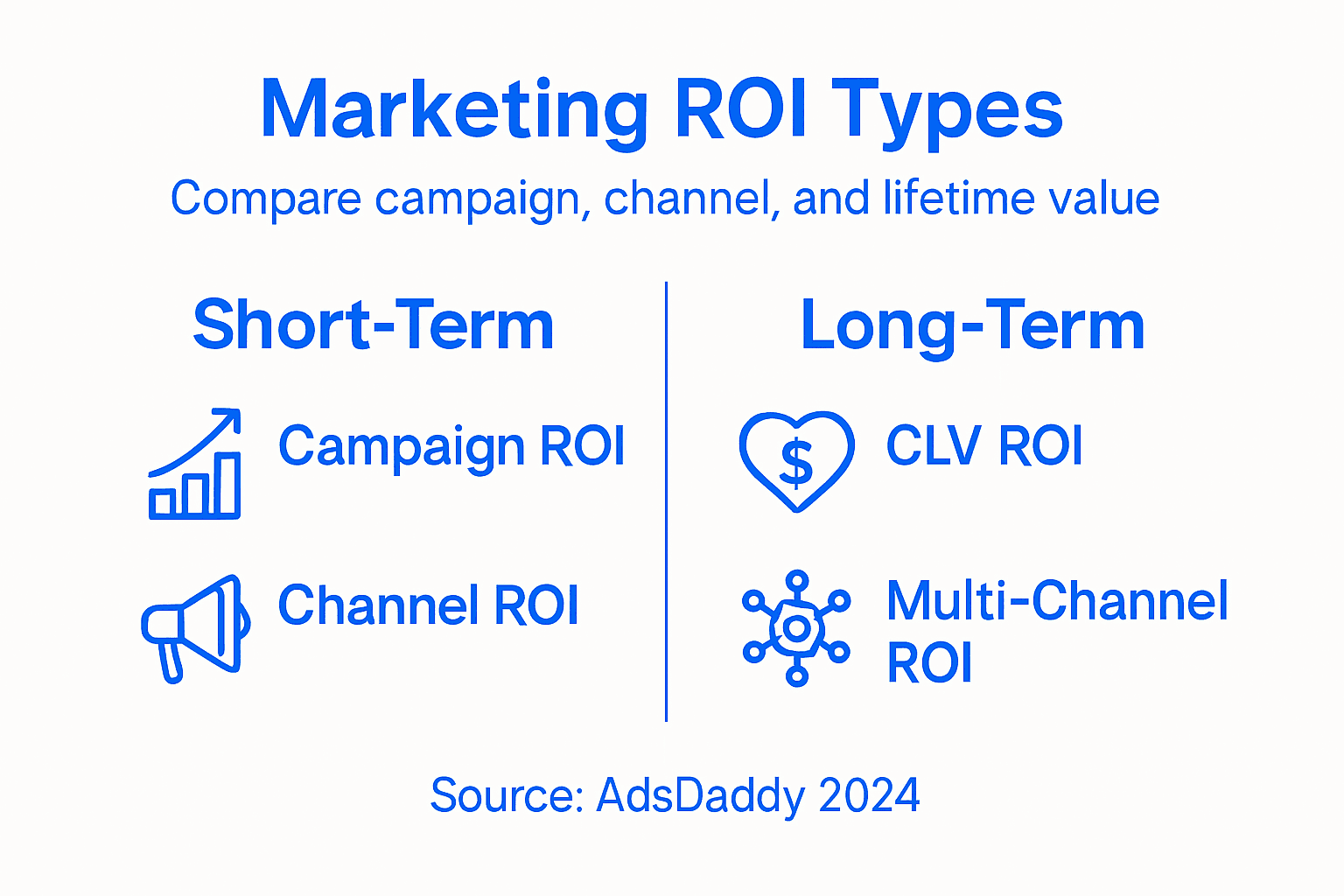
Here's a comparison of the three main types of ROI in digital marketing and how each benefits Australian businesses:
| ROI Type | What It Measures | Key Benefit for Business | Ideal Use Case |
|---|---|---|---|
| Campaign ROI | Return on a specific ad campaign | Tracks short-term performance | Evaluating new offers |
| Channel ROI | Efficiency of each marketing channel | Optimises budget across platforms | Choosing high-performing platforms |
| Customer Lifetime Value ROI | Total revenue per acquired customer | Reveals long-term business value | Deciding on retention strategies |
Pro tip: Build a simple spreadsheet tracking campaign ROI, channel ROI, and estimated CLV alongside each other—update it weekly, not monthly, so you catch underperformers before they waste significant budget.
How to Calculate Marketing ROI Effectively
Calculating ROI sounds simple until you actually try to do it. The formula itself is straightforward: (Revenue from Campaign minus Total Campaign Cost) divided by Total Campaign Cost, multiplied by 100. But the devil lives in those definitions. What counts as "total campaign cost"? Is it just ad spend, or do you include design time, copywriting, account management? What counts as "revenue from campaign"? Only direct purchases within 30 days, or do you factor in repeat customers acquired through that campaign? Most Australian e-commerce owners get this wrong because they skip the foundational step: defining what they're actually measuring before they start measuring it. The calculation only works if your inputs are accurate.
Start by identifying every cost associated with your campaign. This includes obvious expenses like paid media spend on Facebook or Google, but also production costs (photography, video, design), platform fees, software subscriptions used to manage the campaign, and sometimes labour costs if your team built the campaign internally. Identifying total campaign costs including production and overheads is where most calculations fail. You can't measure ROI accurately if you're only counting half your expenses. Next, set up proper tracking. Connect your advertising platform to your e-commerce store using conversion pixels. When someone clicks an ad and purchases, that pixel fires and records the sale. But here's the catch: attribution matters. Did they buy because of that one ad, or did they see your ad three times before purchasing? Did they click an email link after seeing your ad? Modern marketing rarely works with a single touch. You need an attribution model that allocates credit across touchpoints rather than giving all credit to the first or last interaction. Most platforms default to "last-click attribution," which distorts your actual ROI.
The practical approach is to use multi-touch attribution where possible. Google Analytics 4 and Facebook Ads Manager both offer this, though the data models differ slightly. Track a few key timeframes: immediate ROI (sales within 7 days of ad click), short-term ROI (within 30 days), and extended ROI (60 and 90 days). You'll notice patterns. Some campaigns look poor in the 7-day window but strong at 30 days. This tells you your audience needs more time to decide, not that the campaign is failing. Real-time dashboards matter because ROI isn't static. Set up automated tracking in Google Sheets or your analytics platform so you're seeing fresh data daily, not weekly. When you catch an underperforming campaign early, you can pause it before burning through your entire budget. The most common mistake is waiting until the campaign ends to calculate ROI, then wondering why performance was poor. By then, it's too late.
Pro tip: Create a simple cost tracker listing every expense associated with each campaign before launch, then add actual revenue daily using your platform's conversion data—this prevents the "wait until the end" trap and helps you spot ROI issues within days, not weeks.
The table below highlights common ROI calculation mistakes for Australian e-commerce SMBs and ways to address them:
| Common Mistake | Negative Impact | Prevention Tactic |
|---|---|---|
| Ignoring labour or platform fees | Underestimated campaign costs | List all expenses upfront |
| Relying only on last-click attribution | Skewed ROI and poor insights | Use multi-touch tracking models |
| Delayed ROI measurement | Late identification of failures | Monitor ROI daily or weekly |
| Excluding repeat purchase value | Missed long-term opportunities | Include CLV in ROI assessments |
Common ROI Challenges for Aussie SMBs
Australian small and medium-sized businesses face a unique set of ROI obstacles that larger companies simply don't encounter. The biggest culprit isn't complexity—it's resource scarcity. Most SMBs have lean marketing teams, often just one person wearing multiple hats. That person is simultaneously running campaigns, managing social media, handling customer service, and trying to measure ROI. They're stretched thin, which means ROI tracking becomes a "when I have time" task rather than a daily discipline. Add to this the challenge of limited capital. When your marketing budget is £5,000 per month instead of £50,000, every pound matters more. You can't afford to run experiments or test channels like larger competitors. You need results immediately, which creates pressure to cut underperforming channels before they've had time to mature. Many Australian SMBs struggle with resource constraints and lack of expertise in digital tools, making data-driven decision-making feel impossible rather than essential.
The second major challenge is tracking complexity across multiple channels. You might be running Facebook ads, Google Search, TikTok, Instagram, and email simultaneously. Each platform reports data differently, uses different attribution models, and integrates poorly with your e-commerce system. One person trying to collate all this data into a coherent ROI picture is fighting an uphill battle. You end up with spreadsheets that are two weeks out of date, reports that don't match across platforms, and no clear picture of which channel is actually driving profit. Then there's the cash flow problem. Even if your campaigns generate positive ROI, the money takes time to arrive. You spend £3,000 on ads today, but the revenue doesn't hit your bank account for 5 to 10 days because of payment processing, shipping delays, and refunds. During that gap, your cash position looks worse than it actually is. This forces many SMBs to make budget decisions based on cash flow rather than ROI, which often means cutting winning campaigns because the money hasn't arrived yet.
A third challenge is the skill gap. Managing marketing effectiveness and leveraging available tools requires knowledge most SMB owners don't have. Setting up attribution models, understanding conversion pixels, and interpreting analytics data demands technical expertise. Many SMBs underinvest in training, so they're flying on instinct rather than data. They might be using targeted advertising strategies poorly, missing audience segmentation opportunities that could dramatically improve ROI. Another hidden challenge is market saturation and algorithm changes. Facebook's algorithm changes overnight and suddenly your ROI drops 40%. Google's cost per click rises because competition increases in your industry. Your ROI calculation from last month becomes irrelevant this month, forcing constant recalibration. Small teams don't have the bandwidth to adapt quickly, so they often find themselves chasing ROI targets that keep moving.
The reality is that overcoming these challenges requires systems, not heroics. You can't think your way out of resource constraints, but you can systematise them. You can't stop algorithm changes, but you can build flexibility into your strategy so you're not dependent on a single channel performing at last month's levels.
Pro tip: Partner with an external agency or consultant for 3 months to set up your tracking infrastructure, training, and SOPs—investing £2,000 upfront to establish proper ROI measurement systems typically saves £10,000 in wasted ad spend within six months.
Maximising ROI Across Facebook and Google Ads
Facebook and Google Ads are the two pillars of digital advertising for Australian e-commerce. Together, they reach nearly every potential customer, but they work fundamentally differently. Facebook thrives on audience targeting and creative resonance. Google dominates intent-based search. Most businesses treat them as separate channels when they should be orchestrating them as complementary systems. The key to maximising ROI across both is understanding that each platform has different strengths. Facebook is excellent at awareness and retargeting because you control exactly who sees your ads based on their interests, behaviours, and demographics. Google Search is superb at capturing high-intent traffic because people are actively searching for what you sell. The winning move is not picking a favourite. It's using Facebook to build awareness and warm audiences, then capturing them on Google when they're ready to buy. Start with crystal-clear audience segmentation on Facebook. Don't just create one "interested in fashion" audience and call it a day. Segment by purchase history, browsing behaviour, income level, and device type. Data-driven targeting across platform-specific analytics is how you cut through the noise and reach people most likely to convert. Then layer in dynamic retargeting strategies where people who visited your website but didn't buy see your ads repeatedly on Facebook. This combination creates frequency without waste.
On Google Search, the equation is different. You're not building awareness—you're capitalising on existing demand. The person typing "best running shoes Melbourne" has intent. Your job is to bid on keywords strategically and ensure your landing page quality score is high. This is where most Australian SMBs fail. They set up broad match keywords, don't optimise their landing pages for relevance, and wonder why their cost per acquisition is sky-high. Google's algorithm rewards relevance aggressively. If your keyword, ad copy, and landing page all align perfectly around "running shoes Melbourne," your quality score increases and your cost per click drops. This directly improves ROI. The other critical move is using search campaigns to capture high-intent traffic whilst Facebook builds your long-term audience pool. Someone searching for your product category is already 80% of the way to a purchase decision. Your Google ad just needs to be there and relevant. That's efficient ROI. Meanwhile, on Facebook, someone seeing an ad about your brand for the first time might take weeks before they're ready to buy. Both timelines are valid. Both drive ROI. You just have to measure them differently and allocate budget accordingly.
The practical implementation is to split your budget roughly 60 per cent to whichever channel is converting better for your specific business, then 40 per cent to the other channel. Most e-commerce businesses find Google Search converts faster but at higher cost per click. Facebook converts slower but at lower cost per acquisition when you segment audiences properly. Then use comprehensive analytics platforms to capture performance insights and adjust bidding strategies dynamically. Don't set campaigns and forget them. Check performance daily. If Facebook's cost per acquisition spikes, pause broad audiences and double down on your best-performing segments. If Google Search's cost per click rises, tighten your keyword match types and improve landing page speed. ROI maximisation on these platforms isn't one-time setup. It's weekly optimisation based on real performance data.
Pro tip: Create a shared Google Sheet that tracks daily performance metrics from both Facebook Ads Manager and Google Ads—cost per acquisition, click-through rate, and return on ad spend side by side—so you can spot performance shifts within 24 hours and adjust budgets before wasting money.
Maximise Your Marketing ROI with Expert Campaign Management
Understanding ROI in digital marketing is crucial for any business aiming to thrive in competitive Australian markets. If you are struggling with challenges like tracking accurate ROI across multiple platforms, optimising budget allocation between Facebook and Google Ads, or gaining insights into customer lifetime value, you are not alone. These pain points can prevent you from making data-driven decisions that truly grow your business.
At AdsDaddy, we specialise in creating, managing, and optimising high-performance advertising campaigns tailored to solve these exact challenges. Leveraging proven strategies across Facebook, Instagram, Google, and more, we help small and medium-sized businesses enhance visibility, attract quality leads, and boost sales while delivering accurate ROI measurement and continuous campaign optimisation.

Take control of your digital marketing performance today. Visit our landing page to discover how our expert team can build customised campaigns that track your true ROI, improve budget efficiency, and unlock long-term customer value. Don’t let unclear data or resource constraints hold you back. Get started now with AdsDaddy and transform your advertising into measurable growth.
Explore how we manage multi-platform campaigns and boost ROI through targeted ad strategies by checking out our solutions at AdsDaddy.
Frequently Asked Questions
What is ROI in marketing?
ROI in marketing, or Return on Investment, is a measure of the financial return generated from every dollar spent on marketing campaigns. It helps businesses evaluate the effectiveness of their marketing efforts by calculating the revenue produced relative to the costs incurred.
How do you calculate ROI for a marketing campaign?
To calculate ROI, use the formula: (Revenue from Campaign - Total Campaign Cost) / Total Campaign Cost * 100. This gives you a percentage that indicates how much profit you made for every dollar spent.
Why is measuring ROI important for businesses?
Measuring ROI is crucial because it helps businesses identify which marketing channels and campaigns are effective, enabling them to allocate their budgets wisely and make data-driven decisions. A clear understanding of ROI can lead to improved profit margins and more successful marketing strategies.
What are the different types of ROI in marketing?
The different types of ROI include campaign-level ROI, which measures the return from specific advertising campaigns; channel ROI, which looks at the performance of individual marketing platforms; and customer lifetime value (CLV) ROI, which calculates the total revenue generated from a customer over their relationship with the business.