6 Step Playbook for Marketers Planning Ad Campaigns to Deliver ROI
. By Ads Daddy.

If you're planning advertising campaigns without a framework, you're basically throwing spaghetti at the wall and calling it a strategy. The single system that works every time: objective, audience, channels, budget, creative, test, measure. One primary objective per campaign, success defined by SMART KPIs before you spend a dollar. Build a KPI tree, set your testing decision rules upfront, and treat every campaign like a repeatable experiment, not a one-off punt. That's how Adsdaddy runs campaigns for clients who need results, not vibes.
TL;DR:
- Most campaigns fail because they lack clear objectives, audience specifics, and measurement plans rather than due to poor creative quality or channel choice.
- Setting a strict primary goal and building detailed audience profiles, message clarity, channel match, and testing rules before launch improves campaign success rates.
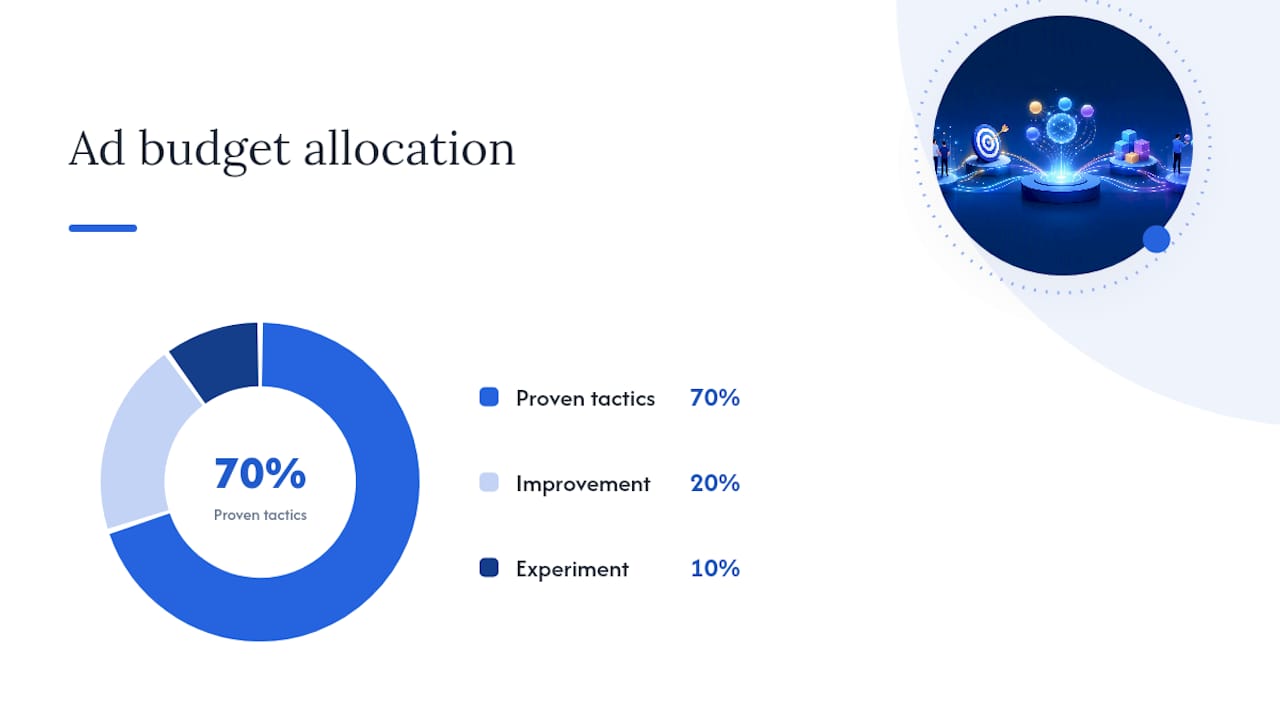
- Budgeting should follow the 70-20-10 rule, allocating 70% to proven tactics, 20% to testing improvements, and 10% to experimentation, with thresholds to ensure effective data collection.
- Choosing channels depends on audience behavior and intent, not on platform popularity, and sequence planning between awareness and conversion channels enhances results.
- Regular KPI tracking with explicit ownership and decision cadences enables timely adjustments, preventing wasted spend and fostering continuous campaign improvement.
Table of Contents
- How do you plan an advertising campaign step by step?
- Budgeting and forecasting: where does the money actually go?
- How do you choose the right channels and media mix?
- What goes into a creative brief that actually works?
- What are the testing rules that protect your ad spend?
- How do you build a KPI tree that links ads to revenue?
- What does real campaign management experience actually look like?
- How do you actually research your audience before you spend a cent?
- How does competitive analysis sharpen your campaign strategy?
- What legal and compliance rules apply to advertising campaigns?
- How do you build a creative strategy and messaging framework?
- Quick checklist before you hit launch
- Ready to run this framework without doing it all yourself?
- Templates and further reading worth bookmarking
- FAQ
How do you plan an advertising campaign step by step?
You plan an advertising campaign in six moves: set one objective, define the audience, pick the channels, lock the budget and timeline, brief the creative, then build in testing and measurement from day one. Skip a step and you're not planning a campaign, you're gambling with a marketing budget.
Here's the thing nobody tells you: most campaigns don't fail because the ad was ugly. They fail because nobody agreed on what "winning" looked like before launch. Let's fix that.
1. Pick ONE primary objective.
Not three. Not "brand awareness and leads and sales, whatever comes first." One. Awareness, consideration, or conversion. Each needs different creative, different channels, and different KPIs. Trying to do all three with one ad set is like trying to date, get married, and file for divorce in the same weekend. Pick your lane.
Deliverable: a single objective statement tied to a business outcome. "Generate 150 qualified leads at under $40 CPA in 60 days" beats "increase brand visibility" every single time, because you can actually measure it.
2. Build the audience profile.
Who exactly are you talking to? Not "small business owners aged 25 to 54." That's not an audience, that's a census. You need pain points, buying triggers, platform habits, and objections. The tighter the profile, the cheaper your clicks.
Deliverable: a one-page audience snapshot with demographics, top three pain points, and where they actually hang out online (more on this below).
3. Nail the core message.
What's the one thing you want them to remember? If you can't say it in one sentence, your ad copy will ramble and nobody finishes reading it.
Deliverable: a single-sentence value proposition that becomes your headline's backbone.
4. Choose your channels.
Facebook, Instagram, Google, YouTube, Microsoft Bing, LinkedIn. Each has a different job. Google catches people actively searching. Facebook and Instagram catch people scrolling and daydreaming. LinkedIn catches people at work pretending to be productive. Match the channel to where your audience's head is actually at.
Deliverable: a ranked channel list with a one-line reason for each.
5. Set budget and timeline.
How much, over how long, split how? This is where most small business owners freeze up because nobody taught them the maths (we cover the actual split in the next section).
Deliverable: a budget table by channel and funnel stage, plus a start and end date.
6. Define the measurement plan.
Before launch, agree on what you're tracking, how often you're checking it, and who's accountable when numbers wobble.
Deliverable: a KPI list with owners and reporting cadence attached.
The campaign brief: your repeatable template
Every campaign needs a brief. Not a 40-page deck nobody reads, a punchy one-pager that answers:
- Objective: What outcome, by when, at what cost?
- Audience: Who are we targeting and why do they care?
- Message: What's the one thing they need to hear?
- Channels: Where are we running this and in what order?
- Budget and timeline: How much, over how long, split how?
- Measurement: What KPIs, who owns them, how often do we check?
Fill that in properly and half your planning work is already done. It's also the exact document that stops "creative feedback" turning into a 47 reply email thread with no decision at the end.
Budgeting and forecasting: where does the money actually go?
Most business owners set ad budgets by vibes. "Let's try $2,000 a month and see." That's not a budget, that's hope with a credit card attached.
The smarter approach uses the 70-20-10 rule:
- 70% on proven tactics — the channels and creative formats that already convert for you or for businesses like yours.
- 20% on improvement — testing variations of what's working to squeeze out better performance.
- 10% on experimentation — new channels, new formats, new audiences. This is your innovation budget, and yes, some of it will fail. That's the point.
Within that split, allocate by funnel stage too.
Two ways to actually set the number:
- Objective-and-task budgeting: work backwards from the outcome. Want 150 leads at $40 CPA? You need roughly $6,000, plus a buffer for testing waste.
- CPA-driven budgeting: if you already know your target cost per acquisition, reverse-engineer spend from your revenue goals.
One rule that trips up almost everyone: minimum spend thresholds. Platforms like Meta and Google need a certain volume of conversions each week per ad set before their algorithm actually learns who to target. Underfund a test and you're not testing, you're just donating money to Silicon Valley.
When you present this to stakeholders, don't lead with the total number. Lead with the split and the logic. "$10,000 a month, 70% to what's proven, 20% to sharpening it, 10% to finding the next winner" sounds like a plan. "$10,000 a month" sounds like a wish.
How do you choose the right channels and media mix?
Wrong question. The right question is: where does your audience actually spend their time, and what are they doing there? Chasing the "hot new platform" because your competitor is on it is how budgets die.
Score each channel candidate on:
- Audience fit — do your buyers actually use this platform, and are they in buying mode when they do?
- Intent match — is this a "searching to solve a problem" channel (Google, Bing) or a "scrolling and discovering" channel (Facebook, Instagram, YouTube)?
- Cost efficiency — what's the realistic CPC or CPM for your industry on this platform?
- Format fit — does your offer work as a 15 second video, a carousel, or does it need the longer-form context LinkedIn allows?
Once you've picked your channels, decide HOW you'll show up over time. There are six standard media plan types, and picking the wrong one wastes real money:
- Continuous — steady spend all year, good for always-on demand (think searches for "plumber near me").
- Flighting — bursts of heavy spend with quiet gaps between, good for seasonal products.
- Pulsing — a continuous baseline with periodic spikes, good for retailers with a steady base plus promo periods.
- Seasonal — spend concentrated around a known peak (End of Financial Year, Christmas).
- Drip — light, consistent spend to stay top of mind without pushing hard.
- Roadblock — dominating multiple channels simultaneously for a short, high-impact window, usually for launches.
Sequence matters too. Awareness channels (YouTube, Facebook reach campaigns) should generally run ahead of conversion channels (Google Search, retargeting), so by the time someone hits your search ad, they already recognise the brand.
What goes into a creative brief that actually works?
A good creative brief fits on one page and covers six things. Anything longer and your designer stops reading by field four.
- Audience pain point — the specific problem this ad speaks to, not a generic demographic description.
- The hook — the first three seconds or first line that stops the scroll.
- The offer — what exactly are they getting, and why now?
- Social proof — a stat, review count, or result that makes the claim believable.
- The call to action — one action, stated plainly. Not three.
- Format variants needed — square, vertical, horizontal, and how many caption lengths.
Every advertising message ultimately breaks down into five parts: headline, subheading, body copy, image or video, and the CTA. Your brief should make each of those five obvious before anyone opens a design tool.
On production: build once, resize often. A hero video shot in 9:16 for Stories can usually be cropped for 1:1 feed placement and trimmed to 6 seconds for a bumper ad. Write captions in three lengths (short, medium, long) so you're not rewriting copy for every platform's character limits.
Approval bottlenecks kill more timelines than bad creative does. Fix it by naming ONE final approver per asset, not a committee, and giving them a 24 hour turnaround window written into the brief itself.
What are the testing rules that protect your ad spend?
Test one variable at a time. Changing multiple elements simultaneously means any "winner" won’t reveal which change caused success. Testing single variables ensures clear insights and effective optimization.
- Test structure first, then message, then creative execution. Structure (campaign objective, bid strategy) has the biggest impact on results, so get that right before you argue over button colours.
- Set a spend threshold before you judge anything. A solid rule of thumb: let each variant spend roughly 3x your target CPA before calling it a winner or a failure. Judge too early and you're reading noise as signal.
- Write your win and fail rules down BEFORE the test starts. "If Variant B beats Variant A's CPA by 20% at the 3x spend mark, it wins" removes the temptation to fall in love with your favourite ad.
- Don't scale on gut feel. A variant only earns more budget once it clears three gates: it performs across multiple audience segments (not just one lucky group), it's stable over at least a week (not a one-day fluke), and you've got a replacement creative ready before the winner inevitably fatigues.
Pro Tip: Keep a "graveyard doc" of every failed test and why it failed. Six months in, that document is worth more than any course you'll ever buy, because it's a record of what your specific audience actually rejects.
Automation tools can speed up the ideation and the number crunching, but the decision to scale or kill still needs a human reading the context. For more on where that line sits, the role of automation in campaigns is worth a proper read.
How do you build a KPI tree that links ads to revenue?
If your weekly report is just "we got 200 clicks," your boss is right to be unimpressed. Clicks don't pay bills. Revenue does. A KPI tree connects the two.
Start at the top with your business KGI (revenue or qualified leads), then branch down: impressions feed click-through rate, click-through rate feeds conversion rate, conversion rate feeds actual conversions, and conversions roll up into cost per acquisition and, eventually, revenue. Every layer needs an owner, or nobody's accountable when a number slips.
Set a decision cadence so you're not drowning in dashboards every single day:
- Daily: check spend pacing and any red-flag metrics (CPA spiking, ad disapprovals). React fast, don't overreact.
- Weekly: review test results against your win/fail thresholds and decide what scales or gets killed.
- Monthly: step back and look at channel mix, budget reallocation, and creative fatigue trends.
- Quarterly: reassess the whole strategy against the business KGI. Is the campaign still solving the right problem?
Your dashboard should show, at minimum: spend pacing, CPA/CPL trend, top-performing creative, and funnel drop-off points, each with a named owner. Using campaign analytics to maximise ad performance properly means every number on that dashboard has a person whose job it is to act on it, and real-time views (see real-time analytics in advertising) make the daily check genuinely useful instead of a box-ticking exercise.
What does real campaign management experience actually look like?
Frameworks are great on a whiteboard. They mean nothing until someone's actually running the media buys, watching the CPA creep, and deciding at 4pm on a Thursday whether to kill an underperforming ad set.
Campaign management includes running advertising on major platforms, applying testing rules and KPI tracking in client accounts. This also covers ad creative development in multiple formats and integrated lead capture through customer engagement tools to ensure leads are properly managed. For the operational side of ongoing optimisation, improving ad performance for higher ROI shows how that discipline plays out week to week.
How do you actually research your audience before you spend a cent?
Guessing your audience is the most expensive mistake in advertising. Before you write a single headline, you need real answers to three questions: who has the problem, what triggers them to look for a solution, and where do they go when they start looking?
Start with what you already own. Your customer list, your CRM, your past ad data. Who converted before, and what did they have in common? Layer on platform data too: Meta's Audience Insights and Google's Audience Manager both show you demographic and interest overlaps you'd never guess sitting in a boardroom.
Then go qualitative. Read your reviews (the 3-star ones especially, they're brutally honest). Scroll competitor comment sections. Look at what questions show up in your industry's Reddit threads or Facebook groups. That's raw, unfiltered language you can steal for ad copy.
Build your targeting around behaviour, not just demographics. A 35-year-old mum and a 35-year-old tradie are the same "age bracket" and nothing else. Aligning media mix to where the audience actually spends time, rather than chasing platform trends, is what separates campaigns that convert from campaigns that just generate impressions. If you're guessing at platforms instead of confirming with data, you're paying full price for a maybe.
How does competitive analysis sharpen your campaign strategy?
Your competitors are running free market research for you right now. Use it.
Pull up their ads through Meta's Ad Library or Google's Ads Transparency Centre. What offers are they leading with? What's their hook? How long have specific ads been running (a long run time usually means it's working)? This isn't about copying, it's about spotting the gap they're leaving open.
Positioning is where this gets interesting. If every competitor in your space is shouting "cheapest price," and you can't win on price, don't compete there. Find the angle they're ignoring: faster turnaround, better guarantee, a niche they're not targeting. Your ad campaign should say something they can't say, or say the same thing in a way that lands harder.
Map it simply: list your top three to five competitors, note their main channel, their core message, and their obvious weakness. That weakness is your opening line.
What legal and compliance rules apply to advertising campaigns?
This is the part everyone skips until they get an ad rejected, or worse, a fine. Rules vary by country, but the patterns repeat everywhere.
Platform policy compliance comes first. Meta, Google, and LinkedIn all have advertising policies covering prohibited content, restricted categories (health, finance, and housing get extra scrutiny), and required disclosures. Break these and your ad gets rejected, your account gets flagged, or in repeat cases, your whole ad account gets suspended.
Truth-in-advertising rules matter just as much. Claims need to be substantiated. "Clinically proven" needs an actual clinical study behind it, not a vibe. Testimonials need to reflect genuine experiences, and if you're paying for one, disclosure obligations usually apply in most jurisdictions.
Data privacy law is the other big one. Depending on where your audience sits, regulations like GDPR (EU) or various local privacy acts govern how you collect and use data for targeting and retargeting. If you're running pixel-based retargeting or custom audience uploads, check what consent and disclosure your specific market requires. When in doubt on a legal question specific to your jurisdiction, that's a conversation for a qualified professional, not a marketing blog.
How do you build a creative strategy and messaging framework?
Creative strategy isn't "make it look nice." It's deciding, before a single design file opens, what emotional lever you're pulling and why.
Start with the pain point, not the product. Nobody wakes up wanting your service, they wake up wanting a problem solved. Your messaging framework should map: the problem (stated in the customer's own words), the cost of not solving it, your solution, and the proof it works.
Every message maps to five components: headline, subheading, body copy, imagery, and call to action. Get the headline wrong and nothing else matters, because nobody reads far enough to see your beautiful subheading.
Consistency across the funnel matters more than most businesses realise. Your top-of-funnel ad might lead with a bold problem statement, while your retargeting ad leans on urgency or social proof. Both should feel like the same brand talking, just at a different point in the conversation.
Test your message hierarchy the same way you test creative. If the hook doesn't stop the scroll in three seconds, the world's best offer sitting in paragraph two never gets read.
Quick checklist before you hit launch
Before any campaign goes live, run this: one clear objective written down, an audience profile with actual pain points (not just demographics), a budget split using the 70-20-10 logic, and win/fail rules agreed on paper.
The traps I see constantly? Audience and channel mismatch (wrong message, wrong platform), tests funded with pocket change instead of real spend, and KPIs so vague nobody can call a campaign a win or a loss. Fix those three and you're already ahead of most advertisers running campaigns today.
— Adrian
Ready to run this framework without doing it all yourself?
Building the framework above is the easy part. Running it daily across six platforms while watching CPAs, swapping fatigued creative, and reading dashboards at 11pm is where most business owners burn out. That's the gap Adsdaddy exists to close: managed campaign execution built on exactly the testing rules and KPI trees covered above, without you needing to become a full-time media buyer.
A first engagement with Adsdaddy typically starts with an account audit and a campaign brief built from the six-step framework, followed by a 30/60/90 day plan covering setup, structured testing, and scaling decisions. Adsdaddy runs campaigns across Facebook, Instagram, Google, YouTube, Microsoft Bing, and LinkedIn, with creative development and lead capture built in through tools like Klaviyo and newCustomer.io. If your current campaigns are underperforming or you're planning a launch and don't want to learn platform algorithms the hard way, get in touch with Adsdaddy and get a plan built around your actual numbers, not a template.
Templates and further reading worth bookmarking
For deeper reading: demystifying campaign objectives for SMART goal setting, digital ads optimisation process for operational checklists, and AI productivity gains for agencies for automation context.
FAQ
How do you plan an advertising campaign?
Set one primary objective, define your audience, choose channels that match audience behaviour, lock a budget using the 70-20-10 split, brief the creative, then build in testing and measurement before launch, not after.
What is the 3-3-3 rule in marketing?
Definitions of the 3-3-3 rule vary across marketing circles, and it isn't a framework this article's sources establish a canonical version of, so it's best to confirm the specific definition with whoever is presenting it before applying it to your campaign.
What are the five key steps in creating an advertising campaign?
Set your objective, research and define your audience, choose your channels and budget, produce and brief the creative, then implement with measurement built in from day one, mirroring the six-step framework covered above with budget and channel decisions grouped together.
How much should I spend before judging if an ad is working?
A practical rule of thumb is to let each ad variant spend roughly three times your target cost per acquisition before deciding whether it's a winner or a failure, so you're judging on real signal rather than early noise.