How to write a Facebook ad that actually converts
. By Ads Daddy.

TL;DR:
- Write compelling Facebook ads by starting with a clear, standalone hook that grabs attention in the first 125 characters. Focus on one specific message and match your creative, landing page, and CTA to maximize conversions. Prioritize testing diverse creative hypotheses over time to optimize ad performance and exit the learning phase quickly.
Write a high-converting Facebook ad in six repeatable steps: define your audience, nail the hook, state the benefit, add proof, choose one CTA, and match your creative. That's the whole game. Everything else is just execution.
TL;DR — the six steps at a glance:
- Audience: Know exactly who you're talking to before you write a word
- Hook: Lead with a compelling scroll-stopper in the first visible portion of the primary text
- Benefit: State the outcome, not the feature
- Proof: One number, one result, one real claim
- CTA: One action only — "Shop Now," "Book a Call," "Get the Guide"
- Creative: Your image or video must match the copy's promise
Quick example you can paste and edit right now:
Pre-launch checklist — three things before you hit Publish:
- Pixel or Conversions API is firing on your thank-you page
- Budget is concentrated on one campaign, not split across five
- You have at least three distinct creative variations ready to test
Table of Contents
- What does each Meta ad field actually do?
- How to write a Facebook ad step by step
- What copy tactics actually stop the scroll?
- How do you test copy and measure what's working?
- Ready-to-use Facebook ad templates and swipe file
- Common Facebook ad mistakes and how to fix them fast
- Key takeaways
- Why creative-first testing is the only playbook worth following
- Adsdaddy manages your Facebook ads so you can focus on the business
- Useful sources and further reading
- FAQ
What does each Meta ad field actually do?
Meta structures everything as Campaign > Ad Set > Ad. The campaign sets the objective (sales, leads, traffic). The ad set controls budget, schedule, and audience. The ad is where your copy lives: primary text, headline, description, and the CTA button.
Most writers get this backwards. They agonise over the headline and forget that on mobile, nobody sees it first.
Primary text is your real hook. Only a limited number of characters are visible in the feed before the "See more" truncation kicks in. That first line needs to work completely on its own. Think of it like a text message from a mate — if the first sentence doesn't grab you, you're not reading the rest.
The headline is the bridge to action. It sits below the image or video, and it's the last thing a user reads before they decide to click. Keep it short and punchy, aiming for full visibility across placements.
The description (the smaller grey text below the headline) supports the headline and sets expectations. It's often hidden on mobile. Write it, but don't rely on it.
The CTA button is chosen from Meta's dropdown — "Shop Now," "Learn More," "Book Now," and so on. It should align with your objective. A lead gen ad with a "Shop Now" button creates friction before the click even happens.
Character visibility by placement
| Placement | Primary text visible | Headline visible | Description visible |
|---|---|---|---|
| Facebook Feed | ~125 characters | ~40 characters | Sometimes |
| Instagram Feed | ~125 characters | ~40 characters | Rarely |
| Facebook Reels | ~50 characters | Not shown | No |
| Stories | ~90 characters | Not shown | No |
| Audience Network | Varies | ~25 characters | No |
Pro Tip: Write your primary text so the first sentence is a complete, standalone hook. If the rest gets cut off, the ad still makes sense and still earns the click.
For format-specific copy, Reels and Stories demand even tighter openers. Drop the warm-up sentences entirely. Lead with the payoff.
How to write a Facebook ad step by step
This is the workflow Adsdaddy uses on every new campaign. Follow it once and it becomes second nature.
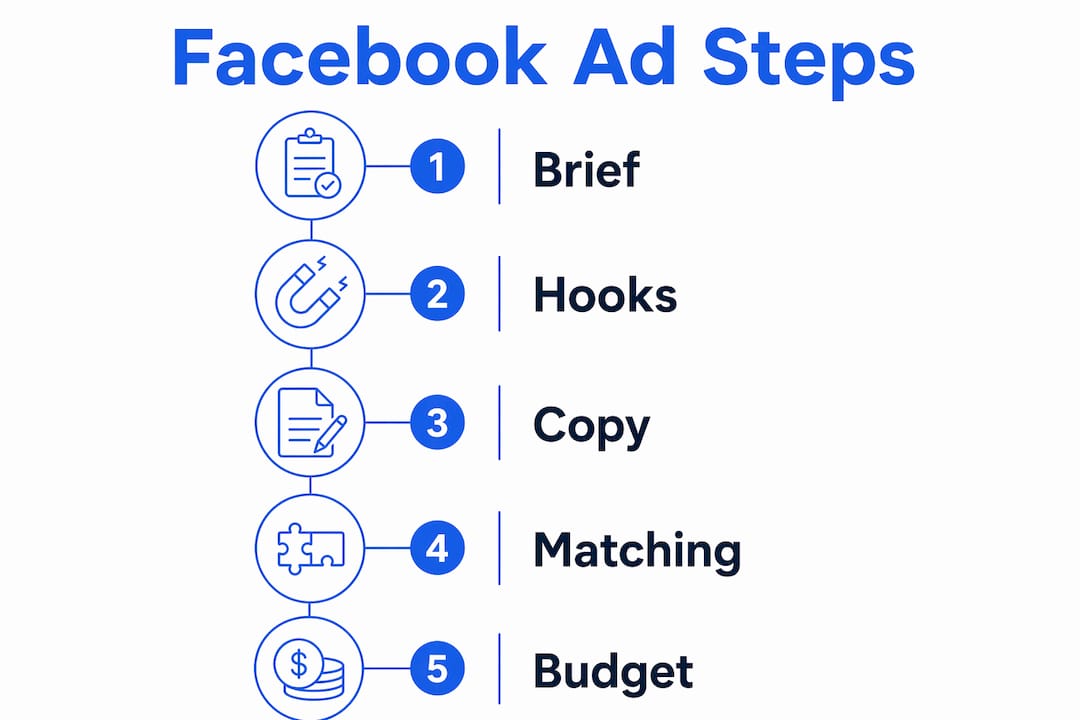
Step 1: Write a micro-brief
Before you open Ads Manager, answer three questions in writing:
- Who is this person? (one specific persona, not "everyone aged 25–55")
- What is the single outcome they want?
- What is the one thing stopping them right now?
Example: "Sarah, 34, runs a small Brisbane café. She wants more weekday foot traffic. She doesn't know how to reach locals who aren't already following her on Instagram."
That brief writes the ad for you.
Step 2: Brainstorm 5–10 hooks
Each hook is a different hypothesis about what will make Sarah stop scrolling. Try these angles:
- Audience call-out: "Brisbane café owners — here's what's killing your weekday numbers."
- Bold claim: "We filled 40 empty weekday seats for a Fortitude Valley café in 30 days."
- Specific outcome: "Turn your quiet Tuesdays into your busiest day of the week."
- Provocative question: "Why do some local cafés stay packed on Mondays?"
- Transformation: "From 12 covers on a Wednesday to a full house — here's how."
Don't judge them yet. Write all five. Then pick the one that feels most like something Sarah would screenshot and send to a friend.
Step 3: Write the full ad
Take your strongest hook and build out the primary text, headline, and CTA. Keep each element standalone — the headline should make sense even if the primary text is cut off.

Primary text: Hook + one-sentence benefit + one-sentence proof + CTA prompt Headline: Action-oriented, 40 characters or less CTA button: Matches the landing page action
Step 4: Match copy to creative and landing page
Your image or video needs to echo the copy's promise. If the copy says "fill your quiet Tuesdays," the creative shouldn't show a packed Saturday brunch. The landing page needs to deliver exactly what the CTA promised — no detours, no surprises.
Step 5: QA before launch
- Pixel or Conversions API is firing correctly
- Ad copy complies with Meta's policies (no prohibited claims, no misleading before/after)
- Creative is accessible (captions on video, readable text overlay)
- UTM parameters are set
Step 6: Set the budget and evaluation window
Start with a practical daily budget on a single campaign. Meta needs a sufficient number of conversion events per ad set to exit the learning phase. That usually takes several weeks. Don't judge the campaign too early, and avoid major changes initially.
Pro Tip: Run a 15-minute hook brainstorm with a timer. Set it, write fast, don't edit. The best hooks usually come in the first five minutes when you stop overthinking.
For a deeper look at creative testing frameworks, the Adsdaddy blog has a full breakdown.
What copy tactics actually stop the scroll?
Creative drives the majority of ad performance. Copy supports it. One practitioner analysis puts creative at roughly 60–80% of performance, with primary text at 15–20% and the headline at 10–15%. That doesn't mean copy is unimportant — it means your copy needs to work with the creative, not fight it.

Hook formulas and when to use them
| Hook type | Best for | Example |
|---|---|---|
| Audience call-out | Cold traffic, niche audiences | "Attention Melbourne tradies…" |
| Bold claim | Warm audiences who know the problem | "We cut our client's CPA by half in 30 days." |
| Specific outcome | Conversion campaigns | "Get 10 new leads this week for under $200." |
| Provocative question | Awareness, broad targeting | "Why do most Facebook ads waste money?" |
| Transformation story | Retargeting, warm traffic | "Six months ago I had zero online sales. Here's what changed." |
Frameworks for cold, warm, and hot audiences
Cold audiences (never heard of you): Use PAS — Problem, Agitate, Solution. Lead with the pain, make it real, then offer the fix.
Warm audiences (visited your site, engaged with content): Use AIDA — Attention, Interest, Desire, Action. They already know the problem; now you're building desire.
Hot audiences (cart abandoners, past buyers): Skip the framework. Be direct. "You left something behind. Here's 10% off to finish your order."
Voice and brevity
Write for a thumb mid-scroll. Your first sentence should be 12 words or fewer where possible. "Stop paying full price for flights" beats "Are you someone who frequently travels and wants to save money on airfares?"
Specificity converts. "Save $400 a year" beats "save money." "10 new leads in 7 days" beats "grow your business." Numbers create credibility even when they're modest.
Avoid these openers like the plague:
- Your brand name as the first word
- "We are proud to announce…"
- "Introducing [Product Name]…"
- Vague benefit statements like "Take your business to the next level"
For more on persuasive copy techniques that work across Meta placements, this guide from BabyLoveGrowth is worth a read.
How do you test copy and measure what's working?
Testing without a plan is just spending money on guesses. Here's how to run it properly.
Starter budgets and the learning phase
Meta needs conversion events per ad set to exit the learning phase and optimise delivery properly. Starting at a daily budget within a practical range on a single campaign, that typically means an initial evaluation period of a few weeks. Splitting $20/day across three campaigns means each one never learns — you get noisy data and wasted spend.
Allocate 60–70% of your initial budget to prospecting (cold audiences). That's where the algorithm builds its learning. Retargeting can come later once you have volume.
What to measure and when
| Metric | What it tells you | When to judge |
|---|---|---|
| CTR (link) | Is the hook and creative compelling? | After 1,000+ impressions |
| CPC | How competitive is your audience? | After 500+ clicks |
| Conversion rate | Does the landing page deliver? | After 50+ clicks |
| CPA | Is the campaign profitable? | After learning phase exits |
| ROAS | Overall return on ad spend | After 2–4 weeks |
A low CTR means the hook or creative isn't working. A high CTR with low conversions means the landing page is the problem. Don't fix the ad when the issue is the page.
Testing order and sample sizes
- Creative first — test 5–10 genuinely different images or videos before touching copy
- Primary text second — once a winning creative is identified, test 2–3 hook variations
- Headline third — small impact, but worth testing once copy is proven
- CTA button last — marginal gains, test only when everything else is stable
Avoid making major edits in the first 3–7 days. Budget increases above 20%, creative swaps, or audience changes all reset the learning phase clock. You're back to zero conversions and another 2–4 weeks of learning.
A practical 4-week beginner cycle looks like this:
- Week 1: Launch with 5 creatives, one objective, one ad set, $30/day — do not touch it
- Week 2: Review CTR and early CPC data; pause obvious underperformers (bottom 20%)
- Week 3: Introduce one new creative variation to replace the paused one
- Week 4: Evaluate CPA and ROAS; decide whether to scale or restructure
For more on managing ad spend without wasting budget, the Adsdaddy guide covers daily budget decisions in detail.
Ready-to-use Facebook ad templates and swipe file
These templates are built for Australian audiences. Swap the specifics for your offer and you're ready to test.
Templates by objective
| Objective | Hook | Headline | CTA |
|---|---|---|---|
| Product sales | "Sydney pet owners — your dog deserves better than supermarket food." | "Premium dog food, delivered free." | Shop Now |
| Lead gen | "Running a trade business in QLD? We help tradies get 10+ leads a week." | "Get your free lead gen audit." | Get Quote |
| Event sign-up | "Melbourne marketers — this one's for you. Free workshop, 90 minutes." | "Claim your free seat now." | Sign Up |
| Brand awareness | "Most Aussie businesses waste 40% of their ad budget. Here's why." | "Stop wasting your ad spend." | Learn More |
Swipe file — 8 copy starters
- "Attention [city/audience] — [specific problem] is costing you [specific loss]."
- "[Number] [audience type] in [location] switched to [solution] last month."
- "You've tried [common solution]. Here's why it didn't work — and what does."
- "Free [lead magnet] for [audience]. No catch. Just [specific benefit]."
- "Last chance — [offer] ends [day/date]. Don't miss it."
- "[Customer result] in [timeframe]. Here's exactly how."
- "If you're a [audience] who [problem], this is for you."
- "We helped [number] [audience type] achieve [outcome]. You're next."
Length guidance by placement
Feed ads can carry 3–5 sentences in the primary text if the hook earns it. Reels and Stories need to front-load everything — treat the first line as the only line. For Instagram feed, keep primary text under 125 characters for full visibility without truncation.
You can run the same core message across placements by adjusting length and tone. The feed version gets the full story. The Reels version gets the punchline. The Story version gets the visual with a one-line overlay.
For more ad copywriting tips tailored to Meta placements, the Adsdaddy blog has practical examples you can adapt.
Common Facebook ad mistakes and how to fix them fast
Most underperforming ads have one of four problems. Here's how to spot and fix each one.
Mistake 1: Weak hook The first line starts with the brand name or a vague benefit. Nobody stops scrolling for "Welcome to [Brand]."
Fix: Replace the opener with a direct audience call-out or a specific outcome. "Melbourne tradies — here's how to fill your calendar in 30 days" beats "At XYZ Plumbing, we pride ourselves on quality service."
Mistake 2: CTA doesn't match the landing page The ad says "Get Your Free Guide" but the landing page is a product page with no guide in sight.
Fix: Audit every ad's CTA against its destination URL. The promise in the ad must be the first thing visible on the landing page. Mismatched expectations kill conversion rates.
Mistake 3: Copy is too long for mobile A 200-word primary text block might work on desktop. On mobile, users see 125 characters and a "See more" link they will almost certainly ignore.
Fix: Rewrite the primary text so the first sentence is a complete, compelling hook. Everything after that is a bonus — write it, but don't depend on it.
Mistake 4: Budget split across too many campaigns Running five campaigns at $5/day each means none of them exit the learning phase. You get inconclusive data and zero optimisation.
Fix: Consolidate into one campaign at $25/day. Let it learn. Then scale what works.
Pro Tip: Before you pause a campaign, check whether it's still in the learning phase. Pausing during learning resets the clock. If it's learning, give it the full 2–4 weeks before you judge.
Key takeaways
The most effective Facebook ad copy leads with a standalone hook in the first 125 characters, matches one clear message to one CTA and one landing page, and earns its results through creative-first testing over a 2–4 week learning window.
| Point | Details |
|---|---|
| Hook comes first | Write the first ~125 characters as a complete, standalone hook — mobile users rarely tap "See more." |
| One message, one CTA | Every ad needs a single clear outcome; mismatched CTAs and landing pages destroy conversion rates. |
| Launch 5–10 creatives | Broad targeting with multiple distinct creatives lets the algorithm find the cheapest buyers. |
| Budget concentration | Start at $20–50/day on one campaign; judge performance only after the learning phase exits (2–4 weeks). |
| Adsdaddy's approach | Adsdaddy runs creative-first testing with concentrated prospecting budgets to exit learning fast and scale what works. |
Why creative-first testing is the only playbook worth following
Most people who struggle with Facebook ads are following a 2018 playbook. They obsess over audience targeting, stack interests, and tweak demographics — then wonder why nothing works.
Here's the honest truth: the algorithm is the targeting engine now. Your creative is the signal it uses to find buyers. A strong hook in a broad campaign will outperform a weak hook in a hyper-targeted one almost every time.
The Adsdaddy approach starts with tracking, concentrates the prospecting budget on a single campaign, uses Advantage+ placements for most beginners, and launches 5–10 genuinely different creative hypotheses. Not five versions of the same ad with different colours. Five completely different angles — different hooks, different audiences called out, different emotional triggers.
The ones that win tell us something real about what the audience responds to. The ones that lose tell us something equally valuable. Either way, we're learning. That's the whole point.
What most solo marketers skip is the discipline of waiting. Two weeks feels like forever when you're watching money leave your account. But pulling the plug at day five, before the algorithm has found its rhythm, is the single most expensive mistake you can make. Give it the full window. Then iterate on what the data actually shows.
Adsdaddy manages your Facebook ads so you can focus on the business
If writing, testing, and optimising Facebook ads sounds like a full-time job — that's because it is. Adsdaddy's managed Facebook Ads service takes the whole thing off your plate: creative development, tracking setup, campaign structure, and weekly optimisation.

A typical first-month engagement includes a creative test matrix (5–10 distinct ad variations), full pixel and Conversions API setup, and a single prospecting campaign structured to exit the learning phase as fast as possible. For most Australian small businesses, a realistic starter ad spend sits in the $600–$1,500/month range, depending on the industry and objective. Adsdaddy's management fee is separate and quoted based on scope.
No lock-in contracts. No agency jargon. Just a clear plan, measurable results, and a team that treats your budget like it's their own.
Ready to stop guessing and start scaling? Book a strategy call with the Adsdaddy team today.
Useful sources and further reading
These are the primary references and guides worth bookmarking if you want to go deeper.
| Source | What it covers | Why it's useful |
|---|---|---|
| Meta Business Help — Ads structure | Campaign > Ad Set > Ad hierarchy; primary text field roles | Official reference for ad field definitions and copy placement |
| Meta Business Help — Learning phase | 50-conversion threshold; 2–4 week evaluation window | Authoritative guidance on when and how to judge campaign performance |
| Meta Business Help — Budget guidance | $20–50/day starter range; budget concentration principles | Official starting point for beginner budget decisions |
| AdRiseLab 2026 practitioner guide | 8-step runbook; creative-first testing; broad targeting | Practical field guide for setting up and running campaigns in 2026 |
| Hootsuite 2026 Facebook Ads guide | Step-by-step setup; Advantage+ targeting and placements | Beginner-friendly walkthrough with current platform screenshots |
| GrowWithSakib 2026 copy guide | Character counts by placement; hook prioritisation | Precise copy-length guidance for mobile-first writing |
| Shopify marketing blog | Campaign structuring by funnel stage; 60–70% prospecting allocation | Practical budget allocation framework for scaling campaigns |
| Adsdaddy — Facebook advertising guide | Ad hierarchy, objectives, creative variation | In-depth local guide for Australian advertisers |
| Adsdaddy — Ad spend optimisation | Daily budgets, avoiding budget-splitting, ROI focus | Practical budget decisions for Facebook and Google |
| BabyLoveGrowth — Persuasive copy guide | Persuasive copy frameworks for Meta placements | Advanced copy tactics for marketers ready to go deeper |
FAQ
Is $5 a day enough for Facebook ads?
No. At $5/day, your ad set will rarely generate the roughly 50 conversion events Meta needs to exit the learning phase, which means the algorithm never optimises delivery. Meta recommends starting at $20–50/day on a single campaign for meaningful results.
How much does it cost to run a Facebook ad in Australia?
There's no fixed price — you set your own daily or lifetime budget. Most Australian small businesses start with $20–50/day in ad spend. Adsdaddy typically sees realistic first-month budgets in the $600–$1,500/month range depending on the objective and industry.
How do Facebook ads work for beginners?
You create a campaign with an objective (sales, leads, traffic), set a daily budget at the ad set level, and write your ad copy at the ad level. Meta's algorithm then shows your ad to people most likely to take the action you've chosen, learning and improving over 2–4 weeks.
How do you run ads on Facebook and Instagram at the same time?
Use Advantage+ placements when setting up your ad set. Meta will automatically serve your ad across Facebook, Instagram, Messenger, and the Audience Network, optimising delivery to wherever your audience is most likely to convert.
What's the biggest mistake beginners make with Facebook ad copy?
Leading with the brand name instead of the customer's problem. Your first ~125 characters need to hook the reader before they scroll past. Start with their pain point, a specific outcome, or a direct audience call-out — not your logo or company name.