How to create a marketing strategy that actually works
. By Ads Daddy.

A marketing strategy is your long-term compass. It's the answer to two questions: who do you serve, and why should they pick you over the next business in their feed? A marketing plan is the tactical roadmap that gets you there, usually rebuilt every 12 months. Confuse the two and you'll spend a fortnight "planning" without ever deciding what you stand for.
Here's the checklist. Work through it in order and you'll have a working strategy by the time you finish your coffee (okay, maybe a few coffees).
- Situation analysis — audit where you actually stand, not where you hope you stand.
- SMART goals — one primary goal, measurable, time-bound.
- Audience and personas — who you're actually talking to.
- Unique value proposition (UVP) — why them, why you, why now.
- Channels and the 4 Ps — product, price, place, promotion.
- Budget and owners — money and a name attached to every task.
- 90-day action plan — the sprint that proves the strategy works.
- KPIs — the numbers that tell you if it's working.
- Review cadence — when you revisit and adjust.
That's it. Nine moves. Everything below unpacks each one.
TL;DR:
- Focusing on one primary, measurable SMART goal, like increasing sales by a specific percentage within 12 months, enhances strategic clarity and effectiveness.
- Validating customer personas through interviews and small ad tests reduces reliance on assumptions, resulting in more targeted messaging that resonates with actual audiences.
- Testing one channel, one offer, and one metric for at least 30 days provides crucial insights before scaling, preventing wasted budget on ineffective campaigns.
- Allocating 10 to 15% of your marketing budget for experiments allows data-driven optimization, increasing the likelihood of discovering high-performing tactics.
- Partnering with a managed media team, like Adsdaddy, can accelerate results by handling creative, setup, and optimization, saving time and improving campaign performance.
Table of Contents
- How do you create a marketing strategy step by step?
- What are SMART marketing goals and how do you set them?
- Who is your audience and what does their persona look like?
- What makes a strong unique value proposition?
- How do you build your marketing mix and choose channels?
- How much should you budget and who owns what?
- How do you turn a strategy into a 90-day action plan?
- What KPIs should you track and how often should you report?
- When should you review and update your strategy?
- How does AdsDaddy validate channels with paid media?
- How should you map the customer journey and its touchpoints?
- How do you align sales and marketing teams for execution?
- How do you integrate branding with your marketing strategy?
- How do you analyse competitors and market trends?
- Author perspective: the mistakes I see on repeat
- Want someone else to run the experiment for you?
- Key Takeaways
- FAQ
How do you create a marketing strategy step by step?
Step one is research, and most SMBs skip it because it feels slow. Don't. A strategy built on assumptions is just a guess wearing a suit.
Start with a SWOT: strengths, weaknesses, opportunities, threats. It's blunt, but it forces honesty. Pair it with a quick PEST scan (political, economic, social, technological) if your industry is exposed to regulation or seasonal swings — a gym chain cares about PEST more than a boutique candle brand does.
Then go talk to actual humans:
- Interview several customers — ask what almost stopped them buying.
- Run a short survey with a few questions through email or Instagram Stories.
- Check your analytics for drop-off points and top traffic sources.
- Scan social comments and reviews for recurring language — customers hand you your ad copy for free if you listen.
Timebox it. A rapid audit takes a couple of weeks. A thorough one, done properly with interviews and data pulls, takes several weeks. Building the full plan around it can chew up a similar stretch, so don't try to do it between meetings.
Pro Tip: Record customer interviews and transcribe the exact phrases they use. Their words, not your marketing team's words, make the best ad hooks.
What are SMART marketing goals and how do you set them?
Vague goals kill strategies. "Grow the brand" isn't a goal, it's a wish. SMART goals fix that: Specific, Measurable, Achievable, Relevant, Time-bound.
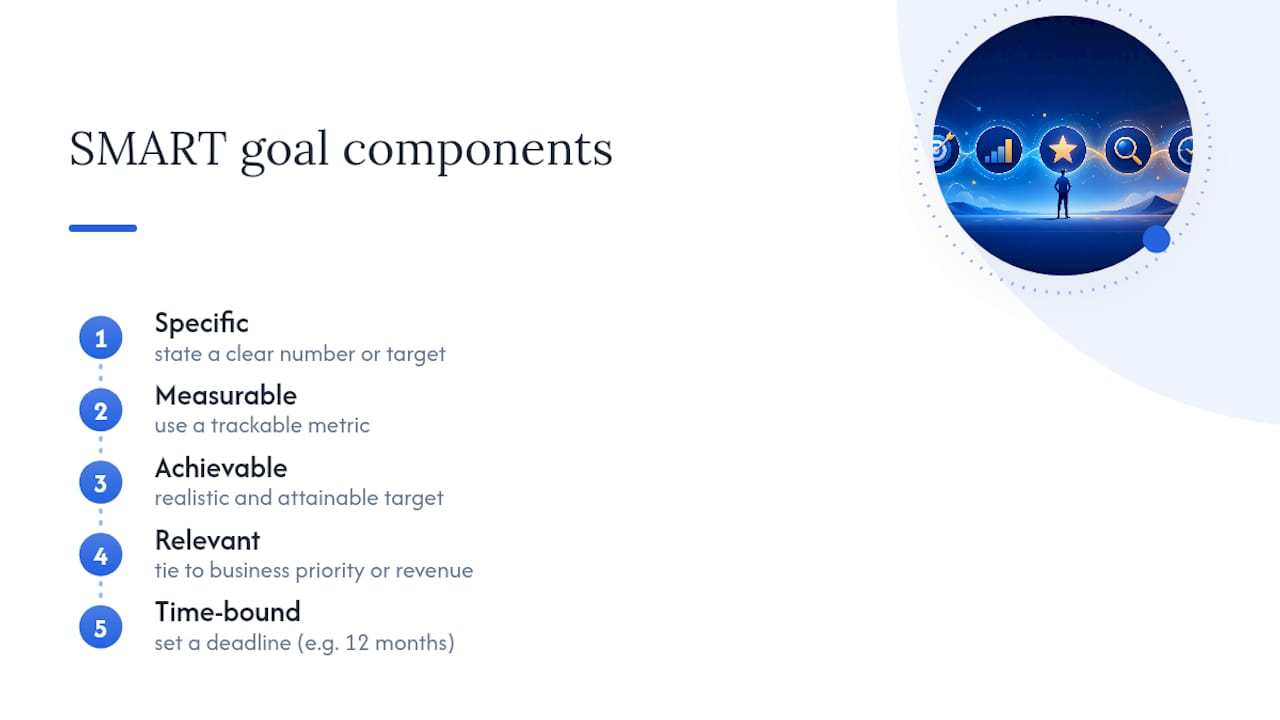
A real SMART goal reads like this: increase sales over the next 12 months. Specific number, specific timeframe, tied directly to revenue.
Pick one primary goal. Everything else takes a back seat. For example, an awareness goal involves a longer, top-of-funnel approach, while lead generation requires specific tactics like forms and offers, and revenue goals focus budgeting and channels on conversion.
Add one or two supporting goals if you must, but don't stack five priorities and call it focus. Your goal decides your budget and channel priorities before you spend a dollar on ads.
Businesses that write specific, measurable targets consistently outperform those chasing vague ambitions like "more visibility." A number with a deadline beats a feeling every time.
Who is your audience and what does their persona look like?
A segment is a group. A persona is a person. You need both, but they solve different problems: segments help you divide the market, personas help you write copy that doesn't sound like it was written for nobody in particular.
Build the persona with key fields such as demographics, job-to-be-done, triggers, objections, and preferred channels.
Then test it. Run 5 to 10 interviews against the persona and see if reality matches your assumptions. Check on-site analytics for behavioural signals that confirm or contradict it. Run a small A/B test on ad creative targeting that exact persona and watch the click-through rate. A persona that survives contact with real data is worth ten built on guesswork. For a deeper walkthrough on building buyer personas, the template approach works well alongside this method.
What makes a strong unique value proposition?
Your UVP is one sentence: "For [audience], [product] delivers [specific benefit] unlike [alternative]." That's it. If it takes a paragraph to explain why someone should choose you, it's not a UVP, it's a pitch deck.
Micro-example: "For busy tradies, InvoiceFast gets you paid in 24 hours, not 30 days, without chasing a single client."
- Write three variations.
- Put each on a landing page or a single ad set.
- Run them against real traffic for a week.
- Kill the losers, scale the winner.
Data beats debate every time. Whichever version gets the best click-through and lowest cost-per-lead is your UVP, not the one your business partner likes best.
Pro Tip: A UVP that a competitor could copy tomorrow isn't defensible. Anchor it in something structural, like your process, guarantee, or turnaround time, not just a nicer adjective.
How do you build your marketing mix and choose channels?
The 4 Ps aren't a university lecture, they're a filter. Product shapes your messaging. Price shapes who can afford you and which channels suit that price point (nobody's buying a $3,000 course from a random Instagram Reel with no trust built first). Place is where and how customers actually buy. Promotion is everything downstream of the first three: the ads, the emails, the content.
Shortlist channels using three filters:
- Audience presence — are they actually there, or are you just assuming they are?
- Goal fit — does this channel suit awareness, leads, or direct sales?
- Execution capacity — can you realistically produce content for it every week?
Some combos that work well in practice:
- Acquisition: Google Search Ads + Meta prospecting campaigns.
- Retention: Email flows (think Klaviyo) + retargeting ads.
- Awareness: YouTube pre-roll + organic social + a light LinkedIn presence for B2B.
Pick one to two primary channels, not six. Trying to dominate Facebook, Instagram, LinkedIn, TikTok, and email simultaneously with a two-person marketing team is how good ideas turn into half-finished content calendars. For e-commerce brands specifically, sequencing multiple paid channels properly matters more than being everywhere at once.
How much should you budget and who owns what?
Rule of thumb: allocate a portion of revenue for marketing and carve out a test budget before committing the rest. Split the budget across creative production, paid media, and tools/software. Assign a RACI for every campaign: identify roles responsible, accountable, consulted, and informed.
A simple RACI example: the marketing coordinator is Responsible for the ad campaign, the owner is Accountable for the budget sign-off, a designer is Consulted on creative, and the sales team is Informed of the launch date. Skip this step and you'll find three people all think someone else was managing the Google Ads account.
How do you turn a strategy into a 90-day action plan?
Strategy without a deadline is a daydream. The 90-day plan is where it becomes real.
- Set three milestones, one per month, each tied to your primary goal.
- List the specific experiments you'll run (one channel test, one creative test, one offer test).
- Assign an owner and a due date to every task, no exceptions.
- Sequence launches so you validate your UVP first, then scale the channel that proves it.
- Build a simple handover doc so if someone's on leave, the campaign doesn't stall.
Don't try to launch five channels in week one. Validate the message with a small, cheap test before you pour budget behind it. Speed matters, but sequence matters more.
What KPIs should you track and how often should you report?
Layer your metrics into three tiers: awareness, engagement, conversion. Chasing a single "attribution" number across every channel is a fool's errand, especially for small teams without a data analyst on staff. Track top-of-funnel reach, mid-funnel engagement (click-through, time on site), and bottom-funnel conversion (leads, sales, cost per acquisition) separately.
Pick a few KPIs per channel. For example, awareness could be reach and impressions; engagement might include click-through and open rates; conversion could involve cost per lead and conversion rate.
Report on a rhythm: weekly dashboards for the team running campaigns, monthly reviews with decision-makers, and a quarterly strategy check to see if the whole thing still holds up. Practitioners who avoid overcomplicating attribution models early tend to make faster, cleaner decisions than those drowning in fifteen half-understood metrics.
When should you review and update your strategy?
Set a cadence and stick to it: monthly for quick performance check-ins, quarterly for a proper strategy review, and an annual refresh where you rebuild the plan against fresh market conditions.
Know the difference between a pivot trigger and an optimisation sign. A channel underperforming by 10% for two weeks? Optimise the creative. A channel underperforming for three straight months with no signal of improvement? That's a pivot trigger.
- Keep the strategy document to one page. Include audience, positioning, channels, and measurement method, nothing more.
- A shorter document gets read and used; a 40-page deck gets opened once and forgotten in a shared drive.
- Update annually at minimum, more often if your market moves fast.
Pro Tip: Print the one-pager and stick it near your desk. If your team can't recall the primary goal without opening a file, the strategy isn't working as a strategy, it's working as a document.
How does AdsDaddy validate channels with paid media?
Here's a practitioner example. Structure a minimum viable campaign around four variables: audience, creative, budget, and the single metric that decides a win.
- Audience: one tight segment, not a broad "everyone" target.
- Creative: two to three variants, tested against each other.
- Budget: small and controlled, enough to get statistically useful clicks.
- Metric: cost per lead or cost per purchase, decided before launch, not after.
Tools like Meta for Business, Google Ads, and Klaviyo handle the media and follow-up email side, while a platform like newCustomer.io ties lead capture and nurture together so nothing falls through the cracks. This is the same testing logic Adrian applies across client accounts before scaling spend.
How should you map the customer journey and its touchpoints?
A strategy that ignores the customer journey treats every touchpoint as equally important, and that's a fast way to waste budget. Map it out in four stages: awareness, consideration, decision, and retention.

At awareness, the touchpoint might be a YouTube ad, an organic search result, or a friend's recommendation. The job here isn't to sell, it's to get remembered. At consideration, customers are comparing options, reading reviews, checking your Instagram grid for proof you're legit. This is where your UVP either lands or gets scrolled past.
Decision touchpoints are the moments right before purchase: the checkout page, the sales call, the final retargeting ad. Friction here (slow load times, confusing pricing, no clear guarantee) kills conversions that everything before it worked hard to earn. Retention touchpoints, post-purchase emails, loyalty offers, follow-up service, decide whether someone buys once or becomes a repeat customer.
Map each stage against the channels you've already chosen. If your awareness touchpoint is Instagram but your decision touchpoint is a clunky five-step checkout, you've built a leaky bucket. Fix the friction points before you spend more on the top of the funnel.
Most SMBs over-invest in awareness and under-invest in the decision stage, chasing more traffic instead of fixing the leak in the middle. A journey map, even a rough one sketched on a whiteboard, exposes exactly where that leak sits.
How do you align sales and marketing teams for execution?
Misalignment between sales and marketing is one of the quietest strategy killers. Marketing generates leads, sales calls them "junk," and nobody agrees on what a qualified lead even looks like. Sound familiar?
Fix it with a shared definition of a Marketing Qualified Lead (MQL) versus a Sales Qualified Lead (SQL). Marketing owns getting a prospect to MQL status, sales owns converting from SQL to customer. Write this down. Verbally agreeing "we're on the same page" in a meeting means nothing three weeks later when the finger-pointing starts.
Run a short weekly or fortnightly sync between the two teams, even if it's just 15 minutes. Marketing shares what messaging is landing, sales shares what objections keep coming up on calls. That feedback loop should directly inform your ad copy and landing page changes, not sit in a Slack channel nobody reads.
Use the same RACI structure from your budgeting step here too. Assign one person as Accountable for the lead handoff process. If a lead sits untouched for three days because nobody owned the handover, that's not a sales problem or a marketing problem, it's a process gap you can close in an afternoon.
Small teams often skip this because "everyone talks anyway." Everyone talking isn't the same as everyone agreeing on what a qualified lead looks like, and that gap is exactly where good marketing spend goes to die.
How do you integrate branding with your marketing strategy?
Branding and marketing strategy aren't separate projects, they're the same conversation happening at different altitudes. Your brand is the promise. Your marketing strategy is how you keep it in front of the right people, consistently, until it sticks.
Here's where SMBs get it backwards: they build a logo, pick two brand colours, then bolt a marketing plan on top without checking if the two agree with each other. If your brand promise is "premium and considered" but your ads are all urgent, red, countdown-timer discount banners, you've got a mismatch that confuses buyers and dilutes trust.
Your UVP, the one you pressure-tested earlier, should read like an extension of your brand voice, not a separate marketing document. If your brand is playful and irreverent, your ad copy should sound like it. If your brand is built on trust and precision (think accounting or legal services), your creative shouldn't suddenly turn into meme-format Instagram Reels.
Consistency compounds. A brand that shows up the same way across Google Ads, email, and social builds recognition faster than one that reinvents its tone every campaign. That recognition is what eventually lets you spend less to get the same result, because people already half trust you before the ad even finishes loading.
Treat brand guidelines as an input to your channel and creative decisions, not an afterthought reviewed after the ads are already live.
How do you analyse competitors and market trends?
You don't need a $10,000 market research report to understand your competitive landscape. You need curiosity and 90 minutes.
Start with a direct competitor audit: pick your three closest competitors and study their pricing, their ad creative (Meta's Ad Library shows you exactly what competitors are running, for free), their customer reviews, and their positioning language. What are they promising that you're not? What are customers complaining about that you could fix?
Then zoom out to market trends. Are customer preferences shifting toward sustainability, convenience, or price sensitivity in your category? Economic pressure, like rising interest rates or cost-of-living squeezes, changes buying behaviour faster than most strategy documents get updated. If your entire pricing strategy assumes customers have the same disposable income they had two years ago, that assumption needs revisiting.
Google Trends is free and shows you seasonal demand shifts for your product category. Industry newsletters and trade associations often flag regulatory or technology shifts before they hit mainstream coverage. Neither takes more than an hour a month to check.
Fold both into your SWOT from step one. A competitor undercutting you on price is a threat. A market trend toward your exact value proposition is an opportunity you should be leaning into harder, not treating as background noise. Strategy isn't static, and neither is the market it operates in.
Author perspective: the mistakes I see on repeat
Three mistakes show up constantly: no primary goal (everything's a priority, so nothing is), too many channels (five half-run campaigns beat zero well-run ones), and skipping measurement entirely because "we'll figure it out later."
The shortcut? Run one minimum viable campaign for 30 days. One channel, one offer, one metric. Download the 90-day starter checklist and just start.
— Adrian
Want someone else to run the experiment for you?
Everything above works if you've got the time, the tools, and the patience to test, measure, and adjust week after week. Not every business owner has that spare capacity, and that's fair. Adsdaddy exists for exactly that gap: instead of DIY-ing your way through Meta Ads Manager at 11pm, you get a team that builds, launches, and optimises campaigns across Facebook, Instagram, Google, YouTube, Microsoft Bing, and LinkedIn while you run the actual business.

If you've got the audience and UVP sorted but need execution grunt, that's the DIY-to-managed handoff point. Adsdaddy builds the ad creative (image, video, carousel, text), sets up the tracking, and layers in tools like Meta for Business, Klaviyo, and newCustomer.io so leads don't vanish into a spreadsheet nobody checks. Small retailers wanting fast acquisition and service businesses needing steady lead flow both benefit from handing the media-buying grind to a dedicated team instead of splitting attention between running the business and running the ads.
Ready to see what that looks like for your business? Book a call with Adsdaddy and get your channel strategy reviewed before you spend another dollar on ads that aren't tied to a goal.
Key Takeaways
A marketing strategy works when it defines one clear goal, a specific audience, and a UVP, then gets executed through a focused 90-day plan with named owners and tracked KPIs.
| Point | Details |
|---|---|
| Strategy vs plan | A strategy is your long-term compass; the plan is the 12-month tactical roadmap that executes it. |
| One primary goal | Set a single SMART goal (like "increase sales by 10% in 12 months") before choosing channels. |
| Build testable personas | Validate personas with 5 to 10 interviews and a small ad creative test, not assumptions alone. |
| Budget with a test slice | Reserve 10 to 15% of spend for experiments before committing the rest to proven channels. |
| Adsdaddy as execution partner | Adsdaddy runs the paid media testing (Meta, Google, YouTube, Bing, LinkedIn) so SMBs skip the DIY learning curve. |
Authoritative templates and further reading
For structured templates, government-backed marketing plan guides offer solid checklists worth adapting to your own business. Explainers on strategic marketing fundamentals from established marketing associations help ground the rationale behind each step, while tactical execution guides provide channel-specific how-to details once your strategy is locked.
- Government business planning templates for practical, step-by-step checklists.
- Marketing association explainers for strategic grounding and terminology.
- Tactical execution guides for channel-specific implementation detail.
FAQ
What are the 5 main marketing strategies?
Most frameworks group strategies into content marketing, paid advertising, email marketing, social media marketing, and search engine optimisation (SEO), each suited to different stages of the customer journey.
What is the 3-3-3 rule in marketing?
Definitions vary across sources, but a common version suggests testing three audiences, three creative variations, and three offers before scaling a campaign, a disciplined way to find what actually converts before committing budget.
What are the 7 steps of marketing strategy?
A practical seven-step sequence covers situation analysis, SMART goal setting, audience and persona definition, UVP development, channel and mix selection, budget and resourcing, and measurement with a review cadence.
What are the 5 steps of marketing strategy?
A condensed version narrows to research, goal setting, audience definition, channel selection, and measurement, essentially the same framework with resourcing and review folded into execution.
How long does it take to build a full marketing strategy?
A thorough strategy with proper research typically takes four to eight weeks to develop, though a rapid audit and basic version can be pulled together in around two weeks if resources are tight.