How to advertise my website for free: a 30-day plan that works
. By Ads Daddy.

Here's the answer, no fluff: the highest-leverage free channels for getting eyeballs on your website are on-site SEO targeting long-tail keywords, a claimed and optimised Google Business Profile, content that solves an actual customer problem, and email (yes, including your boring old email signature).
That's it. That's the shortlist. Everything else is a variation on those four themes.
If you're wondering how to advertise my website for free without torching a weekend or your credit card, skip the extensive research rabbit hole. Do these three things today:
- Claim and verify your Google Business Profile (or your main industry directory listing if GBP doesn't apply). Fill in every field. This alone can start pulling local search clicks within days.
- Pick one page on your site and optimise it for one long-tail keyword. Three or four words, specific, low competition. Not "shoes." Try "waterproof hiking boots for wide feet."
- Add your website link to your email signature, then post it to one social profile. Every email you send today becomes a tiny billboard.
Here's a quick starter checklist you can knock out in under an hour:
- Verify your Google Business Profile listing
- Rewrite one page's title tag and meta description around a long-tail phrase
- Add a link + short pitch to your email signature
- Post your homepage or best blog link to one social channel
- Bookmark AnswerThePublic and Ubersuggest for content ideas later this week
None of this costs a cent. All of it compounds. Let's build the plan.
Table of Contents
- A no-budget 30-day plan you can actually follow
- On-site SEO and technical basics that actually move the needle
- Content that attracts links and converts
- Guest posting, directories, and Google Business Profile that pull their weight
- Use social platforms and niche communities without paid ads
- Build and use email to drive repeat traffic
- How to measure success, key metrics and realistic timelines
- What to avoid: things that waste time or actively hurt growth
- Utilising social bookmarking sites and content aggregators
- Participating in free online events or webinars
- A strategist's take: when free is enough, and when it's time to pay
- If you need faster results, paid ads are a legitimate shortcut
- Five things to remember and act on today
- Free tools and references to get started
- FAQ
A no-budget 30-day plan you can actually follow
Free promotion isn't "do everything at once and pray." It's sequencing. Do the quick wins first, then stack content, then outreach, then repurpose and measure. Here's the month broken down.
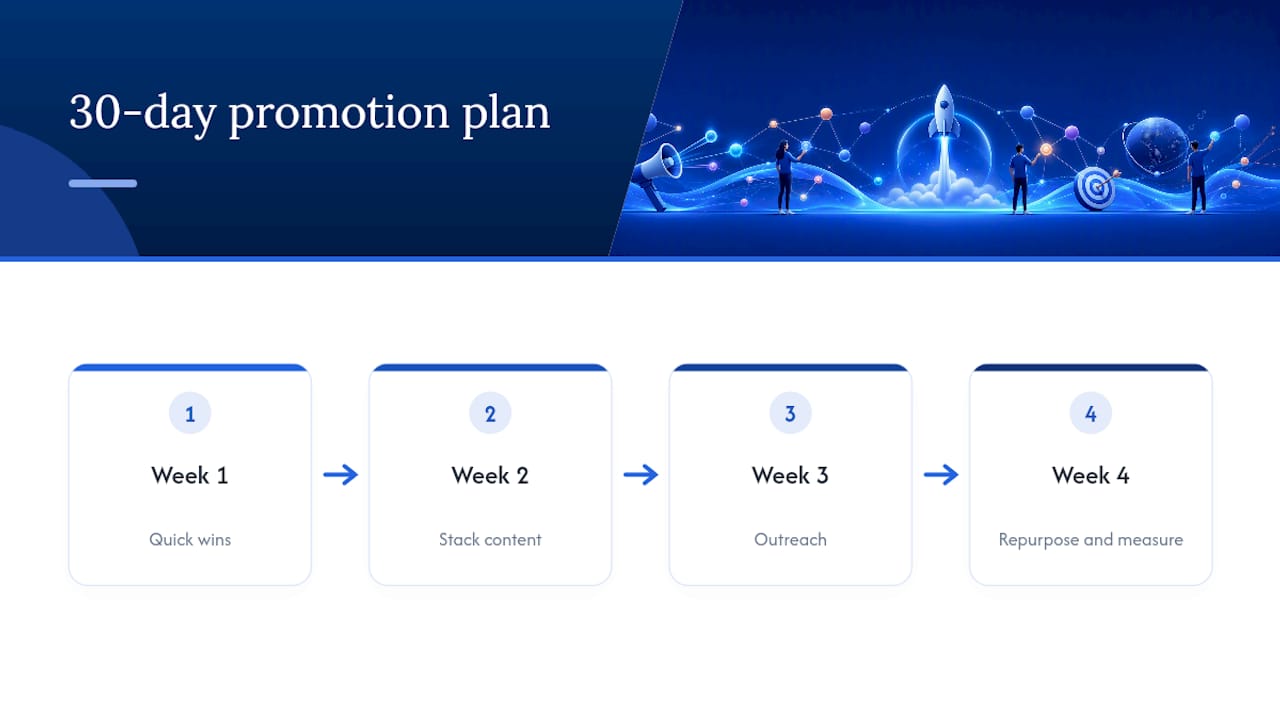
Week 1: Foundations and quick wins
This week is about setting up assets you'll lean on for months.
- Claim your Google Business Profile and fill in hours, categories, photos, and a real business description. GBP is widely considered the single most powerful free local SEO tool going, because it puts you directly in front of people already searching for what you do.
- Polish one social profile — bio, link, profile photo, pinned post.
- Add the link to your email signature with a one-line reason to click.
- Optimise one page's on-page SEO: title tag, H1, meta description, and a long-tail keyword woven naturally through the first 100 words.
Week 2: Publish something genuinely useful
Write one blog post that answers a real question your customers ask you constantly. Not a listicle for the sake of it. A proper "here's exactly how to do this" guide. While you're there, slot in a lead magnet placeholder (a checklist or template you'll build out properly later).
Week 3: Go knock on doors
Submit your site to two or three relevant directories. Pitch one guest post to a blog your audience already reads. Ask five happy customers for a review, on Google or wherever your industry lives.
Week 4: Repurpose and measure
Take that Week 2 blog post and chop it into three short video clips, a carousel post, and an email snippet. Then set up Google Search Console and GA4 if you haven't already, so you can actually see what's working.

Pro Tip: Batch your "daily" tasks into 30 to 60 minute blocks and attach them to something you already do, like your morning coffee. Free marketing dies not from lack of ideas but from lack of a system that survives a busy Tuesday.
On-site SEO and technical basics that actually move the needle
Most people treat SEO like a mystical art performed by wizards in hoodies. It's not. For a small site, on-page SEO is mechanical, repeatable, and free.
Start with long-tail keywords, phrases of three or four words that are specific and low-competition. "Best CRM" is a bloodbath you'll never win without a budget. "Best CRM for solo real estate agents" is a fight you can actually pick and win. Long-tail phrases are consistently the most effective free SEO lever for new or small sites because they face less competition and tend to convert better, since the searcher already knows exactly what they want.
Place your target long-tail keyword in:
- The title tag
- The H1 heading
- The first 100 words of the page
- The meta description
- At least one image alt tag
The technical stuff that costs nothing to fix
Before you write another word of content, check these boxes:
- Mobile friendliness — most of your traffic is on a phone. If your site looks broken on mobile, nothing else matters.
- Page speed — a slow site bleeds visitors before they read a word.
- HTTPS — if you don't have the padlock, fix it today.
- Indexability — make sure your robots.txt isn't accidentally blocking Google, and that you've submitted a sitemap.
Internal linking: the free traffic redistribution trick
Internal links pass authority from your popular pages to the pages that actually make you money. If your blog post is getting traffic but your services page is a ghost town, link from the post to the page. It's the simplest structural fix on this entire list, and almost nobody bothers doing it properly.
Pro Tip: Build one "money" page (your main service or product page) and support it with three blog posts that each target a related long-tail keyword and link back to it. That's four pieces of content working as one topical cluster instead of four random shouts into the void.
Here are the free tools to bookmark right now:
| Tool | What it's for |
|---|---|
| Google Search Console | Tracks clicks, impressions, average position, and indexing issues |
| PageSpeed Insights | Diagnoses speed problems on mobile and desktop |
| Google Keyword Planner | Finds search volume for keyword ideas |
| Ubersuggest | Suggests long-tail keyword variations and competitor gaps |
| AnswerThePublic | Maps the exact questions people are typing into search engines |
Once Search Console is running, check these baseline metrics weekly and watch the trend, not the daily wobble:
| Metric | What "good" looks like early on |
|---|---|
| Organic clicks | Slow, steady climb week on week |
| Impressions | Should rise faster than clicks at first |
| Average position | Moving from page 3+ toward page 1 or 2 |
| Page speed score | Above 70 on mobile is a solid baseline |
Solid technical SEO on its own also feeds into how AI-powered search tools understand your site, which is worth a closer look if you want your content surfacing in answer engines as well as classic search results.
Content that attracts links and converts
Content marketing is the engine room of free promotion. It's the thing that turns a static "we exist" website into a place people actually trust. Content built around solving a real, specific customer problem attracts backlinks and shares far more reliably than an opinion piece nobody asked for.
Here's how to find what to write about:
- Plug your topic into AnswerThePublic and screenshot the actual questions people are asking.
- Cross-check search volume with Ubersuggest.
- Pick the question you can answer better, more specifically, or more honestly than the top-ranking result.
Lead magnets that people actually want
A generic "download our free guide" gets ignored. Specific stuff gets clicked:
- A checklist (like "12-point website launch checklist")
- A template (a swipe-file email, a budget spreadsheet, a content calendar)
- A short email course (five days, one tip per day)
The repurposing framework
One good blog post shouldn't die alone on page one of your blog. Push it through this chain:
Blog post → short video clips → social carousel → email snippet → downloadable checklist.
Repurposing one solid piece of long-form content into smaller formats multiplies your reach without multiplying your workload. It's the closest thing to a free lunch in marketing.
Pro Tip: A step-by-step guide with original examples and a bit of your own data (even anecdotal) earns more backlinks than a generic "top 10" post, because it gives other writers something specific to cite.
Consistency beats intensity here. One well-considered post a fortnight, published on schedule, will outperform four posts crammed into one manic weekend followed by three months of silence. If you need a framework for planning that cadence without burning out, a content marketing checklist built for small teams is worth working from.
Guest posting, directories, and Google Business Profile that pull their weight
Off-page work is where you borrow other people's audiences instead of building yours from scratch every time.
Guest blogging that doesn't get ignored
- Find blogs your ideal customer already reads (not blogs that just accept anyone).
- Pitch a specific angle, not "can I write for you?" Editors delete vague pitches on sight.
- Offer a short, punchy draft outline in the first email, not just an idea.
- Negotiate an author bio with one link back to a relevant page on your site.
Directories and the NAP consistency trap
List your business consistently across relevant directories. The trap here is small formatting inconsistencies, like "St." in one listing and "Street" in another. That mismatch can quietly weaken your local search signals, so pick one canonical format for your Name, Address, and Phone number and paste it identically everywhere.
Prioritise directories that:
- Are actually relevant to your industry, not generic spam directories
- Allow a real business description and category
- Show up when you search your own business category plus location
Google Business Profile deserves its own moment
GBP is free, and it's arguably the single biggest bang-for-buck local visibility tool available. Fill in every field: hours, services, photos, categories, and a proper business description with your key terms woven in naturally. Post an update at least monthly. Encourage every happy customer to leave a review, because review volume and freshness both influence how often you show up in local results. Our own breakdown of local business marketing tips goes deeper on getting GBP working properly for a local audience.
Outreach email structure that gets replies
- Subject line: specific, not clickbait ("Quick idea for [their blog name]")
- First line: prove you actually read their content
- Ask: one clear, small request
- Follow-up: one polite nudge after five to seven business days, then let it go
For a broader list of no-cost link-building tactics and sites worth pitching, this backlink resource is a solid companion to your outreach list.
Use social platforms and niche communities without paid ads
Social media isn't about being everywhere. It's about being consistently useful in one or two places your actual audience hangs out.
Pick your one or two platforms based on where your customers already are, not where you personally enjoy scrolling. A tradie's audience is not swiping through the same app as a boutique jewellery brand's audience.
Community posting without getting torched
Reddit, niche forums, and Q&A sites like Quora can send solid, targeted traffic, but only if you play by the room's rules:
- Answer the actual question first. Link only when it genuinely adds value, not as the entire point of your comment.
- Read the community rules before posting anything. Some subreddits ban links outright; others welcome them if you've been an active member for a while.
- Build a reputation before you promote. Show up, answer things, help people, and your link becomes a bonus, not a spam flag.
Link-in-bio tools for single-link platforms
Instagram and TikTok give you one link. Tools like Linktree and Carrd turn that single link into a mini landing page with multiple destinations, your blog, your shop, your booking page, all in one tap. If you're posting content across multiple platforms and pointing them all at one profile, a link-in-bio page saves you from constantly editing your bio link every time you publish something new.
Pro Tip: Treat social platforms as a discovery layer, not a sales floor. The account that only ever posts "buy now" gets muted. The account that's genuinely useful gets followed, and eventually clicked.
Dos and don'ts, quickly:
- Do show up consistently, even if it's just twice a week.
- Do reply to every comment for the first hour after posting.
- Don't drop your link in every single comment across ten different threads in one sitting.
- Don't buy followers. Fake numbers don't convert and platforms increasingly penalise the accounts that do it.
Build and use email to drive repeat traffic
Here's the uncomfortable truth about social media: you don't own it. The algorithm can change tomorrow and your reach can vanish overnight. Your email list is the one channel you actually own outright.
Build it properly:
- Create a genuinely useful lead magnet, a checklist, a short guide, a discount code, something worth an email address.
- Place opt-in forms in your blog sidebar, your footer, and on a dedicated landing page.
- If you're speaking to an international audience, use clear, plain-language consent wording when someone subscribes, and make unsubscribing genuinely one click. Privacy expectations vary by region, so keep the language honest rather than legally clever.
- Set up an automatic welcome email that fires the moment someone subscribes, so the relationship starts before you've lifted a finger.
Then there's the signature. Every single email you send, whether it's a client reply or an invoice follow-up, is a chance to point someone back to your site. Adding your link to your email signature is one of the simplest set-and-forget tactics in this whole playbook:
- Name, title, one-line value statement
- Website link
- One social link (pick your best-performing platform, not all five)
- Optional: a link to your latest blog post or lead magnet
Keep your newsletter cadence realistic. Once a fortnight with a genuinely useful tip beats a weekly newsletter that burns out after six weeks and quietly dies.
How to measure success, key metrics and realistic timelines
Here's where most people quit too early. They post for three weeks, see nothing dramatic, and assume free marketing "doesn't work." It works. It's just not instant.
Budget for several months of consistent weekly effort before you see a sustainable uplift in organic traffic. That's the standard horizon most SEO and content practitioners point to for small sites building from scratch. Organic growth compounds, and compounding takes time to get moving, exactly the same way it takes a while for a snowball to become an avalanche.
But you're not flying blind in the meantime. Watch these early signals in the first two to eight weeks:
- A long-tail keyword climbing from page 4 to page 2
- Impressions in Search Console creeping upward, even if clicks lag behind
- A small but real trickle of referral traffic from a directory or guest post
Track these KPIs and split your review cadence:
Avoid vanity metrics. A follower count going up means nothing if it's not translating into clicks, signups, or enquiries. Rising impressions with a slowly improving average position is a genuinely good early sign, even if the click number itself still looks unimpressive.
What to avoid: things that waste time or actively hurt growth
Some of the most common "free marketing" moves people make actually cost them ranking, reputation, or both. Here's the fast fix-it list.
- Spammy link dropping. Pasting your URL into every comment section and forum thread you can find looks desperate and gets you banned. Fix it: answer the actual question first, link only when relevant.
- Publishing in bursts, then vanishing. One frantic week of five posts followed by three months of silence tells search engines and readers you're unreliable. Fix it: pick a cadence you can sustain even on a bad week, and stick to it.
- Ignoring mobile and speed while chasing volume. More blog posts on a slow, broken mobile site is like adding more toppings to a burnt pizza. Fix it: run PageSpeed Insights before you write your next post, not after.
- NAP inconsistency across directories. "123 Smith St" in one listing and "123 Smith Street" in another confuses local search signals. Fix it: pick one exact format, then go update every listing to match.
- Chasing every platform at once. Trying to be brilliant on five channels usually means being mediocre on all five. Fix it: cut to your best two.
Most of these are fixable in under an hour once you've spotted them.
Utilising social bookmarking sites and content aggregators
Social bookmarking sites and content aggregators are the quiet corner of free promotion that most people skip, and that's exactly why they're worth a look.
These platforms let you submit a link to your content where other users can upvote, comment, and share it. A well-timed submission to the right niche aggregator can send a genuine spike of referral traffic, plus a valuable inbound link if the platform allows it.
The trick is relevance and timing. Submitting your generic homepage to a broad aggregator gets ignored. Submitting a genuinely useful, specific post (a tutorial, a data-backed guide, an original take) to a community that cares about that exact topic gets attention. Treat these platforms the same way you'd treat a forum: contribute value, don't just drop links, and read the submission guidelines before you post anything.
Participating in free online events or webinars
Hosting or joining a free webinar is one of the most underused ways to build authority and drive traffic without spending a cent on ads.
If you host one, pick a genuinely specific topic, not "everything about our industry." A 30 to 45 minute session on one tightly scoped problem, with a Q&A at the end, gives attendees a reason to visit your site afterward for the resources you mention.
If hosting feels like too much right now, guest-appear on someone else's webinar or podcast instead. You get access to their audience, they get free expert content, and you walk away with a link and a mention. Either way, always close with a specific, memorable call to your website, not a vague "check us out sometime."
A strategist's take: when free is enough, and when it's time to pay
Free marketing is the foundation. Paid ads are the accelerator. Confusing the two is where most small business owners waste months.
Free methods are how you build compound growth: content that keeps ranking, a list that keeps growing, listings that keep converting quietly in the background. None of that needs a media budget. It needs consistency.
Here's the decision checklist I'd run before spending a single dollar on ads:
- Is there a proven conversion funnel already? If people who land on your site never buy or enquire, paid traffic just pours more people into a leaky bucket faster.
- Does a sustainable offer already exist? Paid ads amplify what's working. They don't fix a weak offer.
- Do you need predictable, scalable volume right now? If organic is trickling in nicely but you need a specific number of leads by a specific date, that's exactly when paid earns its keep.
A sensible hybrid looks like this: publish organically first, watch which piece of content or which page quietly outperforms the rest, then put a small paid budget behind that specific winner to scale it faster. You're not guessing with cash. You're backing a horse that's already shown form.
That's the real difference between free and paid. Free finds the winners. Paid scales them.
If you need faster results, paid ads are a legitimate shortcut
Everything above works. It also takes time, because organic growth compounds rather than spikes. If you've built a page that converts and you need volume now, not in month four, paid ads are the honest next move, not a failure of the free strategy.
The maths is simple: once you know a page reliably turns visitors into leads or sales, paid traffic to that exact page has a predictable return. That's the whole game, and it's where Adsdaddy comes in. Adsdaddy runs targeted campaigns across Facebook, Instagram, Google, YouTube, Microsoft Bing, and LinkedIn, so instead of guessing which platform your budget should go to, you get a strategy built around where your specific audience actually is.

You don't need to abandon the free playbook to start. Keep publishing, keep building your list, keep polishing your Google Business Profile. Paid just puts a megaphone behind the pages already proving themselves. If you want a second opinion on where your budget would work hardest, book a free consult with Adsdaddy and find out before you spend a cent.
Five things to remember and act on today
The fastest path to free website traffic is stacking long-tail SEO, a fully optimised Google Business Profile, problem-solving content, and consistent email outreach into one repeatable monthly rhythm.
| Point | Details |
|---|---|
| Start with three micro-tasks | Claim your Google Business Profile, add your site link to your email signature, and optimise one page for a long-tail keyword. |
| Follow the month-one rhythm | Foundations in week one, one solid blog post in week two, outreach in week three, repurposing and measurement in week four. |
| Watch early signals, not miracles | Look for keyword and impression gains within two to eight weeks, but budget three to six months for real, sustainable traffic growth. |
| Fix technical issues before publishing more | Mobile speed, HTTPS, and indexability problems undercut every piece of content you publish until they're resolved. |
| Scale winners with Adsdaddy when ready | Once a page converts reliably, Adsdaddy can run targeted paid campaigns to amplify it across search and social. |
Free tools and references to get started
You don't need a subscription stack to run this whole plan. Here's what to sign up for right now, and why each one earns its place.
- Google Business Profile — your local visibility control panel, and free to claim in minutes.
For earning media coverage without a PR budget, HARO (Help a Reporter Out) connects you with journalists actively looking for expert sources, and free press release distribution services can get a genuine announcement in front of niche publications. Both take a bit of patience, but a single pickup can deliver a backlink no amount of forum posting ever will.
The pattern across nearly every credible guide to free website promotion is the same: long-tail SEO plus a maintained Google Business Profile plus consistent, problem-solving content outperforms scattergun tactics every time, and it does so without spending a cent on media.
FAQ
How to get 1,000 visitors a day to your website?
There's no single free trick that delivers that overnight. It's the compound result of long-tail SEO, consistent content publishing, an optimised Google Business Profile, and repurposing content across social and email, sustained over several months rather than weeks.
Can I publish my own website for free?
Yes. Free website builders and hosting tiers exist, though most come with limitations on design control, storage, or branding. Once your site is live, the promotion tactics in this guide, on-page SEO, content, and email, cost nothing extra to run.
Can I put my website on Google for free?
Yes. Submitting a sitemap through Google Search Console and ensuring your site isn't blocked in robots.txt gets it indexed at no cost. Getting indexed is step one; ranking well for the keywords that matter is the ongoing work covered throughout this guide.
Is there a way to advertise for free?
Yes, through owned and earned channels rather than paid placements: on-site SEO targeting long-tail keywords, a fully filled-out Google Business Profile, problem-solving content, guest posts, directory listings, and email. If you later need faster, scalable volume, that's when a paid approach through a platform like Adsdaddy becomes worth considering.
How long does free website promotion take to work?
Expect early signals, like keyword or impression gains, within two to eight weeks, but budget three to six months of consistent effort before seeing a sustainable lift in organic traffic.