Geo Targeting: Boosting Local E-Commerce Sales in Australia
. By Ads Daddy.

Geo-targeting can drive up to 30 percent higher conversion rates for australian e-commerce businesses compared to standard online marketing. For small and medium retailers, reaching customers in the right suburb or region means more relevant offers and reduced wasted ad spend. This introduction guides you through the practical ways geo-targeted strategies personalise shopping experiences so your australian store connects with local buyers and stands out in a crowded market.
Table of Contents
- Geo Targeting Explained For E-Commerce
- Types Of Geo Targeting In Digital Ads
- How Geo Targeting Works On Major Platforms
- Legal And Data Privacy In Australia
- Maximising Roi And Avoiding Common Mistakes
Key Takeaways
| Point | Details |
|---|---|
| Effective Personalisation | Geo targeting allows e-commerce businesses to create tailored online experiences for customers based on their geographic location. |
| Utilising Advanced Techniques | Techniques like geofencing and IP address targeting enhance the effectiveness of marketing campaigns, providing precise audience segmentation. |
| Compliance is Essential | Australian businesses must adhere to legal frameworks regarding data privacy, ensuring explicit consent and robust data protection measures. |
| Continuous Refinement | Regularly analyse geo-targeting performance metrics to optimise advertising strategies and enhance ROI. |
Geo Targeting Explained for E-Commerce
Geo targeting is a powerful digital marketing strategy that enables e-commerce businesses to deliver personalised online experiences tailored specifically to customers based on their geographic location. By customising content through location detection, online retailers can dramatically improve user engagement and conversion rates.
At its core, geo targeting uses sophisticated technologies like IP address tracking, GPS data, and mobile network information to understand precisely where a potential customer is located. This allows businesses to adapt their digital storefronts in real time, showing region-specific pricing, shipping options, currency, and culturally relevant product recommendations. Australian e-commerce businesses can leverage this approach to create hyper-localised marketing strategies that speak directly to customers in specific cities, suburbs, and regions.
The mechanics of geo targeting involve multiple sophisticated techniques. Businesses can segment audiences by country, state, postcode, or even precise neighbourhood boundaries. This granular approach means a boutique clothing store in Melbourne can show different product ranges and promotions to customers in Sydney versus those in rural Western Australia. Advanced geo targeting platforms can also help businesses adjust their advertising spend, focusing resources on high-potential geographic markets with demonstrated purchasing power.
Pro tip: Start small by geo-targeting your existing customer base to understand location-based purchasing patterns before expanding to broader targeting strategies.
Types of Geo Targeting in Digital Ads
Geo targeting in digital advertising encompasses several sophisticated strategies that allow businesses to deliver highly personalised marketing messages based on geographic location. Advanced targeting techniques enable marketers to segment audiences with remarkable precision, transforming how online advertisements engage potential customers.
The primary types of geo targeting include location targeting, which segments audiences by country, state, city, or neighbourhood; audience targeting, which combines geographic data with demographic insights; and contextual targeting, such as weather-based advertising. Location targeting allows businesses to create hyper-localised campaigns that resonate with specific regional audiences. For instance, a surf shop in Queensland might showcase different products to customers in tropical regions compared to those in cooler southern states.

More advanced geo targeting methods include geofencing, IP address targeting, and hyperlocal marketing. Geofencing creates virtual boundaries around specific locations, triggering targeted ads when users enter or exit those areas. IP targeting uses internet protocol addresses to serve location-specific content, while hyperlocal marketing focuses on extremely narrow geographic segments like specific shopping centres or suburban precincts. These techniques provide unprecedented granularity in digital advertising, allowing Australian businesses to craft messages that feel intimately personalised.
Here is a comparison of common geo-targeting methods available to Australian e-commerce businesses:
| Method | Level of Precision | Main Technology Used | Example Application |
|---|---|---|---|
| Location Targeting | City, state, neighbourhood | GPS, IP tracking | Different offers for each state |
| Geofencing | Address or venue radius | Mobile GPS, Wi-Fi | Store visits tracked for campaigns |
| IP Address Targeting | Suburb, business, postcode | IP database mapping | Custom pricing for remote regions |
| Hyperlocal Marketing | Street, shopping precinct | GPS, mobile app data | Promotions for local shoppers |
Pro tip: Experiment with different geo targeting techniques by starting with broader location segments and progressively narrowing your focus based on performance data and customer engagement metrics.
How Geo Targeting Works on Major Platforms
Sophisticated geo-targeting technologies enable digital platforms to deliver highly personalised advertising experiences by leveraging precise location data. Major digital advertising platforms like Google Ads, Facebook, Instagram, and LinkedIn have developed complex systems that allow businesses to target audiences with remarkable geographic precision, transforming how online marketing reaches potential customers.
Each platform offers unique geo-targeting capabilities that go beyond simple country or city-level segmentation. Facebook and Instagram, for example, enable advertisers to create custom audiences based on specific location parameters, including radius targeting around physical store locations, detailed neighbourhood selections, and even exclusion of certain geographic areas. Google Ads provides similar functionality, allowing businesses to adjust their advertising based on regions, postcodes, and proximity to specific landmarks or business locations.
The technical mechanisms behind geo-targeting involve multiple data points, including IP address tracking, GPS coordinates, mobile network information, and user-provided location settings. Social media platforms collect additional contextual information like check-ins, location tags, and demographic data to refine targeting capabilities. This multilayered approach ensures that advertisers can create hyper-localised campaigns that speak directly to customers in specific geographic contexts, whether they're targeting suburban Melbourne shoppers or rural Western Australian consumers.
Pro tip: Regularly update and refine your geo-targeting settings by analysing performance metrics and adjusting your geographic segments to maximise advertising efficiency.
Legal and Data Privacy in Australia
Navigating the complex landscape of data privacy requires Australian businesses to understand the rigorous legal frameworks governing geo-targeting practices. Australian Privacy Principles establish comprehensive guidelines for collecting, storing, and using location-based information, ensuring consumer protection and maintaining ethical digital marketing standards.
The Privacy Act 1988, administered by the Office of the Australian Information Commissioner (OAIC), mandates strict protocols for handling personal data. Businesses engaged in geo-targeting must obtain explicit, informed consent from users before collecting location information. This means clearly explaining how GPS coordinates, IP addresses, and other location data will be used, and providing users with transparent opt-out mechanisms. Any geo-targeting strategy must prioritise individual privacy rights, with significant penalties for non-compliance including substantial financial fines and potential legal repercussions.
Key compliance requirements for Australian businesses include implementing robust data protection measures, maintaining secure data storage systems, and conducting regular privacy impact assessments. Companies must be prepared to demonstrate that their geo-targeting practices meet the highest standards of data protection. This involves documenting consent processes, ensuring data minimisation principles are followed, and maintaining clear, accessible privacy policies that explain exactly how location data is collected, used, and protected.
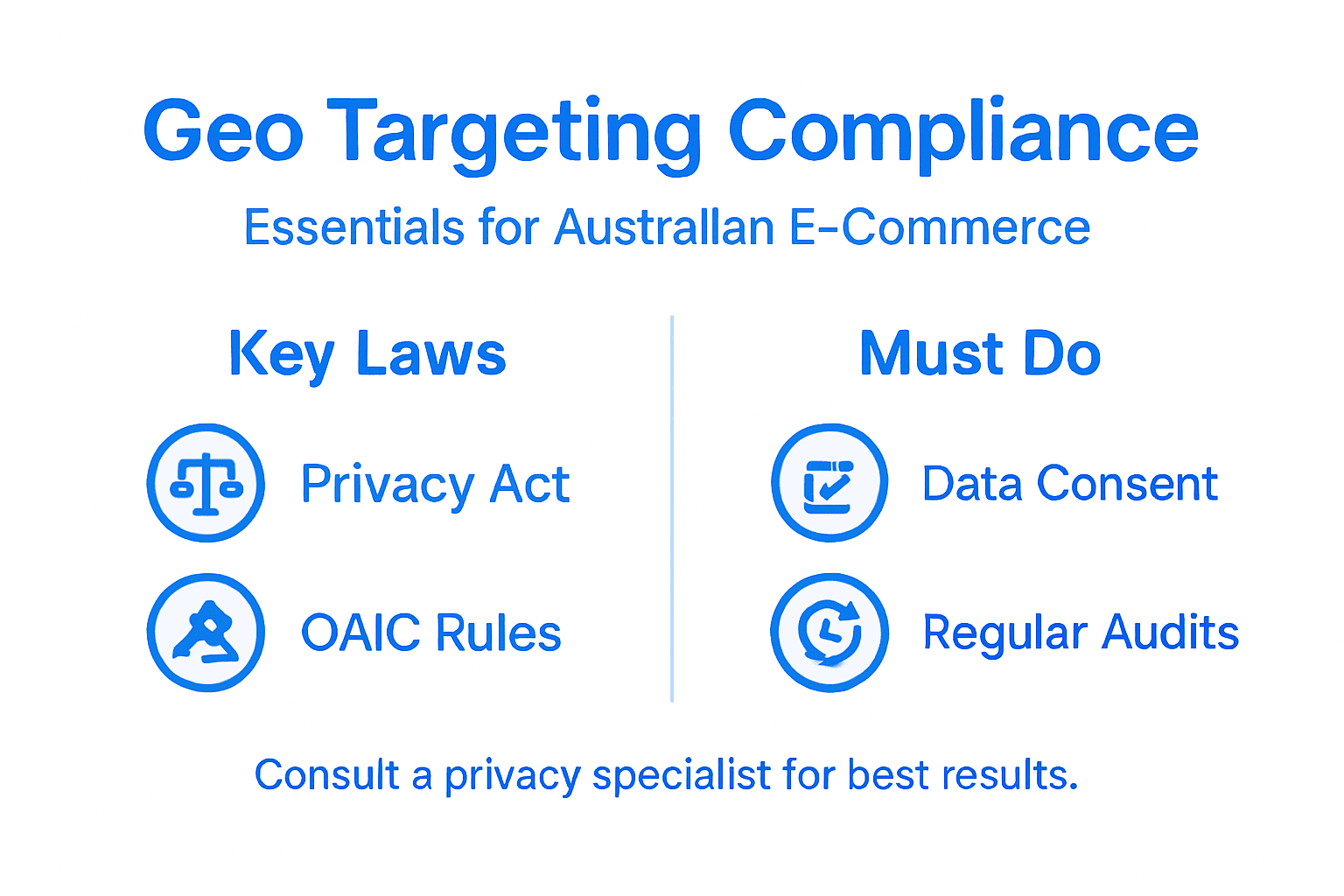
The table below summarises key legal considerations when using geo-targeting in Australia:
| Legal Aspect | Requirement | Compliance Action |
|---|---|---|
| User Consent | Must be explicit and informed | Obtain opt-in before data collection |
| Data Storage | Secure, local or compliant offshore storage | Implement robust encryption |
| Privacy Policy | Clearly state data collection and use | Update and publish privacy details |
| Regular Assessments | Conduct privacy impact reviews | Schedule and document audits |
| Penalties for Breaches | Substantial financial penalties and possible litigation | Maintain strict compliance records |
Pro tip: Consult with a privacy legal specialist to conduct a comprehensive audit of your geo-targeting practices and ensure full compliance with Australian data protection regulations.
Maximising ROI and Avoiding Common Mistakes
Targeted marketing strategies require a sophisticated approach that goes beyond simple geographic segmentation. Successful geo-targeting demands a nuanced understanding of how location data intersects with user behaviour, interests, and purchasing potential. Australian e-commerce businesses must move beyond basic demographic targeting to create truly dynamic, responsive marketing campaigns.
Common mistakes in geo-targeting include over-generalising audience segments, neglecting temporal targeting, and failing to continuously refine audience parameters. Many businesses make the critical error of treating location data as a static attribute, rather than a dynamic indicator of potential customer interest. This approach leads to poorly constructed campaigns that waste advertising budgets and deliver minimal returns. Smart marketers understand that location is just one piece of a complex targeting puzzle, requiring integration with behavioural insights, purchase history, and real-time engagement metrics.
To maximise return on investment, e-commerce businesses should implement a multi-layered targeting approach. This involves creating detailed customer personas that combine geographic information with deep behavioural analysis. Sophisticated geo-targeting means understanding not just where customers are located, but their specific preferences, purchasing patterns, and contextual motivations. Businesses should invest in robust analytics platforms that can track and interpret location-based data in conjunction with other critical marketing signals, enabling more precise and effective targeting strategies.
Pro tip: Implement a monthly review process to analyse your geo-targeting performance, tracking key metrics like conversion rates, customer acquisition costs, and geographic engagement levels to continuously refine your targeting approach.
Unlock the Full Power of Geo Targeting with AdsDaddy
E-commerce businesses in Australia face the challenge of turning geographic insights into real sales growth. This article shows how personalised location-based marketing is the key to boosting local engagement and conversions. However, implementing precise geo targeting across platforms like Facebook, Instagram, and Google Ads can be complex and time-consuming. Common pain points include accurately segmenting audiences, complying with privacy laws, and continuously optimising campaigns to maximise ROI.
That is where AdsDaddy comes in. Our digital marketing experts specialise in creating, managing, and optimising targeted advertising campaigns that harness sophisticated geo targeting techniques. We help you reach local customers with tailored ads that consider their unique location, behaviour, and preferences. By leveraging data-driven strategies and intuitive ad formats including image, video, and carousel ads, we drive your local e-commerce growth faster and smarter.

Ready to turn geographic data into your biggest sales advantage Take control of your local marketing with AdsDaddy today and experience expert campaign management that elevates your Australian online store. Visit AdsDaddy now to get started and see how precision geo targeting can transform your visibility and revenue.
Explore our solutions for optimising multi-platform ads at AdsDaddy and learn more about crafting campaigns that connect deeply with local audiences.
Frequently Asked Questions
What is geo targeting in e-commerce?
Geo targeting in e-commerce is a digital marketing strategy that customises online experiences for customers based on their geographic location, enabling businesses to show location-specific content, pricing, and product recommendations.
How does geo targeting improve online sales?
By using geo targeting, businesses can create personalised shopping experiences that resonate with local customers, ultimately enhancing user engagement and conversion rates, leading to increased online sales.
What are the main types of geo targeting used in digital advertising?
The main types of geo targeting include location targeting, audience targeting, contextual targeting, geofencing, IP address targeting, and hyperlocal marketing, each allowing businesses to focus their marketing efforts on specific geographic segments.
What legal considerations should Australian e-commerce businesses be aware of when using geo targeting?
Australian businesses must comply with the Australian Privacy Principles, which require explicit user consent for data collection, secure data storage, clear privacy policies, and regular privacy assessments to protect consumer information.
Recommended
- Why Use Targeted Ads: Complete Guide for Australia 2026 - Ads Daddy. Advertise on All Plattforms.
- content Archives - Ads Daddy. Advertise on All Plattforms.
- Facebook Ads Archives - Ads Daddy. Advertise on All Plattforms.
- business growth Archives - Ads Daddy. Advertise on All Plattforms.
- UK beauty retailer | Google Ads, Meta Ads & Strategy || A&T Agency