Free online marketing courses Australians can start today
. By Ads Daddy.

The fastest way to build a foundation in digital marketing without spending a cent is to combine three courses: Google's Fundamentals of Digital Marketing, HubSpot Academy's Digital Marketing certification, and Meta Blueprint. Together they cover SEO, paid ads, email, social, and analytics — the full stack. Here's where to start:
- Google Fundamentals of Digital Marketing (Google Skillshop) — best for absolute beginners who want a structured, module-by-module intro with a free certificate
- HubSpot Academy Digital Marketing — best for learners who want a free, recognised certificate covering content, SEO, email, and reporting in one course
- Meta Blueprint — best for anyone focused on Facebook and Instagram advertising
- Coursera (audit mode) — best for learners who want university-backed depth without paying for a credential
- Alison — best for self-paced learners who want free enrolment and optional paid certification
- edX / FutureLearn — best for strategy-level thinking backed by real universities
Key takeaways
Free online marketing education works best when you pair recognised micro-certifications with real portfolio projects and free tools from day one.
| Point | Details |
|---|---|
| Start with Google and HubSpot | Google Fundamentals and HubSpot Academy both offer free, recognised certificates covering SEO, email, social, and analytics. |
| Audit mode unlocks university content | Coursera and edX let you access full course content for free; pay only if you need the shareable certificate. |
| Portfolio beats certificates | A live SEO audit, a 3-post social campaign, and a welcome email series demonstrate more capability than credentials alone. |
| Use free tools from day one | Google Search Console, Keyword Planner, Canva, and Brevo free tier give you real data to practise with at zero cost. |
| Adsdaddy for fast execution | When urgency is high and the stakes are real, Adsdaddy manages campaigns across Google, Facebook, Instagram, and more so you get results without the wait. |
Table of Contents
- What do the best free online marketing courses actually cover?
- How do you choose the right course and build a learning roadmap?
- Which free tools and templates should you use while you learn?
- Free vs paid certificates: what actually matters to employers?
- Where can Australians find free local training and workshops?
- When should you keep learning and when should you just hire someone?
- Already past the learning curve? Here's a faster path to results
- Sources
- FAQ
What do the best free online marketing courses actually cover?
Not all free courses are built the same. Some are glorified sales funnels. These six are genuinely worth your time.
Google's Fundamentals of Digital Marketing is 26 modules built around practical exercises. It's the closest thing to a free marketing degree you'll find online, and it's accredited by the Interactive Advertising Bureau Europe. HubSpot's course is shorter but punchy — you can finish it in a weekend and walk away with a certificate that hiring managers actually recognise.
Meta Blueprint's free learning content is solid for social ads. The paid certification is optional, so you can absorb everything without touching your wallet.
Coursera's audit mode is the hidden gem most people miss. You get full access to course content from universities like the University of Edinburgh — including modules on user personas, competitor audits, and practical strategy — without paying for the certificate. The University of Edinburgh's digital marketing strategy short course, available through platforms like edX and FutureLearn, is particularly good for building a real strategy framework rather than just channel tactics.
Alison requires you to complete assessments to graduate, which is actually a feature, not a bug. It forces you to retain what you learn.
Pro Tip: Start with Google Fundamentals for breadth, then layer HubSpot's certification on top for depth. You'll have two recognised credentials and a full skill set before you've spent a dollar.
How do you choose the right course and build a learning roadmap?
Think of it like training for a sport. You don't start with the grand final. You build the fundamentals, then specialise.
Here's a decision checklist before you enrol in anything:
- How much time do you have per week? Less than 3 hours? Stick to HubSpot's short courses. Got 5+ hours? Google Fundamentals is your starting point.
- What's your goal? Job seeker needs a certificate. Business owner needs practical skills fast. Creator needs content and social knowledge.
- Which channel matters most to your situation? Social, search, email, or paid ads? Pick one pillar first.
- Do you need a credential? If yes, prioritise Google Fundamentals (free cert) and HubSpot Academy (free cert). Coursera and edX certificates cost money.
- Do you want hands-on practice? Google and HubSpot both include exercises. Coursera audit mode gives you assignments without grading.
The beginner-to-job-ready roadmap
Weeks 1–4: Foundations. Complete Google Fundamentals of Digital Marketing. Don't skip the exercises. By the end, you'll understand how search, social, email, and analytics connect.

Weeks 5–8: Channel specialisation. Pick your primary channel. Social? Do Meta Blueprint. Content and email? Do HubSpot's full certification. Strategy? Audit a Coursera or edX course from a university.
Weeks 9–12: Analytics and measurement. Set up Google Analytics and Google Search Console on a real or practice site. Run a basic SEO audit. Build a simple reporting dashboard.
Month 4 onwards: Portfolio. Stop collecting courses. Start building work. One real project beats five certificates every time.
Pro Tip: *Use the SES framework to sequence your learning: Search first, then Email, then Social. These three pillars cover the highest-ROI channels and protect you against algorithm changes because search and email are owned or earned, not rented from a platform.
Which free tools and templates should you use while you learn?
Learning without practising is like watching cooking videos and never touching a pan. Here are the tools to use from day one.
- Google Search Console — tracks how your site appears in search results; verify ownership on day one so data starts collecting immediately
- Google Keyword Planner — free keyword research inside Google Ads; no spend required to use the tool
- Google Analytics — measures traffic, behaviour, and conversions; pairs directly with Search Console
- Canva — free tier covers social graphics, presentations, and ad creatives; no design experience needed
- Brevo (formerly Sendinblue) or Mailchimp free tier — build and send email campaigns to up to a few hundred subscribers at no cost
- Meta Ads Manager — create and preview ad campaigns without spending; use it to understand targeting and creative formats
- Ahrefs Free — permanently free account with keyword and backlink tools; some features unlock only after you verify site ownership
For templates, HubSpot's marketing blog offers free downloadable planning resources including content calendars, campaign briefs, and email series templates. Grab them and fill them in as you complete each course module.
Three mini assignments to build your portfolio
| Assignment | What to do | Deliverable |
|---|---|---|
| SEO page audit | Pick one page on a real or practice site, research one target keyword in Keyword Planner, and rewrite the title tag, meta description, and first paragraph | One-page audit doc with before/after |
| 3-post social campaign | Plan a 3-post Instagram or Facebook campaign for a real or fictional product; write copy, design graphics in Canva, and map to a simple goal | Content calendar + 3 finished posts |
| Welcome email series | Write a 3-email onboarding sequence for a new subscriber; build it in Brevo or Mailchimp free tier and send a test | Live email flow with subject lines and copy |
These three pieces, done well, are enough to show a potential employer or client that you can think strategically and execute. For deeper competitor research to pair with your SEO audit, a step-by-step competitor analysis guide walks you through the no-cost process.
Pro Tip: Verify your Google Search Console and Ahrefs Free accounts on the same day you start your course. Both tools need time to collect data, and you want real numbers to work with by the time you hit the analytics module.
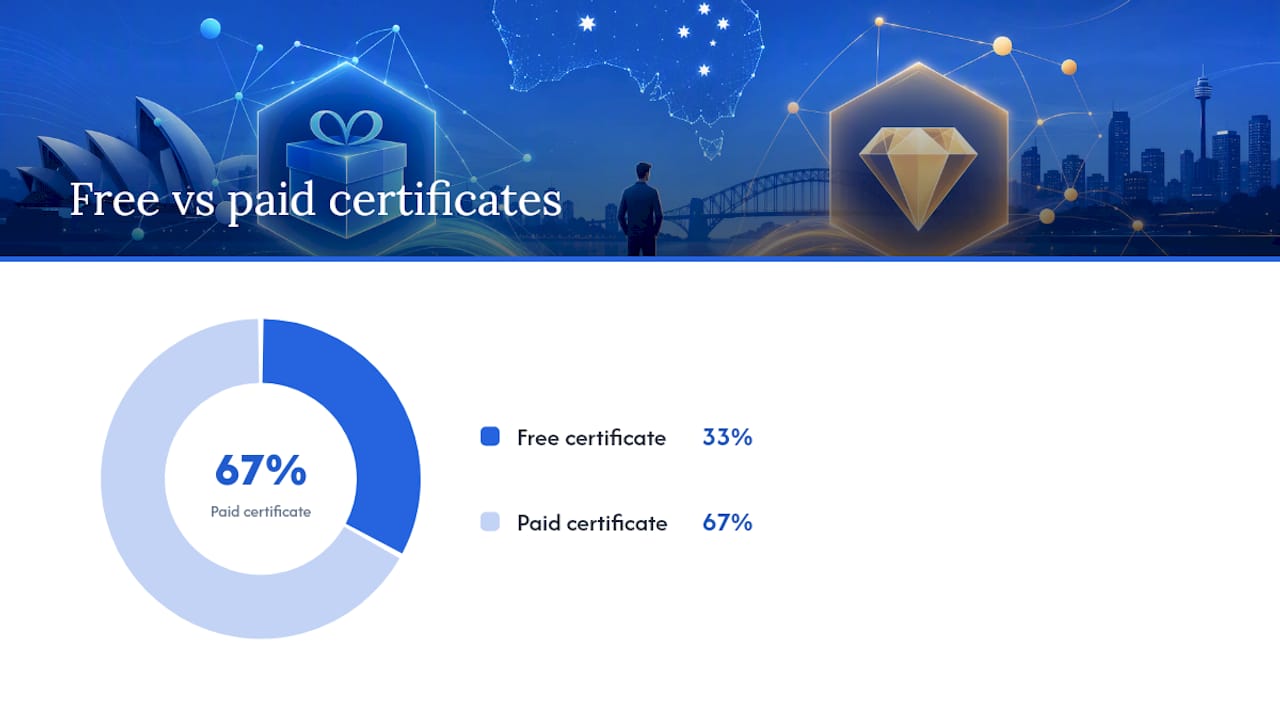
Free vs paid certificates: what actually matters to employers?
Here's the honest answer: the certificate matters less than the work behind it.
That said, some free certificates carry genuine weight:
- Google Fundamentals of Digital Marketing — free certificate, accredited by the Interactive Advertising Bureau Europe; widely recognised by Australian employers
- HubSpot Academy — free certificate across multiple courses; HubSpot is a household name in marketing, so the credential lands well
- Alison — free to learn and complete assessments; the certificate itself costs money, but the learning is free and the assessment requirement means you actually earned it
- Coursera and edX (audit mode) — full course content is free; the shareable certificate requires payment; audit mode is worth it for the knowledge even without the credential
- Meta Blueprint — free learning content; the official Meta Certified Digital Marketing Associate credential requires a paid exam
For portfolio projects, think like a client brief. Include a target audience, a channel plan, a simple KPI, and a results hypothesis. Employers want evidence of thinking, not just a PDF certificate. An SEO audit with before/after data, a four-week social content calendar, or a live email onboarding flow all demonstrate more capability than a certificate alone.
When you're ready to go deeper on creating buyer personas for your portfolio projects, that's a skill that shows up in every strategy module and every job interview.
Where can Australians find free local training and workshops?
Online courses are great. But nothing accelerates learning like a real human giving you feedback on your work.
- Local libraries — many state and council libraries run free digital skills workshops; check your local library's events calendar monthly
- TAFE short courses — TAFE institutes across Australia offer low-cost and sometimes subsidised digital marketing short courses; check your state TAFE's website for current offerings
- State small-business centres — Business Victoria, Business NSW, and equivalent state bodies run free workshops and webinars on digital marketing for small businesses
- University short courses — the University of Edinburgh's digital marketing strategy course is accessible online from Australia through edX and FutureLearn; other Australian universities offer similar short-course programmes
- Google Digital Garage live events — Google periodically runs free in-person and virtual workshops in Australian cities; sign up through the Digital Garage website
When you attend a workshop or meet a mentor, bring three things: your portfolio project (even a draft), a list of two or three specific questions, and your Google or HubSpot certificate as a conversation starter. Ask the organiser whether they can connect you with a local business owner who needs a volunteer marketing assistant — that's how most people land their first real brief.
When should you keep learning and when should you just hire someone?
Here's my honest take: most people spend too long in learning mode and not enough time in doing mode.
Free courses are brilliant for building foundations. But there's a point where more courses stop compounding and start delaying. If you've completed Google Fundamentals and HubSpot's certification, run a real SEO audit, and built a social campaign, you know enough to execute. More courses at that point are procrastination dressed up as productivity.
The decision rule is simple: complexity × urgency × impact. If your marketing need is high urgency (you need leads this month, not next quarter) and high impact (it's the primary growth lever for your business), hire a specialist. The ROI on speed-to-market almost always beats the ROI on six more weeks of self-study.
Think of it like plumbing. You can absolutely learn to fix a leaky tap on YouTube. But if your pipes burst and you've got water through the ceiling, you call a plumber. The cost of delay is higher than the cost of expertise.
If you're building long-term capability — you want to understand what your agency is doing, manage a junior marketer, or run your own channels in-house — keep learning. That's a different goal and free courses serve it well.
The middle path works too. Learn the strategy, outsource the execution. You'll brief better, waste less money, and hold your agency accountable.
Already past the learning curve? Here's a faster path to results
Free courses teach you the rules. Adsdaddy runs the game.
If you're a time-poor business owner who needs leads now, not in three months, Adsdaddy sets up, manages, and optimises paid campaigns across Facebook, Instagram, Google, YouTube, and LinkedIn. No learning curve. No trial and error on your ad budget. Just campaigns built on data-driven strategy from day one.

The hybrid approach works well for a lot of Australian businesses: use free courses to understand the fundamentals, then hand execution to a team that does this every day. You stay informed, your agency stays accountable, and your campaigns actually run while you're focused on the business.
Ready to skip the DIY phase? Book a free strategy call with the Adsdaddy team and find out what a properly managed campaign looks like for your budget and goals.
Sources
Every link below is accessible from Australia and free to start:
- Internet marketing guide and free templates — HubSpot Blog
Coursera and edX audit mode is worth flagging: you get every lecture, reading, and assignment. You just can't submit for a graded certificate. For building skills and portfolio work, that's all you need.
FAQ
Can you really learn digital marketing for free?
Yes. Google Fundamentals of Digital Marketing, HubSpot Academy, and Meta Blueprint all offer full course content at no cost, with free certificates available from Google and HubSpot.
How do you do free marketing online with no money?
Start with owned channels: set up a Google Business Profile, publish consistent content on one social platform, and build an email list using a free tier like Brevo or Mailchimp. These channels cost time, not budget.
Can I do digital marketing for free?
Absolutely. Free tools like Google Search Console, Google Analytics, Canva, and Keyword Planner cover SEO, analytics, and creative production without any spend.
What is the 3-3-3 rule in marketing?
Definitions vary across sources. A common version refers to capturing attention in 3 seconds, delivering the core message in 3 sentences, and including a clear call to action within 3 steps. It's a useful copywriting heuristic, not a formal industry standard.
How do I show employers I know digital marketing without paid qualifications?
Build a portfolio with three pieces: an SEO audit with before/after data, a social content campaign, and a live email welcome series. Pair that with a free Google or HubSpot certificate and you have more evidence than most applicants with paid credentials.