Make People Watch: 5 Facebook Video Ad Samples with Copyable Scripts
. By Ads Daddy.
Test UGC testimonials, short product demos and founder stories first. Every one of them shares the same DNA: a visual pattern break in the first 0.5 to 3 seconds, proof of value by the 7 second mark, and one clear CTA at the end. Everything else in this Facebook video ads sample guide, the real examples, the scripts, the testing checklist, exists to help you copy that formula faster.
TL;DR:
- Testing rough, unpolished video versions first often yields better results than investing in highly produced content, especially for lower budgets.
- UGC testimonials, product demos, and founder stories are the most cost-effective and high-converting Facebook video ad formats to start with.
- Focusing on the first half second for a pattern break and showing proof within seven seconds maximizes viewer retention and reduces costs.
- Matching ad format to funnel stage is crucial: shorter, cold prospecting videos target new audiences, while longer, trust-building formats work better for retargeting.
- Continuous testing of hooks, captions, and formats with sufficient impressions ensures optimization and prevents creative fatigue.
Table of Contents
- Why these Facebook video ad examples actually work
- High-value Facebook video ad formats worth testing
- Real Facebook video ad examples worth stealing
- Copyable scripts, captions and a storyboard checklist
- Testing checklist: what to test, what to watch, what to spend
- Specs and placements cheat sheet
- How Adsdaddy tests creative before scaling spend
- Legal and copyright considerations for using content in Facebook video ads
- Integrating branding without drowning the hook
- Retargeting with Facebook video ads
- Budget allocation: small advertisers versus large advertisers
- What actually matters in this Facebook video ads sample library
- Want AdsDaddy to build and test these for you?
- Where this article's guidance comes from
- FAQ
Why these Facebook video ad examples actually work
Forget "creative." Think retention.
Facebook's algorithm doesn't care how pretty your ad looks. It cares whether people watch it. Miss the hook, and the platform quietly punishes you with higher CPMs before you've even had a chance to make your pitch. Nail the first half a second, and you're rewarded with cheaper reach and a longer runway to sell.
That's the entire game.
Here's the mechanical breakdown behind every good Facebook video ad example:
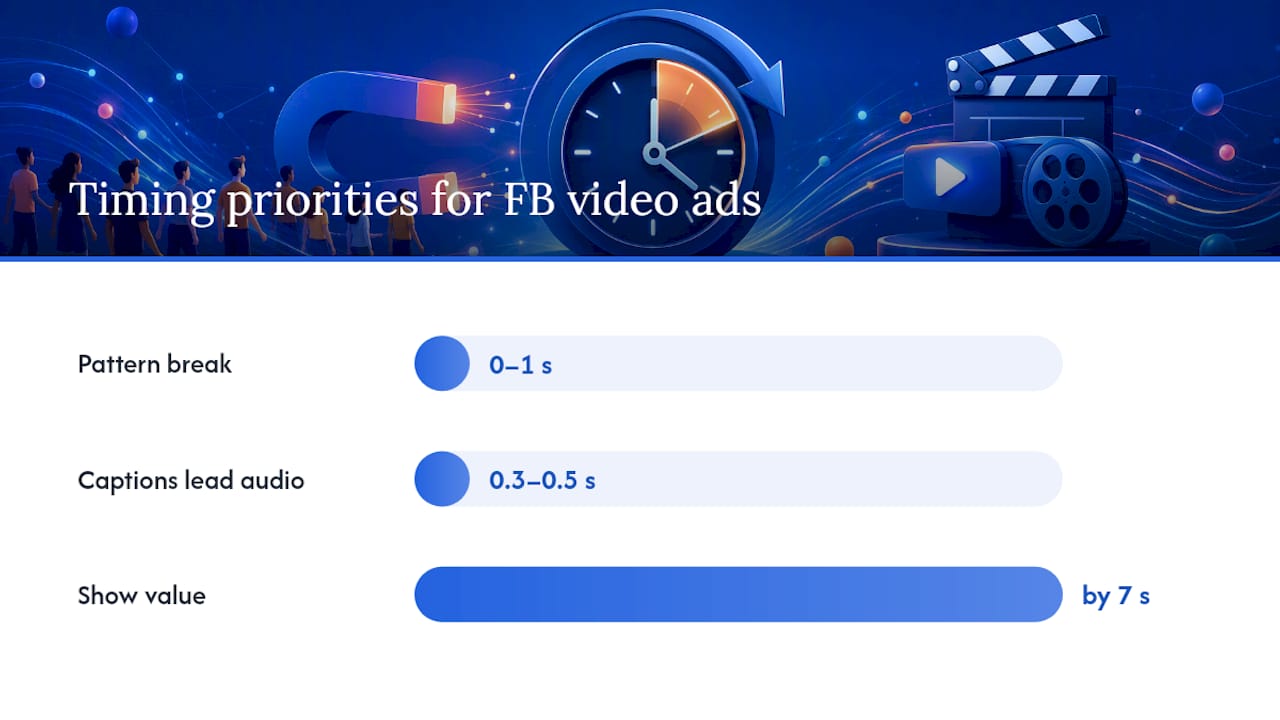
- The pattern break (0 to 1 second): a jump cut, a close-up, someone talking straight to camera mid-sentence. Something that stops the scroll like a plot twist stops a Netflix binge.
- Sound-off design: most people scroll with the sound off, so captions need to lead the audio by roughly 0.3 to 0.5 seconds and burn in as bold, punchy text, not a verbatim transcript. Write captions like headlines, not subtitles.
- Authenticity over polish: unpolished, phone-shot UGC regularly beats slick, agency-produced video. It reads as a mate's recommendation instead of an ad, and that trust gap converts.
- Value by 7 seconds: whatever you're selling, show it working, show the transformation, or show the proof before the viewer's thumb gets itchy.
- One CTA, not five: pick a single action and repeat it once in voice, once in text. Multiple CTAs is like asking someone to marry you and also split the bill on the first date.
Pro Tip: Before you invest in a "nice" video, shoot a rough phone version first. Test it against your polished cut. More often than not, the ugly one wins on cost per result, and now you've saved yourself a production budget you didn't need to spend.
The examples further down this Facebook video ads sample breakdown all lean into these same fundamentals, they just wear different outfits depending on the industry.
High-value Facebook video ad formats worth testing
You don't need twenty formats. You need five, tested properly.
- UGC testimonial (15 to 30 seconds). Best for DTC ecommerce and cold prospecting. Real customer, real phone camera, real problem solved. UGC testimonials deliver two to three times the click-through rate of branded video in Meta's own creative benchmarks, which makes this the format to test first if you sell a physical product. Watch CTR and add-to-cart rate.
- Product demo (15 to 45 seconds). Best for showing a before-and-after or a "how it actually works" moment. Great for skincare, gadgets, software with a visual interface. Watch ThruPlay rate and cost per click, because this format lives or dies on whether people stick around to see the reveal.
- Founder story (30 to 60 seconds). Best for brand lift and higher-consideration purchases where trust matters more than price. This is the "why we built this" ad. Watch engagement rate and cost per lead, since this format is built to warm people up, not close them cold.
- Listicle or educational (15 to 30 seconds). Best for cold prospecting when you're teaching a "5 mistakes" or "3 signs you need this" angle. Watch CTR and view-through rate.
- Reels and Stories short-form (6 to 15 seconds). Best for creator-first, native-feeling placements. Fast cuts, vertical only, sound-off first. Watch reach and CPM, because this format is cheap when it's done right and expensive the moment it looks like an ad.
Notice the pattern. Shorter formats chase cold, unfamiliar audiences. Longer formats do the heavy lifting with warmer audiences who already know your name. Match the format to the funnel stage, not the other way around.
Real Facebook video ad examples worth stealing
Here's where the theory becomes tactics. These are real brand approaches worth studying, broken down into the parts you can actually copy.
Monday.com's product walkthrough ads. Hook: a chaotic, cluttered spreadsheet or sticky-note wall flashes up for one second before cutting to a clean, colour-coded board. Proof moment: the interface animates itself into order, showing tasks moving across columns without a single voiceover needed. CTA: a text overlay reading something like "Get organised in minutes," paired with the standard "Learn More" button. Copy this: Monday.com's trick is the "before chaos, after clarity" cut. Film your own product's messiest use case first, then jump straight to the fix. No narration required.
Colgate's everyday-moment demo ads. Hook: a relatable close-up, someone about to eat, someone smiling, someone about to head out the door. Nothing dramatic, just familiar. Proof moment: quick, bright shots of the product in use, often paired with a dentist or expert cue for credibility. CTA: simple, benefit-led text like "Try it tonight." Copy this: familiarity is the hook here, not shock. If your product fits into a daily habit, film the habit first and let your product interrupt it naturally.
Squarespace's founder-and-creator ads. Hook: a real person, usually a small business owner, talking directly to camera about a problem they had before building their site. Proof moment: a fast montage of their finished website, often with a client testimonial voiceover layered on top. CTA: "Start your free trial," reinforced by on-screen text. Copy this: Squarespace leans hard on creator-led footage shot vertically with sound-off-first captions, a format that consistently wins early for tools and creator-economy products. Borrow the "person talking straight to camera about their old problem" opener for your own founder story.
A DTC skincare UGC testimonial. Hook: a woman filming herself in bad bathroom lighting saying "okay I need to talk about this serum." Proof moment: a 3 second side-by-side of skin texture before and after two weeks. CTA: verbal "link in the ad" plus a text overlay discount code. Copy this: the bad lighting is doing work, not hurting it. It signals "this isn't a paid actor." Shoot your testimonial in a real bathroom or kitchen, not a studio.
A SaaS "3 mistakes" listicle ad. Hook: bold text on screen reading "3 things killing your ad spend" over a fast zoom on a laptop screen. Proof moment: three quick cuts, each showing a mistake and a fix side by side. CTA: "Get the free audit," linked to a lead form. Copy this: listicles work because they promise organised value in a scroll. Number your hooks. Viewers commit to watching "number 2" even if they'd have skipped a vague headline.
A meal-kit comparison ad. Hook: two hands shown side by side, one holding a sad supermarket sandwich, one holding a fresh home-cooked plate. Proof moment: quick price and time comparison text overlay. CTA: "See this week's menu." Copy this: comparison format wins when your product has a clear "versus" story. Find your closest alternative and film the contrast literally, side by side, same frame.
A fitness app founder story. Hook: "I got dumped and started running" spoken straight to camera, deadpan. Proof moment: a quick montage of progress photos and app screen recordings. CTA: "Try 7 days free." Copy this: vulnerability beats polish here. The founder's slightly awkward delivery makes it feel unscripted, which is exactly the point.
A pet product demo ad. Hook: a dog aggressively ignoring a toy for one second before it lights up or squeaks unexpectedly. Proof moment: the dog goes wild for it. CTA: text reading "Dogs can't resist this," paired with a shop-now button. Copy this: let the reaction do the selling. No voiceover needed if the visual proof is instant and obvious.
A furniture brand Reels-style ad. Hook: a fast, satisfying assembly time-lapse compressed into 4 seconds. Proof moment: the finished piece styled in a bright room. CTA: "Shop the collection." Copy this: time-lapse assembly is an easy win for any physical product with a build or setup step. It's satisfying content people watch even without intending to buy.
A B2B software comparison ad. Hook: text overlay "Still doing this manually?" over a screen recording of a clunky spreadsheet process. Proof moment: cut to the same task completed in three clicks inside the software. CTA: "Book a demo." Copy this: screen recordings are free production value. If your tool solves a visible, clunky problem, film the clunky version first.
Every single one of these follows the same rule structure from the previous section. The wrapping paper changes. The gift inside never does.
Copyable scripts, captions and a storyboard checklist
Theory's cheap. Scripts are gold. Here are three you can shoot this week.
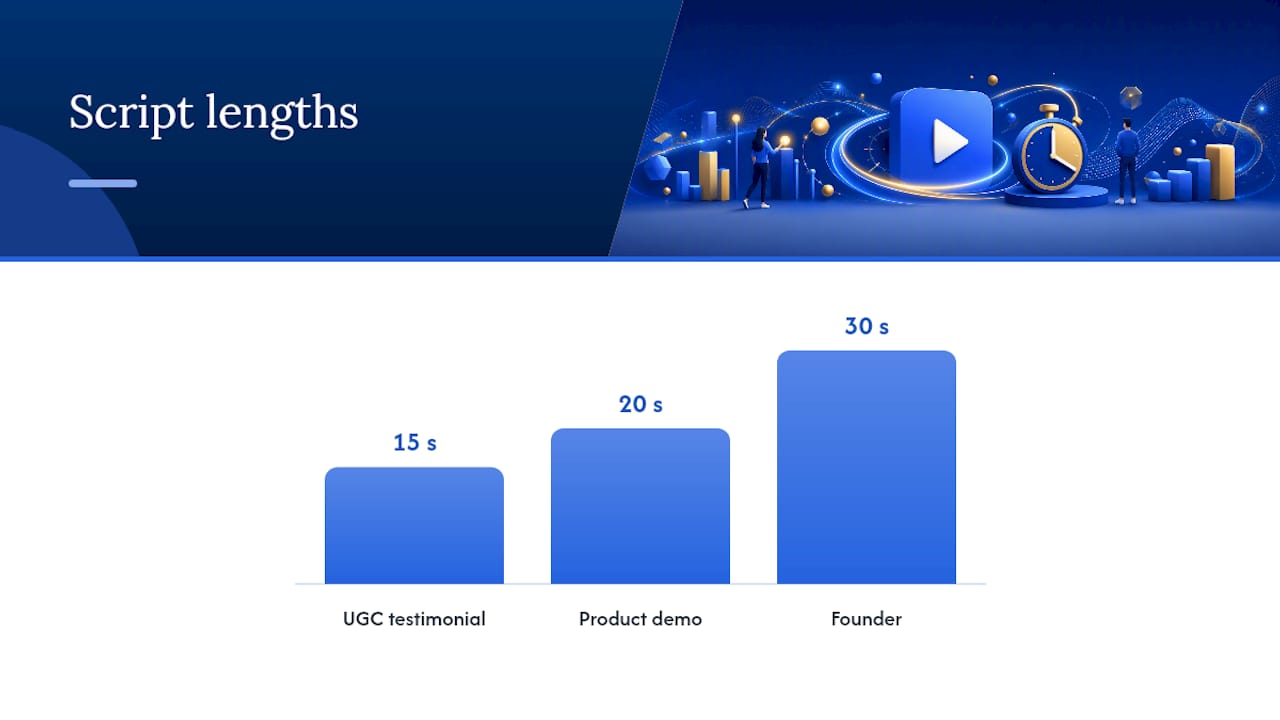
UGC testimonial script (15 seconds)
- 0 to 2s: "Okay, I need to talk about [product]." (Straight to camera, handheld, imperfect lighting is fine.)
- 2 to 8s: "I used to [problem], but now [result]." Show the product briefly.
- 8 to 13s: Quick proof shot, before/after, unboxing, or result close-up.
- 13 to 15s: "Link's right there, go get it." Text overlay repeats the offer.
Product demo script (20 seconds)
- Shot 1 (0 to 3s): The problem in action. Messy, frustrating, relatable.
- Shot 2 (3 to 12s): Product introduced. Show the actual mechanism working, not just the packaging.
- Shot 3 (12 to 17s): The reveal moment. This is your "proof by 7 seconds" beat stretched slightly for a longer format.
- Shot 4 (17 to 20s): Text CTA plus a clean end card with logo and offer.
Founder script (30 seconds)
- 0 to 5s: Emotional hook. "I built this because [personal reason]."
- 5 to 20s: The mission line. What the business exists to fix, told plainly, no jargon.
- 20 to 27s: Fast proof montage, customers, results, reviews.
- 27 to 30s: "Try it yourself, link below."
Caption overlay snippets you can reuse:
- "Wait for it…"
- "This changed everything for us."
- "Still doing this the hard way?"
- "3 things nobody tells you about [topic]."
End-card CTA templates: "Shop now, link below" / "Book your free call" / "Try it free for 7 days" / "Get the guide, tap here."
Storyboard checklist before you shoot:
- Master file framed 9:16, vertical, full length
- Key subject and text kept inside the centre 4:5 safe zone so Advantage+ crops don't cut off your hook
- Captions burned in, punchy, not a word-for-word transcript
- Hook visible and understandable within the first frame, since that paused frame often becomes your thumbnail
- One CTA, repeated in voice and text, not five competing asks
Pro Tip: Write your captions before you film anything. If the caption alone can't hook someone scrolling with sound off, no amount of pretty footage will save the ad. For more on tightening the visual story before you shoot, this visual storytelling breakdown is worth a read.
Testing checklist: what to test, what to watch, what to spend
Running one video and hoping is not a strategy. It's a coin flip with extra steps.
- Test hooks first, not whole ads. Run three hook variants against the same body content and the same audience. The hook is doing 80% of the work, so isolate it.
- Test captions on versus off, and test two different caption copy treatments. Sound-off viewing is the default, so this matters more than most advertisers assume.
- Give each variant real breathing room. A workable rule of thumb is enough daily spend to hit 500 to 1,000 impressions per variant per day, run for 7 to 10 days, before calling a winner or a loser.
- Watch these metrics in order: CPM (cost efficiency), 3 second view rate (hook strength), ThruPlay rate (watch-through quality), CTR (message match), and CPA last (the scoreboard).
- Kill fast, scale slower. If 3 second view rate is weak after a couple of days of real spend, kill the creative. Don't wait for CPA to confirm what the hook rate already told you.
- Split budget between learning and scaling. Keep a portion of spend dedicated to fresh creative tests even once you have a winner, because winners fatigue and audiences get bored of seeing the same face for the fourth week running.
Advantage+ creative variants may auto-generate crops and text placements from a master file, which is why safe-zone framing from the storyboard checklist matters. A clean, centred master file avoids ugly surprises in placements. For deeper testing frameworks, optimising your ad creatives covers the ROI side of this in more depth, and pairing creative tests with sharper ad targeting strategies tends to compound results faster than either lever alone.
Specs and placements cheat sheet
One master file, cut for every placement, beats five separate edits every time.
Shoot vertical, 9:16, and keep your subject and text inside the centre 4:5 zone. That single habit means your one video survives being auto-cropped for Feed, Stories, and Reels without losing the hook or slicing off your CTA text.
| Placement | Recommended aspect ratio | Ideal length |
|---|---|---|
| Feed | 4:5 or 1:1 | 15 to 30s (6 to 10s for high-CTR hook clips) |
| Reels | 9:16 | Up to 90s, but hook within first 3s |
| Stories | 9:16 | 15s or under |
| Retargeting placements | 4:5 or 9:16 | 30 to 60s |
Keep file sizes lean and formats standard (MP4 or MOV, H.264 compression) so nothing gets rejected or auto-downgraded in review. Burn captions in as text, don't rely on Facebook's auto-captions alone, since accuracy varies and you want control over the punchiness of the copy.
How Adsdaddy tests creative before scaling spend
Here's the recipe we lean on before putting real budget behind any client's ads: run a UGC testimonial, a product demo, and a founder story together, with three hook variants each, against the exact same audience. Same targeting, same budget split, same 7 to 14 day learning window. No guessing which format "should" win. Let the data settle it.
Decisions should weight 3 second view rate and ThruPlay first, because a creative that fails to hold attention early is dead regardless of how the CTA is written. Only once a format proves it can hold a scroll do we look at CTR and CPA to decide what earns more budget.
For more on structuring tests for leads-focused clients, see the write-ups on social media campaign optimisation.
Legal and copyright considerations for using content in Facebook video ads
Grabbing a trending audio clip or a stranger's UGC video off TikTok and slapping it into your ad is a fast way to get your account flagged, or worse, sued.
Music is the biggest trap. Commercial tracks require licensing, and Facebook's copyright detection catches most unlicensed audio automatically, muting your ad or rejecting it outright. Stick to Meta's own sound collection, a licensed library like Epidemic Sound, or original audio you recorded yourself.
Customer testimonials need explicit permission before they go into a paid ad, not just an organic post. A customer tagging your brand in a Story is not the same as consenting to be the face of a paid campaign that might run for months. Get it in writing, even if it's just a quick message confirming they're happy for you to use the clip commercially.
Using a competitor's product, logo, or packaging in a comparison ad without alteration can also trigger trademark issues depending on how it's framed. Comparative advertising is generally allowed when it's factual and not disparaging, but the line between "fair comparison" and "trademark infringement" depends on jurisdiction and how the competitor's mark is used, so when in doubt, blur the logo or seek advice specific to your situation.
Stock footage licences matter too. A licence for social media use isn't automatically the same as a licence for paid advertising use, some stock platforms charge extra for ad usage rights.
Integrating branding without drowning the hook
Nobody scrolls past an ad because it wasn't branded enough. They scroll past because it bored them in the first second, and heavy branding upfront is one of the fastest ways to cause that boredom.
Put your logo where it belongs: the end card, not plastered across the hook. The first 3 seconds should sell the problem or the moment, not the badge. Save the reveal of "who made this" for after you've already earned the viewer's attention.
Colour and tone can carry branding quietly. If your brand has a signature colour palette or font, apply it to the caption text and end card rather than a big logo watermark sitting in the corner the whole video. It reads as branded without reading as an ad.
Founder and UGC formats already carry brand identity in the voice and face on screen, so they need less explicit logo treatment than a straight product demo does. Let the format do the branding work it's naturally suited to.
Pro Tip: Watch your ad muted with the sound off and squint. If you can't tell what you're selling within 5 seconds, your branding is either too subtle or your hook buried it. Fix the hook before you touch the logo.
Retargeting with Facebook video ads
Cold audiences need a hook. Warm audiences need a reminder and a reason to finish what they started.
Retargeting video ads can run longer, 30 to 60 seconds is comfortable, because the viewer already knows your brand and doesn't need convincing from zero. This is where founder stories and fuller product demos earn their keep, formats that would be too slow for a cold scroll suddenly work because trust is already half-built.
Segment your retargeting by behaviour, not just by "visited the site." Someone who added to cart and left needs a different message than someone who watched 75% of your last video ad but never clicked through. The cart-abandoner needs urgency and proof, maybe a testimonial showing the product actually works. The video-watcher needs a fresh hook and a stronger CTA, because they were interested but not yet convinced enough to act.
Rotate creative more aggressively for retargeting pools than for cold prospecting. Retargeting audiences are smaller and see your ads more frequently, so fatigue sets in faster, sometimes within a week or two rather than a month.
Budget allocation: small advertisers versus large advertisers
A $30 a day budget and a $3,000 a day budget need completely different testing philosophies, and pretending otherwise is how small advertisers burn cash chasing "best practices" built for someone ten times their size.
Small advertisers (roughly $10 to $50 a day) should run fewer variants at once, maybe two hooks instead of five, because splitting a small budget five ways means no single variant gets enough impressions to produce a decisive signal within a reasonable timeframe. Prioritise UGC and founder formats here since they're the cheapest to produce and often the highest converting for smaller catalogues.
Mid-size advertisers ($100 to $500 a day) can afford the fuller test recipe: three hooks, two caption treatments, one core audience, running the full 7 to 10 day window before making calls.
Large advertisers ($1,000+ a day) should be running format tests continuously, UGC against demo against listicle, with dedicated "always-on" learning budget separate from the scaling budget on proven winners. At this spend level, creative fatigue hits faster too, simply because more of the target audience sees the ad more often, so the content pipeline needs to move at a similar pace.
Whatever your bracket, the ratio that matters most is testing spend versus scaling spend, not the total dollar figure. A $2,000 a day advertiser who never tests new hooks is arguably worse off than a $50 a day advertiser running a disciplined weekly test.
What actually matters in this Facebook video ads sample library
Most "creative inspiration" content is a highlight reel with no instructions attached. Pretty ads, zero scripts, and a vague "be authentic" close that leaves you exactly where you started.
That's backwards. The formats in this Facebook ad video inspiration guide aren't interesting because they're clever. They're useful because they're structural, a hook, a proof beat, a CTA, repeatable in fifteen seconds with a phone camera and no crew.
Where conventional advice falls short is treating polish as the goal. It isn't. Retention is the goal, and retention rewards specificity, a real problem, a real face, a real moment of proof, not a bigger production budget. The founder story that gets shot in someone's actual office will usually beat the one filmed on a rented set with a teleprompter.
If you take one thing from this article, test your ugliest idea first. Shoot the rough UGC version before you commission the polished one. Let the data decide which one earns your budget, not your gut feeling about what "looks professional."
— Adrian
Want AdsDaddy to build and test these for you?
Reading a Facebook video ads sample library is one thing. Getting a stack of tested, winning creative into your ad account by next week is another. Adsdaddy exists for advertisers who'd rather skip months of trial and error and start with a team that runs these exact hook, demo, and founder tests every single day across dozens of accounts.

A creative audit with Adsdaddy typically covers:
- A review of your current ad account's top and bottom performing creative, with a clear read on why each is winning or losing
- A prioritised list of the first three formats worth testing for your specific product or service, based on what's actually converting in your industry right now
- A ready-to-shoot script and caption pack so your first test batch can go live within days, not weeks
If you're ready to stop guessing which format will work and start running a proper test recipe, book a discovery call through the Adsdaddy landing page and let's get your first batch of creative into market.
Where this article's guidance comes from
- Meta's official Ad Creative Inspiration hub for browsing real, live ad examples by industry
- HubSpot's practical walkthrough on building Facebook video ads, including brand examples worth studying
- VidPros' technical breakdown of specs, hooks, and editing tactics for Facebook video
- Conversion.studio and Vaizle's format and performance notes on what converts in current Facebook campaigns
FAQ
Is $10 a day enough for Facebook ads?
It's enough to keep a single ad alive and gather early signal, but it's too thin to test multiple hook variants at once. At that budget, run one strong creative rather than splitting spend across three or four variants.
Is $1,000 enough for Facebook video ads?
Yes, and at that level you can comfortably run the full test recipe: three hook variants, two caption treatments, against one audience, hitting a solid daily impression volume per variant within the 7 to 10 day testing window.
Can you run video ads on Facebook?
Yes, video is one of Facebook's core ad formats and performs across Feed, Stories, Reels, and in-stream placements, and Meta's own creative benchmarks show video regularly outperforming static image ads on engagement.
What is the ideal video format for Facebook ads?
Shoot a 9:16 vertical master file with your key subject and text kept inside the centre 4:5 safe zone, which lets one file get reframed cleanly across Feed, Stories, and Reels without losing your hook.
How do I know which Facebook video ad example to copy first?
Match the format to your funnel stage: UGC testimonials and listicles for cold prospecting, founder stories and fuller product demos for warmer, retargeted audiences. Adsdaddy's approach is to test a UGC, demo, and founder version simultaneously against the same audience to let the data pick the winner rather than guessing upfront.