$0.70–$1.75 CPC: Facebook & Instagram ad costs 2026 for Australian SMBs
. By Ads Daddy.

Blended 2026 Meta benchmarks typically range from about $0.70 to $1.75 per click, $11 to $13.50 per 1,000 impressions, and $20 to $45 per acquisition, though your industry can cause variation in these figures. For testing, budget $1,000 to $3,000 a month, not the $5-a-day minimum Meta shows you at setup. That figure is a survival number, not a learning number. Everything else, including your actual result, comes down to creative, targeting and how patient you are with the auction.
TL;DR:
- The typical blended CPC range for Meta ads in 2026 is $0.70 to $1.75, with a recommended testing budget of $1,000 to $3,000 monthly.
- Reels inventory offers the lowest CPC if creative is native, vertical, and sound-on, but static images perform better on Feed placements for higher-ticket offers.
- Ad costs are influenced by auction competition, creative quality, campaign objective, seasonality, and data maturity, with underperforming creative and narrow audiences increasing CPC.
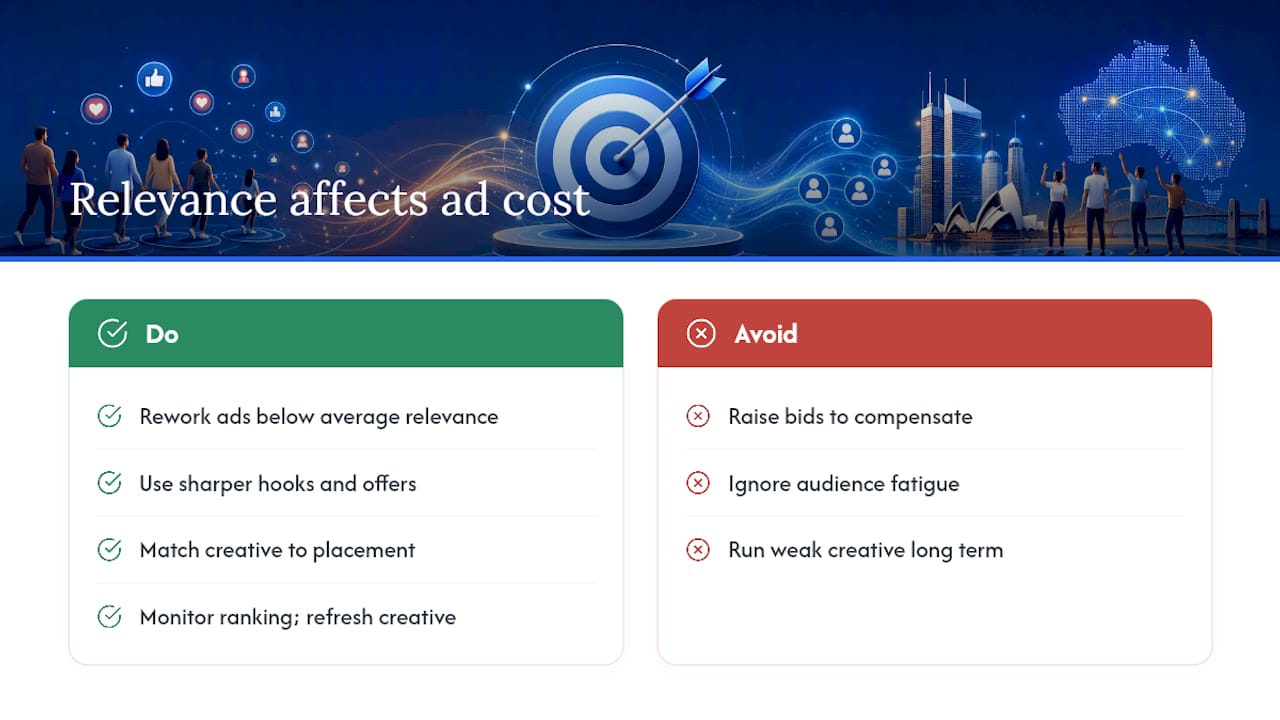
- Using a low relevance score reduces ad efficiency and increases costs, so improving creative hooks and matching placement is essential for cost control.
- For most SMBs, a minimum of $1,000 to $3,000 per month is necessary to gather enough data for meaningful optimization and scale successfully.
Table of Contents
- Facebook and Instagram ads cost: the 2026 benchmarks
- Facebook vs Instagram: why placement changes everything
- What actually drives your Meta ad costs up or down
- How much to spend on testing, launching and scaling
- Budgeting by business type: what your industry actually costs
- Placement and creative trade-offs that move your price
- Optimisation moves that actually lower your CPA
- Working out your real cost per customer, including management fees
- Why these numbers hold up
- Does a low relevance score actually cost you money?
- Do costs change by country or audience?
- What I'd actually run first with $2,000 a month
- Ready for someone else to run the numbers?
- Where these numbers come from
- Sources
- FAQ
Facebook and Instagram ads cost: the 2026 benchmarks
Let's kill the fantasy right away: there's no single "correct" price for a click on Meta. Anyone who tells you otherwise is selling you something.
What we can give you is a stable range, built from aggregating several 2026 benchmark reports rather than trusting one publisher's number. Aggregating multiple sources gives you a more reliable planning input than cherry-picking whichever number looks best, because individual publishers define "click" and "conversion" differently, pull from different account sizes, and sample different geographies.
Here's the blended picture:
Pro Tip: Don't fixate on CPM in isolation. A $9 CPM with a rubbish 0.4% click-through rate can cost you more per lead than a $14 CPM with a 2% CTR. Cost per click, not cost per impression, is what actually pays your bills.
Why do sources disagree so much? Three reasons. First, data set size, a benchmark built from a handful of accounts skews easily. Second, definitions, some count "link clicks," others count "all clicks" including profile taps, which inflates the denominator and quietly deflates CPC. Third, geography. Meta's own combined reach across Facebook and Instagram now spans billions of monthly active users globally, and pricing in the US auction is not pricing in the Australian auction.
Here's a rough conversion exercise that makes the numbers usable. That's 15 clicks per 1,000 impressions, or roughly $0.87 per click, comfortably inside the blended CPC range. Drop that CTR to 0.8% (weak creative, wrong audience) and your cost per click nearly doubles to about $1.63, even though your CPM never moved. The auction didn't get more expensive. Your ad just got worse at doing its job.
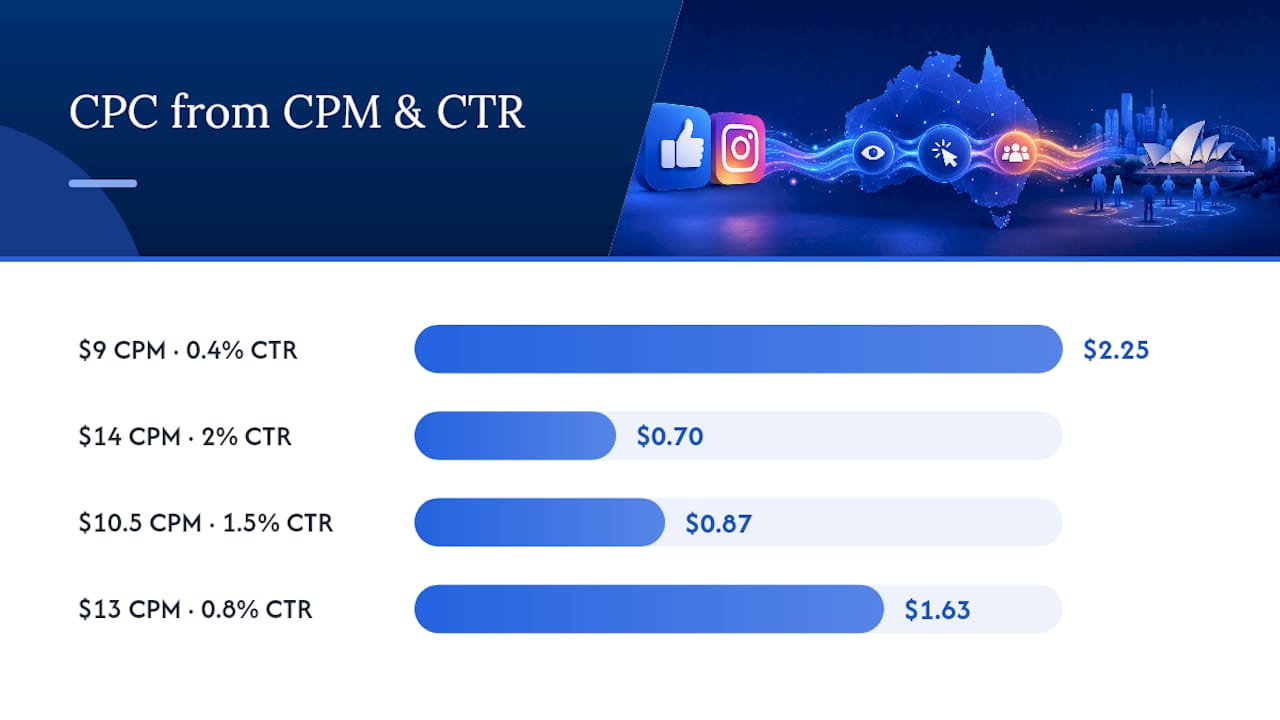
That's the number one thing business owners miss: CPM tells you what you paid for attention. CTR tells you whether anyone cared.
Facebook vs Instagram: why placement changes everything
Same advertiser, same budget, same audience, wildly different costs depending on where the ad actually lands. That's the bit nobody explains properly.
Some 2026 data shows Instagram CPCs running higher than Facebook's on average. Makes sense: Instagram's user base skews younger, more visually demanding, and less forgiving of an ad that looks like it was made in PowerPoint. But there's a twist. Reels inventory is currently pricing below Feed when you supply genuinely native, vertical, sound-on creative. That's a real arbitrage opportunity sitting right there for anyone willing to put the work in.
Quick breakdown of what you're actually buying at each placement:
- Facebook Feed: Older, more transactional audience. Higher intent for considered purchases (insurance, home services, B2B). Static image ads still perform here.
- Instagram Feed: Younger, aesthetics-driven. Rewards polish. Punishes anything that looks like an ad rather than content.
- Stories (both platforms): Fast, disposable, cheap attention. Good for retargeting, weak for cold prospecting.
- Reels: Currently the cheapest inventory on Meta if your creative is vertical, sound-on, and built to be watched, not skipped. Punishes recycled 1:1 square video hard.
The mistake most small business owners make is running one creative across every placement and wondering why performance is patchy. Feed wants a stopping visual. Reels wants a story that unfolds in the first three seconds. Treat them the same and the algorithm treats your budget the same way, badly.
If your offer is considered and higher-ticket (think finance, legal, B2B software), lean Facebook Feed and Instagram Feed, where intent runs higher even at a higher CPC. If you're selling something impulse-friendly and visual (apparel, food, beauty), Reels is where the cheap reach lives right now, provided your creative doesn't look like an ad in disguise.
What actually drives your Meta ad costs up or down
Your CPC isn't set by Meta. It's set by an auction you're competing in, and most of the "why is my cost so high" panic comes down to five levers.
- Auction competition and audience size. A tiny, hyper-specific audience in a competitive niche (say, divorce lawyers in one postcode) gets bid up fast; understanding audience targeting explained can help you manage these costs effectively. A broader audience with room to move gives the algorithm space to find cheap wins.
- Creative quality. Thumbnail, hook, and offer clarity in the first three seconds. This is the single biggest lever most advertisers ignore while obsessing over targeting.
- Campaign objective and conversion event. Optimising for "purchase" when you've had four sales ever gives Meta almost nothing to learn from, and costs spike as the algorithm guesses. Optimise for an event you actually generate volume on.
- Seasonality. Q4 is brutal. Retailers flood the auction from October through December, and CPMs climb across the board, unrelated to anything you did.
- Data maturity. Accounts with a mature pixel, server-side tracking (via the Conversions API), and real purchase history feed the algorithm better signal, which tends to lower cost over time. New accounts pay a "we don't know you yet" tax.
Pro Tip: Before you touch your budget, check your ad relevance and quality ranking in Ads Manager. A low ranking is Meta politely telling you your creative is the problem, not your bid.
Picking the wrong campaign objective is the quiet budget killer nobody talks about, because it doesn't look broken.
How much to spend on testing, launching and scaling
Meta's own guidance floats a $5-a-day minimum for some objectives. Ignore it. That's a "the platform will technically run" number, not a "you'll learn anything useful" number.
Here's what actually works, based on aggregated 2026 spend guidance and what a mature account structure needs to breathe:
- Testing phase: Budget $1,000 to $3,000 a month total, spread across 3 to 5 ad sets, each with 3 to 4 creative variations. Underfunding this stage is the single most common way SMBs waste money, they run one ad, one audience, for three days, then declare Facebook ads "don't work."
- Learning phase timeline: Give each ad set 2 to 3 weeks of consistent daily spend before you touch it. Meta needs roughly 50 conversions per ad set to exit the learning phase reliably, fewer than that and you're gambling, not testing.
- Consolidation: Once you've got a winning creative and audience combo, kill the losers and shift budget rather than launching five new campaigns. Momentum inside a proven ad set beats a fresh start almost every time.
- Scaling rule of thumb: Increase budget by no more than 20% every 3 to 4 days. Double it overnight and you'll reset the algorithm's learning, sending your CPA straight back up.
Think of testing budget like a first date. Turn up with $5 and you're not learning anything about compatibility, you're just there. Turn up prepared to actually invest some time and money, and you get real signal.
Budgeting by business type: what your industry actually costs
Not all niches play the same auction. Some industries are basically bidding against banks. Others are basically bidding against nobody.
- Ecommerce (apparel, home goods): CPC often under $1, CPA in the $15 to $35 range depending on price point. Meaningful monthly test budget: $1,500 to $2,500.
- Local services (trades, hospitality, fitness): CPC around $0.80 to $1.50, CPL often $10 to $25. Meaningful monthly budget: $1,000 to $2,000, since local audiences are smaller and cheaper to saturate.
- B2B and SaaS: CPC frequently $1.50 to $3, CPA can run $50 to $150+ depending on deal size. Meaningful monthly budget: $2,500 to $5,000, because the sales cycle is longer and you need volume to feed it.
- Finance, insurance and legal: CPC commonly sits in the $2 to $4+ band, with correspondingly higher CPA. These are regulated, high-value verticals where competitors will happily outbid you for the same eyeballs.
If you're in a regulated or niche vertical, throw the generic benchmark table out the window and build your own baseline over the first month. A $4 CPC in legal advertising isn't a failure, it's just what that auction costs. Judge yourself against your own trend line, not against an apparel brand's numbers.
Placement and creative trade-offs that move your price
Cheap inventory has a price, and that price is effort. Reels rewards vertical, sound-on, native-feeling video, but building that consistently takes real production discipline, not just a phone camera and good intentions.
- Static image ads: Cheapest to produce, still solid for Facebook Feed, weakest performer on Reels and Stories.
- Carousel ads: Strong for ecommerce showing multiple products or a before/after sequence.
- Vertical video (Reels-native): Currently the best-value inventory on Meta if you can produce it consistently, three to five fresh cuts a month, not one video reused for a quarter.
- UGC-style creative: Often outperforms polished brand video on Instagram because it doesn't look like an ad, and audiences are increasingly ad-blind to anything too glossy.
If your team can't produce fresh vertical video weekly, don't force Reels. Lean into Feed placements where a well-shot static image still competes. Chasing cheap Reels inventory with tired creative just gets you cheap impressions nobody watches, which is worse than expensive impressions that convert. For a deeper workflow breakdown, this Instagram advertising workflow guide is worth a read.
Optimisation moves that actually lower your CPA
Most "optimisation advice" online is fluff. Here's what genuinely moves the needle, fast.
- Run creative tests in pairs, not solo. Launch two clear variants (different hook, same offer) and let data decide within the first 3 to 5 days, don't eyeball it after six hours.
- Exclude converters and build lookalikes. Stop showing prospecting ads to people who already bought, and build a 1% lookalike from your best customers to sharpen targeting without shrinking reach too far.
- Fix your landing page before you touch your bid. A slow-loading page or a confusing checkout kills more campaigns than bad targeting ever does. This is a five-minute audit that costs nothing.
- Use Campaign Budget Optimisation carefully. It's powerful but can starve new ad sets of spend before they get a fair shot, watch the delivery split, not just the total.
Pro Tip: If your CPA suddenly spikes, check your landing page load time before you touch a single setting in Ads Manager. It's the cheapest fix that gets ignored the most.
Small, fast fixes beat big, slow strategy decks. Read more tactics in this breakdown of proven strategies for better ROI.
Working out your real cost per customer, including management fees
Your Ads Manager dashboard lies to you by omission. It shows platform spend, not total cost per customer.
The real formula: platform spend ÷ conversions = CPA, then CPA + management fee per customer = true CAC.
- Freelancers typically charge flat monthly fees or a percentage of spend, often lower cost but variable in availability and depth.
- Agencies commonly charge retainer fees that include strategy, creative, and reporting, generally higher cost but more consistent delivery.
- Either way, add that fee into your CAC calculation, not just your ad spend, or you'll think a campaign is profitable when it's actually barely breaking even.
Build a simple spreadsheet: spend, conversions, CPA, management fee, total CAC, average order or contract value. If total CAC is creeping close to your margin, that's your sanity check to pull back or renegotiate, not to panic and pause everything. Tracking the right numbers matters more than tracking more numbers, this guide to the metrics that matter covers exactly which ones.
Why these numbers hold up
These aren't guesses pulled from a vibe. They're built from aggregating multiple 2026 benchmark reports, cross-checked against Meta's own audience scale (Facebook and Instagram combined reach billions of monthly active users, per Statista), rather than trusting a single publisher's rounded-off average.
Client work backs the same pattern: campaigns rebuilt around tighter conversion events and native-format creative consistently outperform the "boost post and hope" approach. You can see the full breakdown on the Adsdaddy homepage.
Does a low relevance score actually cost you money?
Yes, directly. Meta's ad ranking system scores your ad on estimated action rates and quality, alongside your bid, to decide auction outcomes. A high-relevance ad can beat a higher bid from a competitor with weaker creative, because Meta wants to show people ads they'll actually engage with.
Practically, this means a low-ranked ad pays more per result than a high-ranked one targeting the exact same audience. Two advertisers can bid identically and pay meaningfully different prices purely because one built an ad people want to tap and one didn't.
The fix isn't mysterious, it's the same fix as everywhere else in this guide: sharper hooks, clearer offers, and creative that matches the placement it's running in. If your relevance ranking sits below average in Ads Manager, that's your signal to rework the ad, not raise the bid. Raising the bid on a low-relevance ad is like shouting louder at someone who's already tuned you out. It doesn't fix the actual problem.
Ad relevance also compounds. A creative that starts strong and holds attention keeps its ranking healthy for longer, while a weak one decays fast as audience fatigue sets in, quietly pushing your costs up week over week even if you never touch a setting.
Do costs change by country or audience?
Substantially, yes. Country-level differences in Meta ad pricing are real and expected, not a sign something's broken on your end. Australian-specific commentary notes CPMs in Australia often trend higher than US averages, a smaller population competing for the same global ad product tends to push local pricing up.
Audience demographics move costs too. Broader, less competitive demographics (say, general interest audiences in outer-metro or regional areas) typically cost less to reach than hyper-competitive urban professional segments everyone else is also chasing.
If you're an Australian SMB benchmarking against a US case study you found online, adjust your expectations. A $9 CPM might be genuinely excellent in the US and merely average locally. Build your baseline from your own account's first month of real spend, then compare month to month, not against a number from a different country's auction entirely.
What I'd actually run first with $2,000 a month
Give it three full weeks before judging anything. The single biggest red flag I see constantly? Businesses spreading that same $2,000 across eight ad sets and killing each one after two days. That's not testing, that's noise. If you want a second set of eyes on your plan, book a call before you spend a dollar.
— Adrian
Ready for someone else to run the numbers?
Everything above is exactly what a sharp in-house marketer or a savvy business owner can execute solo, given enough time and enough patience for the learning phase. Adsdaddy exists for the businesses that would rather skip the trial-and-error months and start closer to the winning formula.

Campaigns can be built and managed across Facebook, Instagram, Google, YouTube, Microsoft Ads, and LinkedIn, including creative production (image, video, carousel), which this guide highlights as a key cost factor. A typical path includes a quick audit of your current account or offer, a starter plan matched to your actual budget rather than a generic template, then ongoing optimisation once the data starts flowing. Decisions on which ad set to pause or which creative angle to test next are made based on real account data. If you're ready to stop burning testing budget on guesswork, get in touch with Adsdaddy and let's build your starter plan.
Where these numbers come from
The benchmark ranges in this guide are aggregated from multiple 2026 Meta advertising cost reports, cross-checked rather than pulled from a single source. For official platform minimums and scheduling settings, Meta's own ads pricing guidance is worth a read alongside your own account data, which will always be the most accurate benchmark for your specific audience and offer.
FAQ
Is $1 a day enough for Facebook ads?
No. $1 a day sits well below Meta's own recommended minimums and won't generate enough impressions or clicks to produce reliable data, treat it as a technical test that the campaign runs, not a real learning budget.
How much do Instagram ads cost per 1,000 views?
Blended 2026 CPM benchmarks across Meta sit around $11 to $13.50 per 1,000 impressions, though Instagram Feed often trends slightly above that range while Reels can trade below it with strong native creative.
Is $500 enough for Facebook ads?
a lower monthly budget can work for a very tightly targeted local business with one clear offer, but for most SMBs the recommended range to gather enough conversion data to optimise properly is $1,000 to $3,000 a month.
How much do Instagram ads cost in Australia?
Australian CPMs often run higher than US averages due to a smaller population competing in the same auction, so expect your local CPC and CPM to sit toward the upper end of the blended 2026 ranges, or above them in competitive metro areas.