Facebook advertising budget: how much should you spend in 2026?
. By Ads Daddy.

What is a Facebook advertising budget and how much do you actually need?
Your Facebook advertising budget is the monetary limit you set on your ad campaigns, either per day or across a campaign's lifetime. It tells Facebook's auction system exactly how much you're willing to spend, and the platform uses that figure to control delivery, pacing, and who sees your ads.
Here's the thing most people get wrong: picking a number out of thin air. Your budget needs to match your objective, or you're just burning cash.
The Meta Business Help Center confirms these minimum spends by campaign objective:
- Awareness campaigns: $1/day minimum
- Link clicks or engagement: $5/day minimum
- Conversion campaigns: $10–$20/day minimum
- App install campaigns: $40+/day minimum
For Australian small businesses just getting started, a practical tiering looks like this:
- $10/day: bare minimum for testing; expect slow learning
- $20–$50/day: faster learning, stronger creative tests
- $100+/day: scaling proven campaigns with real data behind them
The bottom line? Your facebook advertising budget is a tool, not a guess. Set it based on your goal and the minimum spend that gives Facebook enough signal to actually optimise.
Table of Contents
- Daily vs lifetime budgets: which one fits your campaign?
- How Facebook actually spends your budget (and why it sometimes overshoots)
- How to calculate your Facebook ad budget using goals and Australian benchmarks
- Common Facebook ad budget mistakes that waste your money
- How your bidding strategy shapes every dollar you spend
- Adsdaddy takes the guesswork out of your Facebook ad spend
- FAQ
- Key takeaways
Daily vs lifetime budgets: which one fits your campaign?
Facebook gives you two budget structures, and choosing the wrong one will mess with your pacing and results.

A daily budget sets a spending cap for each 24-hour period. Facebook paces delivery throughout the day and has some flexibility to spend more or less depending on auction conditions. This suits ongoing campaigns, always-on brand awareness, or any situation where you want consistent, controllable spend week after week.
A lifetime budget sets a total spend cap across the entire campaign duration. Facebook's algorithm decides when to spend more or less based on when your audience is most likely to convert. This works well for fixed-period promotions, product launches, seasonal sales, or events with a hard end date.
Daily budget pros and cons:
- ✅ Easy to pause, adjust, or scale at any time
- ✅ Predictable weekly spend
- ✅ Better for ongoing testing and learning
- ❌ Less flexibility for Facebook to find peak delivery windows
- ❌ Can underdeliver on slow days without hitting your cap
Lifetime budget pros and cons:
- ✅ Facebook can front-load spend during high-conversion windows
- ✅ Ideal for time-sensitive campaigns
- ✅ Built-in dayparting options
- ❌ Harder to adjust mid-campaign without disrupting pacing
- ❌ Less visibility into day-by-day spend control
The Meta Business Help Center recommends daily budgets for most ongoing campaigns and lifetime budgets when you have a defined end date and want Facebook to find the best delivery windows automatically.
How Facebook actually spends your budget (and why it sometimes overshoots)
Facebook's ad delivery runs on an auction. Every time someone is eligible to see an ad, Facebook runs a real-time auction factoring in your bid, your estimated action rate, and your ad quality. That auction dynamic means your daily spend will fluctuate.
Here's what surprises most advertisers: Facebook can spend more than your daily budget on a single day, up to 75% more, to optimize delivery. For example, if your daily budget is $20, Facebook could spend up to $35 on a particularly active day, but the total spend across any 7-day period will never exceed 7× your daily budget — so your $20/day budget caps out at $140 per week, just as Meta guarantees. Why does this happen? A few reasons:
- Auction competitiveness: Facebook pushes harder on days when your audience is more active and likely to convert
- Pacing recovery: if delivery was slow earlier in the week, Facebook compensates later
- Optimisation signals: more spend on high-signal days improves overall campaign learning
Pro Tip: Don't panic when you see a daily overspend in your reports. Check the 7-day total instead. If it's within 7× your daily budget, the system is working exactly as designed.
Managing expectations here is half the battle. If your cash flow is tight, set a lifetime budget with a hard cap rather than relying on daily budget flexibility.
How to calculate your Facebook ad budget using goals and Australian benchmarks
Forget gut feel. The right facebook ads budget comes from a formula tied to your business unit economics.
The learning phase formula:
Minimum daily budget per ad set = (Expected CPA × 50) ÷ 7
Facebook needs a sufficient number of optimisation events per ad set per week to exit the learning phase and deliver stable results. If your target cost per acquisition is $50, your minimum daily budget per ad set is calculated accordingly to meet learning phase requirements. Running less than that keeps your campaign stuck in learning, burning money on volatile delivery.
Australian market benchmarks for 2026:
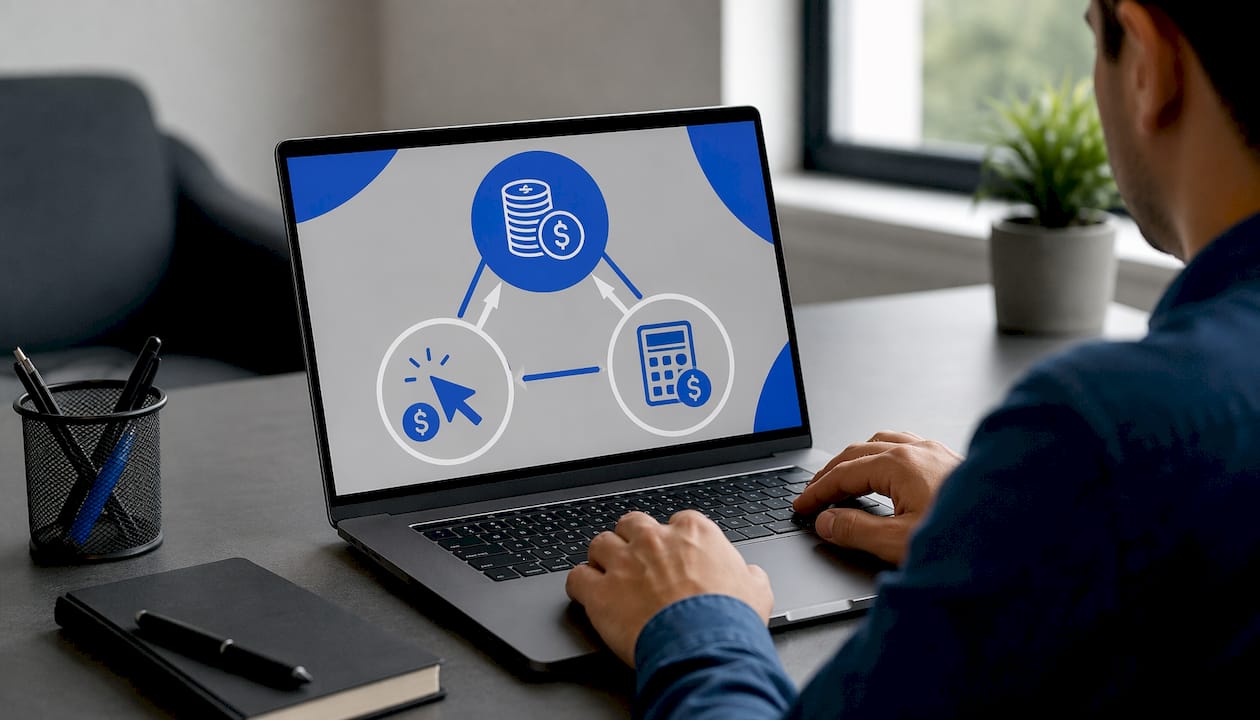
| Metric | Australian average (2026) |
|---|---|
| Cost per click (CPC) | AUD $0.68 |
| Cost per 1,000 impressions (CPM) | AUD $12.50 |
| Cost per lead (CPL) | AUD $21.98 |
Budget calculation by campaign type:
| Campaign goal | Formula | Example |
|---|---|---|
| Traffic | Budget = target clicks × CPC | 500 clicks × $0.68 = $340/month |
| Lead generation | Budget = target leads × CPL | 50 leads × $21.98 = $1,099/month |
| Sales/conversions | Budget = target sales × CPA | 20 sales × $50 CPA = $1,000/month |
Once a campaign proves itself, reallocate spend toward the ad sets generating the most conversions. Don't spread budget thin across five ad sets hoping one works. Concentrate spend on the sets with the strongest signals, then scale from there. This approach to optimising ad spend is what separates profitable campaigns from expensive experiments.
Common Facebook ad budget mistakes that waste your money
Most advertisers don't lose money on bad creative. They lose it on bad structure. Most advertisers waste 20–40% of their budget on structural errors — settings and structuring choices — rather than on poor creative content. Here are the mistakes worth avoiding:
- Budgeting by gut feel or copying competitors. Your competitor's budget means nothing if their CPA, margins, and goals differ from yours. Build from your own unit economics.
- Setting budgets too low to exit the learning phase. If your daily budget can't generate 7–10 conversions per ad set per day, your campaign stays stuck and your CPAs blow out.
- Ignoring overspend fluctuations. Panicking at a high-spend day and pausing campaigns resets the learning phase. Check weekly totals, not daily ones.
- Using Campaign Budget Optimisation (CBO) too early. CBO works well once you have clean data and distinct audience segments. Without that, it starves your best ad sets and wastes spend on weak ones. Start with manual ad set budgets (ABO) to gather clean test data first.
- Splitting budget across too many ad sets. Four ad sets at $5/day each generate almost no useful signal. Two ad sets at $10/day each will learn faster and give you cleaner data to act on.
- Ignoring seasonality. Facebook advertising costs rise sharply in Q4 due to holiday competition. If you're planning a November or December campaign, build that cost increase into your budget from the start.
Pro Tip: Run your ad creative tests with ABO first. Once you know which creative and audience combination wins, then switch to CBO to let Facebook allocate spend efficiently.
How your bidding strategy shapes every dollar you spend
Your bidding strategy doesn't just affect what you pay per click. It controls how aggressively Facebook spends your budget and how quickly it burns through it.
Facebook offers several bidding approaches, each with a different relationship to your budget:
Lowest cost (automatic bidding) tells Facebook to get you the most results for your budget. It spends freely when opportunities arise, which can exhaust your daily budget fast during competitive windows. Good for campaigns where volume matters more than a specific cost target.
Cost per result goal (formerly cost cap) sets a target average cost per result. Facebook tries to stay near that figure, which means it may underspend your budget on days when it can't find results at your target cost. Useful when you have a firm CPA ceiling and can't afford to overpay.
Bid cap sets a hard ceiling on what Facebook bids in each auction. This gives you the tightest cost control but often results in limited delivery, especially in competitive Australian markets where CPMs run around AUD $12.50. If your bid cap is too low, Facebook simply won't enter enough auctions to spend your budget.
The practical takeaway: lowest cost suits testing phases where you want data fast. Cost per result goal suits campaigns where you've already found a profitable CPA and want to protect it at scale. Bid cap suits very specific situations where margin control is non-negotiable. Pair your bidding strategy with a budget that actually supports it. A cost per result goal strategy with a $5/day budget will rarely generate enough events to function. For a deeper look at how these strategies interact with campaign structure, digital campaign planning frameworks can help you map the full picture before you spend a dollar.
Adsdaddy takes the guesswork out of your Facebook ad spend
Running Facebook ads without a clear budget strategy is like driving without a GPS. You'll move, but probably not toward profit.
Adsdaddy manages Facebook ad campaigns for Australian small and medium businesses end to end. That means building your budget from your actual CPA targets and unit economics, not a random number someone Googled. The team handles campaign setup, creative development, audience targeting, and ongoing optimisation, so your budget works harder from day one. No long-term lock-in contracts. No handing over your ad account to someone who disappears after onboarding.
If you're spending money on Facebook ads and not sure whether your budget is set up to actually exit the learning phase, that's exactly the conversation Adsdaddy is built for. Book a strategy call and get a clear picture of what your budget should look like for your goals.
FAQ
What is a good budget for Facebook advertising in Australia?
A practical starting daily budget for Australian small businesses is AUD $10 for minimal testing, AUD $20–$50 for faster learning and stronger creative tests, and AUD $100+ for scaling proven campaigns. The right figure depends on your target CPA and campaign objective.
How much do Facebook ads cost per 1,000 views in Australia?
The average CPM in Australia is approximately AUD $12.50 in 2026, though costs rise during competitive periods like Q4.
Is $5 a day enough for Facebook ads?
$5/day covers basic awareness or engagement campaigns, but it's too low for conversion campaigns. Facebook needs roughly 50 conversion events per ad set per week to exit the learning phase, and $5/day rarely generates enough signal to get there.
Is $500 enough for Facebook ads?
$500/month is a workable starting budget for a single lead generation or traffic campaign in Australia, giving you about $15–$16 per day. It won't support multiple ad sets simultaneously, so focus that spend on one tightly defined audience and objective to get clean data.
Key takeaways
Your Facebook advertising budget only works when it's built from your CPA target, campaign objective, and the 50-event learning phase threshold, not from a number you picked because it felt reasonable.
| Point | Details |
|---|---|
| Minimum spends by objective | Awareness from $1/day; conversions need $10–$20/day minimum per Meta Business Help Center. |
| Learning phase formula | Set daily budget per ad set at (Expected CPA × 50) ÷ 7 to exit the learning phase. |
| Overspend is by design | Facebook can spend up to 75% more on a given day but caps weekly spend at 7× your daily budget. |
| Australian 2026 benchmarks | Average CPC is AUD $0.68, CPM is AUD $12.50, and CPL is AUD $21.98. |
| Adsdaddy builds budgets from data | Adsdaddy structures Facebook ad budgets from your actual CPA targets, not guesswork, for Australian SMBs. |