Demographic Targeting: Boosting Ad Relevance for Aussies
. By Ads Daddy.

Over 70 percent of Australians feel they lack control over their personal data, raising serious questions about how digital advertising reaches everyday people. For Australian businesses, making every advertising dollar count means using demographic targeting that is both precise and responsible. This guide reveals how understanding audience traits can help your ads connect with the right Australians while respecting privacy and building trust from the start.
Table of Contents
- Demographic Targeting Defined For Australian Ads
- Major Types Of Demographic Segmentation
- How Platforms Use Demographic Data
- Limitations And Privacy Rules In Australia
- Common Pitfalls In Demographic Advertising
Key Takeaways
| Point | Details |
|---|---|
| Enhanced Targeting | Demographic targeting allows Australian advertisers to reach specific audience segments precisely. |
| Diverse Segmentation Types | Key categories include age, gender, income, and parental status, which enhance advertising relevance. |
| Importance of Data Privacy | Compliance with Australian Privacy Principles is crucial to ensure ethical advertising practices. |
| Avoiding Stereotypes | Advertisers should avoid oversimplifying audiences and respect the complexities of demographic identities. |
Demographic Targeting Defined for Australian Ads
Demographic targeting is a precision marketing strategy that allows advertisers to zero in on specific audience segments based on key personal characteristics. Google Ads defines this approach as reaching specific audiences through attributes like age, gender, parental status, and household income.
For Australian businesses, demographic targeting transforms digital advertising from a shotgun approach to a surgical strike. Instead of broadcasting messages to everyone, you can now pinpoint exactly who sees your ads. Imagine crafting an ad for a new fitness supplement that specifically targets men aged 25-40 with middle to high household incomes, or a baby product campaign aimed exclusively at new parents in urban areas.
The core demographic targeting categories typically include:
- Age ranges
- Gender
- Parental status
- Household income
- Geographic location
- Language preferences
- Relationship status
Pro Tip: Strategic Targeting Starts Small. Begin by selecting 2-3 core demographic segments most aligned with your product, then progressively refine your targeting as you gather performance data.
By leveraging these precise targeting options, Australian businesses can dramatically improve ad relevance, reduce wasted ad spend, and increase the likelihood of connecting with potential customers who are genuinely interested in their offerings.
Major Types of Demographic Segmentation
Demographic segmentation offers Australian marketers a powerful toolkit for precision targeting. Google Ads provides a comprehensive framework for breaking down audience characteristics, enabling businesses to craft hyper-specific advertising strategies that resonate with exact audience groups.
Age Segmentation remains the most fundamental demographic targeting approach. Marketers typically divide populations into distinct groups like:
- 18-24 years (Gen Z)
- 25-34 years (Young Professionals)
- 35-44 years (Established Adults)
- 45-54 years (Mid-Career)
- 55-64 years (Pre-Retirement)
- 65+ years (Retirement Age)
Beyond age, gender targeting allows advertisers to design campaigns speaking directly to specific gender experiences and preferences. This doesn't mean stereotyping, but understanding nuanced communication styles and product relevance.

Income-based Segmentation provides another critical targeting dimension. Platforms enable advertisers to reach audiences based on household income brackets, which can dramatically improve ad spend efficiency. Whether you're marketing luxury goods or budget-friendly services, income targeting helps ensure your message reaches the most receptive audience.
Additional demographic categories include:
- Parental status
- Relationship status
- Education level
- Language preferences
- Geographic location
Pro Tip: Demographic Precision Matters. Start with 2-3 core demographic segments most aligned with your product's ideal customer profile, then methodically test and refine your targeting based on real campaign performance data.
Here's a summary of major demographic targeting types and their primary advertising benefits in Australia:
| Targeting Type | Main Benefit | Typical Use Case |
|---|---|---|
| Age | Delivers generational relevance | Tailored messaging for young adults |
| Gender | Increases campaign resonance | Products aligned to gender identity |
| Household Income | Optimises ad spend efficiency | Promoting luxury or value products |
| Parental Status | Enhances product fit | Ads for families or new parents |
| Geographic Location | Connects with local audiences | Local business or regional offers |
| Language Preference | Improves communication clarity | Multilingual ad campaigns |
How Platforms Use Demographic Data
Advertising platforms have evolved into sophisticated data ecosystems that leverage intricate demographic insights to deliver highly targeted marketing experiences. A large-scale audit of over 435,000 ad impressions reveals the complex algorithmic mechanisms platforms use to segment and target Australian users, demonstrating how demographic data transforms digital advertising.
Algorithmic Targeting works through sophisticated data collection and analysis processes. Platforms aggregate information from multiple sources including:
- User profile details
- Browsing history
- Purchase behaviour
- Engagement patterns
- Location data
- Device interactions
Political and commercial advertisers particularly exploit these demographic insights. Research examining political advertising strategies during the 2022 Australian federal election campaign showed how platforms strategically cultivate and reinforce partisan and issue-based identities, highlighting the nuanced ways demographic data gets weaponised for targeted messaging.

The targeting process typically involves creating audience lookalike models where platforms identify users with similar demographic characteristics to an initial seed audience. This allows advertisers to exponentially expand their reach while maintaining precise targeting parameters.
Key demographic data points platforms prioritise include:
- Age
- Gender
- Income level
- Education
- Geographic location
- Marital status
- Professional interests
- Online behaviour patterns
Pro Tip: Data Privacy Awareness. Always review and adjust your platform privacy settings, understanding that your demographic information is continuously being analysed and categorised for advertising purposes.
Limitations and Privacy Rules in Australia
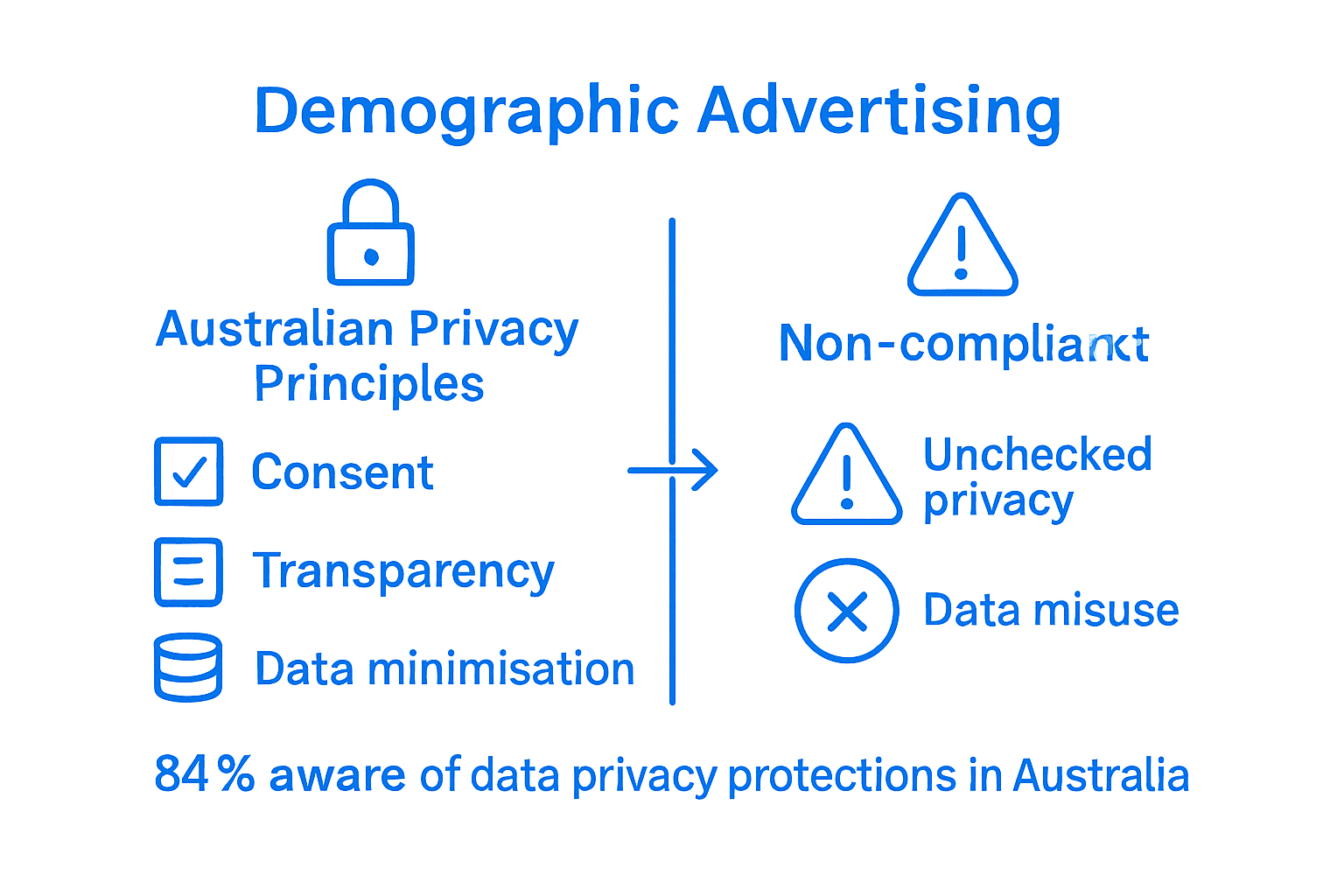
Privacy protection in demographic targeting represents a critical battleground for Australian consumers and businesses. The Office of the Australian Information Commissioner (OAIC) emphasises that organisations must comply with strict privacy principles when using tracking technologies for targeted advertising, ensuring fair and transparent data collection practices.
The Australian Privacy Principles (APPs) establish comprehensive guidelines for demographic data usage. Key limitations include:
- Mandatory consent for personal data collection
- Transparent disclosure of data usage intentions
- Right to access and correct personal information
- Prohibition of unsolicited marketing communications
- Restrictions on cross-platform data sharing
Government Intervention has become increasingly robust. Recent government proposals aim to provide individuals with an unqualified right to opt out of targeted advertising and require explicit consent for personal information trading, signalling a significant shift towards stronger consumer protections.
Advertisers must navigate a complex landscape of ethical and legal constraints. This means:
- Obtaining explicit user consent
- Providing clear opt-out mechanisms
- Maintaining transparent data collection practices
- Respecting individual privacy preferences
- Implementing robust data protection measures
Pro Tip: Privacy Shield Strategy. Regularly audit your advertising practices, ensuring full compliance with the Australian Privacy Principles and maintaining a clear, opt-out friendly approach to demographic targeting.
Compare Australia's key privacy rules for demographic advertising:
| Principle | Requirement Detail | Business Implication |
|---|---|---|
| Consent | Must obtain explicit agreement | Require opt-ins for data use |
| Transparency | Clearly state data collection | Mandate clear privacy policies |
| Access & Correction Rights | Allow personal data review/edit | Systems for data access requests |
| No Unsolicited Marketing | Forbidden without permission | Limit cold outreach campaigns |
| Restrictions on Sharing | Controls cross-platform data flows | Partners must comply with law |
Common Pitfalls in Demographic Advertising
Algorithmic bias represents a significant challenge in demographic targeting. A large-scale audit of ad impressions reveals critical vulnerabilities, including disproportionate advertising targeted at socioeconomically vulnerable populations, exposing the potential for discriminatory marketing practices.
Common demographic advertising pitfalls include:
- Oversimplifying audience characteristics
- Relying too heavily on stereotypical assumptions
- Ignoring intersectional complexities
- Failing to update audience segments
- Misinterpreting demographic data
Consumer Trust has become a critical concern. Research indicates that 70% of Australians feel they lack control over their personal data, highlighting the urgent need for transparent and ethical targeting strategies.
Key risks in demographic advertising involve:
- Reinforcing harmful stereotypes
- Exploiting vulnerable demographic groups
- Creating echo chambers of information
- Perpetuating unconscious biases
- Reducing individual complexity to simplified categories
Successful advertisers must move beyond simplistic segmentation, embracing nuanced, respectful approaches that recognise the multifaceted nature of human identity and experience.
Pro Tip: Demographic Diversity Check. Regularly audit your targeting strategies to ensure they represent diverse perspectives and avoid perpetuating harmful stereotypes or narrow demographic assumptions.
Unlock Precise Demographic Targeting With Ads Daddy
Australian businesses know that broad ad campaigns waste budgets and miss genuine customers. This article highlights key challenges like oversimplified segmentation and privacy constraints that can make demographic targeting feel complex and risky. At Ads Daddy, we understand your need to connect with the right audiences—those defined by age, gender, income, and more—while safeguarding consumer trust and complying with Australian privacy laws.
Our expert team specialises in crafting tailored campaigns using platforms such as Google, Facebook, and LinkedIn, helping you reach your most valuable segments with clarity and confidence. Whether your goal is to improve ad relevance or reduce wasted spend through data-driven insights and ethical targeting, Ads Daddy is your trusted partner for success.
Ready to boost your ad impact without compromising compliance or consumer trust? Discover how our expert campaign management can transform your digital marketing efforts today.
Explore how Ads Daddy can sharpen your demographic targeting strategies now by visiting our main page. Dive deeper into campaign optimisation and privacy-compliant advertising with our detailed guidance at AdsDaddy.com. Let us help you maximise your visibility, attract qualified leads, and grow your Aussie business with smart, strategic advertising.
Frequently Asked Questions
What is demographic targeting in advertising?
Demographic targeting is a marketing strategy that allows advertisers to focus on specific audience segments based on personal characteristics such as age, gender, parental status, and household income.
How can demographic targeting improve ad relevance?
By using demographic targeting, advertisers can tailor their messages to specific audience segments, leading to increased relevance, reduced wasted ad spend, and higher chances of connecting with potential customers who are genuinely interested in their offerings.
What are the main demographic categories used in targeting?
The main demographic categories include age, gender, parental status, household income, geographic location, language preferences, and relationship status.
What are the common pitfalls to avoid in demographic advertising?
Common pitfalls include oversimplifying audience characteristics, relying on stereotypes, ignoring intersectional complexities, not updating audience segments, and misinterpreting demographic data.
Recommended
- Why Use Targeted Ads: Complete Guide for Australia 2026 - Ads Daddy. Advertise on All Plattforms.
- Complete Guide to Why Target Specific Audiences - Ads Daddy. Advertise on All Plattforms.
- Role of Video Ads: Complete Guide for Australian SMEs - Ads Daddy. Advertise on All Plattforms.
- Role of Ad Targeting: Complete Guide for Businesses - Ads Daddy. Advertise on All Plattforms.