What Is CPM in Advertising? Impact on ROI
. By Ads Daddy.

Struggling to stretch your advertising budget further while still reaching the right customers can be a real challenge for Australian e-commerce businesses. Tracking where the money goes is vital, and understanding Cost Per Mille (CPM) is key to gaining the upper hand. With CPM, you can benchmark the efficiency of your campaigns across different platforms and make smarter choices about where your brand is seen. This guide uncovers actionable CPM concepts that support confident, cost-effective ad decisions.
Table of Contents
- Cpm Meaning And Key Advertising Concepts
- Major Cpm Variations And Their Uses
- How Cpm Works Across Ad Platforms
- Comparing Cpm To Cpc And Cpa Models
- Real Costs, Risks, And Roi Impacts
- Common Cpm Mistakes And How To Avoid Them
Key Takeaways
| Point | Details |
|---|---|
| Understanding CPM | Cost Per Mille (CPM) is critical for measuring the cost of advertising based on impressions, aiding in evaluating campaign effectiveness. |
| CPM Variations | Familiarity with CPM variations like Traditional CPM, vCPM, and Targeted CPM allows marketers to tailor strategies to specific campaign goals. |
| Platform Differences | Each advertising platform has unique CPM mechanics, requiring marketers to assess targeting and cost structures for optimal investment. |
| Common Mistakes | Avoiding common CPM pitfalls such as poor targeting and low ad viewability enhances campaign efficiency and effectiveness. |
CPM Meaning and Key Advertising Concepts
Cost Per Mille (CPM) represents a fundamental metric in digital advertising that measures the cost an advertiser pays for one thousand ad impressions. This standard pricing model helps marketers evaluate the financial efficiency of their advertising campaigns across different media platforms. Advertising effectiveness relies on calculating cost per thousand impressions to benchmark and compare marketing strategies.
Understanding CPM requires breaking down its core components. The term "mille" originates from Latin, meaning thousand, which indicates advertisers pay a set rate for every thousand times their advertisement is displayed. Unlike performance-based models like Cost Per Click (CPC), CPM focuses purely on potential visibility. Marketers use this metric to assess how much they're spending to reach a specific audience segment, regardless of whether viewers interact with the ad.
The strategic value of CPM lies in its ability to provide transparent cost comparisons across different advertising channels. Advertising effectiveness varies based on exposure and consumer response characteristics, making CPM a crucial benchmark for evaluating marketing investments. Businesses can analyse their ad spend efficiency by calculating the total campaign cost divided by the number of impressions, then multiplied by one thousand.
Pro tip: When comparing CPM rates across platforms, always consider the audience quality and engagement potential, not just the raw impression numbers.
Major CPM Variations and Their Uses
Cost Per Mille (CPM) has evolved to include several nuanced variations that cater to different advertising objectives and measurement strategies. Performance-based advertising models offer diverse pricing options that help marketers optimise their campaign spending and track effectiveness across various digital platforms.
The primary CPM variations include traditional CPM, viewable CPM (vCPM), and platform-specific adaptations. Traditional CPM charges advertisers for every thousand impressions served, regardless of actual user engagement. In contrast, viewable CPM introduces a more precise measurement approach where payment occurs only for impressions that are actually viewable by users - typically defined as at least 50% of the ad being visible for a minimum of one second.

Other significant CPM variations include targeted CPM, which focuses on reaching specific audience segments, and guaranteed CPM, where advertisers secure a predetermined number of impressions at a fixed rate. Digital platforms like social media and programmatic advertising networks have further refined these models, allowing marketers to choose pricing strategies that align with their campaign goals, whether it's brand awareness, engagement, or direct conversions.
Here’s how major CPM variations compare in practical application:
| Variation | How It Works | Best For |
|---|---|---|
| Traditional CPM | Pays per 1,000 served impressions | Broad brand awareness |
| Viewable CPM | Pays only for viewable impressions | Maximising actual exposure |
| Targeted CPM | Pays for impressions to specific segments | Niche audience campaigns |
| Guaranteed CPM | Pays set rate for fixed impression count | Predictable and scalable buys |
Pro tip: Analyse multiple CPM variations and select the model that best matches your specific campaign objectives and target audience characteristics.
How CPM Works Across Ad Platforms
Online advertising platforms employ sophisticated CPM models to help marketers strategically purchase ad inventory and manage exposure efficiency. These platforms utilise complex algorithms that predict click-through rates and optimise campaign performance across different digital channels, enabling businesses to make data-driven advertising decisions.
Digital Ad Platform CPM Mechanics include unique bidding structures and impression tracking mechanisms. Various ad platforms measure impression delivery and costs differently, with most charging based on every thousand potential ad views. Social media networks, search engines, and programmatic advertising exchanges each implement their own nuanced approach to CPM calculation, considering factors like audience targeting, ad placement, and user engagement potential.
The CPM model operates differently across platforms like Google Ads, Facebook Advertising, LinkedIn, and programmatic networks. Each platform offers distinct targeting options, allowing advertisers to refine their audience reach while managing budget constraints. Marketers must understand platform-specific CPM variations, including minimum bid requirements, audience segmentation capabilities, and real-time bidding mechanisms that dynamically adjust pricing based on competition and audience relevance.
Pro tip: Compare CPM rates and audience targeting capabilities across multiple platforms to identify the most cost-effective channels for your specific marketing objectives.
Comparing CPM to CPC and CPA Models
Digital advertising pricing models present unique strategic approaches for marketers seeking to optimise their campaign performance and budget allocation. Each model - Cost Per Mille (CPM), Cost Per Click (CPC), and Cost Per Acquisition (CPA) - offers distinct advantages and risks that align with different marketing objectives.
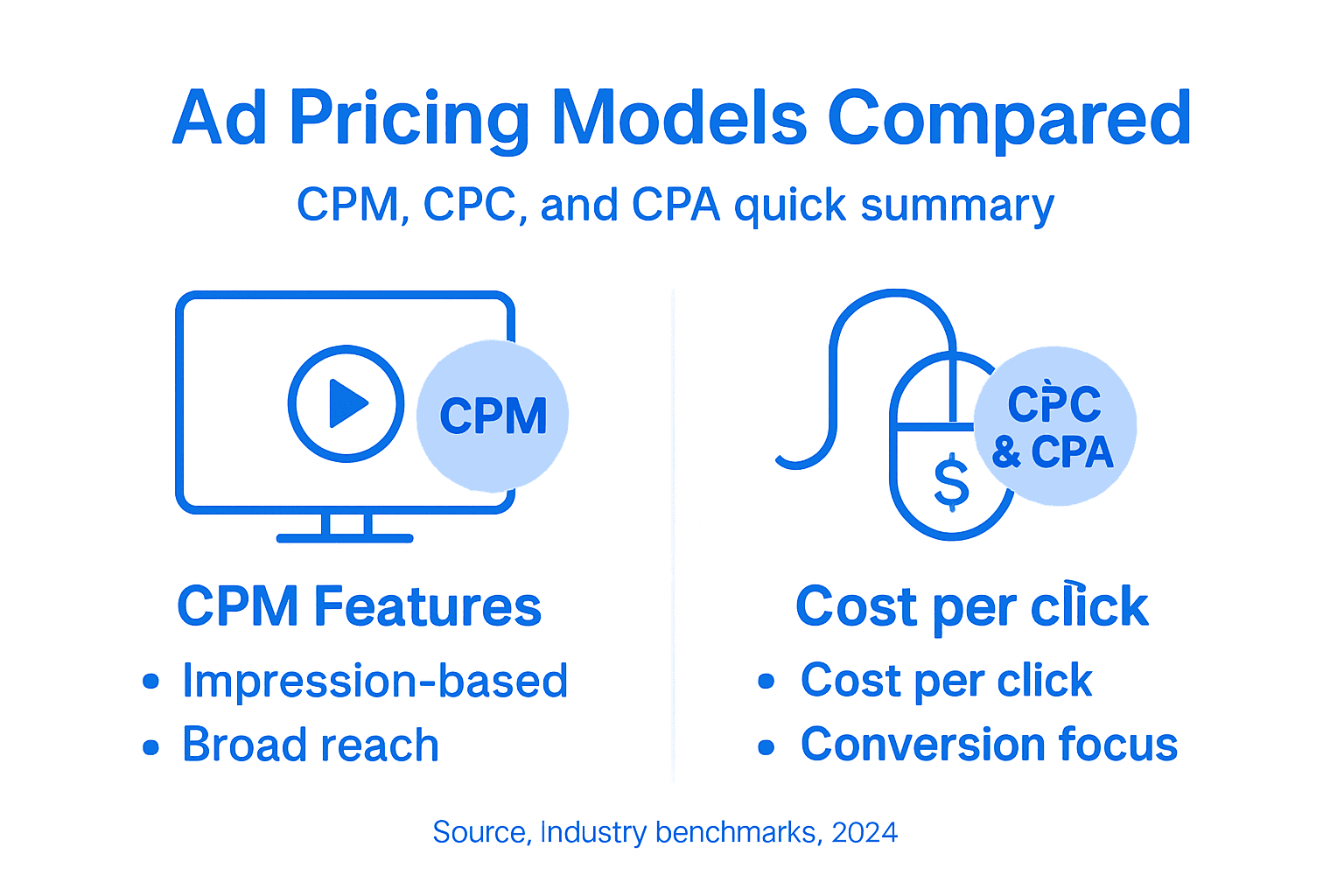
CPM Model Characteristics focus on visibility and broad reach, charging advertisers for every thousand ad impressions regardless of user interaction. In contrast, CPC Model shifts financial risk by charging only when users actively click on advertisements, making it more performance-oriented. The CPA Model represents the most targeted approach, with advertisers paying exclusively for completed conversions or specific actions like sales or sign-ups, minimising wastage and maximising return on investment.
Comparing advertising pricing models reveals nuanced risk profiles for different campaign goals. CPM works best for brand awareness campaigns seeking maximum exposure, CPC is ideal for driving website traffic and engagement, while CPA delivers the most precise ROI tracking for direct response marketing. Marketers must carefully evaluate their specific objectives, target audience behaviour, and budget constraints when selecting the most appropriate pricing model for their advertising strategy.
Pro tip: Combine multiple pricing models strategically across different campaign stages to balance visibility, engagement, and conversion objectives.
Real Costs, Risks, and ROI Impacts
Advertising costs extend beyond simple media purchases, encompassing complex calculations of direct spending, targeting precision, and potential return on investment. Marketers must navigate a nuanced landscape where initial ad expenses represent just one component of a comprehensive financial strategy, with long-term brand value and consumer engagement playing critical roles in determining true marketing effectiveness.
The financial risks inherent in CPM models are particularly significant, as advertisers pay for raw impressions without guaranteed engagement. Unlike performance-based models, CPM requires upfront investment with uncertain outcomes, meaning businesses might spend substantial budgets generating visibility that does not translate directly into measurable consumer actions. Advertising effectiveness depends on strategic execution, with ROI heavily influenced by targeting accuracy, creative quality, and alignment between message and audience expectations.
Comprehensive ROI analysis demands a multifaceted approach that evaluates both immediate financial metrics and long-term brand development. While direct conversion tracking provides clear short-term insights, sophisticated marketers recognise that brand awareness generated through CPM campaigns can create downstream value through increased recognition, consumer trust, and eventual sales conversions. This requires balancing quantitative performance indicators with qualitative brand perception measurements to construct a holistic understanding of advertising investment returns.
This table highlights key risks and ROI factors for each advertising pricing model:
| Pricing Model | Main Financial Risk | Primary ROI Consideration |
|---|---|---|
| CPM | Paying for unseen ads | Long-term brand lift measurement |
| CPC | Low engagement clicks | Quality of site visits generated |
| CPA | High cost per action | Direct conversion attribution |
Pro tip: Implement robust tracking mechanisms that capture both immediate and long-term campaign impacts to develop a comprehensive ROI assessment strategy.
Common CPM Mistakes and How to Avoid Them
Digital advertising requires strategic approach to avoid common pitfalls in CPM campaign management. Marketers frequently encounter subtle yet significant errors that can dramatically reduce the effectiveness and efficiency of their advertising investments, making it crucial to understand and proactively address potential performance limitations.
The most prevalent CPM mistakes include inadequate audience targeting, neglecting ad viewability, and failing to implement frequency capping. Imprecise audience segmentation means advertisers waste budget on irrelevant impressions, while poor viewability results in paying for advertisements that potential customers never actually see. Sophisticated marketers must develop nuanced strategies that combine precise demographic targeting, robust viewability tracking, and intelligent frequency management to maximise campaign performance and minimise unnecessary expenditure.
Successful CPM campaign management demands a holistic approach that transcends simple impression counting. Comprehensive advertising strategies require multi-dimensional performance evaluation, integrating key performance indicators beyond raw impression numbers. This means combining CPM metrics with engagement rates, conversion tracking, and qualitative audience response data to create a comprehensive understanding of advertising effectiveness and return on investment.
Pro tip: Implement weekly campaign audits that review audience targeting precision, viewability rates, and impression quality to continuously optimise your CPM advertising strategy.
Maximise Your Advertising ROI with Expert CPM Campaign Management
Understanding CPM and its impact on your marketing budget is just the first step. The challenge lies in avoiding costly mistakes like poor audience targeting and low ad viewability, which can drain your investment without delivering real results. If you want to transform your CPM strategy into a powerful tool for brand awareness and sustained revenue growth, AdsDaddy.com offers tailored solutions that bring data-driven expertise and multi-platform optimisation to the forefront.
Take control of your advertising spend today by partnering with a digital marketing agency that specialises in optimising CPM campaigns across Facebook, Google, LinkedIn, and more. Visit AdsDaddy.com to discover how our strategic ad placements and integrated customer engagement tools help small and medium-sized businesses convert impressions into measurable returns. Ready to increase your visibility, attract quality leads, and boost sales? Start your journey now with AdsDaddy.com and experience advertising domination that truly impacts your bottom line.
Frequently Asked Questions
What does CPM mean in advertising?
CPM stands for Cost Per Mille, which is a metric used in digital advertising to measure the cost an advertiser pays for one thousand ad impressions, helping to assess the cost-efficiency of advertising campaigns.
How does CPM differ from CPC and CPA?
Unlike Cost Per Click (CPC), which charges advertisers only when a user clicks on the ad, and Cost Per Acquisition (CPA), which charges based on completed conversions, CPM focuses on the cost for each thousand impressions served, irrespective of user interaction.
What are some common mistakes to avoid when using CPM?
Common mistakes include inadequate audience targeting, neglecting ad viewability, and failing to implement frequency capping, which can all lead to inefficient ad spending and reduced campaign effectiveness.
How can I measure the ROI of a CPM advertising campaign?
Measuring ROI for CPM campaigns involves a comprehensive analysis of both immediate financial metrics and long-term brand development, taking into account engagement rates, conversion tracking, and overall brand perception alongside raw impression counts.
Recommended
- Role of Ad Optimization: Complete Guide for 2024 - Ads Daddy. Advertise on All Plattforms.
- Complete Guide to Cross-Platform Advertising - Ads Daddy. Advertise on All Plattforms.
- Why Test Ad Formats: Complete Guide for 2026 - Ads Daddy. Advertise on All Plattforms.
- Cross-Platform Ads Explained: Boost Reach and ROI - Ads Daddy. Advertise on All Plattforms.
- Partner Up & Get Paid | MyHair