Best digital advertising platforms for marketers in 2026
. By Ads Daddy.

TL;DR:
- Google Ads captures existing demand, while Meta Ads creates new demand through discovery. Most Australian advertisers focus on these platforms, layering specialist channels once proven.
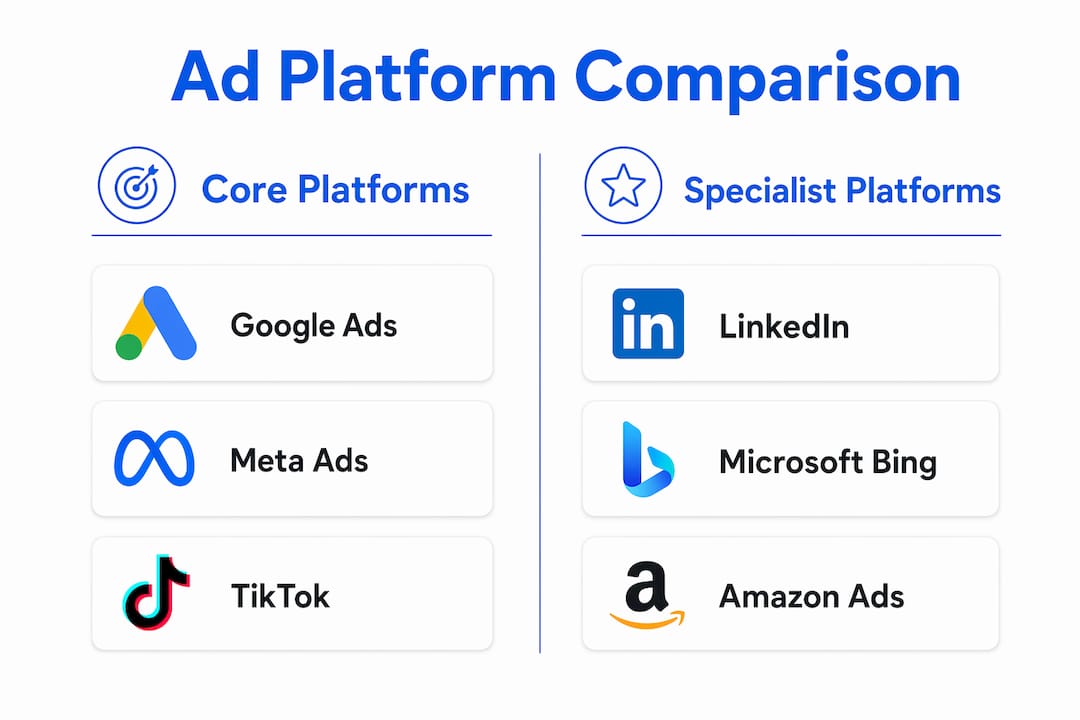
Here's the short answer: Google Ads for demand capture, Meta Ads for discovery, TikTok for Gen Z reach, LinkedIn for B2B, and Amazon Ads if you sell on marketplace. That's your core stack. Everything else is a specialist layer you add once the core converts.
Here's the quick-verdict shortlist by marketing job:
- Best for awareness: Meta Ads (Advantage+), TikTok for Business, YouTube Ads, Spotify Ads
- Best for consideration: Pinterest Ads, YouTube Ads, LinkedIn Ads, X for Business
- Best for conversion/demand capture: Google Ads (Performance Max & Shopping), Microsoft Advertising, Amazon Ads
- Best for retention/re-engagement: AdRoll, Customers.ai, Meta Ads retargeting, Google Display
A large survey found that most marketers use Google Ads or Meta Ads, with many naming Google as their top performer and a significant number naming Facebook. That's your baseline. But the best digital advertising platforms for your business depend on where your customer is in the funnel, not just where everyone else is spending.
Start with Google Ads for search intent. Add Meta for discovery. Layer in specialists once your core ROAS is proven.
Table of Contents
- Which platforms should you actually be running ads on?
- How platforms map to your marketing funnel
- How do you choose the right platform for your business?
- What does a research-backed AU budget mix actually look like?
- Measurement, attribution and the after-the-click fixes that protect your ROAS
- How well do these platforms integrate with your existing tools?
- Australian campaigns that show what's actually possible
- What support can you actually expect from these platforms?
- Ad policies and Australian compliance you need to know
- Key takeaways
- Adsdaddy runs your full-funnel ad stack so you don't have to
- FAQ
Which platforms should you actually be running ads on?
Before the deep profiles, here's the honest truth: most businesses waste money running the same creative on every platform and expecting the same result. A Google Shopping ad and a TikTok video are not interchangeable. They serve completely different jobs.
Google Ads (including Performance Max & Google Shopping)
Google captures demand that already exists. Someone searches "buy running shoes Sydney" and your Shopping ad appears. Performance Max (PMax) automates asset delivery across Search, Shopping, YouTube, Gmail and Display from a single campaign. For ecommerce, Northbeam Q1 2026 benchmarks show Google Shopping/PMax delivers a median blended ROAS of 4.2x versus Meta Advantage+'s 3.6x, with Google’s advantage widening for higher average order values. The weakness: PMax's "black box" reporting makes it hard to see exactly where spend goes.

Meta Ads (Facebook & Instagram, Advantage+)
Meta creates demand. People aren't searching for your product; Meta shows it to them before they know they want it. Advantage+ Shopping Campaigns automate audience selection and creative delivery, making it the go-to for top-of-funnel discovery. The same Northbeam benchmarks put Meta Advantage+ at a median blended ROAS of 3.6x, strong but typically below Google Shopping/PMax’s 4.2x. Reels and Stories placements are where the attention is right now.

TikTok for Business
Short-form video that reaches Gen Z and younger Millennials at scale. The platform rewards native-feeling creative over polished production. The first 3 seconds of your video determine whether someone keeps scrolling, so build your hook before your logo. Adoption is rising fast among Australian advertisers, particularly in fashion, beauty, food and entertainment.
Microsoft Advertising (Bing)
Lower competition, lower CPCs in many verticals, and access to Bing/Yahoo partner inventory. Often overlooked by Australian advertisers, which is exactly why smaller teams can get better initial CPCs here before scaling on Google. Particularly useful for B2B and older demographics.
LinkedIn Ads
The only platform where you can target by job title, seniority, company size and industry simultaneously. CPCs are high (often AU$8–15+ per click), but if you're selling to procurement managers or CFOs, no other platform gets you in front of them as precisely. Best for B2B lead generation and account-based marketing.
Pinterest Ads
Pins have a long shelf life. Unlike a Facebook post that dies in 48 hours, a Pinterest ad can drive clicks for months after launch. Works best for visual product categories: home décor, fashion, food, weddings, DIY. Planning-intent audiences here are genuinely ready to buy.
Spotify Ads
Audio ads reach listeners during commutes, workouts and cooking. It's a lean-back format where your message plays without competition from other content on screen. Best for brand awareness and storytelling, not direct response.
AdRoll
Cross-channel retargeting built for ecommerce teams without a dedicated programmatic desk. Connects display, social and email retargeting in one dashboard. Good for smaller teams who want multi-channel reach without managing separate DSP relationships.
The Trade Desk (programmatic)
Enterprise-grade demand-side platform for open-web programmatic buys. Gives granular control over audience segments, inventory sources and bid strategies. Best suited to brands with dedicated media buyers or agency partners managing programmatic.
Amazon Ads
If your product is on Amazon, this is non-negotiable. Sponsored Products and Sponsored Brands appear inside a purchasing marketplace, meaning the audience already has their wallet out. For brands not on Amazon, the utility drops significantly.
YouTube Ads
Video storytelling at Google-scale reach. Skippable in-stream ads, non-skippable bumpers and YouTube Shorts placements cover everything from 6-second brand hits to 2-minute product demos. Integrated with Google Ads, so you get search-intent data layered onto video targeting.
Vibe
Listed in platform roundups as a niche or emerging ad solution. Availability and feature depth vary by region. Worth testing as an alternative inventory source if you're looking to diversify beyond the major platforms.
StackAdapt
Specialist programmatic platform focused on native ads, display and connected TV (CTV). Strong for contextual targeting and native placements that don't look like traditional banner ads.
Pinpoint
A newer adtech tool appearing in roundups. Feature set and AU integrations are still developing. Best treated as an experimental channel for brands with appetite to test emerging platforms.
Blend AI
AI-assisted creative and optimisation features. Positioned as a tool for brands wanting to test AI-driven ad generation or optimisation workflows. Check AU availability before committing budget.
Customers.ai
Marketing automation meets ad integration. Useful for brands that want tighter connections between their ad audiences and customer communications, particularly for re-engagement sequences.
X for Business (Twitter/X Ads)
Real-time social platform best suited to time-sensitive campaigns: product launches, live events, trending conversations. Reach has shifted since the platform's ownership change, but it still delivers for conversational marketing and event-driven placements.
Platform comparison table
| Platform | Best for | Primary ad formats | Audience targeting strengths | Typical budget signal | Measurement & attribution | AU availability | Strengths / weaknesses |
|---|---|---|---|---|---|---|---|
| Adsdaddy | Full-funnel managed campaigns across multiple platforms | All major formats (search, social, video, display) | Cross-platform audience strategy | Flexible; scales with client goals | Cross-platform reporting and attribution | Australia-wide | Managed service removes execution burden; not a self-serve tool |
| Google Ads (PMax & Shopping) | Demand capture, product retail | Search, Shopping, Display, YouTube, Gmail | Keyword intent, in-market audiences | AU$20–50/day starter; scales to $500+/day | GA4, conversion tracking, offline imports | Full AU support | High intent; PMax reporting opacity |
| Meta Ads (Advantage+) | Discovery, new-customer acquisition | Image, video, carousel, Reels, Stories | Lookalike, interest, behavioural | AU$20–30/day starter | Meta Pixel, Conversions API | Full AU support | Strong creative testing; iOS attribution gaps |
| TikTok for Business | Gen Z discovery, viral creative | Short-form video, TopView, Spark Ads | Age, interest, lookalike | AU$20/day minimum; scales quickly | TikTok Pixel, Events API | Full AU support | High engagement; limited older demographics |
| Microsoft Advertising | Cost-efficient search, B2B | Search text, Shopping, Responsive | Keyword intent, LinkedIn profile data | AU$10–20/day starter | UET tag, conversion tracking | Full AU support | Lower CPCs; smaller AU search volume |
| LinkedIn Ads | B2B lead gen, ABM | Sponsored Content, InMail, Lead Gen Forms | Job title, seniority, company, industry | AU$15–25/day minimum | Insight Tag, CRM integration | Full AU support | Precise B2B targeting; high CPCs |
| Pinterest Ads | Visual products, planning audiences | Promoted Pins, video, shopping | Interest, keyword, demographic | AU$10–15/day starter | Pinterest Tag, conversion events | Full AU support | Long ad lifespan; niche audience |
| Spotify Ads | Brand awareness, audio storytelling | Audio, video, display overlays | Age, genre, playlist, behaviour | — | Ad Studio reporting | Full AU support | Lean-back attention; no direct response |
| AdRoll | Cross-channel retargeting | Display, social, email retargeting | Site visitors, CRM lists | AU$15–20/day | Multi-touch attribution dashboard | Full AU support | Easy retargeting setup; limited prospecting |
| The Trade Desk | Programmatic scale, open web | Display, video, CTV, native | Custom audiences, data partnerships | AU$5,000+/month typically | Advanced programmatic reporting | AU available | Granular control; requires expertise |
| Amazon Ads | Marketplace product sales | Sponsored Products, Brands, Display | Purchase intent, product category | Varies by category; CPC model | Amazon attribution | AU available | In-purchase intent; requires Amazon presence |
| YouTube Ads | Brand building, product education | Skippable, non-skippable, Shorts, bumpers | Google audiences, interest, intent | AU$10–20/day starter | Google Ads, GA4 | Full AU support | Mass reach; requires strong video creative |
| Vibe | Niche/experimental inventory | Varies | Varies | Not publicly listed | Varies | Check AU availability | Alternative inventory; limited public data |
| StackAdapt | Native, CTV, contextual | Native, display, CTV, video | Contextual, behavioural | — | Campaign analytics | AU available | Strong native; less known in AU |
| Pinpoint | Emerging adtech testing | Varies | Varies | Not publicly listed | Varies | Check AU availability | Experimental; limited AU track record |
| Blend AI | AI-driven creative/optimisation | Varies | AI-assisted | Not publicly listed | Varies | Check AU availability | AI features; AU availability unconfirmed |
| Customers.ai | Ad-to-CRM integration | Varies | Customer data activation | Not publicly listed | CRM-linked reporting | Check AU availability | Tight CRM integration; niche use case |
| X for Business | Time-sensitive, event-driven | Promoted posts, video, Spaces | Interest, keyword, follower lookalike | AU$10–15/day starter | X Pixel, conversion tracking | Full AU support | Real-time reach; declining organic amplification |
How platforms map to your marketing funnel
Mixing up funnel roles is one of the most expensive mistakes in digital advertising. Using Google Shopping to build brand awareness is like using a fishing rod to catch a whale. Wrong tool, wrong job.
| Funnel stage | Goal | Best platforms | Why |
|---|---|---|---|
| Awareness | Reach new audiences, build brand | Meta Ads, TikTok, YouTube, Spotify, Pinterest | Broad reach, discovery formats, visual/audio storytelling |
| Consideration | Educate, nurture intent | YouTube, LinkedIn, Pinterest, X for Business | Longer content formats, professional targeting, planning intent |
| Conversion | Capture existing demand | Google Ads (Search/Shopping/PMax), Microsoft Advertising, Amazon Ads | High-intent keywords, in-market audiences, purchase-ready placements |
| Retention | Re-engage customers, upsell | AdRoll, Meta retargeting, Customers.ai, Google Display | CRM-based audiences, past purchasers, cross-sell creative |
The sequencing rule: start with conversion channels to validate your offer and CPA. Once you know what a customer costs, invest in awareness to fill the top of the funnel. Don't run TikTok awareness campaigns before you know your Google Shopping conversion rate.
For most Australian businesses, the practical layering looks like this: Google Ads first (search intent is the fastest path to revenue), then Meta Ads for discovery once you have a proven offer, then specialist channels once you have budget headroom and creative resources to support them.
How do you choose the right platform for your business?
The decision checklist
- Define your funnel stage first. Are you trying to capture existing demand or create new demand? Search for capture, social for creation.
- Check your creative capability. TikTok and YouTube require video. Pinterest needs strong imagery. Google Search needs sharp copy. Match the platform to what you can actually produce.
- Confirm your tracking is ready. No pixel, no Conversions API, no GA4 = no reliable data. Fix this before you spend a dollar.
- Set a realistic starter budget. AU$20/day on Google Ads or Meta Ads is enough to gather data. It won't scale a business, but it will tell you if the offer converts.
- Identify your audience. B2B? LinkedIn. Gen Z? TikTok. Marketplace buyers? Amazon. Visual product? Pinterest. Match audience to platform.
- Assess your team's bandwidth. Programmatic DSPs like The Trade Desk require dedicated expertise. If you don't have it, start with managed platforms.
Sample AU starter budgets
| Business stage | Monthly budget | Recommended split |
|---|---|---|
| Early-stage / testing | AU$600–1,500/month | 70% Google Ads (Search/Shopping), 30% Meta Ads |
| Growing / scaling | AU$1,500–5,000/month | 50% Google, 30% Meta, 10% TikTok or Microsoft, 10% retargeting (AdRoll or Meta) |
| Growth-stage / multichannel | AU$5,000–15,000/month | 40% Google, 25% Meta, 15% TikTok or YouTube, 10% LinkedIn or Amazon, 10% programmatic |
Microsoft Advertising is worth testing early. Smaller teams often get better initial CPCs there before scaling on Google, particularly in verticals with high Google competition.
KPIs to track
- First-touch ROAS: which platform introduced the customer?
- Last-touch ROAS: which platform closed the sale?
- Blended ROAS: total revenue divided by total ad spend across all platforms.
- Cost per new customer (CaC): the real metric for growth sustainability.
- Click-through rate (CTR): a proxy for creative relevance.
Red flags that mean stop and fix
- Landing page load time above 3 seconds on mobile.
- Ad headline doesn't match landing page headline.
- No conversion tracking firing on the thank-you page.
- CPA is 3x your target after 2 weeks of spend.
- Attribution is entirely last-click with no view-through data.
Questions to ask a platform rep or agency
- What's the minimum budget to exit the learning phase on this platform?
- How does your attribution model handle cross-channel journeys?
- What creative specs perform best in AU markets right now?
- How do you handle iOS attribution gaps?
What does a research-backed AU budget mix actually look like?
The principle is simple: assign platforms by funnel job, not by what's trending. Search and shopping capture demand that already exists. Social and video generate demand that doesn't yet.
Low budget (AU$600–1,500/month):
- 70% Google Ads (Search or Shopping): validates offer and CPA fast.
- 30% Meta Ads: tests creative and discovery audiences.
- Hold TikTok and specialist channels until core ROAS is proven.
Mid budget (AU$1,500–5,000/month):
- 50% Google Ads: scale what's working in Search/PMax.
- 30% Meta Advantage+: broaden discovery with automated creative.
- 10% TikTok or Microsoft Advertising: one new channel test per quarter.
- 10% retargeting (AdRoll or Meta): re-engage site visitors and past purchasers.
Growth budget (AU$5,000–15,000/month):
- 40% Google (Search + PMax + Shopping).
- 25% Meta (Advantage+ prospecting + retargeting).
- 15% TikTok or YouTube: short-form video adoption is growing fast among Australian advertisers, particularly for fashion, beauty and consumer goods.
- 10% LinkedIn or Amazon: specialist channel matched to product and audience.
- 10% programmatic (StackAdapt or The Trade Desk): open-web reach and CTV.
Testing cadence: run a new platform for a minimum of 4 weeks before judging it. Give it enough budget to exit the learning phase (typically 50 conversions per ad set on Meta, or enough daily spend to gather statistical signal). Don't kill a channel in week one because the ROAS isn't there yet.
Google Shopping/PMax delivers a median blended ROAS of 4.2x versus Meta Advantage+'s 3.6x for many ecommerce stores, with Google's advantage widening for average order values above AU$150. That's your anchor for budget allocation decisions.
Pro Tip: Test one new platform per quarter, not three at once. Spreading budget across too many channels simultaneously means none of them get enough data to optimise.
Measurement, attribution and the after-the-click fixes that protect your ROAS
You can have the best ad creative in Australia and still lose money if the click lands on a slow, mismatched page. The after-the-click experience is where most ROAS problems actually live.
Measurement readiness checklist
- GA4 installed and firing on all key pages (product, cart, purchase confirmation).
- Meta Conversions API (CAPI) set up server-side to recover iOS-lost events.
- Google Tag Manager container audited for duplicate or misfiring tags.
- TikTok Events API configured if running TikTok campaigns.
- Offline conversion imports set up for any phone or in-store sales.
- Attribution window set to match your sales cycle (7-day click is standard for most ecommerce).
Common after-the-click problems and fixes
- Page speed above 3 seconds: compress images, use a CDN, reduce render-blocking scripts. Google's Core Web Vitals score directly affects Quality Score and ad costs.
- Creative-to-landing mismatch: if your ad says "50% off running shoes," the landing page must say the same thing above the fold. Mismatched messaging kills conversion rate.
- Generic landing pages: sending all traffic to your homepage is a waste. Build dedicated campaign landing pages for each major ad group or offer.
- No social proof above the fold: reviews, trust badges and real product images reduce bounce rate on paid traffic.
Advertisers who fix the after-the-click experience see materially better ROAS. Page speed and message match are the two highest-leverage fixes before you scale any budget.
Pro Tip: Match your ad headline to your landing page H1 word-for-word. It's the single highest-impact CRO change most advertisers haven't made. Pair it with product page optimisation to compound the gains.
How well do these platforms integrate with your existing tools?
Platform integrations determine how much manual work your team does every week. Here's how the major platforms connect to common marketing stacks.
Google Ads integrates natively with GA4, Google Merchant Centre, Salesforce, HubSpot and most major CRM platforms via connector tools. Offline conversion imports via Google's GCLID system are well-documented and reliable.
Meta Ads connects to Shopify, WooCommerce, Klaviyo, HubSpot and Salesforce. The Conversions API is the critical integration for post-iOS accuracy. Meta's native Shopify integration is one of the tightest in the industry.
TikTok for Business has a direct Shopify app and integrates with Klaviyo for audience syncing. The Events API mirrors Meta's CAPI architecture.
LinkedIn Ads integrates with HubSpot, Salesforce, Marketo and Microsoft Dynamics via native connectors. Lead Gen Forms push directly into CRM without a landing page, which reduces friction for B2B campaigns.
Klaviyo sits at the centre of many AU ecommerce stacks, syncing audiences to Meta, Google and TikTok for suppression lists and lookalike seeds. If you're running ecommerce ad strategies on Shopify, Klaviyo-to-platform audience sync is a high-leverage integration.
AdRoll connects to Shopify, BigCommerce, WooCommerce and major email platforms, making it practical for smaller teams who want cross-channel retargeting without a custom tech stack.
The Trade Desk supports data clean room integrations, LiveRamp connectivity and custom first-party data onboarding. It's built for teams with a proper data infrastructure.
Australian campaigns that show what's actually possible
Real results from Australian advertisers illustrate how platform choice and funnel allocation play out in practice.
Google Shopping for a Sydney homewares retailer: A mid-sized homewares brand shifted budget from broad Search campaigns to Performance Max with a strong product feed. The automated asset delivery across Shopping, YouTube and Display improved their blended ROAS while reducing manual campaign management time. The key was a clean Merchant Centre feed with accurate pricing and product titles.
Meta Advantage+ for a Melbourne fashion label: A fashion brand used Advantage+ Shopping Campaigns to test 12 creative variations simultaneously. Meta's automated audience selection found buyers outside their manually-built interest audiences, lowering cost per purchase. Reels placements outperformed feed placements for cold audiences.
TikTok for a Brisbane food brand: A consumer food brand ran Spark Ads (boosted organic content) rather than traditional paid creative. The native-feeling format drove higher engagement rates than polished production ads. The brand's TikTok account grew organically alongside the paid spend, compounding reach.
LinkedIn for a B2B SaaS company in Melbourne: A software company used LinkedIn Lead Gen Forms targeting IT managers and operations directors at companies with 50–500 employees. The cost per qualified lead was higher than Meta, but the lead quality and close rate justified the spend. Job title targeting eliminated the wasted spend that plagued their previous Meta B2B campaigns.
Microsoft Advertising for an AU financial services firm: A financial services advertiser found CPCs on Bing significantly lower than Google for the same keyword set, with a comparable conversion rate. The Bing audience skewed older and more affluent, which matched their customer profile.
What support can you actually expect from these platforms?
Support quality varies enormously across platforms, and it matters more than most advertisers realise when something breaks at 11pm before a major campaign launch.
Google Ads offers phone and chat support for accounts spending above a threshold, plus a dedicated account manager for larger spenders. The Google Ads Help Centre is comprehensive. Response times are generally fast for active accounts.
Meta Ads support is notoriously inconsistent. Chat support exists but resolution quality varies. For account bans or policy issues, resolution can take days. The Meta Business Help Centre is detailed but navigating it is frustrating. Larger accounts get dedicated reps.
TikTok for Business has improved AU support significantly. A dedicated AU sales team is available for accounts spending at meaningful levels. The self-serve Help Centre is improving.
LinkedIn Ads provides solid support for active campaigns, with account managers available for mid-to-large spenders. Their campaign manager interface is less intuitive than Google or Meta, which makes support more necessary.
Microsoft Advertising is often praised for responsive support, particularly for smaller accounts. The AU team is accessible and the platform's lower adoption means less queue time.
Amazon Ads support quality depends heavily on account tier. Seller Central support and Advertising Console support are separate systems, which creates friction.
For smaller AU businesses without in-house expertise, working with a managed service partner removes the support dependency entirely. You're not waiting on hold with Meta at midnight; your agency is.
Ad policies and Australian compliance you need to know
Australian advertisers operate under a specific regulatory environment that platform policies don't always account for automatically.
Australian Consumer Law (ACL) requires that all advertising claims be truthful and not misleading. This applies to ad copy, landing pages and any promotional claims. The ACCC actively monitors digital advertising, and platforms can suspend accounts for ACL-violating copy even if the ad passes platform review.
Financial services advertising on Google, Meta and LinkedIn requires pre-approval or specific disclaimers under ASIC regulations. Ads for credit products, investment services and insurance must comply with the Australian Financial Services (AFS) licensing framework.
Health and therapeutic goods advertising must comply with the Therapeutic Goods Administration (TGA) guidelines. Claims about health products, supplements and medical devices are heavily regulated. Meta and Google both have specific AU-market restrictions for health categories.
Alcohol advertising on all platforms must comply with the Alcohol Beverages Advertising Code (ABAC) and platform-specific age-gating requirements.
Privacy and data collection under the Privacy Act 1988 and the Australian Privacy Principles (APPs) governs how you collect and use customer data for ad targeting. First-party data collection via lead forms must include compliant privacy disclosures.
Platform-specific policies layer on top of Australian law. Meta's ad policies around personal attributes, Google's financial product restrictions and TikTok's community guidelines all have AU-specific nuances. Review platform policy pages for your category before launching, and treat a policy rejection as a signal to check both platform rules and ACL compliance.
This article is general information, not legal or compliance advice. Confirm current regulatory requirements with a qualified professional or the relevant Australian authority for your specific situation.
Key takeaways
Google Ads and Meta Ads form the core of most effective digital advertising stacks in Australia. Google Shopping/PMax delivers a median blended ROAS of 4.2x, while Meta Advantage+ delivers 3.6x — making funnel-stage allocation the single most important decision you'll make.
| Point | Details |
|---|---|
| Start with demand capture | Google Ads (Search/Shopping) validates your offer and CPA before you invest in discovery channels. |
| Assign platforms by funnel job | Search and shopping capture existing demand; social and video create new demand. Never mix the roles. |
| Fix the click before you scale | Page speed, message match and conversion tracking must be working before you increase any budget. |
| Test one new channel per quarter | Spreading budget across too many platforms at once means none get enough data to optimise. |
| Adsdaddy manages the full stack | For AU businesses wanting managed campaigns across Google, Meta, TikTok and LinkedIn, Adsdaddy handles strategy, creative and optimisation. |
Why multichannel allocation is the only approach worth taking
The single-platform mindset is the most common and most expensive mistake in digital advertising. Businesses that run only Google Ads miss the customers who don't know they need the product yet. Businesses that run only Meta Ads miss the customers who are actively searching to buy right now.
The platforms that dominate Australian digital advertising in 2026 are not competing with each other. They're serving different moments in the same customer journey. Google catches the hand-raiser. Meta catches the browser. TikTok catches the scroller who didn't know they wanted it. LinkedIn catches the decision-maker at their desk. The job is to be present at each of those moments with the right message, not to pick one and hope.
What most guides won't tell you: the allocation matters less than the attribution. Businesses that can accurately measure which platform introduced a customer and which one closed them make better budget decisions than businesses optimising each platform in isolation. First-party data, server-side tracking and a clean GA4 setup are worth more than any individual platform choice.
The other thing worth saying plainly: a AU$20/day budget on Google Ads will tell you whether your offer converts. It won't build a business. The goal of the testing phase is to find a CPA you can scale, not to generate revenue from a minimal spend. Once you have a proven CPA, the budget conversation becomes straightforward.
Adsdaddy runs your full-funnel ad stack so you don't have to
Most AU businesses don't have time to manage Google Ads, Meta Ads, TikTok campaigns and retargeting sequences simultaneously. That's exactly what Adsdaddy does.

Adsdaddy is a managed digital advertising agency for Australian businesses that want expert campaign management across Google, Meta, YouTube, LinkedIn and Microsoft Ads, without hiring an in-house team. The concrete difference: you get a cross-platform strategy, not a single-channel operator who optimises one platform in isolation.
A free audit includes:
- A review of your current ad account structure, spend efficiency and attribution setup.
- A funnel-stage gap analysis showing where you're missing demand capture or discovery.
- A recommended platform mix and starter budget split for your specific goals.
From there, onboarding takes roughly two weeks: account access, pixel and tracking audit, creative brief and campaign build. Reporting is monthly with weekly performance check-ins during the first 90 days.
Ready to see where your current ad spend is leaking? Book a free audit with Adsdaddy and get a clear picture of what to fix first.
FAQ
What are the top digital advertising platforms in Australia?
Google Ads, Meta Ads (Facebook and Instagram), TikTok for Business, LinkedIn Ads and Microsoft Advertising are the most widely used platforms by Australian advertisers. The right mix depends on your funnel stage, audience and budget.
Which platform is best for digital marketing overall?
Google Ads leads for demand capture with a median blended ROAS of 4.2x for ecommerce, while Meta Ads leads for discovery and new-customer acquisition at a median blended ROAS of 3.6x. Most businesses need both rather than choosing one.
Is AU$20 a day enough for Google Ads?
AU$20/day is enough to gather conversion data and validate your offer, but it won't exit the learning phase quickly on competitive keywords. It's a testing budget, not a scaling budget. Once your CPA is proven, increase spend to accelerate results.
Which platform works best for online stores?
Google Shopping and Performance Max are the strongest performers for ecommerce conversion, particularly for products with average order values above AU$150. Meta Advantage+ is the best complement for driving discovery and new-customer acquisition at the top of the funnel.
How do you choose between so many ad platforms?
Start by matching the platform to your funnel stage: Google and Amazon for conversion, Meta and TikTok for discovery, LinkedIn for B2B. Then check your creative capability, tracking readiness and budget. Test one or two platforms first, validate your CPA, then layer in specialists.