Ad spend forecasting: a practical guide for SMBs
. By Ads Daddy.

TL;DR:
- Ad spend forecasting predicts future advertising costs using historical data and platform rules to prevent budget waste. It requires at least 90 days of clean, platform-specific data and monthly retraining for accuracy within 10 to 15 percent. Most SMBs neglect these best practices, leading to reactive decisions and ineffective budget management.
Ad spend forecasting is the process of predicting future advertising expenditure using historical campaign data, platform pacing rules, and market trends. Done well, it stops you bleeding budget on underperforming campaigns before the damage shows up in your monthly report. Average digital ad campaigns waste 26% of budget, and forecasting models cut that waste by identifying problem areas before they compound. The industry standard for reliable predictions requires at least 90 days of daily campaign data, and platforms like Google Ads, Meta, and LinkedIn each behave differently enough to demand separate forecast models. This guide breaks down how ad spend forecasting works, where marketers go wrong, and how to build a process that actually holds up.
What is ad spend forecasting and why does it matter?
Ad spend forecasting is the statistical practice of estimating how much your advertising will cost over a future period, and what return you can expect from that spend. The formal industry term is advertising expenditure forecasting, though "ad spend forecasting" is the phrase most marketers use day to day. Both mean the same thing: using data to make budget decisions before the money leaves your account.

The shift from gut-based budgeting to predictive modelling is the single biggest upgrade most SMB marketers can make. Reactive budgeting, where you wait for results and then adjust, means you are always one step behind the algorithm. Forecasting puts you ahead of it.
Good forecasting also protects you from the most common budget killer: overspending on campaigns that look fine on Monday but are quietly haemorrhaging cash by Friday. When you have a forecast in place, you have a benchmark. Anything that deviates from it triggers a review, not a panic.
How do ad spend forecasting models work?
Reliable ad budget prediction starts with data volume. Monthly forecasts reach ±10–15% accuracy when built on 90 or more days of daily campaign data. Weekly forecasts are far noisier, landing at ±20–30% accuracy. That gap matters enormously when you are managing a tight SMB budget.
The core methods used in forecasting advertising costs include:
- Regression analysis: Maps the relationship between spend and outcomes like conversions or revenue. Simple, interpretable, and a solid starting point for most SMBs.
- Time-series modelling: Captures seasonality and trends across weeks and months. Useful for businesses with predictable peaks, like retail around Christmas or tax season for financial services.
- Machine learning models: Incorporate platform-specific signals, audience behaviour, and external variables. More accurate at scale, but require more data and maintenance.
- Blended approaches: Combine statistical baselines with platform-reported pacing data for a more grounded forecast.
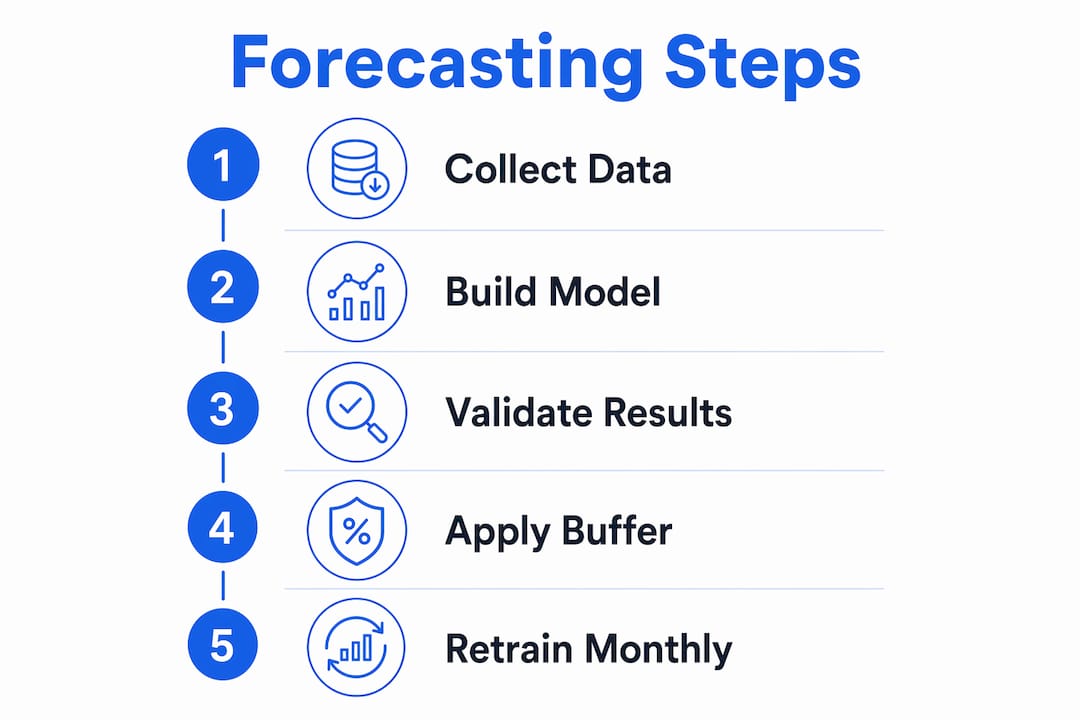
All models degrade over time. Forecasts should be retrained monthly using a rolling 90-day window to stay accurate as campaign conditions shift. Skipping this step is like navigating with last year's map.
Pro Tip: Run your forecast model on last month's data and compare it to what actually happened. If the error is above 20%, your data is too thin or your model needs retraining before you trust it with real budget decisions.
Does each ad platform need its own forecast?
Yes, and this is where most marketers get burned. Each platform has its own pacing logic, and treating them all the same produces forecasts that are wrong in different directions at the same time.
One template does not fit all platforms. Build forecasts per channel, then aggregate them with a buffer for cross-platform variance.
Google Ads pacing
Google uses a 30.4-day billing cycle and can spend up to 2x your daily budget on any given day. It caps total monthly spend at 30.4 times your daily budget. This means your monthly forecast can be accurate even when individual days look wild. Factor the 30.4-day cap into your model, not the calendar month.
Meta Campaign Budget Optimisation
Meta's Campaign Budget Optimisation (CBO) has a learning phase that requires roughly 50 conversions before spend stabilises. During this phase, daily spend is volatile. Meta forecasts need a 10–15% buffer to avoid underestimating costs while a campaign is still learning.
LinkedIn Ads pacing
LinkedIn's lifetime budget pacing is the least predictable of the three. Small budgets see the most volatility, with daily spend swinging significantly above or below the expected rate. Widen your confidence intervals on LinkedIn forecasts and treat any projection as a range, not a fixed number.
| Platform | Pacing behaviour | Forecast buffer needed |
|---|---|---|
| Google Ads | 30.4-day cap, up to 2x daily | Low (5%) |
| Meta CBO | Learning phase volatility | Medium (10–15%) |
| Uneven lifetime pacing | High (15–20%) |
Pro Tip: When running multi-platform ad campaigns, add a 5% cross-platform variance buffer on top of your individual platform buffers. Platforms interact in ways that compound forecast error.
What are the most common ad spend forecasting mistakes?
Most forecasting errors come from behaviour, not maths. Marketers know the theory but react emotionally to data that looks alarming but is actually just noise.
The biggest pitfalls in ad spend analysis include:
- Reacting to daily data. Monthly forecasts are far more stable than daily ones. Daily numbers include attribution lag, platform algorithm swings, and incomplete conversion windows. Acting on them is like steering a ship by watching individual waves.
- Ignoring learning phases. Pausing or cutting a Meta campaign during its learning phase because spend looks high is one of the most expensive mistakes in digital advertising. The campaign never gets to prove itself.
- Using vanity metrics. Use at least two confirming signals before shifting budget. Clicks and impressions tell you almost nothing about whether a campaign is worth more money. Cost-per-conversion and ROAS trend together form a signal stack worth acting on.
- Treating platforms identically. A forecast built on Google data applied to LinkedIn will be wrong. Platform pacing rules are fundamentally different.
- Moving budgets too fast. Wait 24–48 hours for attribution lag before adjusting spend. Cutting a campaign because yesterday's numbers looked bad often means killing a winner before the conversions have been recorded.
The pattern behind all these mistakes is the same: confusing short-term noise for a structural signal. Good forecasting gives you the benchmark to tell the difference.
How to forecast ad spend: a practical framework
Getting this right does not require a data science degree. It requires a process and the discipline to follow it.
- Gather clean data. Pull a minimum of 90 days of daily campaign data per platform. Remove anomalies like days with tracking outages or one-off promotions that will skew your baseline.
- Build platform-specific models. Forecast Google, Meta, and LinkedIn separately. Use regression or time-series methods as your baseline, then layer in platform pacing rules.
- Apply contingency buffers. Add 5% for Google, 10–15% for Meta, and 15–20% for LinkedIn. Add a further 5% cross-platform buffer when aggregating totals.
- Set your performance benchmark. Calculate your break-even ROAS based on unit economics. This is the floor your forecast must clear before you commit more budget. Learning how to optimise ad budgets around this benchmark is what separates profitable campaigns from expensive experiments.
- Allocate using the 70/20/10 rule. Assign 70% of budget to proven performers, 20% to campaigns you are scaling, and 10% to new tests. This keeps your forecast grounded in what works while leaving room to grow.
- Monitor pacing daily, act monthly. Check daily pacing against your forecast to catch overspend early. Make structural budget decisions monthly, not daily.
- Retrain your model monthly. Roll your data window forward by 30 days each month. Drop the oldest data and add the newest. This keeps your forecast current without requiring a full rebuild.
Pro Tip: Automate your pacing alerts. Automated forecasting systems update daily and flag deviations before they become expensive. Manual monthly reviews miss the window to act.
Pair this framework with solid campaign planning fundamentals and you have a forecasting process that holds up across channels and budget sizes.
Key takeaways
Accurate ad spend forecasting requires platform-specific models, at least 90 days of clean data, and monthly retraining to stay within a ±10–15% accuracy range.
| Point | Details |
|---|---|
| Data volume matters | Build forecasts on 90+ days of daily data to reach ±10–15% monthly accuracy. |
| Platform rules differ | Google, Meta, and LinkedIn each need separate forecast models and different contingency buffers. |
| Monthly beats daily | Monthly forecasts are more stable and actionable than daily ones due to attribution lag. |
| Signal stacks prevent mistakes | Require two confirming metrics (ROAS trend and cost-per-conversion) before shifting budget. |
| 70/20/10 allocation | Assign 70% to proven performers, 20% to scaling campaigns, and 10% to new tests. |
Why most SMBs are still forecasting like it's 2018
Here is the uncomfortable truth I see repeatedly when working with SMB advertisers. They are running 2026 ad platforms with 2018 budgeting habits. They check their ad account on a Monday, see a bad weekend, and cut the budget. Then they wonder why their campaigns never scale.
The real problem is not the data. It is the absence of a forecasting framework that tells you what "bad" actually looks like relative to your baseline. Without that, every dip feels like a crisis and every spike feels like a win. Neither reaction is usually correct.
The marketers who get this right do one thing differently: they build their forecast before they spend, not after. They know their break-even ROAS, they know their platform pacing rules, and they have a 70/20/10 allocation locked in before the month starts. When something deviates from the forecast, they investigate. They do not react.
The other thing worth saying plainly: daily forecasting is mostly a waste of time for SMBs. The signal-to-noise ratio on daily ad data is terrible. Monthly forecasting with daily pacing checks is the right cadence. It gives you enough data to act on without sending you down rabbit holes every 24 hours.
If you are managing campaigns across Google, Meta, and LinkedIn without separate forecast models for each, you are flying blind in three different aircraft simultaneously. Fix that first. Everything else follows.
— Adrian
How Adsdaddy helps you take control of ad spend
Forecasting ad spend across multiple platforms is genuinely complex. Most SMBs do not have the time to build separate models for Google, Meta, and LinkedIn, apply the right buffers, and retrain everything monthly.
[IMAGE:cta_image]
Adsdaddy manages multi-platform advertising campaigns with data-driven budget tracking built in. The team handles campaign forecasting, pacing alerts, and budget reallocation across Facebook, Instagram, Google, YouTube, LinkedIn, and Microsoft Bing. You get the ad campaign budget control without the spreadsheet headache. If you are ready to stop guessing and start spending with confidence, visit Adsdaddy to see how the team can put your budget to work.
FAQ
What is ad spend forecasting in simple terms?
Ad spend forecasting is the process of predicting how much you will spend on advertising and what results you can expect, using historical data and platform pacing rules to guide budget decisions before you commit the money.
How much data do I need to forecast ad spend accurately?
You need at least 90 days of daily campaign data per platform. Monthly forecasts built on this volume reach ±10–15% accuracy, which is reliable enough for most SMB budget planning.
Why do I need separate forecasts for each ad platform?
Google, Meta, and LinkedIn each have different pacing rules. Google caps monthly spend at 30.4 times your daily budget, Meta CBO has a volatile learning phase, and LinkedIn pacing is unpredictable for small budgets. One model applied across all three will be wrong on all three.
How often should I update my ad spend forecast?
Retrain your forecast model monthly using a rolling 90-day data window. Check daily pacing against your forecast, but make structural budget decisions monthly to avoid reacting to short-term noise.
What is the 70/20/10 rule in ad budget forecasting?
The 70/20/10 rule allocates 70% of your budget to proven campaigns, 20% to campaigns you are actively scaling, and 10% to new tests. This keeps your forecast grounded in performance while preserving room for growth.