Ad Relevance: Boosting ROI for Aussie Businesses
. By Ads Daddy.

More than 60 percent of australian e-commerce businesses lose advertising spend due to poor ad relevance. For marketing managers, even slight mismatches between message and audience can mean wasted budgets and missed growth. Improving how carefully ads speak to the right australian consumers is not just a luxury—it drives stronger returns, smarter spending, and true competitive advantage across every digital channel.
Table of Contents
- Defining Ad Relevance In Digital Marketing
- Types Of Ad Relevance Across Platforms
- How Ad Relevance Scores Are Calculated
- Impact On Cost, Reach, And Conversions
- Common Missteps And How To Improve
Key Takeaways
| Point | Details |
|---|---|
| Importance of Ad Relevance | Ad relevance directly influences the success of digital marketing campaigns by enhancing consumer engagement through targeted messaging. |
| Tailored Strategies per Platform | Different digital platforms require distinct strategies for ad relevance, focusing on unique factors like keywords or demographics. |
| Impact on Business Metrics | High ad relevance leads to improved cost efficiency, expanded audience reach, and increased conversion rates. |
| Avoid Missteps | Successful campaigns balance creative design with meaningful messaging, ensuring they resonate genuinely with the intended audience. |
Defining Ad Relevance in Digital Marketing
In the fast-paced world of digital marketing, ad relevance is the secret weapon that separates successful campaigns from forgettable noise. At its core, ad relevance measures how well an advertisement connects with its intended audience, addressing their specific needs, interests, and pain points. When an ad speaks directly to a consumer's context and challenges, it transforms from an interruption into a welcome solution.
Research reveals the critical importance of this concept. A comprehensive study from the psychological research on social media advertising demonstrates that customised ad messages significantly enhance advertising effectiveness. By crafting targeted communications that resonate with specific audience segments, businesses can dramatically reduce ad avoidance and increase engagement. This means moving beyond generic messaging to create highly personalised experiences that feel relevant and valuable to potential customers.
Understanding ad relevance involves several key dimensions. It's not just about demographic targeting, but about creating a nuanced connection that demonstrates genuine understanding. Successful ads speak to consumer motivations, solve specific problems, and align with the audience's current context. Ad targeting strategies play a crucial role in achieving this precision, allowing marketers to segment audiences and deliver messages that feel individually crafted.
Pro tip: Conduct regular audience research and use data analytics to continuously refine your understanding of what truly matters to your target market, ensuring your ads remain consistently relevant and compelling.
Types of Ad Relevance Across Platforms
Digital marketing presents a complex landscape of ad relevance strategies across multiple platforms. Online advertising encompasses diverse channels including email marketing, search engines, social media, display advertising, mobile platforms, and contextual advertising. Each platform offers unique opportunities for targeted messaging that resonates with specific audience segments.

Contextual advertising represents a sophisticated approach to platform-specific relevance. Contextual targeting leverages linguistic factors and user browsing behaviour to place ads that align precisely with the content consumers are currently engaging with. This method dramatically improves user experience by ensuring advertisements feel less intrusive and more naturally integrated into the user's digital journey. By analysing the immediate context of a user's online activity, marketers can deliver highly personalised ad experiences that feel almost intuitive.
Each digital platform demands a nuanced strategy for maintaining ad relevance. Cross-platform advertising strategies help businesses navigate the complex ecosystem of digital marketing. Search engine platforms prioritise keyword relevance, social media channels focus on demographic and interest-based targeting, while mobile platforms leverage location and device-specific data to create hyper-personalised ad experiences.
Pro tip: Develop a comprehensive audience persona that transcends individual platforms, allowing you to create consistently relevant messaging across different digital channels and touchpoints.
Here is a comparison of ad relevance strategies across major digital marketing platforms:
| Platform | Key Relevance Factor | Unique Advantage |
|---|---|---|
| Search Engines | Keyword intent matching | High purchase intent audiences |
| Social Media | Demographic & interest | Granular audience segmentation |
| Display Advertising | Contextual content alignment | Broad brand visibility |
| Mobile Platforms | Location/device specificity | Hyper-personalised experiences |
How Ad Relevance Scores Are Calculated
Ad relevance scoring represents a sophisticated mathematical approach to understanding digital advertising effectiveness. Evaluation measures in information retrieval) reveal complex algorithms that analyse multiple dimensions of ad performance, calculating precise relevance through intricate ranking systems that consider user behaviour, content matching, and contextual alignment.
The calculation process involves several critical components. Advanced machine learning techniques like deep learning architectures now simulate human judgment by detecting relevant content locations, determining local relevances through neural networks, and aggregating these insights into comprehensive global relevance scores. These sophisticated models integrate exact keyword matches, semantic understanding, term importance, and proximity cues to generate nuanced ranking mechanisms that go far beyond simple matching techniques.
Modern ad platforms utilise multi-dimensional scoring frameworks that assess relevance across various parameters. These typically include click-through rates, user engagement metrics, content alignment, audience demographic match, and historical performance data. Each platform develops its proprietary algorithm, but the core principle remains consistent: create a mathematically robust method for predicting an advertisement's potential resonance with its target audience.
Pro tip: Regularly audit your ad performance metrics across different platforms, comparing relevance scores to identify patterns and opportunities for targeted refinement of your marketing strategy.
Impact on Cost, Reach, and Conversions
Ad relevance transforms digital marketing by directly influencing three critical business metrics: cost efficiency, audience reach, and conversion rates. Research in social media advertising reveals a nuanced relationship between ad personalisation and consumer engagement, demonstrating how precisely targeted advertisements can dramatically improve marketing performance while managing potential privacy concerns.
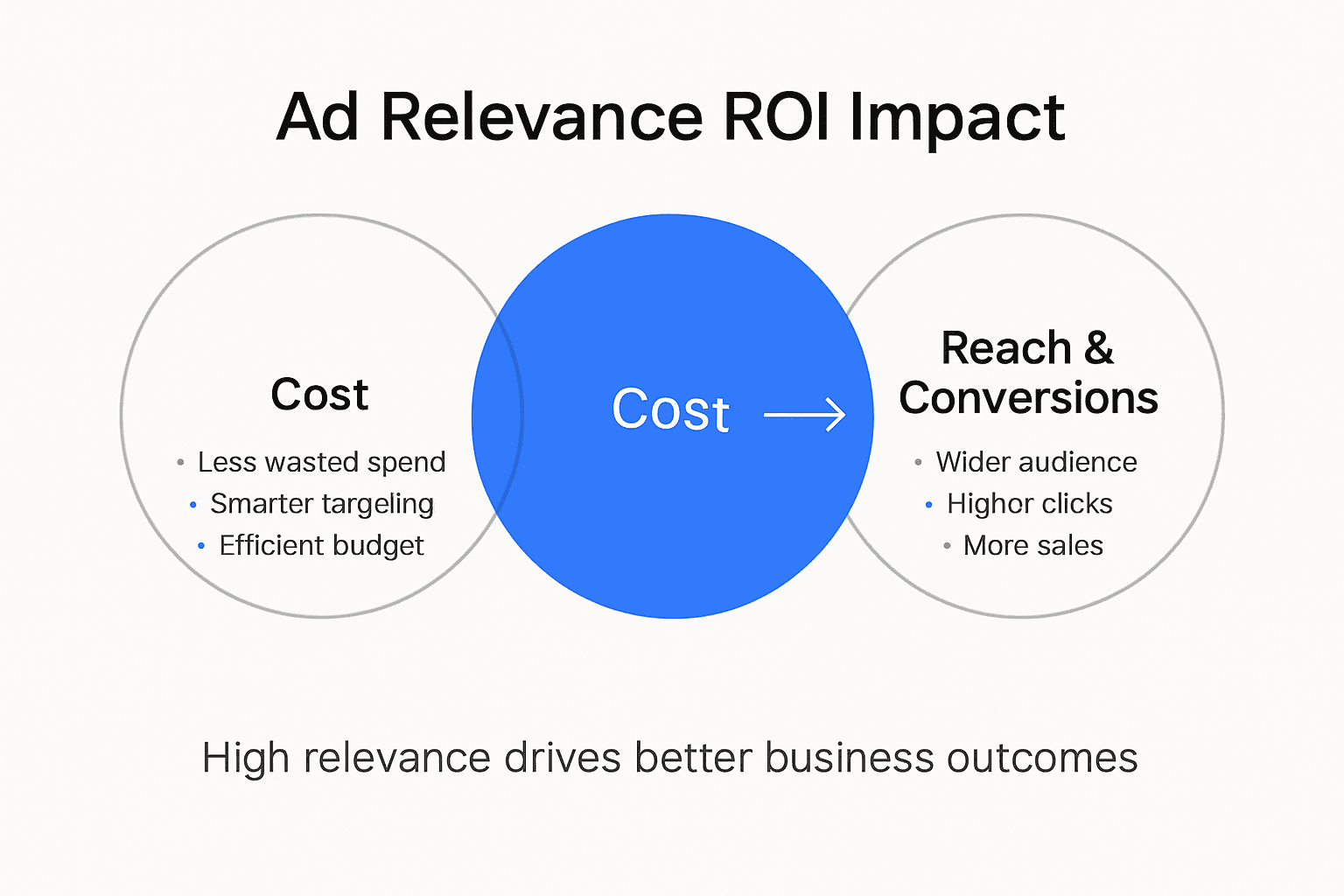
The cost implications of ad relevance are profound. Highly targeted advertisements reduce wasted spend by ensuring marketing budgets are directed towards audiences most likely to convert. Instead of broad, scattergun approaches, businesses can now surgically target their ideal customer segments, minimising irrelevant impressions and maximising return on investment. Ad optimization strategies enable marketers to fine-tune their targeting, reducing cost per acquisition and improving overall campaign efficiency.
Reach and conversion metrics also experience significant improvements through strategic ad relevance. By aligning advertisement content more closely with audience interests and behaviours, businesses can increase engagement rates, reduce ad fatigue, and create more meaningful connections with potential customers. Modern digital platforms provide sophisticated targeting tools that allow granular audience segmentation, enabling businesses to expand their reach while maintaining high relevance and conversion potential.
Pro tip: Conduct regular A/B testing on your ad relevance strategies, tracking key performance indicators to continuously refine your targeting approach and maximise marketing effectiveness.
The following table summarises the main impacts of ad relevance on marketing outcomes:
| Business Metric | Impact of High Relevance | Typical Result |
|---|---|---|
| Cost Efficiency | Lower wasted impressions | Reduced ad spend per lead |
| Audience Reach | More engaged viewers | Expanded relevant audience |
| Conversion Rate | Stronger ad-message match | Increased sales and signups |
Common Missteps and How to Improve
Ad campaign failures often stem from fundamental misunderstandings about audience targeting and messaging. Research on advertising effectiveness reveals critical insights through the ADPLAN framework, which highlights how marketers frequently miscalculate the delicate balance between creative design and genuine audience resonance.
One significant misstep involves over-prioritising visual aesthetics at the expense of meaningful communication. Many businesses invest heavily in eye-catching graphics and clever slogans without ensuring the core message actually connects with their target demographic. This approach leads to wasted marketing budgets and minimal engagement. Successful strategies require a deep understanding of audience psychology, carefully crafting messages that speak directly to specific customer pain points and aspirations.
Privacy considerations in targeted advertising introduce another critical dimension of potential missteps. Marketers must strike a delicate balance between personalisation and respecting user privacy. Overly intrusive targeting can trigger negative consumer reactions, potentially undermining the entire marketing effort. The most effective approaches involve transparent communication, providing clear value propositions, and demonstrating genuine understanding of audience needs without feeling manipulative or invasive.
Pro tip: Develop a comprehensive audience persona that goes beyond demographics, incorporating psychological insights, pain points, and genuine motivations to create more authentic and resonant marketing messages.
Elevate Your Aussie Business with Expert Ad Relevance Strategies
The article highlights the challenge many businesses face in delivering truly relevant ads that cut through the noise and connect deeply with their audience. If you struggle to reduce wasted ad spend or see inconsistent results from your campaigns, the key lies in mastering ad relevance—understanding your customer pain points, motivations, and delivering personalised messaging that increases engagement and conversions. At AdsDaddy.com, we specialise in creating and optimising targeted campaigns across platforms like Facebook, Google, and LinkedIn that focus exactly on these core principles described in the article.
Our data-driven approach includes continuous refinement of audience personas and strategic ad placements, helping you achieve higher relevance scores that lower costs and expand your reach. Whether you need video, carousel, or text ads, we harness the power of advanced targeting and integration tools like Meta for Business and Klaviyo to maximise your ROI.
Unlock the full potential of your digital advertising today with solutions tailored for Australian small and medium-sized businesses that want to transform ad relevance into real revenue growth.
Start crafting campaigns that deliver measurable impact now

Explore how AdsDaddy.com can boost your marketing effectiveness with expert campaign management and strategic optimisation. Visit our website or learn more about our proven ad targeting strategies and ad optimisation solutions to take the next step towards advertising domination.
Frequently Asked Questions
What is ad relevance in digital marketing?
Ad relevance measures how well an advertisement connects with its intended audience by addressing their specific needs and interests. It transforms ads from mere interruptions into valuable solutions for consumers.
How does ad relevance impact my advertising costs?
High ad relevance can significantly reduce wasted advertising spend by ensuring that marketing budgets are directed toward audiences most likely to convert, thus improving overall campaign efficiency.
What strategies can I use to improve ad relevance?
To improve ad relevance, conduct regular audience research, utilise data analytics, and develop comprehensive audience personas that reflect the psychological insights and motivations of your target market.
How can I measure ad relevance for my campaigns?
Ad relevance can be measured through various performance metrics including click-through rates, user engagement, audience demographic match, and content alignment, alongside historical performance data.
Recommended
- Why Use Targeted Ads: Complete Guide for Australia 2026 - Ads Daddy. Advertise on All Plattforms.
- Role of Video Ads: Complete Guide for Australian SMEs - Ads Daddy. Advertise on All Plattforms.
- Facebook Ads Archives - Ads Daddy. Advertise on All Plattforms.
- business growth Archives - Ads Daddy. Advertise on All Plattforms.