Ad Impressions: Maximising Reach for Aussie E‑Commerce
. By Ads Daddy.

Australian e-commerce brands risk wasting up to 44% of ad spend without a clear understanding of how ad impressions work. For small and medium businesses, every dollar counts when running campaigns on platforms like Google or Facebook. Knowing exactly how impressions are tracked means you can identify opportunities to improve lead generation, avoid inefficient spending, and make meaningful marketing decisions backed by real data.
Table of Contents
- Ad Impressions Defined For Digital Ads
- Different Types Of Ad Impressions Online
- How Ad Impressions Are Counted And Tracked
- Key Metrics: Cpm, Viewability, And Reach
- Common Pitfalls And Strategies To Avoid Waste
Key Takeaways
| Point | Details |
|---|---|
| Understanding Ad Impressions | Ad impressions indicate how often an advertisement is displayed, providing insights into brand exposure and audience reach beyond just engagement metrics. |
| Types of Ad Impressions | Differentiating between served, viewable, and unique impressions helps e-commerce businesses gauge their true advertising effectiveness and audience engagement. |
| Key Metrics for Success | Metrics like CPM, viewability, and reach guide marketers in assessing campaign efficiency and optimising advertising spend. |
| Minimising Advertising Waste | Implementing robust measurement techniques and regular audits can significantly reduce wasted ad spend and improve marketing efficiency. |
Ad Impressions Defined for Digital Ads
Understanding ad impressions is crucial for any Aussie e-commerce business looking to measure digital advertising effectiveness. Ad impressions represent the number of times an advertisement is displayed to potential customers, regardless of whether they interact with the ad or not.
These digital marketing metrics capture how often your advertisement appears on screens across various platforms like Google, Facebook, and Instagram. An impression is counted each time the ad loads on a user's device, providing insights into potential brand exposure and audience reach. Importantly, impressions differ from engagement metrics like clicks or conversions - they simply track visibility.
Two primary types of ad impressions exist in digital advertising: served impressions and viewable impressions. Served impressions occur when an ad is delivered to a webpage or platform, while viewable impressions are counted only when a significant portion of the ad becomes visible to a user for a specific duration. This nuanced tracking helps marketers understand the true potential of their advertising efforts.
Pro tip: Track your ad impressions across multiple platforms and compare their performance to identify which channels deliver the most visibility for your e-commerce brand.
Different Types of Ad Impressions Online
Digital advertising offers multiple ways to track and measure ad visibility, with different types of impressions classified by placement, platform, and delivery mode. Understanding these variations helps Aussie e-commerce businesses make more informed marketing decisions and optimise their online advertising strategies.
The primary categories of ad impressions include served impressions, viewable impressions, and unique impressions. Served impressions represent the total number of times an ad is technically delivered across digital platforms like social media feeds, search engine results, and website banners. Viewable impressions are more precise, measured according to industry standards that determine actual on-screen visibility - typically requiring a certain percentage of the ad to be visible for a specific duration.
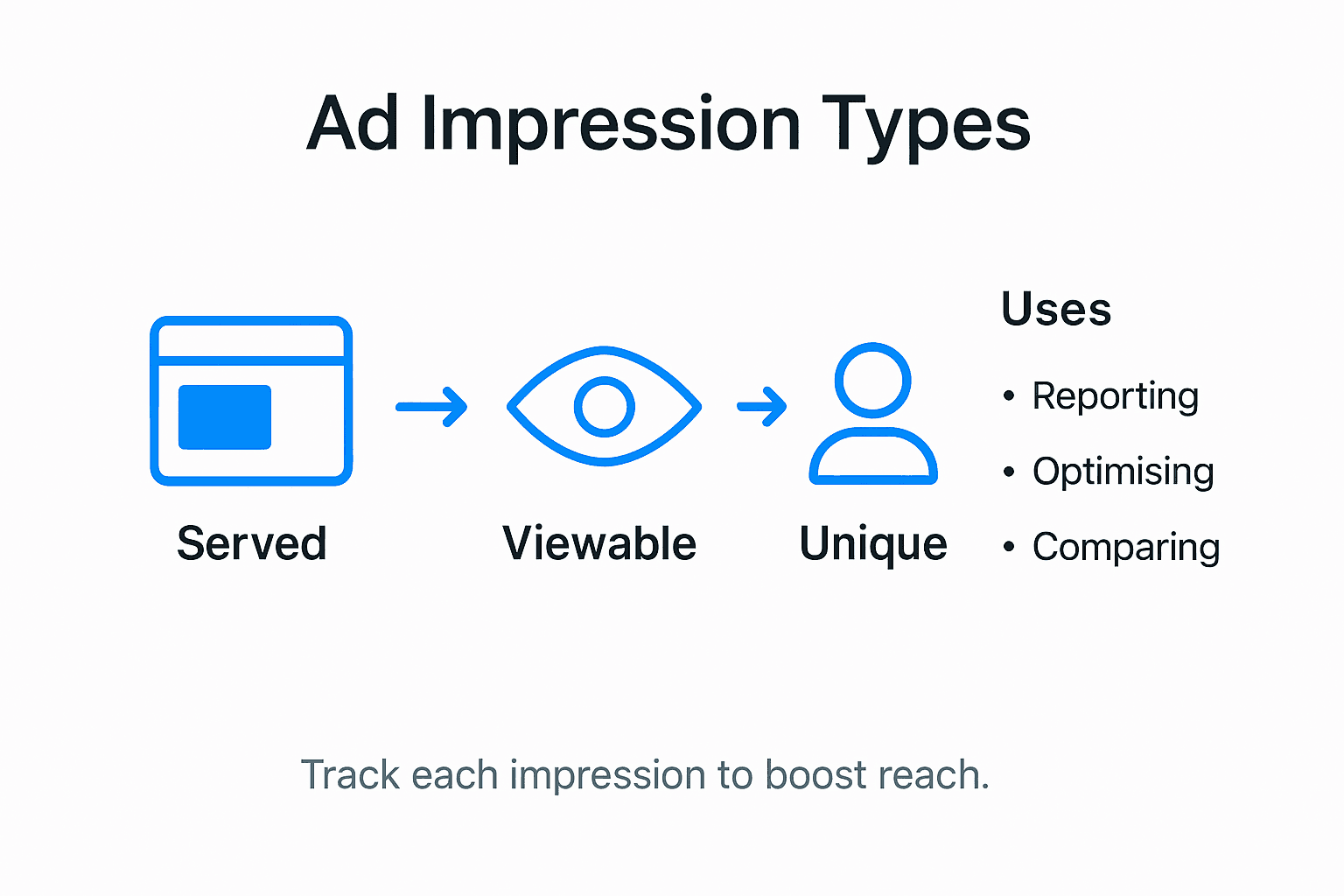
Unique impressions offer another critical metric, tracking the distinct number of individual users who have viewed an advertisement. This differentiates between repeated views by the same user and genuine reach across a diverse audience. E-commerce marketers can further distinguish between paid impressions (from targeted advertising campaigns) and organic impressions (naturally occurring views without direct paid placement).
Here's a comparison of ad impression types and their significance for e-commerce marketers:
| Impression Type | How It's Counted | Business Impact |
|---|---|---|
| Served Impression | Ad loads on a webpage | Indicates brand visibility |
| Viewable Impression | Visible portion for set duration | Measures actual exposure |
| Unique Impression | Distinct users viewing the ad | Reveals genuine reach |
Pro tip: Regularly compare your unique impression metrics across different platforms to understand which channels are delivering the most genuine audience engagement for your brand.
How Ad Impressions Are Counted and Tracked
Digital advertising platforms use sophisticated methodologies to track ad impressions with precision. Major digital platforms follow strict industry standards set by the Media Rating Council and Interactive Advertising Bureau to ensure accurate and transparent measurement across different digital environments.

The counting process typically uses a 'count-on-begin-to-render' methodology, where an impression is registered the moment an ad starts loading on a user's screen. For display and mobile ads, this means tracking the initial rendering, while video ads count an impression when the first frame appears. Different types of impressions are meticulously classified, including measurable impressions, viewable impressions, and invalid impressions. Viewable impressions require additional verification, usually evaluating the ad's visible portion and duration on screen.
Technical tracking involves complex processes across multiple devices and platforms. Advertisers must consider factors like partial ad visibility, screen time, and user interaction to differentiate between genuine and potentially fraudulent impressions. Advanced tracking technologies now incorporate machine learning and real-time verification to provide more accurate and meaningful impression data for e-commerce businesses seeking to understand their true advertising reach.
Pro tip: Regularly audit your ad impression data across different platforms to identify discrepancies and ensure you're getting accurate reporting of your marketing efforts.
Key Metrics: CPM, Viewability, and Reach
Australian Digital Advertising Practices provide crucial frameworks for understanding key digital advertising metrics that help e-commerce businesses track and optimise their online campaigns. These fundamental measurements - CPM, viewability, and reach - offer critical insights into advertising performance and audience engagement.
Cost Per Mille (CPM) represents the price advertisers pay for every thousand impressions of their advertisement. This metric helps businesses understand the basic expense of generating visibility. Viewability introduces a more nuanced measurement, tracking the percentage of ads actually seen by real users. Research indicates that only about half of served digital ads are genuinely viewable, making this metric crucial for understanding true advertising impact.
Reach measures the unique number of individuals exposed to an advertisement, distinguishing between total impressions and actual audience engagement. By combining these metrics, Aussie e-commerce businesses can develop more sophisticated advertising strategies that prioritise not just volume, but meaningful audience interaction. Understanding the relationship between CPM, viewability, and reach allows marketers to make more informed decisions about budget allocation and campaign design.
This table summarises key digital advertising metrics and what they reveal for campaign optimisation:
| Metric | What It Measures | Key Insight for Marketers |
|---|---|---|
| CPM | Cost per thousand impressions | Assesses campaign efficiency |
| Viewability | Proportion of ads seen | Highlights true audience impact |
| Reach | Unique individuals exposed | Shows overall campaign scope |
Pro tip: Always compare your viewability rates across different platforms to identify which channels deliver the most genuine audience visibility for your advertising budget.
Common Pitfalls and Strategies to Avoid Waste
Australian digital advertising faces a substantial waste problem, with studies revealing up to 44% of ad spend potentially being lost through inefficient targeting, fraudulent impressions, and poorly designed campaigns. Understanding these challenges is crucial for Aussie e-commerce businesses seeking to maximise their marketing investment.
Key pitfalls in digital advertising include irrelevant targeting, platform-driven metrics, and fraudulent impression generation. Businesses often fall into the trap of prioritising volume over genuine audience engagement, resulting in wasted resources. Systemic issues like fragmented channel measurement and inflated impression counts can obscure the true performance of advertising campaigns, making it difficult to assess real return on investment.
Strategic approaches to minimise waste involve implementing robust measurement techniques, conducting regular campaign audits, and leveraging data-driven targeting methods. Marketers should focus on granular audience segmentation, use advanced analytics to validate impression quality, and continuously optimize campaign parameters. By prioritising genuine audience interaction over raw impression numbers, e-commerce businesses can significantly reduce advertising waste and improve overall marketing efficiency.
Pro tip: Implement a monthly audit of your ad performance metrics, focusing on viewability rates and actual audience engagement to quickly identify and eliminate inefficient spending.
Maximise Your Ad Impressions and Boost Genuine Reach for Your Aussie E-Commerce Business
Understanding the true value of ad impressions goes beyond mere numbers. The challenge many Australian e-commerce businesses face is cutting through wasted spend caused by inflated or non-viewable impressions. Concepts like viewable impressions, unique impressions, and CPM are crucial to unlocking real visibility and authentic customer engagement. Without expert guidance, it can be frustrating to know where your ads genuinely connect with your audience and how to optimise campaign efficiency.
At Ads Daddy, we specialise in data-driven advertising strategies designed to maximise your ad impression quality across platforms including Facebook, Instagram, Google, and more. Our tailored approach focuses on:
- Enhancing viewability rates so your brand is seen by real, interested users
- Leveraging unique impressions for authentic audience reach
- Reducing wasted ad spend by targeting with precision and auditing campaign performance regularly
With proven expertise in multiple ad formats and integrated tools, we help your e-commerce business transform impressions into measurable growth and sales.
Take control of your digital advertising success today and avoid common pitfalls that drain your budget.

Ready to turn your ad impressions into genuine leads and increased sales? Visit Ads Daddy to start your journey to smarter, more efficient advertising tailored for Australian e-commerce brands.
Frequently Asked Questions
What are ad impressions in digital marketing?
Ad impressions in digital marketing refer to the number of times an advertisement is displayed to users across various platforms, regardless of whether they interact with the ad. This metric is crucial for measuring brand visibility and audience reach.
How are different types of ad impressions categorized?
Ad impressions are categorized into served impressions, which count how many times an ad is delivered, viewable impressions, which measure actual visibility on the screen, and unique impressions, which track the distinct number of users who view the ad. Understanding these types helps in optimizing advertising strategies.
What is the significance of viewability in ad impressions?
Viewability measures the proportion of ads that are actually seen by users. This metric is significant because it highlights the real audience engagement compared to the total number of served impressions, which can greatly affect the true effectiveness of an advertising campaign.
How can e-commerce businesses reduce waste in advertising?
E-commerce businesses can reduce waste by implementing robust measurement techniques, conducting regular campaign audits, and using data-driven targeting methods. Focusing on genuine audience interaction and continuously optimizing campaign parameters helps improve overall marketing efficiency.
Recommended
- 7 Key Ad Formats Explained for Growing Businesses Online - Ads Daddy. Advertise on All Plattforms.
- Why Use Targeted Ads: Complete Guide for Australia 2026 - Ads Daddy. Advertise on All Plattforms.
- Role of Video Ads: Complete Guide for Australian SMEs - Ads Daddy. Advertise on All Plattforms.
- What Is Cross-Platform Advertising? Complete Breakdown - Ads Daddy. Advertise on All Plattforms.
- YouTube Thumbnail Agency From New Generation - Professional CTR Optimized Thumbnails For Higher Views | ViewsMachine