Ad Fatigue – Why It Drains Your ROI Fast
. By Ads Daddy.

With over 60 percent of australian digital marketers reporting a drop in ad engagement, the challenge of ad fatigue is hitting small and medium-sized e-commerce businesses hard. Repeating the same ad creative or message too often can turn once-interested audiences into indifferent scrollers, draining your budget and reducing campaign ROI. This guide breaks down why ad fatigue happens and reveals practical ways to keep australian campaigns effective, helping you stay ahead of reduced performance and rising costs.
Table of Contents
- What Is Ad Fatigue And Why It Occurs
- Major Types Of Ad Fatigue In Digital Ads
- Key Signs Your Ads Are Fatiguing Audiences
- Common Triggers And Costly Mistakes To Avoid
- Best Strategies To Prevent Or Reverse Ad Fatigue
Key Takeaways
| Point | Details |
|---|---|
| Ad Fatigue Explained | Ad fatigue occurs when audiences become desensitised to repeated advertisements, leading to decreased engagement and campaign effectiveness. |
| Types of Ad Fatigue | Key types include visual, message, platform, and frequency fatigue, each affecting campaign performance in unique ways. |
| Signs of Ad Fatigue | Recognising declining engagement metrics, such as lower click-through rates and increased ad skip rates, is critical for timely intervention. |
| Prevention Strategies | Implementing creative diversity, audience segmentation, and frequency management can significantly reduce the risk of ad fatigue and enhance campaign effectiveness. |
What Is Ad Fatigue And Why It Occurs
Marketing campaigns aren't immune to exhaustion. Just like humans experience directed attention fatigue, digital audiences develop resistance to repeated advertising messages. Ad fatigue emerges when potential customers become desensitised to marketing content they've seen multiple times, causing diminishing engagement and reduced campaign effectiveness.
The psychological mechanism behind ad fatigue mirrors human cognitive processing. When consumers are repeatedly exposed to similar visual and messaging stimuli, their brain's inhibitory attention systems start filtering out these repetitive signals. This natural defence mechanism means your carefully crafted advertisements transform from attention-grabbing content to background noise that audiences unconsciously ignore. Think of it like hearing the same radio jingle 20 times - eventually, you'll tune it out completely.
Several key factors contribute to accelerated ad fatigue:
- Repetitive visual designs
- Consistent messaging without variation
- Targeting audiences too broadly
- Running identical ad creatives across extended periods
- Neglecting audience segmentation strategies
The impact on marketing performance can be substantial. Fatigued audiences demonstrate lower click-through rates, reduced conversion potential, and increased advertising costs as platforms penalise less engaging content. Australian businesses investing in digital marketing must proactively manage and prevent ad fatigue to maintain campaign ROI.
Pro tip: Rotate your ad creatives every 2-3 weeks and use dynamic content personalisation to keep your messaging fresh and engaging.
Major Types Of Ad Fatigue In Digital Ads
Digital advertising confronts multiple manifestations of audience exhaustion, each presenting unique challenges for marketers. Creative fatigue in digital advertising represents a critical phenomenon where repeated ad exposures trigger diminishing audience engagement and campaign performance.
The primary types of ad fatigue include:
- Visual Fatigue
- Audiences become desensitised to repetitive graphic designs
- Identical colour schemes, imagery, and layout structures lose impact
- Consumers subconsciously block out visually monotonous advertisements
- Message Fatigue
- Consistent marketing messaging becomes predictable
- Audiences develop immunity to standard promotional language
- Repetitive value propositions reduce emotional connection
- Platform Fatigue
- Different digital platforms generate unique audience exhaustion patterns
- Social media users respond differently compared to search engine audiences
- Targeting strategies must adapt to platform-specific engagement levels
- Frequency Fatigue
- Excessive ad repetition across multiple channels
- Diminishing returns from high-frequency marketing campaigns
- Increased likelihood of negative brand perception
Understanding these nuanced fatigue types allows Australian businesses to develop more sophisticated, dynamic advertising strategies that maintain audience interest and campaign effectiveness.
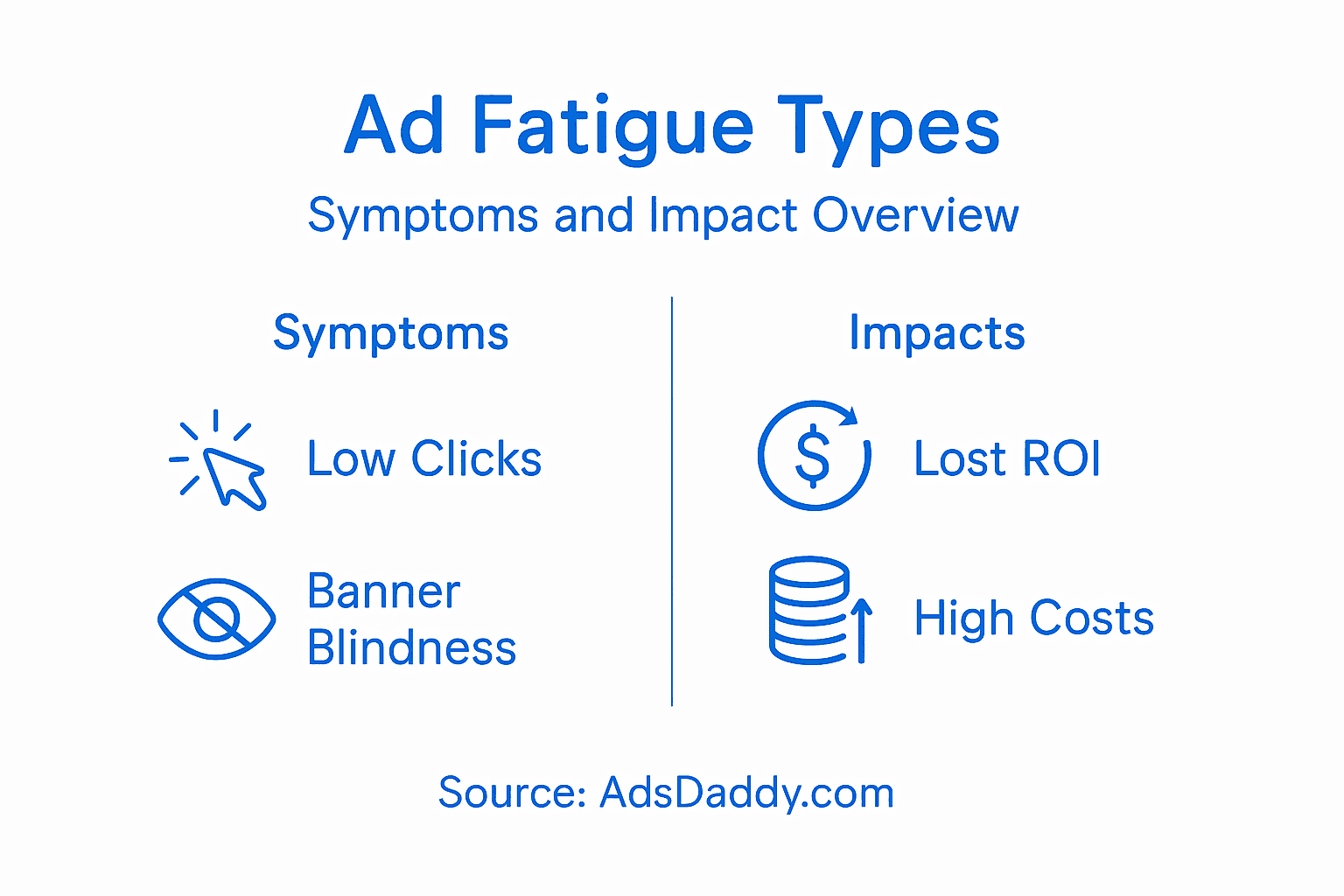
Here's a comparison of the main ad fatigue types and how they uniquely impact campaign performance:
| Fatigue Type | Unique Characteristic | Impact on Campaigns |
|---|---|---|
| Visual Fatigue | Repetitive visual assets | Reduced brand recall, ad blindness |
| Message Fatigue | Unchanging promotional language | Weaker emotional response, disengagement |
| Platform Fatigue | Varies by digital platform | Channel inefficiency, subpar targeting |
| Frequency Fatigue | High exposure across channels | Annoyed audiences, negative brand image |
Pro tip: Implement a rotating creative strategy with at least three distinct ad variations to combat audience desensitisation and maintain engagement.
Key Signs Your Ads Are Fatiguing Audiences
Recognising the symptoms of ad fatigue early can save your marketing budget from unnecessary drain. Advertising clutter creates consumer irritation) that manifests through several distinct performance indicators marketers must monitor closely.

Key performance metrics revealing ad fatigue include:
Quantitative Warning Signs:
- Declining click-through rates (CTR)
- Reduced engagement percentages
- Increased cost per acquisition (CPA)
- Falling conversion rates
- Diminishing return on ad spend (ROAS)
Behavioural Indicators:
- Audiences scrolling past advertisements without interaction
- Growing negative comments on ad posts
- Decreased social media engagement with sponsored content
- Higher ad skip rates
- Minimal shares or meaningful interactions
Emotional Response Signals:
- Audience appearing visibly annoyed by repeated messaging
- Subtle signs of mental exhaustion when encountering familiar ads
- Developing banner blindness or unconscious ad blocking behaviour
- Expressing frustration through digital feedback channels
These signals demonstrate that your digital advertising strategy requires immediate recalibration to maintain audience interest and campaign effectiveness.
Pro tip: Implement a comprehensive analytics dashboard tracking engagement metrics weekly to catch ad fatigue symptoms before they significantly impact campaign performance.
Common Triggers And Costly Mistakes To Avoid
Marketers often unintentionally sabotage their own campaigns by overlooking critical warning signs. Workplace fatigue research highlights systematic triggers that drain advertising effectiveness and consume marketing budgets unnecessarily.
Top Triggers of Ad Fatigue:
- Excessive ad frequency
- Identical creative assets
- Repetitive messaging
- Broad, non-targeted audience segments
- Neglecting audience segmentation
- Ignoring performance analytics
Costly Mistakes Marketers Make:
- Bombardment Strategy
- Flooding audiences with identical ads
- Believing more impressions guarantee better results
- Overwhelming potential customers with aggressive messaging
- Creative Stagnation
- Using unchanged ad designs for extended periods
- Failing to refresh visual and textual content
- Assuming audience engagement remains constant
- Metric Myopia
- Overlooking nuanced performance indicators
- Focusing solely on vanity metrics
- Ignoring qualitative audience feedback signals
Understanding these triggers helps Australian businesses develop more sophisticated, adaptive marketing strategies that maintain audience interest and campaign momentum.
Pro tip: Implement a quarterly creative audit and rotation strategy to proactively prevent ad fatigue and maintain audience engagement.
Best Strategies To Prevent Or Reverse Ad Fatigue
Marketing professionals need strategic approaches to combat the silent killer of campaign performance. Effective fatigue management techniques can dramatically transform your advertising outcomes by keeping audience engagement fresh and dynamic.
Strategic Refresh Techniques:
- Creative Diversity
- Design multiple ad variations simultaneously
- Rotate creative assets every 2-3 weeks
- Develop distinct visual and messaging approaches
- Audience Segmentation
- Break broad audiences into specific micro-segments
- Customise messaging for each audience cluster
- Use behavioural and demographic targeting
- Frequency Management
- Set strict impression limits per user
- Implement intelligent ad scheduling
- Create cooling-off periods between campaign iterations
- Dynamic Content Strategies
- Use personalisation algorithms
- Integrate real-time data for contextual relevance
- Develop responsive ad templates
Successful ad fatigue prevention requires continuous monitoring, agile adaptation, and a commitment to audience experience. Australian businesses must view their advertising as a dynamic conversation, not a monotonous monologue.
The following table summarises proven strategies to mitigate or reverse ad fatigue, highlighting their key benefits for Australian marketers:
| Prevention Strategy | Key Advantage | When to Implement |
|---|---|---|
| Creative Diversity | Maintains novelty, sustains interest | Campaign launch & refresh |
| Audience Segmentation | Boosts relevance, improves response rate | Audience expansion phase |
| Frequency Management | Reduces annoyance, cuts wasted spend | High impression periods |
| Dynamic Content | Increases engagement, personalises ads | Always-on campaigns |
Pro tip: Conduct monthly creative performance audits and maintain an ad variation library to ensure constant campaign freshness.
Combat Ad Fatigue And Protect Your ROI With Expert Digital Strategies
Ad fatigue can silently erode your advertising effectiveness by causing repetitive visual and message fatigue that drains your ROI fast. If you notice declining click-through rates or growing audience disengagement it is critical to act quickly to refresh your campaigns with creative diversity and frequency management. AdsDaddy.com specialises in managing and optimising campaigns across platforms like Facebook, Google, and LinkedIn using data-driven strategies that prevent ad fatigue and keep your ads engaging for your target audience.
Boldly tackle audience desensitisation with:
- Dynamic ad creative rotations designed to maintain novelty
- Precise audience segmentation to tailor messaging
- Intelligent frequency controls that reduce annoyance

Ready to reverse ad fatigue and boost your conversions fast Discover how AdsDaddy.com can deliver fresh, personalised campaigns that sustain engagement and maximise your ad spend today Visit our website to learn more and take the first step towards advertising domination. Experience the power of strategic ad management with AdsDaddy.com now and prevent budget-wasting mistakes before they happen.
Frequently Asked Questions
What is ad fatigue?
Ad fatigue occurs when audiences become desensitised to repeated advertising messages, leading to decreased engagement and diminished effectiveness of marketing campaigns.
What are the signs that my ads are causing ad fatigue?
Key signs include declining click-through rates, reduced engagement, increased cost per acquisition, and negative feedback from audiences such as annoyance or ad skipping behavior.
How can I prevent ad fatigue in my marketing campaigns?
To prevent ad fatigue, consider rotating your ad creatives, segmenting your audience for targeted messaging, managing ad frequency, and utilising dynamic content strategies that keep ads relevant and engaging.
What mistakes should marketers avoid to minimise ad fatigue?
Marketers should avoid bombarding audiences with identical ads, allowing creative stagnation, and focusing solely on vanity metrics instead of a comprehensive analysis of performance indicators.