Ad Copywriting for Ads – Boosting Sales in Australia
. By Ads Daddy.

Over 63 percent of australian online shoppers say clear, persuasive ad copy directly influences their purchasing decisions. With digital competition stronger than ever, getting ad copy right is the key to standing out on platforms like Facebook and Google. If you want to reach more australian customers and convert clicks into sales, understanding what really works in ad copywriting—and which myths to ignore—can make all the difference.
Table of Contents
- What Is Ad Copywriting and Common Myths
- Types of Ad Copywriting for Online Ads
- Core Elements of Effective Ad Copy
- Australian Laws on Ad Copywriting
- Pitfalls and Costly Mistakes to Avoid
Key Takeaways
| Point | Details |
|---|---|
| Understanding Ad Copywriting | It's a strategic form of communication aimed at persuading and converting potential customers through clear narratives and emotional triggers. |
| Types of Ad Copy | Various online ad formats serve unique purposes; understanding these helps in crafting effective, tailored messages. |
| Core Elements of Effective Ad Copy | Successful ad copy combines a compelling headline, value proposition, emotional triggers, and a strong call-to-action. |
| Legal Considerations | Adhering to Australian Consumer Law is crucial to avoid misleading claims and ensure transparency in communications. |
What Is Ad Copywriting and Common Myths
Ad copywriting isn't just writing words - it's strategic communication designed to persuade and convert potential customers. At its core, copywriting represents a sophisticated blend of psychology, marketing strategy, and linguistic precision that goes far beyond simple text creation.
Many business owners mistakenly believe ad copywriting is about cramming fancy words into limited space. The reality? Effective copywriting requires deep understanding of audience psychology, strategic messaging, and targeted communication. It's less about eloquence and more about creating clear, compelling narratives that trigger specific emotional and rational responses from potential customers.
In the Australian market, successful ad copywriting involves several critical components: understanding consumer behaviour, crafting persuasive language, and aligning messaging with specific audience segments. The most powerful copy doesn't just describe a product - it connects emotionally, solves problems, and creates a sense of urgency that compels readers to take action. Digital advertising strategies have transformed copywriting from traditional print methods into a data-driven, precision-targeted discipline.
Common myths about ad copywriting often prevent businesses from developing truly effective marketing messages. Some believe good copy is purely creative, others think it's about using complex language. Neither could be further from the truth. Exceptional copywriting is a strategic skill that combines creativity with psychological insights, market research, and measurable performance metrics.
Pro Tip: Conversion Focus: Before writing any ad copy, clearly define your specific conversion goal. Whether it's generating leads, driving sales, or increasing brand awareness, having a precise objective will sharpen your messaging and improve overall campaign performance.
Types of Ad Copywriting for Online Ads
Ad copywriting isn't a one-size-fits-all approach. In the digital landscape, different types of online ad copy serve unique strategic purposes across various platforms. Understanding these variations is crucial for crafting targeted, high-converting marketing messages that resonate with specific audience segments.
The primary types of online ad copywriting include display ads, search ads, social media ads, email marketing copy, and mobile-specific advertisements. Each format requires a distinct approach to messaging, tailoring communication style and content to the specific platform and audience expectations. For instance, search ads demand concise, keyword-rich text that immediately addresses user intent, while social media ads thrive on conversational, engaging language that sparks immediate interaction.
In the Australian market, successful online ad copywriting breaks down into three core categories: direct response copy, brand-building copy, and informational copy. Direct response copy aims to trigger an immediate action - like making a purchase or signing up for a newsletter. Brand-building copy focuses on creating emotional connections and long-term brand perception. Informational copy educates potential customers about products, services, or industry insights, positioning the brand as an authoritative resource.
Digital platforms demand nuanced copywriting strategies. Search ads require precision and relevance, social media ads need personality and immediacy, and email sequences must balance persuasion with value. Understanding the unique requirements of each platform allows marketers to craft messages that not only capture attention but drive meaningful engagement and conversions.
Here's a side-by-side look at key types of online ad copy and their strategic uses in the Australian digital landscape:
| Ad Type | Primary Purpose | Best-Suited Platform |
|---|---|---|
| Display Ads | Brand visibility, awareness | News, blogs, and websites |
| Search Ads | Immediate conversions | Google, Bing search results |
| Social Media Ads | Engagement, interaction | Facebook, Instagram, LinkedIn |
| Email Marketing | Nurturing leads, retention | Subscriber inboxes |
| Mobile Advertisements | On-the-go engagement | Mobile apps, games, devices |
Pro Tip: Copy Customisation: Always adapt your copywriting style to match the specific platform and audience expectations. What works on Google might fall flat on Instagram, so invest time in understanding each channel's unique communication dynamics.
Core Elements of Effective Ad Copy
Crafting compelling ad copy requires a strategic blend of psychological insight and marketing precision. Effective advertising campaigns demand a careful orchestration of core elements that capture attention and drive action, transforming simple words into powerful conversion tools.
The fundamental elements of impactful ad copy include a headline that immediately grabs attention, a value proposition that clearly communicates unique benefits, emotional triggers that resonate with the target audience, and a compelling call-to-action that motivates immediate response. Each element plays a critical role in creating a cohesive message that moves potential customers through the decision-making process.

In the Australian market, successful ad copy must balance brevity with depth. This means distilling complex offerings into concise, punchy language that speaks directly to the audience's needs and desires. The most effective copy creates an instant connection by addressing specific pain points, highlighting tangible benefits, and presenting a solution that feels personally tailored to the reader's circumstances.
Psychological principles are the backbone of persuasive copywriting. Techniques like social proof, scarcity, urgency, and storytelling transform mundane product descriptions into compelling narratives that trigger emotional and rational decision-making. Understanding these psychological levers allows marketers to craft messages that don't just inform, but genuinely motivate action.
Pro Tip: Emotional Resonance: Always draft your ad copy from the customer's perspective, focusing on the transformation or benefit they'll experience rather than just listing product features.
Australian Laws on Ad Copywriting
Navigating the legal landscape of ad copywriting in Australia requires a comprehensive understanding of strict regulatory frameworks designed to protect consumers and maintain marketplace integrity. Australian Consumer Law provides detailed guidelines governing advertising practices, emphasising the critical importance of honest and transparent communication.
The core legal principles surrounding ad copywriting in Australia centre on preventing misleading or deceptive conduct. This means every advertisement must present information that is factually accurate, substantiated, and not likely to create false impressions about a product or service. Businesses are legally obligated to ensure all claims are verifiable, whether related to pricing, performance, capabilities, or comparative statements about competing products.
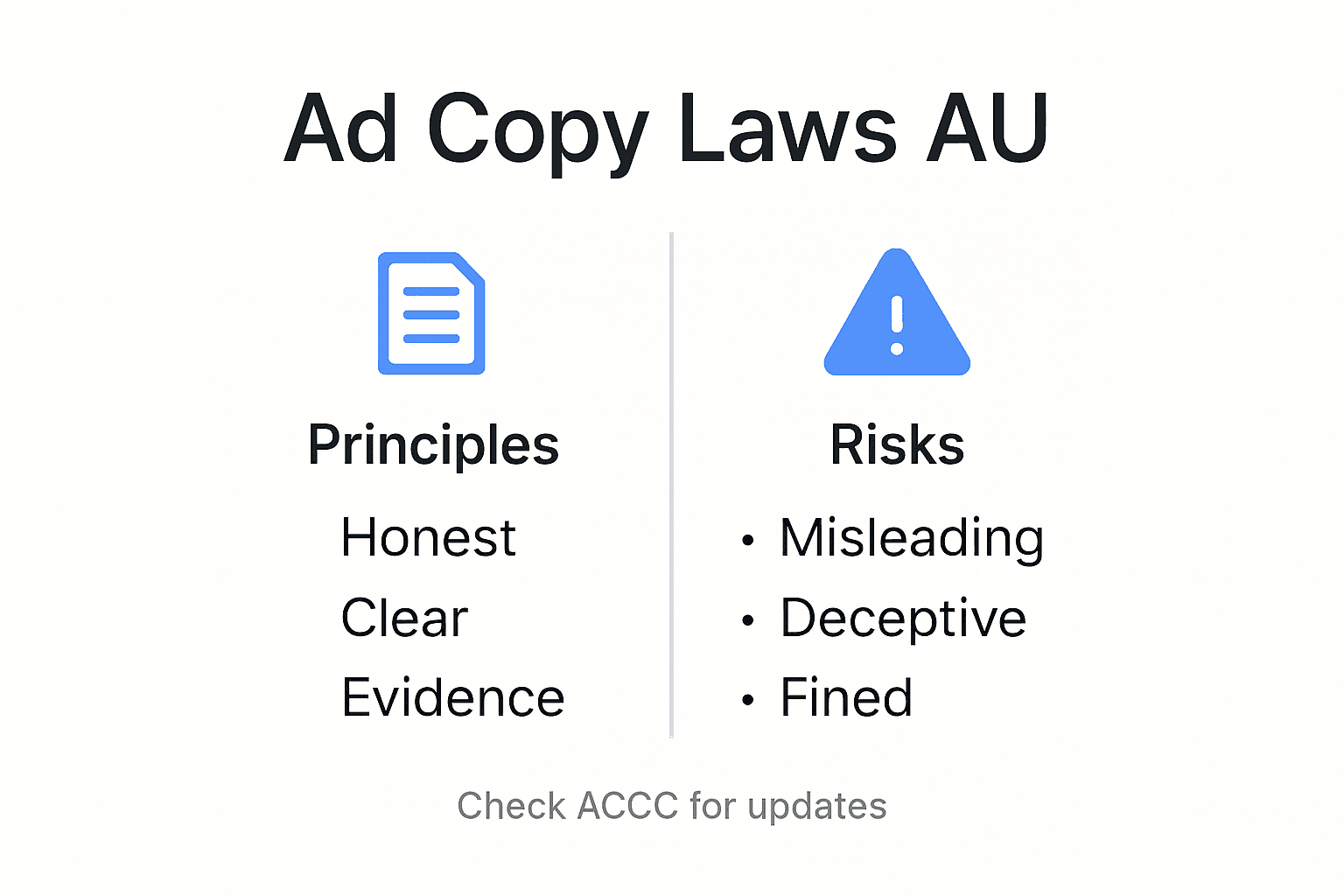
Specific legal considerations for online and digital advertising include stringent rules around testimonials, reviews, and influencer marketing. Advertisements must clearly distinguish between genuine consumer experiences and paid promotional content. Endorsements require explicit disclosure of any financial arrangements, and claims must be backed by legitimate evidence. Penalties for non-compliance can be significant, with potential fines and legal actions that could severely damage a brand's reputation and financial standing.
The Australian Competition and Consumer Commission (ACCC) plays a crucial role in monitoring and enforcing advertising standards. They scrutinise advertisements across all mediums, with particular attention to emerging digital platforms and sophisticated marketing techniques. This means businesses must stay continuously informed about evolving legal requirements and maintain rigorous internal compliance processes to avoid potential legal challenges.
Pro Tip: Legal Safety: Always have your ad copy reviewed by a legal professional specialising in advertising law before publication to ensure complete compliance with current Australian Consumer Law standards.
Pitfalls and Costly Mistakes to Avoid
Common copywriting mistakes can devastate marketing campaigns and drain advertising budgets, turning potentially successful strategies into costly lessons. Understanding these pitfalls is crucial for Australian businesses seeking to maximise their advertising effectiveness and protect their brand reputation.
One of the most significant errors marketers make is creating ad copy that lacks genuine audience understanding. This manifests through generic messaging, overcomplicated language, and weak calls to action that fail to resonate with specific customer segments. Effective copywriting demands deep insights into target audience psychology, pain points, and motivational triggers. Businesses that neglect this fundamental research risk producing advertisements that are instantly forgettable or, worse, completely misaligned with their intended market.
Brand compliance and cultural sensitivity represent another critical area where Australian businesses frequently stumble. Common mistakes include making unsubstantiated claims, using misleading comparative language, and failing to include necessary legal disclaimers. These errors can trigger significant penalties from regulatory bodies like the Australian Competition and Consumer Commission (ACCC), potentially resulting in substantial financial penalties and lasting reputational damage.
Technical execution also plays a pivotal role in avoiding copywriting catastrophes. Poorly structured advertisements, grammatical errors, inconsistent brand voice, and inadequate proofreading can undermine even the most compelling marketing messages. Successful ad copy requires meticulous attention to detail, strategic language selection, and a ruthless commitment to clarity and precision.
To minimise risk and boost campaign performance, review these common copywriting pitfalls and their consequences:
| Pitfall | Impact on Campaign | How to Mitigate |
|---|---|---|
| Generic or broad messaging | Low engagement, wasted budget | Invest in audience research |
| Misleading claims | Legal action, brand damage | Verify all assertions |
| Ignoring platform nuances | Poor response, ad fatigue | Customise copy per channel |
| Weak calls to action | Fewer conversions | Use precise, direct language |
| Lapses in proofreading | Reduced credibility | Apply a strict review process |
Pro Tip: Error Prevention: Develop a comprehensive review checklist that includes audience alignment, legal compliance, technical accuracy, and emotional resonance before publishing any advertisement.
Elevate Your Australian Ad Copywriting with Expert Campaign Management
Crafting effective ad copy requires more than creativity it demands strategic insight into your audience's needs and platform nuances as emphasised in the article. If you struggle with engaging your target market or ensuring legal compliance while boosting conversions AdsDaddy.com offers tailored solutions designed to tackle these challenges head-on. Our expertise in multi-platform campaign management including Facebook Google and LinkedIn ensures your messaging is not only compliant with Australian Consumer Law but also customised to resonate with diverse audience segments.
We understand the critical importance of sharp headlines clear value propositions and compelling calls to action. Partnering with us means leveraging data-driven strategies and cutting-edge tools like Meta for Business and Klaviyo to transform your ad copy into powerful sales drivers. Whether you aim to increase brand awareness or generate immediate conversions we help you avoid costly mistakes and costly legal pitfalls by providing end-to-end support.
Take the next step towards advertising success now with our comprehensive service offerings discover how to convert insights into revenue and dominate the digital space. Visit AdsDaddy to learn more about our campaign management or explore how our integrated customer engagement platforms can boost your sales. Don’t let ineffective ad copy stall your growth take action today and generate measurable results with proven expertise.
Ready to amplify your ad impact and accelerate sales growth in Australia?

Explore expert strategies and start your journey with AdsDaddy.com now for bespoke advertising solutions that truly connect and convert.
Frequently Asked Questions
What is ad copywriting?
Ad copywriting is the strategic communication crafted to persuade and convert potential customers through clear, compelling narratives that resonate with audience psychology.
What are the core elements of effective ad copy?
The core elements include a catchy headline, a clear value proposition, emotional triggers that resonate with the audience, and a compelling call-to-action that encourages immediate responses.
How does digital advertising influence ad copywriting?
Digital advertising has transformed copywriting into a data-driven, precision-targeted discipline, requiring marketers to tailor messages specifically to various platforms and audience expectations.
What are common mistakes to avoid in ad copywriting?
Common mistakes include generic messaging, misleading claims, neglecting platform nuances, weak calls to action, and lapses in proofreading, all of which can negatively impact campaign effectiveness.
Recommended
- 7 Key Ad Formats Explained for Growing Businesses Online - Ads Daddy. Advertise on All Plattforms.
- Role of Video Ads: Complete Guide for Australian SMEs - Ads Daddy. Advertise on All Plattforms.
- Why Use Targeted Ads: Complete Guide for Australia 2026 - Ads Daddy. Advertise on All Plattforms.
- Video Advertising Archives - Ads Daddy. Advertise on All Plattforms.
- YouTube Thumbnail Agency From New Generation - Professional CTR Optimized Thumbnails For Higher Views | ViewsMachine