Ad Campaign Setup Guide for Driving E-commerce Growth
. By Ads Daddy.
Setting up ad campaigns without clear objectives or a precise audience often feels like money slipping through your fingers. For Australian e-commerce businesses looking to grow, defining what success looks like and who you truly want to reach is the foundation that shapes everything else. With a focus on SMART objective setting and data-driven audience insights, this guide shows you how to align goals and customers for more efficient ad spend and better lead generation.
Table of Contents
- Step 1: Define Campaign Objectives And Target Audience
- Step 2: Select Platforms And Ad Formats Strategically
- Step 3: Build Compelling Creative Assets For Engagement
- Step 4: Set Budgets And Schedule Campaigns Precisely
- Step 5: Optimise And Monitor Campaign Performance
Quick Summary
| Key Insight | Explanation |
|---|---|
| 1. Define SMART objectives clearly | Setting Specific, Measurable, Achievable, Realistic, and Time-bound goals transforms your campaign from vague intentions into measurable outcomes. |
| 2. Identify your target audience precisely | Use customer data to create detailed audience profiles instead of relying on assumptions, ensuring your ads reach the right people. |
| 3. Choose platforms and ad formats wisely | Map your target audience to platforms they frequent, and select ad formats that are the best fit for your campaign objectives. |
| 4. Monitor and optimise campaign performance | Establish clear metrics to track and regularly adjust your strategy based on real-time data for maximum effectiveness. |
| 5. Set budgets and schedule effectively | Strategically allocate your budget and time your campaigns to align with when your audience is most likely to convert. |
Step 1: Define campaign objectives and target audience
Before you spend a single dollar on ads, you need clarity on two things: what you're actually trying to achieve and who you're trying to reach. Without these foundations, you're throwing darts in the dark. This step determines whether your campaign becomes a revenue driver or a budget drain.
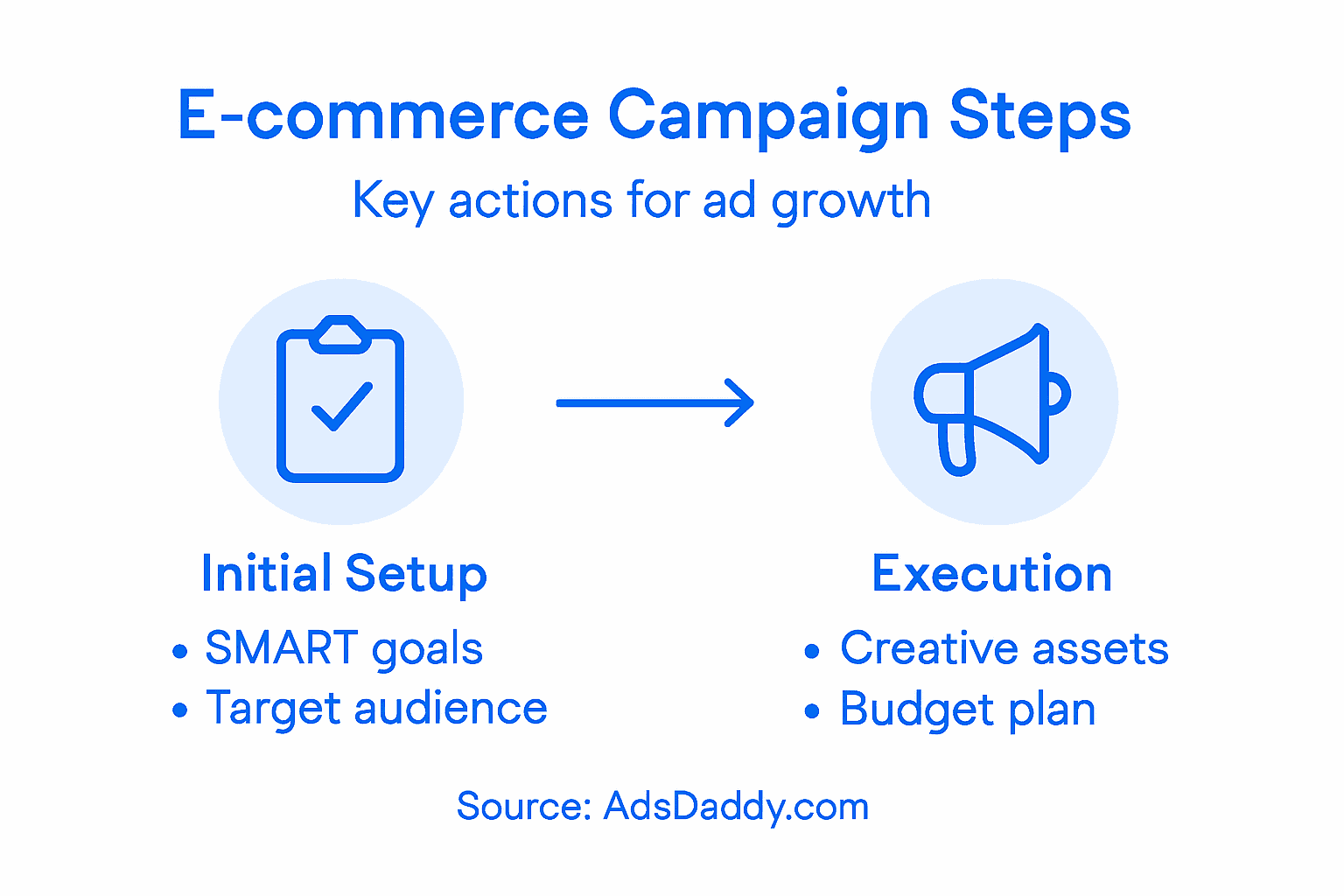
Start by setting SMART objectives. Your goals need to be Specific (not vague like "get more sales"), Measurable (you must be able to track progress with actual numbers), Achievable within your budget and timeline, Realistic based on your historical performance, and Time-bound with a clear deadline. Instead of "increase conversions," try "drive 150 online purchases in 90 days" or "generate 200 qualified leads by end of quarter." This clarity transforms your entire campaign from wishful thinking into a trackable operation.
Next, define your target audience with precision. This isn't about guessing who might buy your products. Use your actual customer data to build detailed profiles based on demographics (age, gender, location), behaviour (what they buy, how often they visit), and motivations (why they choose you). Customer data analysis reveals patterns that separate your best customers from those who waste your ad spend. If you sell premium sportswear, your target isn't "people aged 18 to 65." It's "fitness-focused professionals aged 28 to 45 in metropolitan areas with previous gym equipment purchases." That specificity is where results hide.
Don't rely on assumptions about what your audience wants. Instead, examine your existing customer base. What do your top 20% of customers have in common? Where do they live? What time do they shop? What related products do they buy? This information guides every decision downstream, from which platforms you choose to what your ads actually say.
Once you've defined objectives and audience segments, document them clearly. Share these with your team or campaign manager. This becomes your north star. When you're tempted to chase every trending platform or test random audiences, your documented objectives pull you back to what actually matters for your business growth.
Pro tip Set one primary objective and one secondary objective maximum, otherwise your budget and creative attention get scattered across too many goals, diluting your results and making it impossible to know which efforts actually worked.
Step 2: Select platforms and ad formats strategically
Now that you know what you want to achieve and who you're targeting, it's time to pick your weapons. The platforms you choose and the ad formats you use directly determine whether your message lands or gets scrolled past. This isn't about being everywhere. It's about being in the right place, in the right format, at the right time.
Start by mapping your target audience to where they actually spend time. If you're selling to small business owners aged 35 to 55, LinkedIn might be your goldmine. If you're targeting Gen Z fashion enthusiasts, TikTok and Instagram are non-negotiable. Your audience doesn't care which platform you prefer. They care about the content they see. Facebook, Instagram, Google, YouTube, and LinkedIn each have different user behaviours, attention spans, and purchasing mindsets. A 28 year old scrolling TikTok on their lunch break behaves completely differently than someone searching Google for "best accounting software."
Next, choose ad formats that align with both your platform and your objective. Video ads, carousel ads, display ads, and shopping ads serve different purposes depending on what you're trying to accomplish. If your goal is brand awareness, video content performs better. If you're driving immediate sales, shopping ads on Google show product listings directly. If you want engagement on social media, carousel ads let customers swipe through multiple products. The format isn't decoration. It's the delivery mechanism for your message.

Don't just guess which format works best. Your platform choice and campaign objective should guide your decision together. Someone running a lead generation campaign for a B2B service needs different formats than an e-commerce brand pushing seasonal sales. Test one or two formats per platform initially, then scale what works. Trying every format at once wastes budget and clouds your data.
Consider your budget allocation across platforms too. If you have AUD 1,000 to spend, splitting it five ways across five platforms guarantees insufficient data and weak results. Better to invest AUD 400 to 500 in your strongest platform and build momentum there first.
Pro tip Start with one primary platform and one backup format, master the data and optimisations there, then expand to secondary platforms only once you've proven your messaging and audience targeting work profitably.
Here's a comparison of common digital advertising platforms and their ideal objectives:
| Platform | Best Audience Types | Typical Objectives | Effective Ad Formats |
|---|---|---|---|
| Broad consumer demographics | Brand awareness, leads | Video, carousel, image | |
| Younger, visually-focused | Engagement, e-commerce | Stories, carousel, shopping | |
| Professionals, B2B segments | Lead generation, B2B sales | Sponsored content, message ads | |
| TikTok | Gen Z, trend-savvy users | Brand awareness, engagement | Short video, branded hashtags |
| Intent-driven, broad audience | Direct sales, leads | Search, shopping, display ads | |
| YouTube | All ages, visual learners | Brand awareness, education | Video, bumper ads |
Step 3: Build compelling creative assets for engagement
Your targeting is locked in. Your platforms are chosen. Now comes the part that actually stops the scroll: your creative. This is where strategy meets storytelling. Without compelling visuals, copy, and messaging, even perfect targeting falls flat. Your creative assets are the difference between someone ignoring your ad and actually clicking through.
Start by understanding what drives engagement on each platform. A LinkedIn professional responds differently to a Facebook user. Video content grabs attention faster than static images. But the real secret is alignment. Your creative must reflect your brand, match your audience's interests, and solve a problem they actually have. Building engaging creative content that resonates with your target market requires knowing their pain points, desires, and what language they speak. If you sell eco-friendly products to conscious consumers, your visuals should convey sustainability, not luxury excess.
Take a practical approach to your assets. For e-commerce, show your product in use, not just sitting there. Include real customer testimonials or before and after shots. If you're running a lead generation campaign, your creative should emphasise the benefit of taking action, not just the offer itself. People don't buy products. They buy solutions to problems or feelings they want to experience.
Don't create one generic ad and hope it works everywhere. Test variations. Change your headline, swap your image, adjust your call to action. One audience segment might respond to urgency ("Last chance, 48 hours only"), while another segment responds to social proof ("Trusted by 10,000+ Australian small businesses"). Interactive creative ideas like quizzes and incentives help you stand out in crowded feeds and build genuine connections with potential customers.
Keep your creative fresh too. Run the same ad for months and people stop seeing it. Plan to refresh your visuals and copy every 4 to 6 weeks, especially if you're running ongoing campaigns. Fatigue is real, and engagement drops predictably when audiences see the same thing repeatedly.
Pro tip Create at least three variations of each ad before launching, testing different headlines, images, and calls to action simultaneously so your data shows you what actually resonates instead of guessing what your audience wants.
Step 4: Set budgets and schedule campaigns precisely
Money without strategy is just waste. Strategy without money is just dreams. This step locks both together. Your budget and timing decisions directly impact how many sales you actually generate. Get this wrong and you're either out of money before results show up or running ads when nobody's listening.
Start by calculating your realistic budget based on your campaign goals and profit margins. If your objective is 200 qualified leads and your average customer value is AUD 500, you can probably afford to spend AUD 50 per lead. That means your total budget should sit around AUD 10,000 for this campaign. Work backwards from your desired outcome, not forwards from whatever money happens to be sitting in your marketing account. Strategic budget allocation aligned with campaign goals ensures your spending directly supports what you're trying to achieve, not just generic advertising presence.
Now think about scheduling. Timing matters enormously. If you sell summer products, running ads in winter wastes money. If your audience shops during lunch breaks, running ads at 2 AM helps nobody. Consider your customer's behaviour patterns. When do they search? When do they have time to browse? When are they most likely to convert? This is where media planning and campaign scheduling becomes crucial for ensuring consistent message delivery when your audience actually sees it.
Don't dump your entire budget into week one. Spread it strategically across your campaign duration. If you're running a 12 week campaign, splitting your budget evenly gives you data consistency and lets you pause or accelerate based on early results. Watch your cost per acquisition closely. If it starts climbing, pause immediately and investigate. Don't throw good money after bad hoping things improve.
Set aside 10 to 15 percent of your budget as a testing reserve. Use this to experiment with new audiences, creative variations, or platforms. The insights you gain from testing often pay for themselves many times over when you scale what actually works.
Pro tip Schedule your campaigns to start on Tuesday or Wednesday morning, avoid Sundays and Mondays, and run for at least two full weeks minimum so you gather enough data to make intelligent optimisation decisions instead of reacting to daily fluctuations.
Step 5: Optimise and monitor campaign performance
Launching your campaign is just the beginning. What happens next is where winners separate from everyone else. Without active monitoring and optimisation, your campaign becomes a passive money drain instead of a dynamic revenue generator. Your job now is to watch, learn, and adjust constantly.
Start by establishing what you'll measure. Don't just track clicks and impressions. Focus on metrics that actually matter to your business. If you want sales, measure conversion rate and revenue per ad spend. If you want leads, track cost per lead and lead quality. Effective campaign monitoring requires measuring both outputs and outcomes so you understand not just what your ads did but whether they actually achieved your business goals. Set up dashboards or reports that show these metrics daily. This visibility matters.
Watch your cost per acquisition obsessively. If it's climbing, something's wrong. Your audience might be fatiguing, your creative might be stale, or your targeting might have drifted. When you spot problems early, fixes are cheap. When you ignore them for weeks, that's when budgets evaporate. Check your data at least three times per week in the first month, then twice weekly after that. Real monitoring isn't passive observation. It's active investigation.
Actually use your data to make changes. If one audience segment converts at 8 percent but another converts at 2 percent, reduce spend on the weak performer and boost the winner. If video ads outperform static images by 200 percent, pause the static ads immediately. Learning from performance data and adjusting tactics separates campaigns that scale from campaigns that plateau. Small adjustments compound into massive differences over time.
Don't make changes daily though. Give each adjustment at least 3 to 5 days to show results before evaluating impact. Patience prevents panic optimisation where you change everything and learn nothing. Document every change you make. What did you change? Why? What was the result? This builds institutional knowledge and prevents you from making the same mistake twice.
Pro tip Set up automated alerts that notify you immediately if your cost per acquisition jumps 25 percent or higher, so you catch problems before they drain your entire budget instead of discovering damage days later.
To help with post-campaign evaluation, here is a summary of key digital campaign metrics and what they reveal:
| Metric | What It Measures | Business Insight Provided |
|---|---|---|
| Cost per Acquisition | Spend for each conversion | Campaign cost efficiency |
| Conversion Rate | Percentage taking desired action | Audience engagement effectiveness |
| Revenue per Ad Spend | Sales generated per dollar spent | Overall return on investment |
| Lead Quality | Value of leads generated | Likelihood of future sales |
| Ad Fatigue Rate | Drop-off in engagement over time | Timing for creative refresh |
Unlock Your E-commerce Growth with Expert Campaign Management
Struggling to define clear objectives or find the right platform for your ads can feel overwhelming and costly. The article outlines how focusing on smart targeting, platform selection, compelling creatives, precise budgeting, and ongoing optimisation can turn your ad campaigns into powerful revenue engines. If pinpointing your target audience or choosing the best ad format sounds familiar, you are not alone. Many businesses lose money by spreading their budget too thin or failing to monitor campaign performance closely enough.
Take control of your advertising journey with AdsDaddy.com where our specialists bring clarity and data-driven strategies to your campaigns. We excel in creating, managing, and optimising ads across Facebook, Instagram, Google, YouTube, LinkedIn, and more. Whether you want to boost lead generation with carousel ads or increase sales using video content, our tailored solutions align perfectly with the step-by-step guidance in the article. We help you avoid costly guesswork by sharpening your objectives and refining your creative assets for maximum impact.

Ready to stop wasting budget and start growing your e-commerce sales? Visit AdsDaddy.com today to discover how our expert team utilises advanced tools like Meta for Business and Klaviyo to deliver campaigns that convert. Learn how precise budgeting and scheduling paired with relentless optimisation can create sustainable growth. Let us be your partner in turning digital ads into measurable business success. Get started now at AdsDaddy.com and make every dollar count.
Frequently Asked Questions
How do I set SMART objectives for my e-commerce ad campaign?
To set SMART objectives, ensure your goals are Specific, Measurable, Achievable, Realistic, and Time-bound. For example, instead of saying "increase online sales," aim for "drive 200 online purchases in 60 days." Write down these objectives and share them with your team to keep everyone aligned.
What should I consider when defining my target audience for e-commerce ads?
When defining your target audience, use actual customer data to create detailed profiles based on demographics, behaviour, and motivations. Consider factors such as age, location, purchasing habits, and interests to build a precise target profile, like "active individuals aged 25 to 40 interested in fitness."
Which platforms should I choose for my e-commerce ad campaign?
Choose platforms based on where your target audience spends their time. For instance, if you're targeting young adults interested in fashion, focus on Instagram and TikTok, while LinkedIn may work better for B2B products. Start with one primary platform and a backup to test and refine your strategy.
How can I ensure my ad creative engages my audience?
To create engaging ad content, align your visuals and messaging with your audience's interests and pain points. Use high-quality images or videos that showcase your product in action, and include relevant testimonials or emotions to connect with potential customers. Test variations of your ads to see what resonates best.
What is the best way to monitor and optimise my e-commerce ad campaign?
Monitor your campaign by focusing on key performance metrics like cost per acquisition and conversion rate. Review your data at least three times a week, and make adjustments based on performance, like pausing underperforming ads or reallocating budget to better-converting segments, ideally within 3 to 5 days after changes.
How should I plan my budget and schedule for the ad campaign?
Plan your budget by calculating costs based on your campaign goals, ensuring your spending aligns with expected return on investment. Spread your budget over the campaign duration and avoid dumping all funds in the first week, adjusting as data reveals performance trends.
Recommended
- 7 Essential Types of Online Campaigns for Growing Brands - Ads Daddy. Advertise on All Plattforms.
- What Is Ad Campaign Management? Complete Overview - Ads Daddy. Advertise on All Plattforms.
- How to Create Ad Campaigns for Maximum Results Online - Ads Daddy. Advertise on All Plattforms.
- Role of Ad Optimization: Complete Guide for 2024 - Ads Daddy. Advertise on All Plattforms.
- 7 tipov na Google reklamu pre efektívnejšie kampane
- ¡Domina Google! Cómo alcanzar el Top 3 y convertir clics en clientes – YellowRock Marketing: Posicionamiento Local TOP 3 en Google