What is click-through optimisation? A marketer's playbook
. By Ads Daddy.

TL;DR:
- Improving click-through rate boosts ad quality scores, reduces costs, and enhances visibility across channels.
- Focusing on headlines, intent alignment, and testing small changes consistently drives the most significant CTR gains.
Click-through optimisation is the systematic process of increasing the percentage of people who click your ad, email, or search snippet after seeing it. The formula is simple: CTR = Clicks ÷ Impressions × 100. A higher CTR improves your Google Ads Quality Score, lowers your average cost-per-click, and pushes your ad position up without spending more. Done right, it compounds.
TL;DR — the four levers that move CTR most:
- Headlines and subject lines carry the most weight. Weak copy kills clicks before targeting gets a chance.
- Intent alignment matters more than creativity. Match what the user expects at their stage of the funnel.
- Testing cadence beats single big bets. Many small tests surface winners faster than waiting on one A/B.
- Downstream conversion is the sanity check. A CTR lift that doesn't convert is clickbait, not progress.
This guide goes channel by channel — Search, Display, Social, Email, and on-site links — and includes a real Adsdaddy Australian case study with before-and-after numbers.
Table of Contents
- How do you measure CTR and what benchmarks should you use?
- What creative factors reliably lift your CTR?
- Why does audience fit change CTR more than you think?
- Channel-specific tactics that actually move the needle
- How should you run a CTR test properly?
- What tools do Australian advertisers use to measure and test CTR?
- Adsdaddy Australian case study: a real CTR turnaround
- Key takeaways
- The mistake most teams make with CTR
- Adsdaddy runs your CTR tests so you don't have to guess
- Useful sources
- FAQ
How do you measure CTR and what benchmarks should you use?
The formula is straightforward. If your ad received 50 clicks from 2,000 impressions, your CTR is 2.5%. That single number tells you whether your creative and targeting are working together.
Worked example:
- Impressions: 4,000
- Clicks: 160
- CTR: 160 ÷ 4,000 × 100 = 4%
Benchmarks vary wildly by channel. Use this table as a starting reference, not a target:
| Channel | Typical CTR range | Notes |
|---|---|---|
| Paid search (Google Ads) | 5–10% | Higher for branded terms; lower for broad match |
| Display / banner | 0.5–1% | Placement quality affects this significantly |
| Email (marketing) | ~2% | Varies by list health and segmentation |
| Social feed ads (Meta) | 0.5–2% | Creative quality and audience freshness drive variance |
| Organic search snippets | 2–5% | Position 1 often achieves a significantly higher CTR than lower positions, and beyond the first few spots, CTR declines noticeably. |
How to set your baseline: Pull the last 90 days of data from Google Ads or Meta Ads Manager. Segment by campaign, ad group, position, and device. Your position-3 CTR on mobile is a different animal from your position-1 CTR on desktop. Treat them separately.
Pro Tip: Never benchmark your CTR against market averages. Compare your position-3 results against your own historical position-3 results. That's the only comparison that tells you whether you've actually improved.
What creative factors reliably lift your CTR?
Creative is where most CTR gains live. Here are the six levers worth testing, in rough order of impact:
- Headline or subject line — the single biggest lever. Specificity beats vague promises every time.
- Value proposition clarity — can a stranger understand the benefit in under two seconds?
- Curiosity gap — promise a specific outcome but withhold the "how" so clicking is the only way to resolve it.
- CTA copy — "Get my free audit" outperforms "Submit" in most contexts.
- Meta description or preheader — the supporting line that either reinforces or wastes the headline.
- Visual hierarchy — for display and social, one clear focal point within 1.5 seconds of viewing.
Before/after headline examples (Australian context):
| Before | After |
|---|---|
| "Digital Marketing Services" | "Cut Your CPC by 30% — Free Google Ads Audit" |
| "Email Marketing Platform" | "Send Smarter Emails." |
| "Buy Running Shoes Online" | "Run Faster. Free Returns on All Orders Over $100." |
For email, the preheader is the second subject line. Most marketers leave it as "View this email in your browser." That's a wasted impression.
- Keep subject lines under 50 characters for mobile preview.
- Use the preheader to add a second hook, not repeat the subject line.
- Avoid misleading claims. If your headline promises a free tool and the landing page asks for a credit card, your bounce rate will punish you.
Pro Tip: The curiosity gap only works when the landing page pays it off. If you tease "the one Google Ads setting most agencies miss" in your subject line, the page must answer that question immediately. Fail to deliver and you've trained your audience not to click next time.
Why does audience fit change CTR more than you think?
The best headline in the world won't save a misaligned audience. Intent is the filter everything else runs through.
Informational intent (someone Googling "how does Google Ads work") wants education. Push a free guide or a checklist. A "Book a Call" CTA here will tank your CTR because it's asking for too much, too soon.
Transactional intent (someone searching "Google Ads agency Sydney") is ready to act. A direct CTA with a specific offer works. Soft educational content here loses the click to a competitor who asked for the sale.
Audience prioritisation framework:
| Audience segment | Intent level | Test priority | Why |
|---|---|---|---|
| Remarketing (site visitors) | High | First | Already know you; easiest CTR win |
| Email list lookalikes | Medium-high | Second | Warm signal, scalable |
| Behavioural interest segments | Medium | Third | Broader but targetable |
| Cold broad audiences | Low | Last | Hardest to move; test after wins elsewhere |
Timing and placement also shift CTR in ways most advertisers ignore. Running B2B ads on Saturday mornings, or leaving your display ads on low-quality content networks, drags your numbers down. Dayparting and placement exclusions are free optimisations. Use them.
For deeper guidance on audience segmentation strategies, the prioritisation logic above applies across every channel.
Pro Tip: Pull your own historical CTR by position and placement before touching anything else. Your position-2 search CTR from last quarter is a better target than any industry benchmark you'll find online.
Channel-specific tactics that actually move the needle
Search (Google Ads and organic snippets)
- Write three distinct headlines per ad, each targeting a different angle: benefit, urgency, and social proof.
- Use ad extensions aggressively. Sitelinks, callouts, and structured snippets occupy more SERP real estate and push competitors down the page.
- For organic snippets, front-load the target keyword in the meta title and write meta descriptions as a direct answer to the query.
- Match keyword intent to the ad copy. A broad match keyword pulling in "cheap" queries needs different copy than an exact match on a branded term.
Display banners
- One focal point per banner. A cluttered banner gets zero clicks.
- Use dynamic creative options in Google Ads to test multiple headline and image combinations simultaneously.
- Set frequency caps. Showing the same banner to the same person 15 times in a week burns your CTR and your budget. For practical display optimisation, banner advertising strategies covers placement and creative in detail.
Social feeds (Meta, Instagram, short-form video)
- The first three seconds of a video are the pattern interrupt. If you open with a logo and a jingle, you've lost.
- Caption hooks should mirror the visual. Don't write a question in the caption and show an unrelated image.
- Test UGC-style creative against polished brand creative. UGC often wins on cost-per-click because it feels native to the feed.
- Sample hooks that work: "Most [business type] owners don't know this…" or "We ran $50k in ads last month. Here's what actually worked."
Pro Tip: Feed platforms reward creative velocity. Produce 10–15 variations of your top-performing ad each week and let the algorithm find the winner. One slow A/B test per month is how you stay stuck.
Email (Klaviyo and newCustomer.io)
- Personalised CTAs outperform generic ones. "Get your free audit, [First Name]" beats "Get a free audit" every time.
- Segment your list before you test subject lines. A subject line that works for a cold subscriber won't land the same way for someone who's purchased twice.
- Two subject-line formulas that consistently perform:
- Specificity + benefit: "3 Google Ads changes that cut our client's CPC by 28%"
- Curiosity gap: "The email setting Klaviyo hides in plain sight"
On-site links and CTAs
- Link text matters. "Click here" is dead. "See the full campaign breakdown" tells the reader exactly what they get.
- Test in-content CTAs against sidebar CTAs. In-content usually wins because the reader is already engaged.
- Internal promotion blocks (a banner within a blog post) can lift on-site CTR significantly when the offer matches the content topic.
How should you run a CTR test properly?
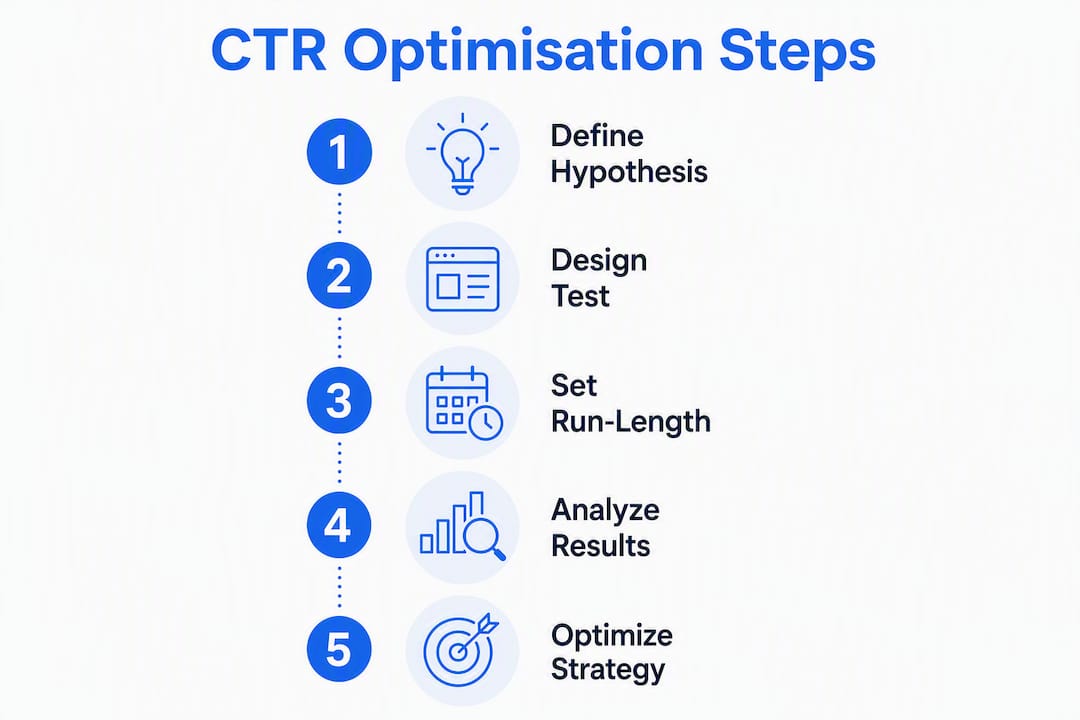
Most teams test wrong. They change three things at once, peek at results after two days, and declare a winner on 40 clicks. Here's the framework that actually works.
Step 1: State a clear hypothesis. "Changing the headline from X to Y will increase CTR because it addresses the user's specific pain point."
Step 2: Design control and variant. Change one variable. One headline. One subject line. One image. Not all three.

Step 3: Set a run-length before you start. For paid search, aim for at least 1,000 impressions per variant before drawing conclusions. For email, segment size and send frequency determine this. Low-traffic tests need longer run times, not early calls.

Step 4: Map CTR changes to downstream KPIs.
| CTR change | Watch for | Why it matters |
|---|---|---|
| CTR up, conversion rate up | Positive signal | Creative and intent are aligned |
| CTR up, conversion rate flat | Investigate | May be attracting wrong clicks |
| CTR up, bounce rate up | Red flag | Likely misleading creative |
| CTR flat, conversion rate up | Targeting win | Audience quality improved |
Step 5: Document and iterate. A test with no written learning is a wasted test. Record the hypothesis, result, and what you'll test next.
Common pitfalls:
- Peeking at results before the run-length is complete.
- Running multiple concurrent changes on the same ad set.
- Prioritising tests that are easy over tests with clear learning potential.
For a broader view of the digital ads optimisation process, the same hypothesis-first logic applies across every channel.
What tools do Australian advertisers use to measure and test CTR?
You don't need a stack of 12 tools. You need the right three or four, used consistently.
- Google Ads — the primary measurement source for paid search CTR, Quality Score, and ad extension performance. Available to all Australian advertisers with no data residency concerns for campaign-level data.
- Google Search Console — tracks organic CTR by query, page, and position. Free and essential for snippet optimisation.
- Meta Ads Manager — CTR, frequency, and creative performance for Facebook and Instagram campaigns. Includes A/B test functionality natively.
- Klaviyo — email open rates, CTR by segment, and A/B subject-line testing. Used by Australian e-commerce brands for list segmentation and personalised send logic.
- newCustomer.io — all-in-one customer acquisition platform for integrated campaign tracking across channels.
- Google Analytics 4 — post-click behaviour. Bounce rate, engagement rate, and conversion tracking to sanity-check CTR gains.
30-day CTR optimisation sprint checklist:
- Pull 90-day CTR data by channel, position, and device.
- Identify the two lowest-performing segments with the highest impression volume.
- Write three new headline variants per ad group or email segment.
- Set up A/B tests in Google Ads or Klaviyo with a pre-defined run-length.
- Add or refresh ad extensions in Google Ads (sitelinks, callouts, structured snippets).
- Review placement reports in Display and exclude low-CTR placements.
- Check organic snippet titles in Search Console and rewrite the bottom 10 by CTR.
- At day 30, document results, pick winners, and set the next test cycle.
For a step-by-step approach to optimising ad campaigns for ROI, the sprint above fits directly into a broader campaign rhythm.
Pro Tip: Pick one measurement source of truth per channel and stick to it for the entire test. Comparing Google Ads CTR to GA4 session data mid-test introduces discrepancies that make your results unreadable.
Adsdaddy Australian case study: a real CTR turnaround
The brief: An Australian e-commerce client running Google Search and Meta feed campaigns had plateaued. Search CTR sat at 2.1% on non-branded terms. Meta feed CTR was 0.6%. Budget was being spent, but Quality Score was dragging CPC up.
The hypothesis: Headline specificity and audience segmentation were the primary gaps. Generic headlines were attracting broad, low-intent clicks. Meta creative hadn't been refreshed in four months.
Primary interventions:
- Rewrote all search ad headlines to lead with a specific benefit and a price anchor.
- Split Meta audiences into remarketing, email lookalike, and cold interest segments, each with tailored creative.
- Added sitelink and callout extensions to all search campaigns.
- Produced 12 new Meta creative variants in week one, including two UGC-style formats.
Results (anonymised ranges):
| Metric | Before | After (30 days) |
|---|---|---|
| Google Search CTR | 2.1% | 2–5% |
| Meta feed CTR | 0.6% | 0.5–2% |
| Average CPC (Search) | $4.20 | $2.90 |
| Conversion rate (Search) | 0.5–2% | ~2% |
The tests that moved the needle fastest were the ones with the clearest hypotheses. Start with your highest-impression, lowest-CTR ad groups. That's where the compounding effect kicks in first.
Full case studies are available on the Adsdaddy website.
Key takeaways
Click-through optimisation compounds: a better CTR improves Quality Score, lowers CPC, and frees budget to run more tests, which finds more winners faster.
| Point | Details |
|---|---|
| CTR formula | CTR = Clicks ÷ Impressions × 100; measure by channel, position, and device separately. |
| Channel benchmarks | Search ads: 5–10%; display: 0.5–1%; email: ~2%; social feed: 0.5–2%. |
| Biggest creative lever | Headline specificity outperforms visual tweaks; test three variants per ad group. |
| Test one variable at a time | Change one element per test; run to at least 1,000 impressions before calling a result. |
| Adsdaddy approach | Adsdaddy combines creative refresh, audience segmentation, and ad extensions to lift CTR and lower CPC simultaneously. |
The mistake most teams make with CTR
Here's the honest take: most teams treat CTR as a vanity metric until their CPC spikes, then they panic and change everything at once. That's backwards.
The real mistake is chasing benchmarks instead of your own baseline. Your competitor's 6% search CTR is irrelevant if your account structure, keyword mix, and audience are different. The only meaningful comparison is your own historical data, segmented properly.
The bold rule worth pinning to your screen: if it clicks but doesn't convert, it's bad copy, not a victory. A 10% CTR on a misleading headline is a budget drain dressed up as a win.
For testing culture, the fix is simple. Run more tests, not bigger ones. A team that ships 10 small creative tests per month will out-learn a team running one polished A/B test per quarter. Speed of learning is the actual competitive advantage.
Adsdaddy runs your CTR tests so you don't have to guess
Most businesses know their CTR is underperforming. Few have the time or creative bandwidth to run the volume of tests that actually move the number.
Adsdaddy manages paid search, Meta, Instagram, YouTube, LinkedIn, and email campaigns for Australian businesses, with creative development and performance optimisation built into every engagement. The approach is the same one used in the case study above: clear hypotheses, fast creative iteration, and measurement tied to conversion, not just clicks.
If your CTR is flat or your CPC is climbing, the fastest next step is a campaign audit. Book a free strategy call with the Adsdaddy team and walk away with a prioritised test plan for your top-performing channels.
Useful sources
- Google Ads Help — Quality Score: The primary reference for how expected CTR, ad relevance, and landing page experience combine to affect ad rank and CPC.
- Google Search Console documentation: Essential for measuring organic CTR by query and position; free and available to all Australian site owners.
- Meta Ads Manager Help Centre: Platform-level guidance on CTR measurement, creative testing, and audience segmentation for Facebook and Instagram.
- Klaviyo Knowledge Base: Email CTR benchmarks, A/B testing setup, and segmentation logic for Australian e-commerce marketers.
- Bloomreach 2025 industry analysis (via Parallel): Source for channel-level CTR benchmark ranges used in the measurement table above.
FAQ
What does click-through mean in digital marketing?
Click-through is the act of a user clicking on an ad, link, or search result after seeing it. Click-through rate (CTR) measures how often that happens, expressed as a percentage of total impressions.
Is a CTR of 5% good?
For paid search ads, 5% is solid and sits within the typical 5–10% range for Google Ads. For display or social feed ads, 5% would be exceptional — those channels normally run between 0.5% and 2%.
What is a good CTR for organic search results?
Position 1 in Google search commonly achieves a significantly higher CTR than lower positions, and beyond the first few spots, CTR declines noticeably. A realistic target for a well-optimised snippet in positions 2–4 is roughly 5–10%, though this varies by query type and SERP features.
Is 7% a good CTR?
For Google Search ads, 7% is above average and a strong result, particularly on non-branded terms. For email or display, 7% would be outstanding. Always evaluate CTR relative to the channel, position, and your own historical baseline.
How does CTR affect ad costs?
A higher CTR improves your Quality Score in Google Ads, which directly lowers your average cost-per-click and can improve your ad position without increasing your bid. Adsdaddy's case study above shows CPC dropping from $4.20 to $2.90 after a CTR improvement driven by headline rewrites and ad extensions.