Use Advantage+: 4 Facebook Audiences That Beat Interest Stacking
. By Ads Daddy.

There are four types of audience in Facebook ads that matter in 2026: Core (detailed targeting), Custom, Lookalike, and Advantage+. Pick between them by matching your objective and your data signal, not your gut. Got pixel data and conversion history? Start broad with Advantage+. No data yet? Core targeting buys you time to learn. Got a warm list? Custom retargeting is where the real profit lives.
TL;DR:
- Advantage+ audiences perform best when your pixel has recent conversion data and you provide it with diverse creative options, avoiding vague signals.
- Custom audiences from website, app, or engagement data yield better results when lists are clean, recent, and focus on high-value segments, with multimonth retention windows.
- Lookalike audiences of 100 to 1,000+ high-value customers outperform large, broad seed lists, especially when seeded with lifetime value data.
- Overly restrictive interest stacking and broad manual targeting can hinder performance; success depends on quality signals rather than excessive filters.
- Proper audience setup, pixel and event configuration, and disciplined testing are essential, best managed by specialists to avoid wasting budget on ineffective targeting.
Table of Contents
- Core audiences: the old-school dial-in (and where it still wins)
- Custom audiences: your first-party data doing the heavy lifting
- Lookalike audiences: quality seed beats big seed, every time
- Advantage+ audiences: when you let Meta's AI drive
- Retargeting and funnel mapping: putting each audience in its lane
- How to choose: the decision ladder that skips the guesswork
- The AdsDaddy playbook: what we actually run for clients
- Why the "more targeting = more control" myth is costing you money
- Want this actually set up properly? Here's the shortcut
- FAQ
Core audiences: the old-school dial-in (and where it still wins)
Core audiences (also called detailed targeting) let you build a crowd from demographics, interests, and behaviours. Age 25 to 34, job title "small business owner," interested in Xero, behaviour flagged as "engaged shoppers." Stack enough filters and you feel like a targeting genius.
Here's the catch. Interest targeting isn't the precision weapon it was in 2018. Privacy changes gutted a lot of the off-platform signal Meta used to rely on, so interests now behave more like loose suggestions than hard fences. Meta's own systems will drift beyond your selected interests if it thinks it'll find you a buyer.
That doesn't mean Core is dead. It's brilliant for:
- Niche products with an obvious, nameable audience (think tradies who need a specific tool)
- Local businesses where geography does the heavy lifting
- Testing creative angles before you've got enough pixel data for anything smarter
Pro Tip: Treat detailed interest targeting as a hypothesis, not a gate. You're testing "does this creative resonate with people who like X?" — not building a fortress around your audience.
Quick setup checklist: pick one clear objective, layer no more than two or three interest groups, set a geography that matches your delivery footprint, and give it at least three to five days before you judge it.
Custom audiences: your first-party data doing the heavy lifting
Custom audiences are built from stuff you already own: website visitors via the Meta Pixel, customer list uploads, app events, and engagement audiences pulled from video views or lead form interactions.
Match rates aren't uniform, and this trips people up constantly:
- B2C email lists typically match a moderate share of uploaded contacts to real Meta profiles.
- B2B lists match lower, because work email addresses rarely line up with someone's personal Facebook login.
- Engagement audiences (video viewers, lead-form openers) don't rely on off-platform tracking at all, so they've become more valuable since signal loss hit third-party data.
You'll get maybe 5,000 to 6,000 matched, and that's before overlap with other audiences.
Retention windows matter too. A 7-day website custom audience suits cart-abandonment messaging. A 180-day audience suits brand reminder content for slower purchase cycles. Exclude recent purchasers from prospecting campaigns, always, or you're paying to advertise a couch to someone who already bought the couch. And keep your lists clean. Consent matters, hygiene matters, and a list scraped from three years ago is doing you no favours.
Lookalike audiences: quality seed beats big seed, every time
Lookalikes get built from a seed audience, then Meta finds people who resemble it. The percentage tiers trade tightness for reach: the closest tier matches users most similar to your seed, while wider tiers increase reach but lessen similarity to your ideal customer.
Meta's minimum seed size is 100 matched users, with recommendations generally suggesting a moderate-sized seed for good performance. Here's the twist most advertisers miss:
- A compact seed of high-value purchasers consistently outperforms a bloated seed of everyone who ever clicked an ad
- Value-based lookalikes (seeded by customer lifetime value, not just "purchased") skew the match toward better spenders, not just more people
- 100 is the floor, not the target. Treat it like a life raft, not a strategy
Our guide on lookalike audiences for Aussie businesses breaks down seed selection in more depth if you want the full playbook.
Advantage+ audiences: when you let Meta's AI drive
Advantage+ audience is Meta's AI-led targeting mode. You give it inputs, like age range, location, or a suggested audience, and Meta treats those as loose starting points, not locked cages. It'll expand wherever the conversion signal takes it, hard controls like Special Ad Category restrictions and legal location/language limits aside.
Advantage+ tends to perform best when your account already has decent conversion history and creative variety to test against. It's not magic for a brand-new pixel with zero events.
- Best suited to accounts with real conversion volume in the past 30 days
- Works better with multiple creative variants, since the AI needs options to test
- Skip it (or lean manual) for strict B2B niches or anything with legal targeting constraints
Pro Tip: Seed Advantage+ with your best first-party signals, your customer list, catalog, and actual conversion events, rather than a vague age-and-location guess. Garbage in, garbage out still applies to AI.
Our deep dive into ad targeting strategies for superior ROI covers exactly how algorithmic delivery behaves once you hand over the wheel.
Retargeting and funnel mapping: putting each audience in its lane
Every audience type has a natural home in the funnel. Mixing them up is how budgets get wasted.
- Top of funnel (prospecting): Advantage+ or Core audiences. Nobody knows you yet, so cast wide and let creative do the convincing.
- Mid funnel (seeded prospecting): Lookalikes. You've got some data, so use it to find people who resemble your best customers.
- Bottom funnel (warm retargeting): Custom audiences built from site visitors, cart abandoners, and past purchasers. This is where messaging shifts from "here's who we are" to "come finish what you started."
Retargeting typically delivers stronger ROAS on small budgets, but only when the pool is big enough to spend against and tracking is actually intact. A 200-person retargeting audience with a $50 daily budget is a recipe for a frequency headache, not a conversion machine. Exclude purchasers from every stage above bottom-funnel, or you'll bid against yourself.
How to choose: the decision ladder that skips the guesswork
Forget staring at the targeting panel wondering what feels right. Feelings don't scale. Signals do.
Step 1: Nail your objective and KPI first. Sales? Leads? App installs? This decides everything downstream.
Step 2: Check your pixel's conversion events from the last 30 days. Got volume? Good, you've got a real signal to feed the machine.
The ladder itself:
- Broad / Advantage+ if you've got conversion signal and creative variety
- Lookalike if you've got a decent seed (1,000+ high-value customers) but want a tighter starting point
- Core detailed if you're brand new with zero pixel data, or testing a fresh creative angle
- Custom retargeting if you've got a warm list and want the highest-ROAS play in your arsenal
Pro Tip: Run every test as a proper cell: same budget, same measurement window, different audience type only. Changing two variables at once tells you nothing.
Common mistakes to dodge: vague audience naming (you'll never diagnose what worked), letting audiences overlap so you bid against your own ads, and testing pools so small Meta can't even deliver properly.
The AdsDaddy playbook: what we actually run for clients
Getting Advantage+ or lookalikes to perform isn't about picking the right button. It's about what feeds them.
- Pixel and Conversions API set up together — redundancy matters more since browser tracking got shakier
- Clean event setup — Purchase, AddToCart, and Lead events firing correctly, checked monthly
- Seed hygiene — value-based seeds only, no dead weight from three-year-old lists
- Naming discipline — something like "PURCH-30d-ValueSeed-2026-06" tells you instantly what an audience is and when it was built
As accounts scale, we shift budget weight toward Advantage+ and keep manual splits running as a control group, not out of habit.
Seed quality now matters more than seed size. A tight list of your best 1,000 customers will outperform a sloppy list of 20,000 almost every time — the algorithm can only be as smart as what you feed it.
Why the "more targeting = more control" myth is costing you money
Here's the uncomfortable bit most targeting guides won't say out loud: obsessive interest-stacking is a security blanket, not a strategy. Advertisers pile on filters because it feels like control. In 2026, with signal loss reshaping how Meta reads intent, that instinct works against you more often than it helps.
The account signal is now the real lever, not your interest selections. If your pixel's firing clean events and you've got creative variety, Advantage+ will usually out-earn a hand-picked Core audience stacked with five interest layers. The ladder only breaks down when people skip Step 2, checking actual conversion signal, and jump straight to "which audience sounds smartest."
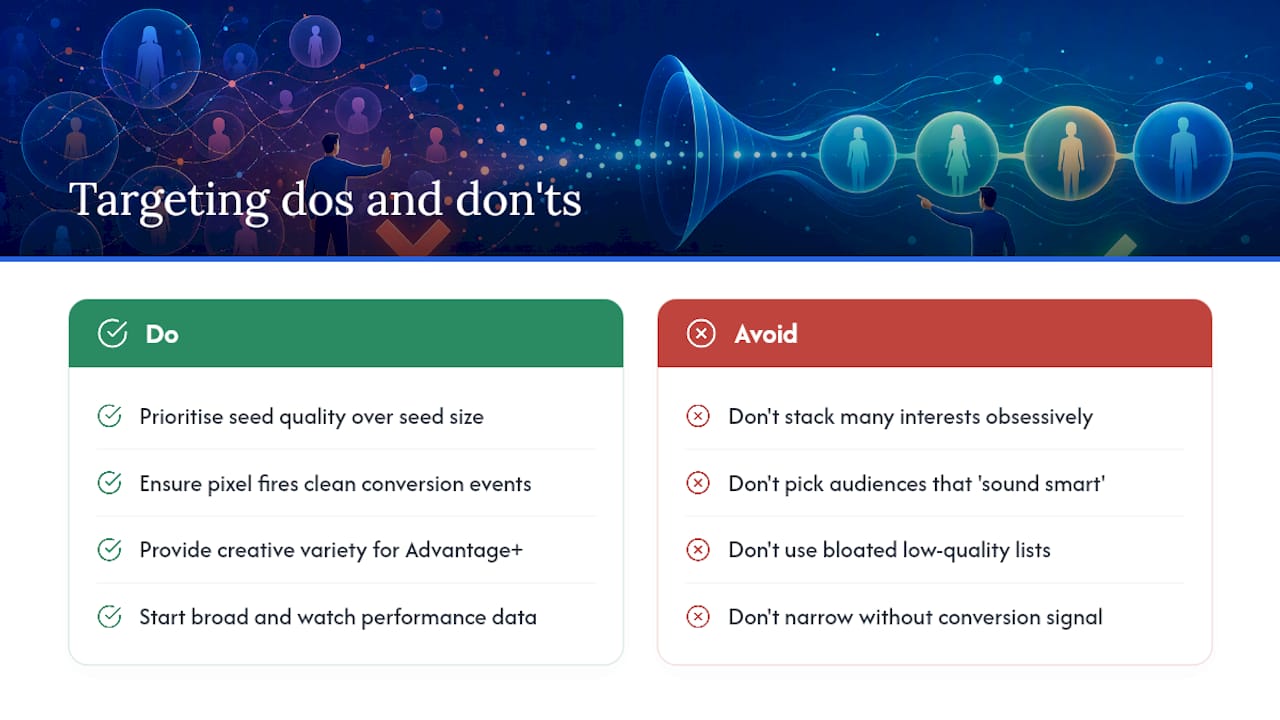
Seed quality beats seed size everywhere in this game, not just lookalikes. A scrappy 1,000-customer list beats a bloated 20,000-name dump built from every lead form you've ever run. Prioritise what you feed the algorithm before you fiddle with what buttons you press.
Start broad, watch the data, narrow only when a real constraint (legal, niche B2B, tiny local market) forces your hand. That's the whole game now.
— Adrian
Want this actually set up properly? Here's the shortcut
Reading about the targeting ladder is one thing. Building it correctly across pixel events, Conversions API, seed audiences, and exclusions while juggling five other business jobs is another.

Adsdaddy runs this exact playbook daily across Facebook, Instagram, and beyond, so you skip the trial-and-error phase that eats budget while you figure out match rates and seed sizes yourself. We handle the pixel setup, the audience architecture, the creative testing cells, and the reporting that tells you which audience type is actually earning its keep. Clients come to us after burning cash on interest-stacked campaigns that never scaled. If you want your Advantage+, Lookalike, and retargeting audiences built and sequenced properly from day one, book a consultation with Adsdaddy and we'll map your account signals to the right ladder rung before you spend another dollar guessing.
FAQ
What are the three main types of audiences used in Facebook ads?
Most practitioners talk about three or four families: Core (detailed) targeting, Custom audiences, Lookalike audiences, and increasingly Advantage+ as the AI-driven fourth category that's largely replaced pure manual broad targeting.
What is the best audience for Facebook ads?
There's no single best audience type. It depends on your data: Advantage+ or Core suits cold prospecting, Lookalikes suit seeded prospecting with a good customer list, and Custom retargeting audiences usually deliver the strongest ROAS for warm, bottom-funnel buyers.
What are the different types of advertising audiences?
Beyond Facebook's four families, most ad platforms distinguish between prospecting audiences (cold, unfamiliar with your brand) and retargeting audiences (warm, already engaged), with lookalike and interest-based targeting sitting in between as ways to find new prospecting audiences.
How big should my lookalike seed audience be?
Meta's minimum is 100 matched users, but 1,000 to 5,000 high-value customers is the recommended range, and a smaller list of genuinely valuable customers will usually outperform a larger, lower-quality one.
When should I use Advantage+ instead of manual targeting?
Use Advantage+ once your pixel has real conversion history and you've got multiple creative variants to test, since the AI needs both signal and options to expand effectively. Stick with manual, Core, or Custom targeting for strict B2B niches or campaigns with legal or Special Ad Category location and language constraints.