The role of audience personas in smarter marketing
. By Ads Daddy.

TL;DR:
- Audience personas turn vague targeting into decisive, revenue-driven marketing strategies.
- They provide precise understanding of who the customer is, what they want, and where to reach them.
Audience personas turn vague targeting into repeatable, revenue-driving decisions. A well-built persona tells you exactly who you're talking to, what they care about, and where to reach them — so every dollar you spend works harder.
Three payoffs you'll feel immediately:
- Sharper targeting. Instead of spraying ads at a broad demographic, you're reaching people whose goals, pain points and behaviours match your offer. Personalised experiences generate significantly more revenue for fast-growing companies.
- Faster creative resonance. When you know the exact language your buyer uses, writing headlines stops being a guessing game. Copy lands on the first draft more often.
- More efficient ad spend. Personas cut waste by eliminating channels and messages that don't fit. Lower cost per acquisition follows naturally.
If you want the template now, skip straight to the Australian examples and 1-page template section below.
Table of Contents
- What is an audience persona, really?
- Why persona development matters for your bottom line
- What goes inside an effective persona?
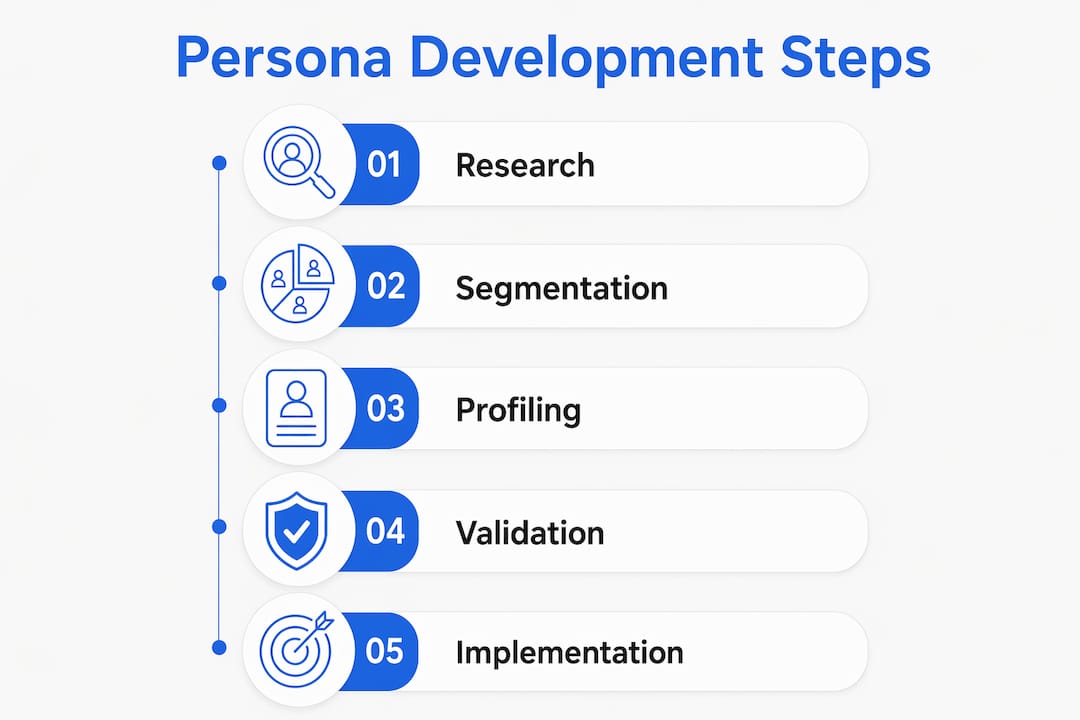
- How to build audience personas step by step
- How many personas do you actually need?
- How to use personas across your marketing and advertising
- Measuring whether your personas are actually working
- Two Australian persona examples and a ready template
- Common mistakes that kill persona programmes
- Keeping personas alive: cadence, owners and versioning
- What to do next: your 30/60/90 day plan
- Key takeaways
- The habit most marketers skip (and why it costs them)
- Ready to put your personas to work in your campaigns?
- Useful sources and further reading
- FAQ
What is an audience persona, really?
An audience persona is a semi-fictional, data-grounded profile of your ideal customer that goes well beyond demographics to include psychographics, goals, pain points, buying triggers and preferred channels. It's the difference between "women aged 25–44 in Sydney" and "Priya, 32, a marketing manager at a mid-size SaaS company who needs to prove ROI to her CFO every quarter and Googles solutions at 10pm on her phone."
That gap matters. A demographic label tells you who someone is. A persona tells you what they want, what they fear, and what will finally make them click.
Persona vs target audience vs buyer persona: your target audience is the broad group you sell to. A buyer persona is the B2B version focused on the purchase decision. An audience persona is the broader, channel-agnostic version used across content, ads, product and sales. They overlap, but the audience persona is the most operationally useful because it maps to every touchpoint, not just the sale.
For a deeper look at how profiling feeds into this, the audience profiling guide from Adsdaddy covers the research foundations well.
Why persona development matters for your bottom line
Skip persona development and you're essentially writing copy for nobody. Here's what you actually get when you do it properly.
Targeting precision. Personas let you filter ad audiences, content topics and channel budgets by the signals that actually predict purchase — not just age and postcode.
Improved creative relevance. When your headline mirrors the exact frustration your persona is Googling at midnight, click-through rates climb. Personas act as a map for multi-modal content strategy: they dictate format, message framing and channel prioritisation so every asset serves the same reader.
Channel prioritisation. A 45-year-old Brisbane manufacturer isn't scrolling Instagram Reels for supplier recommendations. A 28-year-old Melbourne startup founder probably is. Personas tell you where to show up, not just what to say.
Content focus. Instead of publishing whatever feels topical, you publish what your persona is actively searching for. That focus compounds over time into authority and organic traffic.
Sales enablement. When sales reps know a prospect's typical objections before the first call, close rates improve. Personas give them that script.
Measurement clarity. Personas create natural segments for reporting. You stop measuring "all users" and start measuring "how we performed with this specific buyer type."
Stat worth knowing: Firms that invest in personalised, persona-aligned marketing often report notably higher revenue and greater user engagement when experiences are tailored to them.
A quick example: a Melbourne B2B software company running LinkedIn ads to "IT decision-makers" was getting expensive clicks and no demos. After building a persona for their primary buyer — a risk-averse IT manager at a 200-person firm who needed vendor proof before any internal pitch — they shifted to case study ads with compliance-focused copy. Cost per demo dropped significantly within the first month.
What goes inside an effective persona?
Every persona needs these fields. Each one is only useful if it's specific enough to write copy from.
- Name and short bio. "Marcus, 41, operations manager." Humanising the data helps teams write empathetically and keeps messaging consistent.
- Job/role and seniority. Determines language complexity, decision-making authority and proof points needed.
- Demographics. Age, location, income band, education — use these to set channel and format defaults, not to define the whole person.
- Goals. What does Marcus want to achieve this quarter? This year? Goals drive the headline.
- Pain points. What's keeping him up at night? This drives the hook.
- Buying triggers. What event or realisation pushes him to search for a solution? Map these to your ad timing and keyword strategy.
- Objections. What will make him close the tab? Address these in your copy before he thinks of them.
- Preferred channels. LinkedIn at lunch? Google at 9am? Instagram never? Channel choice follows from this.
- Content depth and format. Does he read long-form reports or scan bullet-point summaries? This sets your content format.
- Language and phrasing. The exact words he uses when describing his problem — not your marketing language, his words.
- Trust signals and proof points. Case studies, certifications, client logos, review counts — what makes him believe you?
- Key behaviours. Repeat purchaser? Comparison shopper? Impulse buyer? Behaviour signals shape your funnel design.
For enterprise B2B, add procurement cycle length and number of stakeholders in the decision. A persona for a government buyer in Canberra looks very different from one for a DTC shopper in Perth.
Persona templates should always include triggers, objections, preferred format and trusted proof — these are the fields teams use daily to shape landing pages, ads and sales scripts.

How to build audience personas step by step
No assumptions. No "we think our customer is…" Start with data, validate with humans.
Define your research scope. Decide which customer segment you're profiling. Pick one product line or funnel stage. Don't try to profile everyone at once.
Export your analytics data. From Google Analytics 4 or Meta Ads Manager, pull: age, gender, location, device, session duration, pages per session, top entry pages, conversion path, drop-off points, and acquisition source. These behavioural signals are your starting point.
Run a customer survey. Keep it to 8–10 questions. Ask: What problem were you trying to solve when you found us? What almost stopped you from buying? Where do you usually look for solutions like this? What would you tell a colleague about us? Use Typeform or Google Forms and send it to your last 90 days of customers.
Conduct 5–7 customer interviews. Thirty minutes each. The goal is language, not data. Ask: "Walk me through the moment you realised you needed this." "What other options did you consider?" "What made you choose us?" Record and transcribe with Otter.ai or a similar tool.
Pull customer service data. Your support inbox is a goldmine. The most common complaints and questions reveal the pain points your marketing should address.
Run social listening. Use tools like Brandwatch or even native Reddit and Facebook Group searches to find how your audience describes their problems in their own words.
Synthesise into a draft persona. Group interview and survey responses by theme. Look for patterns in language, triggers and objections. Write a first draft using the field checklist from the previous section.
Validate with a mini test. Run two ad variants — one using your persona's language, one using your current marketing language — against the same audience. Check CTR and conversion rate after 500 impressions per variant. If the persona-language ad wins, your profile is directionally right.
Sample interview questions:
- "What were you Googling when you found us?"
- "What almost made you choose someone else?"
- "How do you usually describe this problem to your boss?"
Analytics fields to export: traffic source, device type, session duration, pages per session, top landing pages, conversion event, funnel drop-off stage, geographic region.
For a practical guide on building buyer personas with question banks, this buyer persona how-to is worth bookmarking.
How many personas do you actually need?
Most teams start with too many. Experts recommend prioritising a small set of personas that drives the most revenue and focusing on a primary persona per funnel stage.
The prioritisation rubric: score each potential persona on three dimensions.
| Dimension | Score 1–5 |
|---|---|
| Revenue contribution (current or projected) | How much does this segment spend? |
| Volume (addressable audience size) | How many people fit this profile? |
| Strategic importance | Does this segment unlock a new market or product line? |
Add the scores. Build personas in descending order. Stop when you hit five, or when the next persona scores less than half your top scorer.
Practical examples:
- B2B SaaS: Start with your champion persona (the internal advocate who pushes for your tool) and your economic buyer (the CFO or VP who signs off). Two personas, two very different messages.
- DTC retail: A repeat buyer persona and a first-time gifter persona cover most of the revenue. Add a bargain-hunter persona only if that segment is worth the creative investment.
Rules of thumb: one primary persona per funnel stage (awareness, consideration, decision). Cap your active set at three to five. Review the set every six months and retire any persona that no longer maps to a real revenue segment.
How to use personas across your marketing and advertising
A persona sitting in a Google Doc does nothing. Here's how to make it operational.

Writing ad briefs from personas
Persona: Marcus (B2B operations manager)
- Headline: "Cut approval delays without another spreadsheet"
- Hook: "Your team's stuck waiting on sign-offs. Here's how 200-person ops teams fix it."
- Offer: Free 14-day trial, no IT setup required
- CTA: "See how it works"
- Channel: LinkedIn, job-title targeting, operations and supply chain roles
- Proof point: Case study from a similar-sized Australian manufacturer
Persona: Priya (marketing manager, SaaS)
- Headline: "Prove campaign ROI before your next board meeting"
- Hook: "CFOs want numbers. Here's the dashboard that gives you them."
- Offer: Free audit call
- CTA: "Book my audit"
- Channel: Google Search (branded + competitor keywords), LinkedIn retargeting
- Proof point: Client revenue uplift stat, named Australian company
Operational checklist for persona-driven campaigns
- Map every ad creative element to a specific persona pain point or trigger. If you can't, cut it.
- Match landing page headline to ad headline — same language, same promise.
- Use the persona's exact phrasing in body copy, not your internal marketing language.
- Set channel targeting rules based on the persona's preferred platform and time of day.
- Address the top two objections somewhere between the ad and the checkout.
- Keep message consistent from ad to landing page to email nurture — any break in tone kills trust.
For a breakdown of targeting methods that pair with persona fields, the audience targeting guide from Adsdaddy is a practical companion.
Measuring whether your personas are actually working
Personas without measurement are just creative writing. Here's what to track.
KPIs by persona segment:
| KPI | What it tells you |
|---|---|
| Click-through rate (CTR) | Is the message resonating at the awareness stage? |
| Conversion rate (CVR) | Is the persona-matched landing page converting? |
| Cost per acquisition (CPA) | Is persona targeting making spend more efficient? |
| Customer lifetime value (LTV) | Are you attracting the right buyers, not just cheap ones? |
| Content engagement (time on page, scroll depth) | Is the format and depth right for this persona? |
| Retention rate | Are persona-matched customers sticking around? |
A/B test design: isolate one variable at a time. To test messaging, run two ads with different copy but identical targeting, creative format and budget. To test channel, run the same ad on LinkedIn and Google Search to the same persona segment and compare CPA. Never change both at once or you won't know what moved the needle.
Dashboard fields your analytics team should build:
| Field | Purpose |
|---|---|
| Persona segment tag | Identifies which persona each session/conversion belongs to |
| Acquisition source by persona | Shows which channels drive each persona |
| Funnel stage by persona | Reveals where each persona drops off |
| Revenue by persona | Quantifies which persona drives the most value |
| CPA by persona | Tracks efficiency per segment over time |
| Content engagement by persona | Monitors format and depth fit |
Segment every report by persona from day one. Aggregated data hides which segments are performing and which are dragging your averages down.
Two Australian persona examples and a ready template
Persona 1: Melbourne marketing manager
Name: Priya S. Role: Marketing Manager, B2B SaaS, 150-person company, Melbourne CBD Age: 32 | Income: $95,000–$115,000 Goals: Prove campaign ROI to the CFO; grow qualified pipeline by 30% this financial year. Pain points: Budget is tight post-COVID; her team is small; she's expected to do more with less and report on it weekly. Buying triggers: A competitor just ran a campaign she admired; her CFO asked why CPA is rising. Objections: "Another agency that won't understand our product." "We've been burned before." Preferred channels: LinkedIn (work hours), Google Search (research mode, evenings), industry newsletters. Content format: Data-backed case studies, short explainer videos, concise blog posts with clear takeaways. Language: "Prove ROI," "qualified leads," "attribution," "board-ready reporting." Trust signals: Named Australian client case studies, transparent pricing, clear onboarding timeline.
Persona 2: Brisbane online retailer
Name: Tom B. Role: Founder/Owner, DTC homewares e-commerce, Brisbane Age: 41 | Revenue: $800K–$2M annually Goals: Scale Meta ads profitably; reduce reliance on organic traffic; hit $3M revenue this financial year. Pain points: Tried running his own Facebook ads — wasted $4,000 in two months. Doesn't trust agencies that don't understand e-commerce margins. Buying triggers: ROAS dropped below 2× after iOS changes; a mate's business doubled revenue with a managed ads service. Objections: "Agencies charge retainers and deliver reports, not results." "I don't have time to babysit an agency." Preferred channels: Facebook and Instagram (personal and business), YouTube for learning, Google for supplier research. Content format: Short-form video, carousel ads, before/after case studies with real numbers. Language: "ROAS," "cost per purchase," "scaling," "profitable growth." Trust signals: Real revenue results from similar Aussie e-commerce brands, no lock-in contracts.
1-page persona template
| Field | What to capture | Usage note |
|---|---|---|
| Name and bio | First name, age, role, company size, location | Humanises the profile for copywriters |
| Goals | Top 1–2 professional or personal goals | Drives headline and value proposition |
| Pain points | Top 1–2 frustrations relevant to your offer | Drives the hook and ad copy |
| Buying triggers | The event that starts their search | Informs ad timing and keyword strategy |
| Objections | Top 1–2 reasons they'd say no | Address in copy before they think of them |
| Preferred channels | Where they spend time and research | Sets channel budget allocation |
| Content format | Long-form, video, short posts, podcasts | Sets creative format |
| Language/phrasing | Their exact words for the problem | Use verbatim in headlines and CTAs |
| Trust signals | What proof makes them believe you | Informs social proof and case study selection |
| Key behaviours | Comparison shopper, impulse buyer, repeat buyer | Shapes funnel and offer design |
Pro Tip: Copy this table into Notion or a shared Google Doc and fill it in during your next customer interview session. One completed persona beats ten half-finished ones.
Common mistakes that kill persona programmes
Most persona projects fail not in the research phase but in the execution. Here are the five traps and how to dodge them.
- Static slide decks. A persona that lives in a PowerPoint nobody opens is worthless. Fix: store personas in a shared, living doc (Notion, Confluence) that the whole team can edit and reference daily.
- Over-segmenting. Building 12 personas sounds thorough. It's actually paralysing. Fix: cap your active set at three to five and retire low-revenue segments.
- Assumption-led profiles. "We think our customer is…" is not research. Fix: start every persona with analytics data and validate with at least five customer interviews before writing a single word of copy.
- Weak validation. Writing a persona and never testing it is just creative fiction. Fix: run a two-variant ad test within two weeks of building a new persona. Let the data confirm or challenge your assumptions.
- Inconsistent voice across channels. Your LinkedIn ad sounds corporate, your email sounds casual, your landing page sounds like a different company. Fix: write a one-paragraph "voice guide" for each persona and attach it to the persona doc.
Pro Tip: Assign one owner to each persona. That person is responsible for keeping it current, flagging when it needs updating, and running the monthly quick check. No owner means no accountability, and the persona quietly dies.
Don't try to measure everything at once. Pick the single highest-impact test — usually messaging vs. channel — and run that first. Add complexity only after you have a baseline.
Keeping personas alive: cadence, owners and versioning
A persona built once and never touched is a liability. Markets shift, products change, and the person you built your persona around in 2024 might have completely different priorities now.
Governance checklist:
- Owner: one named person per persona, responsible for updates and quarterly reviews.
- Cadence: full review every six months; quick check (10 minutes, scan for obvious mismatches) monthly.
- Storage: one canonical location — Notion, Confluence, or a shared Google Drive folder — with a clear naming convention (e.g., Persona_Priya_v2_March2026).
- Update triggers: any of the following should prompt an immediate review.
Signals that should trigger an update:
- A significant drop or spike in CTR or CVR for a persona-targeted campaign
- A new product launch or major feature change
- A channel algorithm update (Meta, Google) that shifts audience behaviour
- A macroeconomic event (interest rate changes, industry regulation, cost-of-living shifts in Australia)
- Customer service flagging a new recurring complaint or question
Versioning practice: when you update a persona, don't overwrite the old one. Save the previous version with a date stamp and keep a one-line change log at the top of the doc: "March 2026 — updated buying triggers after iOS 17 behavioural shift; added LinkedIn as primary channel based on Q1 data." That log takes two minutes to write and saves hours of confusion later.
What to do next: your 30/60/90 day plan
Stop reading and start building. Here's the exact sequence.
Days 1–30: Research and first persona
- Export 90 days of Google Analytics 4 and Meta Ads Manager data — pull the behavioural and acquisition fields listed in the how-to section.
- Send a customer survey to your last 90 days of buyers (8–10 questions, Typeform or Google Forms).
- Book and complete five customer interviews. Record and transcribe them.
- Pull your top 20 customer service tickets and identify recurring themes.
- Write your first persona draft using the template above. Assign an owner.
Stakeholders: marketing lead, customer success, analytics.
Days 31–60: Validate and test 6. Run a two-variant ad test using persona language vs. current marketing language. Minimum 500 impressions per variant. 7. Check CTR and CVR. Update the persona based on what the data tells you. 8. Apply the persona to one landing page — rewrite the headline and hero copy using the persona's exact language. 9. Brief your content team on the persona. Rewrite your top three blog posts to match the persona's format preference and search triggers.
Stakeholders: paid media, content, web/CRO.
Days 61–90: Scale to content and ad operations 10. Build personas two and three using the same research process. 11. Set up persona-segmented reporting in your analytics dashboard using the field list from the measurement section. 12. Run a channel test: same creative, different platforms, same persona segment. Compare CPA. 13. Brief sales on the persona's top objections and preferred proof points. 14. Book a persona-driven campaign audit to pressure-test your work with an outside eye.
Stakeholders: marketing, sales, product, analytics.
Key takeaways
Audience personas work because they replace assumptions with data-grounded profiles that map directly to messaging, channel choice and ad targeting — making every campaign decision faster and more defensible.
| Point | Details |
|---|---|
| Start with behaviour, not assumptions | Export analytics and run interviews before writing a single persona field. |
| Cap your active persona set | Three to five personas cover most revenue; more than that creates confusion, not clarity. |
| Operationalise every field | If you can't map a creative element to a persona pain point or trigger, cut it. |
| Measure by persona segment | Segment CTR, CVR, CPA and LTV by persona from day one to see what's actually working. |
| Adsdaddy builds persona-driven campaigns | Adsdaddy's audit service reviews your personas, ad creative and test plan to lift performance. |
The habit most marketers skip (and why it costs them)
Here's a confession: the most common persona failure isn't bad research. It's a perfectly built persona that never leaves the slide deck.
A campaign runs. The creative team writes "for everyone." The ads manager targets broadly. The landing page uses internal marketing language. And the persona — with all its triggers and objections and exact customer phrasing — sits in a Google Doc that nobody has opened in three months.
The fix is embarrassingly simple. Before writing any ad, email or landing page, open the persona doc and write this at the top of your brief: "I am writing this to [persona name]." Then write to that person. Not to your boss. Not to the algorithm. To Mary, or Marcus, or Tom.
When you're done, check every line against the persona's pain points and objections. If a sentence doesn't speak to at least one field in the persona, cut it or rewrite it. That's the whole habit. It takes an extra five minutes and it changes the quality of everything you produce.
If you want the system behind it, the step-by-step build process and the governance section above give you the full framework.
Ready to put your personas to work in your campaigns?
Knowing your personas is one thing. Running campaigns that actually convert from them is another. Adsdaddy's persona-driven campaign audit is a paid service built for exactly this gap.

Here's what the audit covers: a review of your existing personas (or help building them from scratch), an ad creative brief mapped to each persona's triggers and objections, and a test plan so you know exactly what to run first and how to measure it. No vague recommendations. No 40-page reports you'll never read. Just a clear brief and a test plan you can hand to your media buyer on Monday morning.
Adsdaddy works with Australian businesses across Facebook, Instagram, Google, YouTube, LinkedIn and Microsoft Ads — so whatever channel your persona lives on, the audit covers it. This is a paid service, and spots are limited.
Book your campaign audit and get your personas working for your bottom line.
Useful sources and further reading
A short list of resources worth bookmarking — prioritised for Australian marketers.
- Australian Bureau of Statistics (abs.gov.au): The ABS provides demographic and consumer behaviour data that grounds your persona research in real Australian population data. Use it to validate age, income and geographic assumptions.
- ACCC and OAIC guidance: For marketers collecting customer data for persona research, the Office of the Australian Information Commissioner's privacy guidelines set the rules for how you can use survey and interview data.
- Adsdaddy: Audience profiling guide — What is audience profiling covers the research foundations and links persona development to targeting strategy.
- Adsdaddy: Targeting strategies — Effective audience targeting strategies pairs well with this article for applying personas to paid media.
- Adsdaddy: Ad budgeting — Budgeting for ads helps you allocate spend once you know which personas to prioritise.
- BabyLove Growth: Audience engagement strategies — Audience engagement strategies for business growth covers channel and engagement tactics that complement persona-driven campaign planning.
FAQ
What are audience personas?
An audience persona is a semi-fictional, data-grounded profile of your ideal customer that includes demographics, psychographics, goals, pain points, buying triggers and preferred channels. Unlike a broad demographic label, a persona gives you enough specificity to write copy, choose channels and set targeting rules.
What are the four types of customer personas?
Definitions vary across frameworks, but a common breakdown covers: the champion (internal advocate in B2B), the economic buyer (decision-maker with budget authority), the end user (the person using the product daily), and the influencer (someone who shapes the decision without holding the budget). In DTC contexts, these often simplify to first-time buyer, repeat buyer, gifter and bargain-hunter.
How do you build an audience persona?
Start by exporting 90 days of analytics data, then run a short customer survey and five to seven interviews. Synthesise the patterns into a draft persona using the field checklist in this article, then validate it with a two-variant ad test before treating it as final.
How many personas should a business have?
Most businesses need three to five active personas. Start with one primary persona per funnel stage and prioritise by revenue contribution, audience volume and strategic importance. Retire any persona that doesn't map to a real revenue segment.
How does Adsdaddy use personas in campaign management?
Adsdaddy builds persona-driven campaign briefs that map ad creative, landing page copy and targeting rules directly to each persona's triggers, objections and preferred channels. The persona-driven campaign audit is the starting point for new clients.