8 Marketing Online Blogs That Actually Move Revenue, Plus a 30 Day Plan
. By Ads Daddy.

If you want blogs that actually move revenue, follow Neil Patel, HubSpot, CXL, Backlinko, and Marketing Hub first. Add Neal Schaffer and Yaniv Goldenberg's commentary for framework thinking and Salesforce's strategy content for the big picture. Each earns its spot for a different reason: data density, framework clarity, or brutal honesty about what actually converts. The rest of this guide shows you how to pick, consume, and act on them without drowning in "hacks."
TL;DR:
- Most valuable marketing blogs emphasize data-backed results, documented methodologies, and consistent publishing, reducing reliance on opinion-based advice.
- Prioritize blogs that show clear test details, including sample sizes and failures, over those only highlighting wins or using vague success claims.
- Focus on content formats that match your goals, such as quick newsletters for updates or case studies for frameworks, and turn these insights into small, measurable tests.
- A 30-day testing plan should target one pillar at a time, adapt documented case studies, run micro-experiments, and measure only one key metric for clarity.
- For faster results, consider hiring a professional agency that manages and tests campaigns across multiple channels rather than relying solely on passive blog reading.
Table of Contents
- The 8 marketing online blogs actually worth bookmarking
- How to choose which marketing blogs deserve your attention
- Best formats to follow, and how to actually use them
- Your 30-day plan to turn blog reading into real results
- Common pitfalls when relying on marketing blogs
- Engaging with blog authors and communities for deeper learning
- Different marketing niches and how they shape your blog picks
- How to tell data-driven advice from opinion dressed up as strategy
- How agencies actually mine blogs for real experiments
- When DIY testing hits a wall, here's the faster route
- Selected sources for further reading
- FAQ
The 8 marketing online blogs actually worth bookmarking
Here's the shortlist. No filler, no "50 blogs you should follow" nonsense that nobody reads past number 12.
1. Neil Patel
Neil Patel's blog is the SEO and content marketing equivalent of a Swiss Army knife. It's best for beginners and intermediate marketers who want free tools alongside the advice. Expect long-form guides backed by his own SEO software data. Publication is frequent, sometimes several posts a week, which makes it a solid RSS candidate rather than a newsletter-first read.
2. HubSpot
HubSpot's blog is the reference library for inbound marketing. It's best for marketing managers building out full-funnel strategies, from blogging to email to CRM workflows. The evidence style leans heavily on internal data and benchmark reports, and HubSpot backs its advice with research showing consistent blogging and newsletter distribution genuinely boost traffic and engagement when tied to measurable goals. Publication cadence is daily-ish across its blog network, with a strong newsletter arm.
3. CXL
CXL is for marketers who want proof, not opinions. This is the blog for growth marketers and CRO specialists who want to see the actual test, not just the "10 tips" version. CXL's own guidance on workflow mapping is a standout: skip the tools, map the process first, or you'll just be automating a broken system faster. Publication is less frequent but denser, built for deep reads over quick scrolls.
4. Backlinko
Backlinko, run by Brian Dean, is the SEO nerd's happy place. Best for anyone doing organic search work who wants data-backed link-building and on-page tactics rather than recycled "best practices." Backlinko's structural advice for 2026, built around answer-engine visibility and AI-friendly formatting, is genuinely ahead of most competitors still writing for 2019-era Google. Publishing is infrequent but each post is a genuine resource, not a placeholder.
5. Marketing Hub
Marketing Hub (HubSpot's dedicated resource hub) is best for teams wanting structured courses alongside blog content. Think of it as the classroom next door to HubSpot's main blog. Its strength is bundling frameworks with templates you can actually download and use that afternoon.
6. Neal Schaffer
Best for strategists who want a system, not a scattergun. Schaffer's SES framework (Search, Email, Social) forces you to pick one lever per channel instead of chasing every tactic that trends on LinkedIn. This is one of the most underrated reads on this list precisely because it doesn't try to cover everything.
7. Yaniv Goldenberg
Best for readers allergic to fluff. Goldenberg's commentary consistently pushes for scoring rubrics, sample sizes, and break-even math over vibes-based advice. If a post doesn't show its working, he calls it out. That's rare in this space.
8. Salesforce Marketing Blog
Best for owners thinking beyond single channels. Salesforce's content leans into aligning owned, paid, and earned media into one predictable engine rather than a pile of disconnected tactics. Good for CMOs and business owners who need the boardroom-level view.
None of these are perfect. None of them replace running your own tests. But together, they cover the spectrum from tactical SEO to full-funnel strategy without a single "grow your Instagram in 5 minutes" post between them.
How to choose which marketing blogs deserve your attention
Not every blog with a newsletter deserves your inbox real estate. Here's your 60-second filter before you hit subscribe.
Green flags:
- Data, case studies, or real numbers, not just "results may vary."
- A documented methodology: how the test ran, what the sample size was, what metric they used.
- Regular publishing (weekly or fortnightly beats a burst of five posts then silence for six months).
- A newsletter that adds context instead of just repackaging headlines.
- Named authors with visible track records, not "The Marketing Team."
Red flags:
- Anonymous authorship with zero context on who's writing or why you should trust them.
- Opinion dressed up as strategy, with no metrics anywhere in sight.
- Endless "10 hacks" listicles with no follow-up on whether the hacks actually worked.
Pro Tip: Before subscribing, search the blog for the phrase "we tested." If it shows up often, you've found a source that backs its claims. If it never shows up, you've found an opinion column with better SEO.
Run this rubric on any blog in under a minute: does it show its data (yes/no), does it explain its method (yes/no), does it publish consistently (yes/no)? Two yeses and you're in solid territory. Three, and it's a keeper.
Best formats to follow, and how to actually use them
Different formats suit different goals. Treat them accordingly.
- Newsletters — best for quick wins and staying current. Triage them ruthlessly: skim subject lines, open only what's relevant this week.
- Long-form guides — best for deep learning. Save these in a read-later tool and block 20 minutes, not five.
- Case studies — best for stealing frameworks. These are the posts to highlight and share with your team for alignment.
- Podcasts — best for absorbing strategy while doing something else entirely.
Turn any post into a test using three steps: hypothesis (what you think will happen), test (the smallest version you can run this week), metric (the one number that tells you if it worked). CXL's own advice backs this up: map your workflow before you touch a new tool or tactic, or you'll just be optimising chaos.
Your 30-day plan to turn blog reading into real results
Reading without testing is just marketing homework. Here's how to close the loop in a month.
- Week 1: Audit and pick one pillar. Use the SES framework (Search, Email, Social) and choose the single weakest pillar to improve. Don't try to fix all three at once.
- Week 2: Steal and adapt one case study. Find a blog post with a documented test and adapt it to your business, not copy it word for word.
- Week 3: Run two micro-tests. Try an email subject line A/B test and a landing page CTA tweak. Small, fast, measurable.
- Week 4: Measure and scale the winner. Kill the loser, double down on whichever test moved the metric you picked in week one.
Pro Tip: Pick ONE metric before you start testing, not five. If you're measuring click rate, open rate, and conversion all at once, you won't know what actually caused the win.
Common pitfalls when relying on marketing blogs
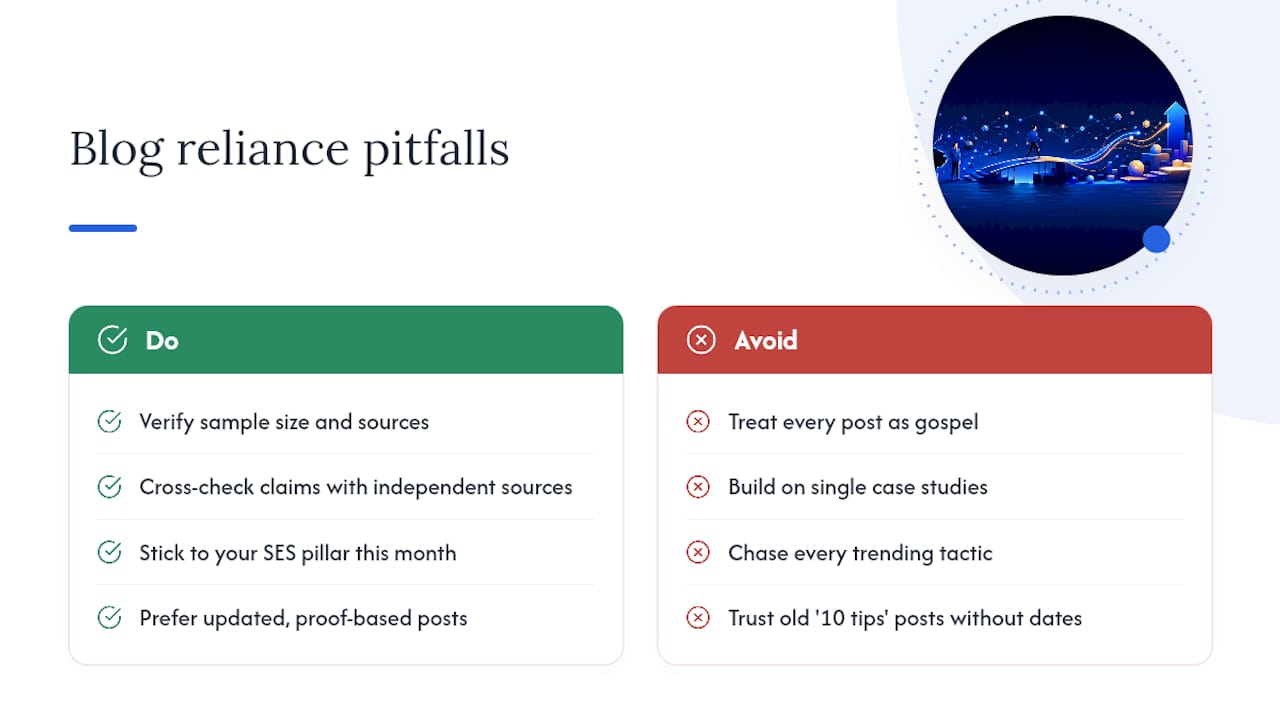
The biggest trap? Treating every blog post like gospel. Blogs monetise attention, and attention loves a bold claim. That's how "hacks" survive years after they've stopped working.
Watch for advice with no sample size attached. A single case study from one Shopify store isn't a strategy, it's an anecdote with good formatting. Cross-check any bold claim against a second, independent source before you rebuild your funnel around it.
Another common mistake: chasing every new tactic the moment it trends. You'll end up with a dozen half-finished experiments and zero clear wins. Stick to your SES pillar for the month and ignore the shiny object parade.
Finally, be wary of blogs recycling the same "10 tips" format with no update history. If a post from 2021 hasn't been refreshed for 2026's answer-engine landscape, the advice inside it is probably stale too. Authoritative content in 2026 leans on structured, AI-friendly formatting and proof-based assets, not viral hacks, so a blog still writing purely for keyword density is behind the curve.
Engaging with blog authors and communities for deeper learning
Reading passively gets you information. Engaging gets you insight you can't get from the post alone.
Comment on posts with a specific question about their methodology, not a generic "great post!" Authors who share real data usually respond to people who clearly read past the headline. Many run Slack communities, Discord servers, or LinkedIn groups tied to their blog, CXL and HubSpot both have active ones, and that's where the unpublished nuance lives.
Attend a webinar or watch a recorded AMA if the author runs one. You'll often hear the caveats that never made it into the polished post. And if you actually run one of their frameworks, tell them the result. Authors who care about credibility want to know what happened when someone tested their advice in the wild, and you might get a direct reply worth more than the original post.
Different marketing niches and how they shape your blog picks
Not every blog serves every goal, so match your reading list to your actual gap, not the topic that's trending this week.
SEO blogs like Backlinko and Neil Patel suit anyone chasing organic traffic and needing technical, data-backed guidance. Content marketing blogs like HubSpot cover the full pipeline from ideation to distribution. Conversion and testing content, CXL's specialty, suits anyone with traffic already but a leaky funnel. Social media coverage tends to live inside broader blogs like HubSpot and Neil Patel rather than as standalone specialists, so treat social advice there as a chapter, not the whole book. Email marketing guidance is scattered but strong inside frameworks like Neal Schaffer's SES model, which treats email as one of three core pillars rather than an afterthought.
Pick based on your weakest channel, not your favourite one. If your email list is stagnant, no amount of SEO reading fixes that.
How to tell data-driven advice from opinion dressed up as strategy
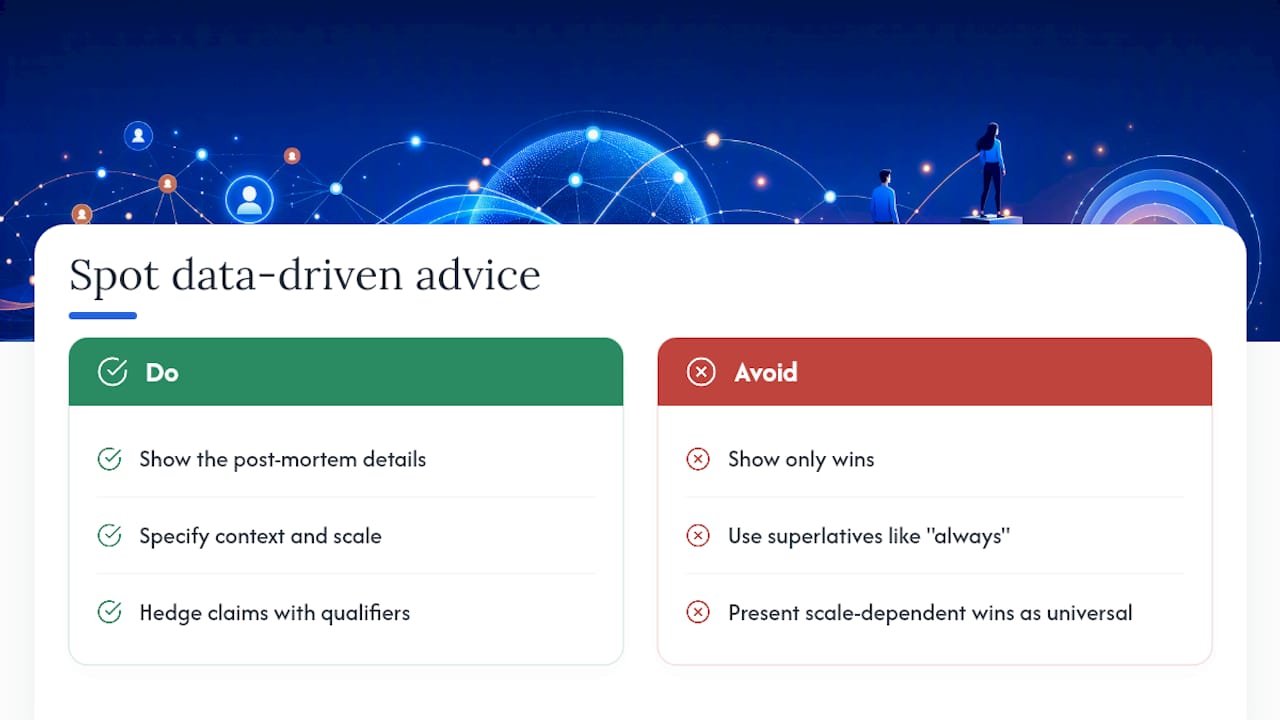
Here's the tell: data-driven advice shows its working. Opinion pieces show their confidence.
Look for the post-mortem. Genuinely useful blog content explains how a test was run, the sample size, the specific metric tracked, and, critically, what failed along the way. Posts that only show wins and never failures are marketing, not education.
Check whether the advice would survive a different context. If a tactic worked because the author had 500,000 newsletter subscribers already, it probably won't replicate for a business with 500. Scale-dependent wins get presented as universal laws far too often.
Finally, treat superlatives as a warning sign. "The best strategy," "always works," "guaranteed results," these phrases usually mean the nuance got cut for a punchier headline. The blogs worth trusting hedge appropriately: "in our test," "for stores over $10k/month," "when paired with X." That specificity is exactly what separates a data-driven marketing tactic from a slogan.
How agencies actually mine blogs for real experiments
Reading a blog post is step one. Turning it into a client win is the actual job.
At Adsdaddy, the pattern looks like this: spot a framework (say, an ad creative test from CXL), scale it down to a single, cheap experiment, run it against a real budget, then write the post-mortem, win or lose. That last part matters most. Reproducible metrics beat opinion pieces every time, because a client doesn't pay for inspiration. They pay for what actually worked, with the receipts to prove it.
— Adrian
When DIY testing hits a wall, here's the faster route
Reading eight blogs and running your own 30-day plan works, if you've got the time and the stomach for a few failed tests along the way. Not every business owner does. That's the gap Adsdaddy fills.

When you need results this quarter, not after a month of trial and error, hiring beats DIY. Adsdaddy builds and manages campaigns across Facebook, Instagram, Google, YouTube, Microsoft Bing, and LinkedIn, with the measurement and reporting built in from day one, so you're not guessing which test actually moved the needle. That's the exact post-mortem discipline covered above, minus the months it takes to learn it yourself. If your funnel needs a cohesive digital marketing strategy rather than another list of hacks, book a consult with Adsdaddy and see what a managed campaign could do for your numbers this month.
Selected sources for further reading
The claims in this guide draw on a handful of genuinely useful references if you want to go deeper:
- Backlinko's work on structuring content for AI search visibility and answer-engine parsing
- Neal Schaffer's writing on the SES framework for focused, scalable strategy
- CXL's guidance on workflow mapping and avoiding tool-first mistakes
- Salesforce's approach to aligning owned, paid, and earned media into one system
- For a deeper SEO-specific read, Baby Love Growth's guide to building online authority covers proof-asset building in more detail.
FAQ
What are the best marketing blogs to follow in 2026?
Neil Patel, HubSpot, CXL, Backlinko, and Marketing Hub cover the core bases, with Neal Schaffer and Salesforce adding framework and strategy depth.
How many marketing blogs should I actually follow?
Three to five is realistic. Following fifteen just means you skim everything and act on nothing.
How do I know if a blog's advice is trustworthy?
Check for a documented methodology, sample sizes, and a post-mortem when a test fails, not just when it wins.
Can reading blogs replace hiring a marketing agency?
Blogs teach you frameworks and ideas, but running the experiments yourself takes time most business owners don't have; that's where a managed service like Adsdaddy fits in.
How often should I check marketing blogs for new content?
Weekly for newsletters, monthly for long-form deep dives, using RSS or a read-later tool to avoid getting buried.