Lead Nurturing Explained: Driving Sales for Aussie SMEs
. By Ads Daddy.
Every Australian online shop owner knows turning curious website visitors into loyal customers takes more than one-size-fits-all messages. Developing genuine relationships across each funnel stage can feel complicated when you juggle dozens of prospects daily. Lead nurturing stands out by focusing on building trust, personalising engagement, and aligning sales with marketing efforts. This guide reveals how a blended strategy using automation and data-driven tactics leads to stronger prospect relationships and more effective conversions in the crowded e-commerce space.
Table of Contents
- What Is Lead Nurturing In Marketing Context
- Types Of Lead Nurturing Strategies Used Today
- How Lead NurturingFunnels Work For E-Commerce
- Essential Tools For Effective Lead Nurturing
- Common Pitfalls And How To Avoid Them
Key Takeaways
| Point | Details |
|---|---|
| Lead nurturing builds relationships | Focus on creating personalized engagements throughout the sales funnel rather than relying solely on automation. |
| Segment your audience | Tailor messages according to the prospect's stage in the funnel to improve conversion rates. |
| Leverage technology effectively | Use a CRM and marketing automation tools to streamline your lead nurturing processes without overwhelming your operations. |
| Track meaningful metrics | Evaluate success through conversion rates and acquisition costs rather than vanity metrics like email open rates. |
What Is Lead Nurturing in Marketing Context
Lead nurturing is the process of building relationships with prospects across every stage of your sales funnel, from the moment they first hear about your business through to when they're ready to buy. It's not about bombarding people with automated emails and hoping something sticks. Instead, it's about delivering the right message at the right time, building trust through genuine engagement, and using data to guide your strategy. Think of it like dating rather than speed dating. You wouldn't ask someone to marry you on the first date, and you shouldn't expect prospects to buy on their first interaction with your brand either.
Automated lead nurturing systems work best under specific conditions such as new leads, short sales cycles, and lower-value deals. The reality is that automation enhances lead interactions and improves sales conversations, but it's not a silver bullet. For Australian SMEs selling e-commerce products or services, this means you need a blended approach. Automation handles the heavy lifting by staying in touch consistently, but your marketing and sales teams need to work together to personalise communication, track what's actually working, and adjust your strategy based on real results. Different industries, different deal complexities, and different customer familiarity levels all affect how well automated nurturing performs.
What makes lead nurturing different from general marketing is the focus on relationships at every funnel stage. A cold prospect discovering your brand for the first time needs different communication than someone who's already visited your website three times or abandoned their shopping cart. Effective lead nurturing aligns your sales and marketing teams so you're speaking with one voice, personalises touchpoints through smart automation, and continuously optimises based on collected data. When you're setting up your lead generation strategy, lead nurturing becomes the engine that converts those leads into actual sales. You generate the audience, but nurturing keeps them engaged long enough to build the confidence they need to buy.
Pro tip: Start by mapping your actual sales cycle. How many touchpoints does a typical customer need before they convert? Build your nurturing sequence around that number, not around guessing how many emails feels right. This single change drives conversion rates up significantly.
Types of Lead Nurturing Strategies Used Today
There are several proven lead nurturing approaches that Australian SMEs can deploy, depending on your business model, sales cycle length, and customer complexity. The most effective strategies blend multiple tactics rather than relying on a single channel. Email nurturing remains the workhorse of lead nurturing because it's measurable, repeatable, and cost-effective. You send targeted content based on where prospects sit in your funnel. Someone who just signed up for your newsletter gets different emails than someone who abandoned a shopping cart two days ago. The key is segmentation and timing, not volume.
Content-based nurturing pairs perfectly with email. You create resources like guides, case studies, product comparisons, or educational posts that speak directly to the questions prospects have at each stage. A visitor in the awareness stage wants to understand the problem. Someone in the consideration stage wants to see how your solution stacks up against competitors. Delivering timely, targeted content reduces buyer uncertainty and ensures your sales team engages with prospects who actually know what they're looking for. Another approach is retargeting advertising, where you show ads to people who've already visited your site. They saw your product once, scrolled past, and left. A strategic ad reminding them what they missed can bring them back.
For e-commerce SMEs, sequential advertising campaigns work well. You might show one ad promoting a discount code to cold audiences, then show a different ad to people who clicked that one, highlighting customer reviews. Then another ad to people who clicked the second one, addressing common objections. It's a staircase approach rather than blasting everyone with the same message. Some businesses also use SMS and push notifications for high-intent prospects ready to convert. These channels have higher open rates than email but should only be used for timely, relevant messages.
The real secret is alignment between your marketing and sales teams. Personalised, segmented communication delivered through automation ensures consistency while allowing you to speak to different audiences differently. Track which messages actually move prospects forward, which channels your customers prefer, and which offers convert. Then optimise ruthlessly based on that data.
Pro tip: Pick two nurturing channels maximum to start (usually email plus one other), master those completely, then expand. Most Australian SMEs fail at lead nurturing not because they lack strategy, but because they try to do everything at once and execute none of it well.
Here's a summary of major lead nurturing strategies and their typical use cases:
| Strategy | Best For | Business Benefit |
|---|---|---|
| Email nurturing | All funnel stages | Delivers scalable, personalised outreach |
| Content-based nurturing | Early to mid-funnel | Educates, builds trust and authority |
| Retargeting advertising | Mid to late funnel | Re-engages prospects, boosts conversion |
| Sequential advertising | E-commerce, complex journeys | Adapts offers to prospect actions |
| SMS & push notifications | High-intent, ready to convert | Drives immediate action, high open rate |
How Lead Nurturing Funnels Work for E-Commerce
An e-commerce lead nurturing funnel is a systematic path that takes someone from "I've never heard of you" to "I just bought your product." It works in stages, and each stage requires different messaging, different content, and different calls to action. The funnel starts wide at the top because you're casting a broad net, capturing anyone who might be interested. As prospects move through it, the funnel narrows because some people drop off, some convert, and some become loyal repeat customers. Your job is to move people down that funnel as efficiently as possible by giving them exactly what they need at each step.
At the top of the funnel sits awareness. Someone discovers your brand through an ad, search result, or word-of-mouth. They might not even know they have a problem yet. Your content here should educate, not sell. Then comes interest and consideration. A prospect has visited your website, maybe read a few product pages, possibly added something to their cart. This is where you show them how your product solves their specific problem, how it compares to alternatives, and why your brand is worth choosing. Next is intent. They're ready to buy but might be hesitant about price, shipping, or return policies. Send them a limited-time offer or remind them of their cart. Automated lead nurturing improves sales conversation quality at this stage, especially for lower-value deals or short sales cycles, by delivering the right message at the right moment to push them over the line.
Once someone purchases, the funnel doesn't end. Loyalty and advocacy stages matter enormously. Send them a thank you email, ask for feedback, and show them related products they might need. This turns a one-time buyer into a repeat customer. The entire customer journey through each funnel stage involves mapping where people currently are, understanding what's stopping them from moving forward, and creating targeted touchpoints to address those specific barriers. For Australian e-commerce SMEs, this means knowing whether your customers drop off because shipping costs are too high, because they need more product information, or because they don't trust your brand yet. Each reason requires a different nurturing response.
The mechanics of your funnel depend on data. You need to track which prospects opened your emails, which ones clicked product links, which ones abandoned their carts, and which ones came back to complete a purchase. Tools like Meta for Business, Klaviyo, and Customer.io help automate this tracking and personalise messages based on behaviour. You send emails to cart abandoners offering a discount. You show retargeting ads to people who viewed your bestseller but didn't buy. You segment your audience so warm prospects get different messaging than cold ones.
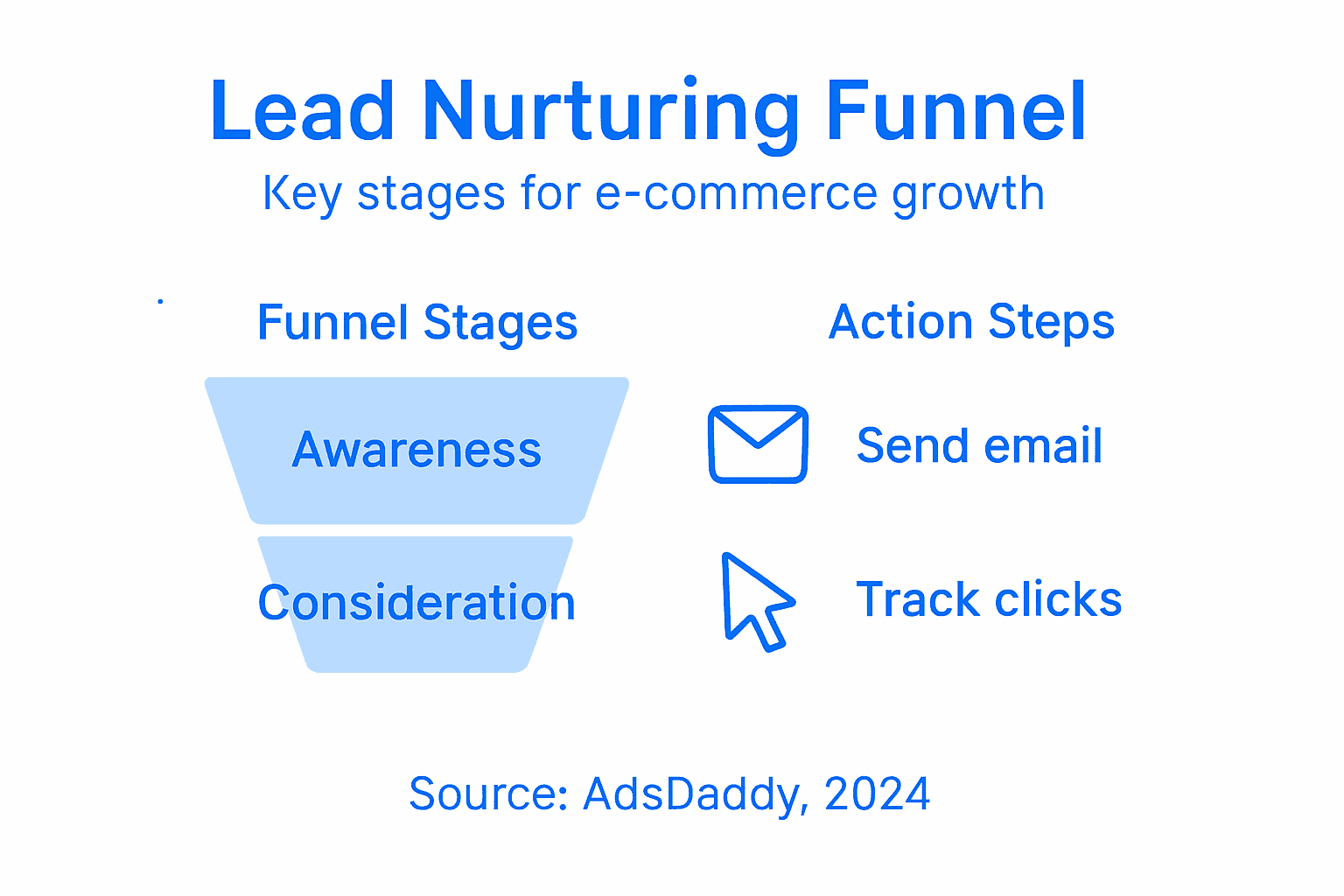
Pro tip: Map your exact funnel stages and create one specific email sequence for each stage, not one sequence for everyone. A cart abandoner needs a different email than someone who just visited your homepage for the first time. Precision here compounds into significantly higher conversion rates.
Essential Tools for Effective Lead Nurturing
You can't nurture leads effectively without the right technology stack. The good news is you don't need to break the bank or implement ten different platforms. Most Australian SMEs succeed with three core tool categories working together. First, you need a Customer Relationship Management (CRM) system to store all your prospect and customer data in one place. Second, you need marketing automation software to send personalised messages at scale. Third, you need analytics and tracking to measure what's actually working. When these three work together, magic happens. Marketing automation platforms integrate with CRM systems to deliver targeted, timely content and improve lead engagement, allowing you to personalise and segment outreach automatically.
For Australian e-commerce SMEs, the tools mentioned on AdsDaddy align perfectly with this approach. Meta for Business powers your advertising and retargeting across Facebook and Instagram, letting you show different ads to different audience segments based on their behaviour. Klaviyo handles email marketing and automation with sophisticated segmentation, so your abandoned cart sequence is completely different from your welcome sequence. Customer.io offers similar functionality with strong integration capabilities. These tools talk to each other, which means when someone clicks an ad, that action flows into your CRM, triggering an automated email sequence and a retargeting ad campaign. No manual work required. You set it up once and it runs on autopilot.
But here's what many SMEs get wrong: they buy fancy tools and don't use them properly. Effective lead nurturing relies on CRMs and marketing automation software combined with proper sales and marketing team alignment. The tools themselves don't nurture leads. Your strategy does. The tools just execute it at scale. You need to define your nurturing sequences, set up your segmentation rules, and create messaging for each audience segment. Then, critically, you need to track the data coming back. Which email sequences convert best? Which ad audiences are most engaged? Which retargeting timeframe works? Use those insights to optimise continuously. Most SMEs neglect this last part and wonder why their nurturing feels stale.
Start small. Pick one primary platform like Klaviyo for email automation, use Meta lead generation tools for paid advertising, and integrate them with a basic CRM like HubSpot free or Zoho. Get proficient with these three before adding anything else. Too many Australian SMEs sign up for eight platforms, integrate two of them poorly, and end up more confused than before.
Pro tip: Don't choose tools based on features. Choose based on integrations. A simpler tool that talks seamlessly to your other platforms beats a powerful tool that sits isolated. Your integration quality determines whether leads flow smoothly through your funnel or get stuck in data silos.
Common Pitfalls and How to Avoid Them
Lead nurturing sounds simple in theory. Send the right message to the right person at the right time. But in practice, most Australian SMEs stumble over the same mistakes repeatedly. The first big one is misalignment between sales and marketing. Marketing sends leads to sales. Sales ignores them because they don't match their definition of a "qualified lead." Marketing gets frustrated. Sales complains the leads are rubbish. Nothing gets nurtured effectively because nobody agrees on what they're trying to achieve. The fix is straightforward but requires actual conversation. Sit down with your sales team and define together what a qualified lead looks like at each stage. What information do they need before they talk to someone? How many touchpoints should a prospect have before sales picks them up? Write it down. Agree on it. Then both teams stick to it.
The second pitfall is treating all leads the same. You send the exact same email sequence to someone who just clicked a Facebook ad and someone who abandoned their shopping cart two days ago. Terrible idea. These people are in completely different positions in the funnel. One needs education. One needs a push to convert. Neglecting differences between new and returning customers kills conversion rates because your messaging doesn't match their situation. A first-time visitor to your website needs different nurturing than someone who bought from you six months ago and might be ready for a repeat purchase. Segment ruthlessly. Create separate sequences for cold prospects, warm prospects, cart abandoners, past customers, and loyal repeat buyers. Yes, it takes more work upfront. It compounds into dramatically higher conversion rates.
The third mistake is obsessing over vanity metrics. You look at your email open rates and think everything's great. Thirty percent open rate sounds good, right? But did those opens turn into actual sales? Evaluating success based on sales conversions and meetings rather than clicks and opens reveals what actually matters. Someone might open your email and never take action. That open is meaningless. What you care about is whether they add something to their cart, click through to your product page, or ultimately buy. Track conversion rates, not click-through rates. Track sales revenue, not email opens. This shifts your entire strategy from vanity to value.
The fourth pitfall is over-automating without strategy. You set up email sequences and retargeting ads and assume they'll run forever without adjustment. Lead nurturing requires shared goals across teams and continuous optimisation based on measurable outcomes. Your sequences get stale. Your messaging stops resonating. Your conversion rates tank. Review your nurturing performance monthly. Which sequences underperform? Which audience segments aren't engaging? Which offers flop? Change them. Test new subject lines, new ad creative, new messaging angles. Automation is a starting point, not an end point.
Pro tip: Track one conversion metric obsessively: cost per acquisition across each nurturing channel and sequence. If Facebook retargeting costs you $15 to acquire a customer but email costs you $8, you know where to focus your budget. This single number matters more than all the vanity metrics combined.
Below is a comparison of common lead nurturing pitfalls and practical solutions:
| Pitfall | Core Issue | Best Solution |
|---|---|---|
| Sales-marketing misalignment | Different lead definitions | Jointly agree on qualification stages |
| Treating leads identically | Communication mismatch | Segment by behaviour and intent |
| Obsessing over vanity metrics | Focus on opens/clicks, not sales | Track revenue and conversions instead |
| Over-automation without review | Stale campaigns, missed signals | Regularly optimise sequences monthly |
Transform Your Lead Nurturing Into Sales Success with AdsDaddy
Are you facing challenges with misaligned sales and marketing teams or struggling to personalise your lead nurturing sequences for different customer journeys As the article highlights, effective lead nurturing demands precise segmentation and timely engagement through the right channels. Pain points like cart abandonment, unqualified leads, and stale campaigns slow down your sales funnel and hurt your conversion rates. AdsDaddy understands the importance of blending automation with personalisation to fuel your sales pipeline. We specialise in utilising powerful platforms such as Meta for Business and Klaviyo to create targeted advertising campaigns that align perfectly with your lead nurturing strategy and customer behaviour.
Take control of your lead nurturing now by partnering with AdsDaddy We help Australian SMEs unlock higher conversion rates by integrating marketing automation with strategic ad placements on Facebook, Instagram, Google, and beyond Discover how to convert prospects into loyal customers through data-driven optimisation and expert campaign management Visit AdsDaddy to learn more about our services and start building a lead nurturing funnel that truly converts. Implement proven tactics like Meta lead generation tools and maximise your email outreach with Klaviyo—your key to personalised marketing automation. Don’t let your leads slip away because of ineffective nurturing Act today and watch your sales grow!
Frequently Asked Questions
What is lead nurturing in marketing?
Lead nurturing is the process of building relationships with prospects throughout the sales funnel, focusing on delivering personalized communication at the right time to build trust and guide them toward a purchase.
How do automated lead nurturing systems work?
Automated lead nurturing systems work by sending targeted messages based on the buyer's journey, improving engagement through consistent communication while allowing for personalized interactions by sales and marketing teams.
What are effective lead nurturing strategies for e-commerce businesses?
Effective lead nurturing strategies for e-commerce businesses include email nurturing, content-based nurturing, retargeting advertising, sequential advertising campaigns, and using SMS or push notifications for high-intent prospects.
How can I optimize my lead nurturing funnel?
To optimize your lead nurturing funnel, track key metrics such as email open rates, conversions, and customer engagement. Ensure alignment between sales and marketing teams, segment your audience based on behavior, and regularly review and adjust your nurturing strategies.
Recommended
- Expert Lead Generation Service to Fuel Business Growth - Ads Daddy. Advertise on All Plattforms.
- Lead Generation - Ads Daddy. Advertise on All Plattforms.
- Expert Lead Generation Service to Fuel Business Growth - Ads Daddy. Advertise on All Plattforms.
- Lead Generation - Ads Daddy. Advertise on All Plattforms.
- The Essential Guide to Lead Nurturing Process - Jarrod Harman