SES First Digital Marketing for Small Teams: AI & First Party Data
. By Ads Daddy.

Digital marketing runs on six moving parts: search, content, social, paid media, email, and analytics, with influencer and affiliate marketing as common add-ons. Run them as a connected system rather than a scattered checklist, and they do three jobs at once: get you discovered, get you chosen, and get you paid again. Miss the "connected" bit and you're just burning ad spend into the void.
TL;DR:
- Focusing on search, email, and social channels first ensures your marketing efforts directly influence discovery, conversion, and retention stages.
- Building a high-quality email list with effective lead magnets and automation flows maximizes owned media ROI once initial traffic and engagement start.
- Proper measurement using unified KPIs and attribution models is essential to optimize campaigns and avoid wasting budgets on ineffective channels.
- Prioritizing connected, results-driven campaigns over spreading efforts thin across all six core channels boosts overall marketing performance.
- Offline assets like print ads, QR codes, and events can be integrated into digital marketing through trackable links, enhancing measurable lead generation.
Table of Contents
- What digital marketing actually is (and why the components matter)
- The key components of digital marketing at a glance
- Search and SEO: how you get found before anyone asks for you
- Content marketing: the fuel every other channel runs on
- Social media marketing: picking platforms and building actual community
- Paid media: building, budgeting and optimising PPC campaigns
- Email marketing and automation: your highest-ROI owned channel
- Affiliate, influencer and mobile channels: when they earn a spot
- Analytics and measurement: how you know any of this is working
- How the components connect: the SES framework for choosing what to run first
- Your first 90 days: a quick-start checklist and the mistakes that waste it
- Integration of offline and online marketing efforts
- Compliance and privacy considerations in digital marketing
- What actually separates teams that win from teams that spin their wheels
- Adsdaddy as your managed alternative to running the stack solo
- Where this article's facts come from
- FAQ
What digital marketing actually is (and why the components matter)
Digital marketing is the practice of promoting a business through measurable online channels, tracking every click, scroll, and dollar back to a result. That measurability is the whole point. A billboard can't tell you who looked at it. A Google ad can tell you exactly who clicked, what they searched, and whether they bought anything twenty minutes later.
Every channel falls into one of three buckets:
- Owned media — your website, email list, app, blog. You control it completely.
- Paid media — Google Ads, Meta Ads, LinkedIn Ads, YouTube Ads. You rent the attention.
- Earned media — reviews, shares, press mentions, organic search rankings. You earn it through good work (or good luck).
Businesses pour money into these channels because digital marketing offers something traditional advertising never could: precise targeting, real-time measurement, and the ability to reach a specific person rather than a general demographic. Google's own guidance on digital marketing frames it as a staged process: define your audience and goals, build a content and channel plan, then measure and adjust. That loop, not any single tactic, is what makes the whole system work.
The key components of digital marketing at a glance
Here's the map before you dive into the detail. Six core channels do most of the heavy lifting, with a couple of specialist add-ons for teams ready to go further.
- SEO and search marketing — gets you found when people are actively looking.
- Content marketing — the fuel that makes every other channel work.
- Social media marketing — builds community and puts you in front of new audiences.
- Paid media (PPC, display, programmatic) — buys speed and reach when organic is too slow.
- Email marketing and automation — your highest-ROI owned channel, full stop.
- Analytics and measurement — tells you what's working and what's wasting money.
- Affiliate and influencer marketing — performance-based extensions once the core six are humming.
Search and SEO: how you get found before anyone asks for you
Search is where buying decisions start. Someone types a problem into Google before they've even decided who's going to solve it, and whoever shows up first gets the first shot at the sale. That's why Coursera's rundown on digital marketing puts search discovery at the front of the queue. It's not the flashiest channel. It's the one doing the quiet, compounding work in the background.
SEO (search engine optimisation) earns you a spot in organic results for free, sort of, if you count the time and effort as free. SEM (search engine marketing) is the paid version. You bid on keywords and pay per click through Google Ads or Microsoft Ads. Think of SEO as growing your own veggies and SEM as ordering delivery. Both feed you. One's slower and cheaper long term, the other's instant and costs you every time.
Practical tactics that move the needle:
- On-page basics: title tags, header structure, and content that actually answers the question someone typed.
- Technical health: fast load times, mobile-friendly design, no broken links dragging your crawl budget down.
- Local SEO: a claimed Google Business Profile and consistent business details across directories, non-negotiable if you serve a physical area.
- Link building: earning mentions from relevant, credible sites, still one of the strongest ranking signals going.
When should you pay instead of wait? If you're launching something new, testing a market, or need leads this month, not in eight, paid search buys you the visibility SEO hasn't earned yet. Track click-through rate, cost per click, and conversion rate on both sides, and watch how they trend against each other over time.
Pro Tip: Run SEO and SEM side by side, not as rivals. Paid search can identify which keywords actually convert, then you build organic content around those exact terms instead of guessing.
Search intent is the real foundation underneath all of this. If you want the deeper mechanics of matching content to what someone's actually trying to achieve, this guide to search intent is worth the read.
Content marketing: the fuel every other channel runs on
Content isn't a channel on its own. It's the raw material every other channel burns through. No content, no SEO rankings, no social posts, no email newsletters. You'd just be standing in an empty room shouting your business name.
Common formats include blog posts, video, podcasts, infographics, case studies, and downloadable guides. Each one does a different job. Blog posts feed SEO. Short-form video feeds social. Case studies feed sales conversations and email nurture sequences. Same core message, different packaging for different appetites.
Here's the bit most small teams skip: repurposing. One solid piece of research becomes a blog post, then five social captions, then an email subject line, then a slide in your next sales deck. You wrote it once. It works six ways. That's the entire game of getting more mileage from less effort.
A basic content plan needs:
- A content calendar mapped to your funnel stages (awareness, consideration, decision).
- A repurposing workflow so nothing gets written once and forgotten.
- Clear ownership, someone has to actually be responsible for hitting publish.
- A feedback loop from analytics back into what gets made next.
KPIs to watch: organic traffic, average time on page, scroll depth, and, most importantly, whether that content is actually pulling people into your email list or your paid retargeting audiences. Content that doesn't feed another channel is just a diary entry with good lighting.
Social media marketing: picking platforms and building actual community
Choosing a platform isn't about where you personally enjoy scrolling. It's about where your buyer already spends their attention. Statista's tracking of global social platform usage shows just how much daily time people funnel into these apps, which means the audience is there. The question is whether they're there for what you're selling.
B2B audiences cluster on LinkedIn. Visual, younger consumer brands lean Instagram and TikTok. Anyone needing detailed community discussion still finds a home on Facebook Groups. Pick based on the buyer, not the trend.
There's a real split between organic and paid social, and it's not either/or:
- Organic builds trust slowly through consistent posting, replies, and genuine community management.
- Paid social buys reach and precision targeting instantly, but that reach disappears the moment you stop paying.
- The strongest setups use organic to build a warm audience, then use paid to retarget that exact audience with an offer.
Creative formats matter more on social than almost anywhere else. Short video consistently outperforms static images for reach, and carousel posts tend to win for engagement depth. Measure the full chain, not just likes: engagement rate, then click-through to your site, then actual conversion. A post with a thousand likes and zero clicks isn't a win. It's a distraction with good numbers attached.
Pro Tip: Reply to every comment for the first hour after posting. The algorithm on most platforms reads early engagement as a signal to show your post to more people, so that first hour is worth more than the next twenty-three combined.
Paid media: building, budgeting and optimising PPC campaigns
Paid media is where you buy speed. Search ads catch intent, display ads catch attention while someone's doing something else entirely, social ads catch people mid-scroll, and programmatic buys ad space across thousands of sites automatically based on audience data. Different mechanics, same underlying job: put your offer in front of the right eyeballs before a competitor does.
A campaign structure that doesn't waste money usually looks like this:
- Separate campaigns by intent (search vs. retargeting vs. cold prospecting), never lump them together.
- Test at least two to three creative variations per ad set before declaring a winner.
- Start budgets conservative, then scale what's already proving itself, never the reverse.
- Set a clear kill criteria in advance: know the CPA you'll pull the plug at before the campaign goes live.
The KPIs that actually matter: click-through rate (CTR) tells you if the ad itself is compelling, cost per acquisition (CPA) tells you if the economics work, and return on ad spend (ROAS) tells you if the whole exercise is profitable once you zoom out. Optimisation isn't a one-off task, it's a cadence. Weekly creative reviews, monthly budget reallocation toward what's winning, quarterly audience refreshes so you're not fatiguing the same 10,000 people for the fifth month running.
If you've got the ad platforms sorted but keep losing the plot on what to actually measure, this breakdown of digital marketing's role in business growth connects the dots between spend and outcome.
Email marketing and automation: your highest-ROI owned channel
Email is the one channel you fully own. Nobody can change the algorithm on your subscriber list, and unlike a social following, that list doesn't vanish if a platform has a bad quarter. Coursera's research on digital marketing channels notes that email consistently ranks among the highest-return channels available, which tracks: you're talking directly to people who already raised their hand and said "yes, tell me more."
That starts with a genuine reason to hand over an email address. A lead magnet, discount, free guide, or early access offer works far better than a bare "subscribe to our newsletter" button, because nobody's inbox needs more of those.
Common automation flows worth setting up once and letting run:
- Welcome sequence for new subscribers, introduces your business before you ever ask for a sale.
- Abandoned cart for e-commerce, recovers revenue that's already halfway in the door.
- Post-purchase nurture, turns a one-time buyer into a repeat customer.
- Win-back campaigns for lapsed customers who've gone quiet.
Segment by behaviour, not just demographics. Someone who clicked your last three emails but never bought is a different conversation than someone who bought once and disappeared.
Track open rate, click-through rate, conversion rate, and lifetime value per subscriber. Tools like Klaviyo make this segmentation and automation setup considerably less painful than building it from scratch.
Pro Tip: Send your welcome email within minutes, not days. Interest decays fast, and a lead magnet delivered a day late feels like a business that's not that interested in you either.
Affiliate, influencer and mobile channels: when they earn a spot
These are the specialist tools you reach for once the core six are running properly, not before. Skipping straight to influencer partnerships while your email list sits at zero is like hiring a wedding photographer before you've found a partner.
Affiliate marketing pays a commission for every sale someone else's referral generates. It's performance-based by design, you only pay for results, which makes it low-risk but also means it rewards affiliates who already have an engaged audience, not ones you're building from scratch.
Influencer marketing works best matched to audience relevance over raw follower count. A micro-influencer with 8,000 tightly engaged followers in your exact niche will often outperform a celebrity with two million followers who couldn't care less about your product. Set expectations early: influencer ROI is genuinely hard to measure cleanly, so agree on trackable links or discount codes before the content goes live, not after.
Mobile marketing covers apps, push notifications, and SMS, channels people check obsessively and respond to fast. Native and display ads blend into the content around them (think sponsored articles or banner placements) and work best for brand awareness rather than hard conversion plays.
Quick guide to when each earns its place:
- Affiliate: you've got a product with margin to share and want performance-based growth.
- Influencer: your audience trusts recommendations from people more than from brands.
- Mobile/SMS: your customers are already glued to their phones and expect fast, direct updates.
- Native/display: you need broad awareness and aren't chasing an immediate click.
Analytics and measurement: how you know any of this is working
None of the above means anything without measurement wired underneath it. This is the component that turns "I think that campaign did okay" into "that campaign returned $4.20 for every dollar spent." HubSpot's guidance on marketing optimisation is blunt about this: continuous testing, unified attribution, and increasingly AI-aware personalisation are what separate teams getting better ROI from teams guessing.
Core KPIs worth tracking across every channel:
- Traffic and traffic sources — where people are actually coming from.
- Conversion rate — the percentage that take the action you wanted.
- CPA — what you're paying per result.
- Customer lifetime value (LTV) — what a customer's actually worth beyond the first sale.
- ROAS — return on every ad dollar spent.
Attribution is where most people trip. Last-click attribution gives all the credit to whatever channel closed the sale, ignoring the search ad, the Instagram post, and the email that all warmed the lead up first. Multi-touch attribution spreads credit more fairly, and incrementality testing (holding back a control group to see what happens without the ad) tells you what your marketing is actually causing versus what would've happened anyway.
Optimisation programmes that unify KPIs and data across channels tend to produce materially better revenue outcomes than teams running each channel in its own silo, according to synthesis reporting from HubSpot. A workable testing programme needs a backlog of hypotheses, a prioritisation method like ICE (Impact, Confidence, Ease), a weekly creative test cadence, and quarterly budget reallocation based on what the incrementality data actually shows.
First-party data (your own CRM and email list, not rented audience data from a platform) is becoming the backbone of good targeting as third-party cookies keep crumbling. Feeding that data back into your ad platforms lowers your cost per acquisition and improves match rates. For a deeper look at building this out properly, this guide to measurement in campaigns covers the setup end to end.
How the components connect: the SES framework for choosing what to run first
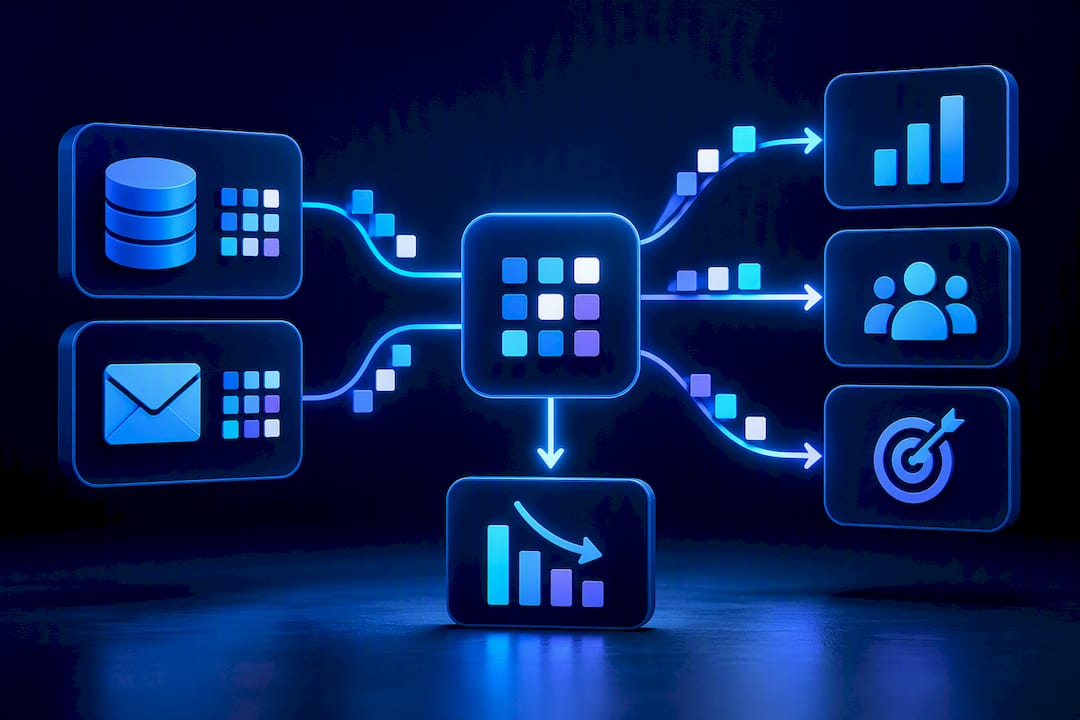
Here's the shortcut that stops most small teams from drowning: the SES framework, Search, Email, Social. Instead of trying to run all six components simultaneously (a fast route to burnout and mediocre everything), SES assigns one channel to do the heavy lifting at each stage of the funnel.
- Search owns discovery. It catches people already looking for a solution.
- Social owns awareness and warmth. It gets you in front of people who don't yet know they need you.
- Email owns conversion and retention. It closes the loop and keeps customers coming back.
The handoffs between them are where the real money gets made. A paid search ad sends traffic to a landing page. That page captures an email address. The email nurture sequence converts the lead. Retargeting ads on social re-engage anyone who didn't convert the first time. That's a closed loop, not four separate projects, and connecting these signals (ads to landing pages to CRM to retargeting) meaningfully cuts down on paying twice to reacquire the same person.
Use this checklist to decide your first three plays:
- Where does your buyer already search? Start there before you build anywhere else.
- Do you have a way to capture an email address today? If not, that's play number two.
- Is there a platform your competitors are winning on that you've ignored? That's a gap worth testing.
| Funnel stage | Primary channel | What it does |
|---|---|---|
| Discovery | Search (SEO/SEM) | Catches active intent |
| Awareness | Social media | Builds familiarity and reach |
| Conversion | Closes the loop, drives the sale | |
| Retention | Email + retargeting | Keeps customers coming back |
Strategy fundamentals like this are exactly what's covered in this explainer on digital marketing strategy, if you want to map it against your own funnel.
Your first 90 days: a quick-start checklist and the mistakes that waste it
Getting started doesn't require mastering all six components on day one. It requires picking the right three and actually finishing them.
- Pick your SES lane. Decide which of search, email, or social gets built first based on where your buyer already is.
- Set up basic tracking. Google Analytics and a pixel on your key ad platforms, non-negotiable before you spend a dollar.
- Build one lead magnet. Give people a reason to hand over an email address.
- Publish consistently for 30 days. Content or posts, doesn't matter which, consistency beats intensity early on.
- Run one small paid test. Modest budget, tight audience, learn fast.
- Set your first three KPIs. Traffic, conversion rate, CPA. Nothing more, not yet.
- Review and cut what's not working at day 60. Sunk cost is not a strategy.
The mistakes that eat budgets fastest: trying every channel at once instead of picking a lane, launching campaigns with no measurement attached (so you never actually know what worked), and running one creative variation for months because testing "felt like extra work."
Realistic early success at day 90 isn't a viral moment. It's a working funnel: traffic coming from one channel, a list starting to grow, and a CPA you can actually calculate.
Pro Tip: Give yourself permission to be mediocre at five channels while being genuinely good at one. That's the entire logic behind SES, and it's the fastest route to a result you can actually point to.
Integration of offline and online marketing efforts
Digital marketing doesn't operate in a bubble away from your physical-world activity, and treating it that way is a wasted opportunity. A QR code on a shopfront window, a print ad, a radio spot, and a market stall banner can all feed directly into your digital funnel if you build the bridge.
The simplest connection is a trackable link or unique promo code on any offline asset. Put a QR code on packaging that lands on a page built specifically to capture an email address, and suddenly a print run becomes a measurable lead source instead of a guess.
Retail and local service businesses benefit especially from this crossover. In-store signage promoting a loyalty program feeds your email list. Event attendance (a trade show, a local market) becomes a chance to scan people directly into a CRM instead of collecting business cards that sit in a drawer forever.
Consistency matters more than people expect. If your brand voice, offer, and visual identity shift wildly between a flyer and your Instagram feed, customers notice the disconnect even if they can't name why something feels off. The same core message should show up whether someone meets you at a market stall or scrolls past your ad at 11pm.
Radio and out-of-home advertising, often written off as "old media," still drive measurable spikes in branded search volume right after a campaign airs. That's an offline channel directly feeding a digital one, and it's worth tracking search traffic timing against any offline campaign schedule to see the effect for yourself.
Compliance and privacy considerations in digital marketing
Privacy law isn't optional reading anymore, it's operational reality. The GDPR (General Data Protection Regulation) governs data collected from anyone in the European Union, and CCPA (California Consumer Privacy Act) covers California residents specifically, but the practical effect for most businesses running digital campaigns globally is the same: assume someone in your audience is covered by one of these frameworks and build your data practices accordingly.
That means clear, plain-language consent before you collect an email address or drop a tracking pixel, not consent buried in a wall of text nobody reads. It means giving people a genuine way to opt out or request their data be deleted, and actually honouring that request when it comes in.
Ad platforms have tightened their own rules well beyond what regulation strictly requires. Meta and Google both restrict certain audience targeting categories (health conditions, financial hardship, and similar sensitive attributes) and can suspend ad accounts for non-compliance regardless of whether you technically broke a law. Policy compliance on the platform side is its own skill, separate from legal compliance, and getting it wrong costs you an ad account, not just a fine.
Third-party cookies are fading out, which is exactly why first-party data (your own email list, your own CRM) matters more every year, not less. Build your list properly now, with real consent baked in, and you're insulated from most of what's coming next in privacy regulation.
What actually separates teams that win from teams that spin their wheels
Most digital marketing advice tells you to "do everything." That's terrible advice, and honestly it's a little lazy. The businesses that win aren't running six channels brilliantly. They're running two or three connected properly, while everyone else spreads thin and wonders why nothing's converting.
The SES framework works precisely because it forces a decision most people avoid: pick your lane. Search, email, social, one heavy lifter per funnel stage, and let the handoffs between them do the rest of the work. That's not a shortcut. It's just better math.
If you want the full breakdown of the case studies and verified results behind this approach, that's exactly what Adrian's work at Adsdaddy digs into. Pick three plays, measure them properly, and book a call if you'd rather have someone else run the stack while you run the business.
— Adrian
Adsdaddy as your managed alternative to running the stack solo
Reading about SES is one thing. Running paid search, social ads, and email automation simultaneously while also running your actual business is another thing entirely, and it's usually the reason "we'll get to digital marketing properly" turns into a permanent to-do list item. A managed digital marketing agency exists to handle campaigns across multiple platforms with integrated tracking and lead delivery so you're not learning ad platforms from scratch.

The specific advantage of an engine of your own is exclusivity: enquiries come from ads in your name and land in your own CRM, rather than the recycled, shared-with-five-other-businesses kind you can get elsewhere. Our pay per lead guide compares both models for finance brokers. If you'd rather have the whole funnel, from search to social to email, built and run for you instead of DIY-ing the SES framework yourself, the lead generation service page is the place to start. Either way, the next step is simple: check current pricing details and book a chat about which setup fits your business.
Where this article's facts come from
- Coursera — background on digital marketing definitions, channel ROI (email in particular), and search as a primary discovery mechanism.
- Grow.Google — Google's own staged framework for defining audience, building a channel plan, and measuring results.
- HubSpot — optimisation practices, testing cadence, and the revenue impact of unified attribution.
- Statista — social platform usage data supporting platform selection guidance.
- Neal Schaffer — origin and reasoning behind the SES (Search, Email, Social) framework used throughout this piece.
FAQ
What are the main components of digital marketing?
The main components are SEO and search marketing, content marketing, social media marketing, paid media (PPC and display), email marketing, and analytics. Affiliate and influencer marketing are common additions once those core six are running well, and Adsdaddy's managed campaigns typically combine paid search, paid social, and lead generation to cover the paid side of that mix.
What are the 7 key elements of digital marketing?
A common seven-part version adds mobile marketing or affiliate marketing to the core six: SEO, content, social media, PPC, email, analytics, plus one specialist channel like mobile or affiliate depending on the business. The exact seventh item varies by source, so treat the first six as the fixed core and the seventh as situational.
What are the 7 C's of digital marketing?
Definitions of the "7 C's" vary considerably across sources and aren't a standardised industry framework the way SES or the core channel list are. Rather than repeat an inconsistent list, it's more useful to focus on the SES framework covered in this article, which is built on documented reasoning about funnel stages rather than a mnemonic.
What are the 5 C's of digital marketing?
Like the 7 C's, the "5 C's" framing isn't consistently defined across authoritative sources, so no single canonical version applies universally. The SES framework (Search, Email, Social) offers a more concrete and consistently applied way to prioritise digital marketing components.
How much does lead generation with Adsdaddy cost?
Ads Daddy does not publish prices: the fee is named on the call. Finance enquiries bought per lead through OptiCheck, our own loan marketplace, are priced by OptiCheck. A fully custom-built lead generation system is a 90-day program, and pricing for it and for broader paid ad management is named on a call.