12 Market Strategy Examples Mapped to Ansoff With One Week Playbooks
. By Ads Daddy.

Marketing strategy is just a fancy term for a decision: what you'll say, to whom, on what channel, to move a specific number. This article gives you 12 examples of market strategies pulled from real campaigns, a simple framework to sort them by risk, and the exact steps to test one yourself. No theory. No fluff. Just proof and a plan.
TL;DR:
- Most growth moves fall into four categories based on Ansoff's matrix, with market penetration being the lowest risk and diversification the highest.
- Real campaigns like CeraVe’s humorous Kevin Durant ads and Lidl’s festival fashion drops show that culturally relevant, simple hooks can generate billions of reach and measurable sales.
- Starting with a clear goal, stage, audience, resource capacity, and risk appetite is essential to select a strategy suitable for your business size and resource level.
- Testing strategies as minimum 30-day pilots, focusing on one channel and clear metrics, improves the chances of gaining reliable signals before scaling efforts.
- Outsourcing becomes necessary when managing multiple ad platforms or scaling quickly, while small tests are better kept in-house to learn without heavy resource commitments.
Table of Contents
- The Ansoff matrix: your cheat sheet for classifying examples of market strategies
- 12 examples of market strategies (and the move you can steal this week)
- How to pick the right strategy for your business (not just the coolest one)
- Real campaigns, real numbers: three case studies worth stealing from
- Your 4-week campaign checklist and 7 tactical playbooks
- When to keep it in-house vs when to call in reinforcements
- Ready to stop guessing and start scaling?
- Selected reading and sources used in this article
- FAQ
The Ansoff matrix: your cheat sheet for classifying examples of market strategies
Before you copy a campaign, know what game you're actually playing. A marketing strategy is the deliberate choice of who you're targeting and what you're offering them to hit a measurable goal. Simple as that.
The Ansoff matrix sorts every growth move into four buckets, based on whether you're using an existing or new product, aimed at an existing or new market:
- Market penetration — sell more of what you already have to people who already know you. Low risk, fast feedback.
- Product development — new offer, same audience.
- Market development — existing offer, new audience or geography.
- Diversification — new product, new market. Highest risk, highest ceiling.
McDonald's "I'm Lovin' It" is textbook penetration. Same burgers, same fries, just a jingle so sticky it's been running since 2003 to keep existing customers buying more often. Apple's first iPhone launch was diversification wearing a turtleneck. It created a category and asked people to abandon a market they'd never questioned (the humble mobile phone). CeraVe's product demos sit closer to penetration too. Same skincare range, but a fresh cultural hook to get more of the existing market talking. Know your quadrant before you pick your example.
12 examples of market strategies (and the move you can steal this week)
Here's the part you came for. Twelve real, working examples of market strategies, what they actually are, and the one thing you can nick from each without a seven-figure budget.
Content marketing. Regular, expert-led content that builds trust and search rankings over time. Moz's "Whiteboard Fridays" turned a co-founder standing next to a whiteboard into a decade of organic traffic. Steal this: pick one weekly format and stick to it for 90 days before judging it.
Social-first humour marketing. Duolingo's unhinged owl mascot roasting users on TikTok turned a language app into a meme factory. Steal this: post something slightly embarrassing this week and watch engagement outperform your polished stuff.
SEO content pillars. Building a hub of interlinked, topic-clustered pages that dominate search for a subject. Steal this: pick one core topic and build five supporting articles around it. Our SEO strategy breakdown shows how the clustering actually works.
Email marketing. Newsletters and automated flows that nurture leads without paying per click every time. Steal this: set up one automated welcome sequence. It's the highest-leverage email you'll ever write.
Paid search (PPC). Bidding on intent-driven keywords so you show up the moment someone's ready to buy. Steal this: run one tightly-themed ad group before scattering budget across ten.
Influencer marketing. Borrowing an audience's trust in a creator to vouch for your product. Steal this: approach five micro-influencers before chasing one big name you can't afford anyway.
Experiential and guerrilla marketing. GoPro's "Be a Hero" strategy handed cameras to actual daredevils and let the footage sell the product. Steal this: find your most extreme genuine user and film them, not an actor.
Product-led growth. The product itself creates the marketing loop, referrals baked into the experience. Steal this: add one shareable moment to your product this month, a badge, an invite, a result worth screenshotting.
Referral and word-of-mouth. Turning happy customers into unpaid sales reps. Steal this: offer an incentive for the referrer AND the referred. One-sided referral programs flop.
Loyalty and retention programs. Rewarding repeat behaviour to lift lifetime value. Steal this: track your repeat purchase rate before building any points system. Fix the product gap first.
Brand marketing at scale. Nike doesn't sell shoes in most of its ads. It sells identity. Dove's Real Beauty campaigns did the same by challenging beauty standards instead of pushing product specs. Steal this: write one ad that mentions your product zero times and see if the emotion still lands.
Omnichannel and AR experiences. Sephora's app blends in-store and online with augmented reality try-ons, so the shopping journey never breaks stride between channels. Steal this: map where your customer drops off between platforms and patch that one gap first.
Heineken's "Boring Phone" campaign, a flip phone stripped of apps, targeted at Gen Z digital fatigue, is worth a mention too. It's brand marketing and product diversification stitched together. It's an actual physical product built entirely around a cultural insight.
How to pick the right strategy for your business (not just the coolest one)
Copying CeraVe's Kevin Durant campaign without CeraVe's budget is like ordering the tasting menu on a servo pie budget. Match the strategy to your stage, not your envy.
Run this diagnostic before you spend a cent:
- Goal first. Awareness, acquisition, or retention? Each needs a different strategy entirely.
- Stage second. Early-stage businesses need penetration and product-led loops. Scaling businesses can afford diversification bets.
- Audience third. Where do they already hang out? Don't build a TikTok strategy for an audience that lives on LinkedIn.
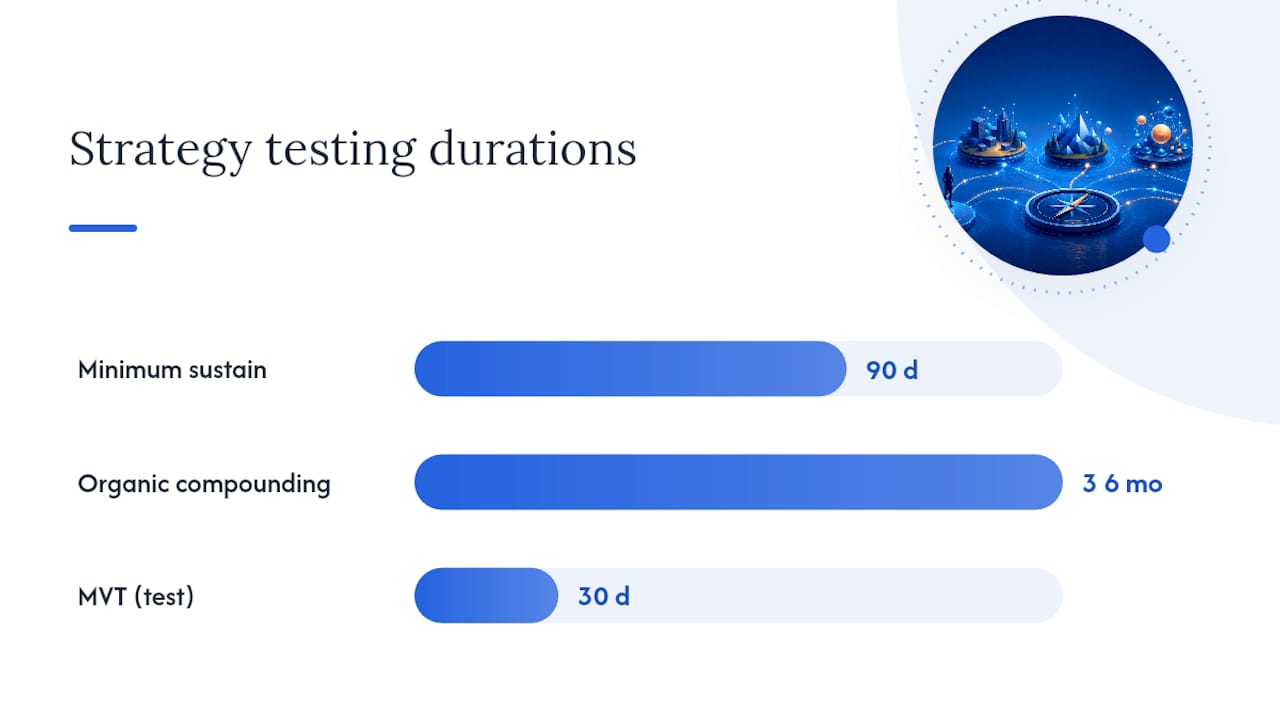
- Resource check. Can you sustain this for 90 days minimum? A strategy you abandon in week three isn't a strategy, it's a stunt.
- Risk appetite. Guerrilla and cultural hijacks can flop publicly. Penetration plays rarely embarrass you.
Match your KPIs to the goal: awareness tracks reach and CPM, acquisition tracks CAC and conversion rate, retention tracks churn and lifetime value. Paid tests can show signal in days; organic plays like SEO pillars usually need three to six months before they compound.
Three red flags that mean pivot immediately: your CAC exceeds your customer lifetime value, engagement is high but conversions are flat (wrong audience, right creative), or you're three months into an organic play with zero upward trend at all.
Pro Tip: Run every new strategy as a 30-day minimum viable test: one audience, one creative variant, one channel, one metric. If you can't measure it that tightly, you're not testing, you're guessing with extra steps.
Real campaigns, real numbers: three case studies worth stealing from
Theory is cheap. Here's what actually happened when brands committed.
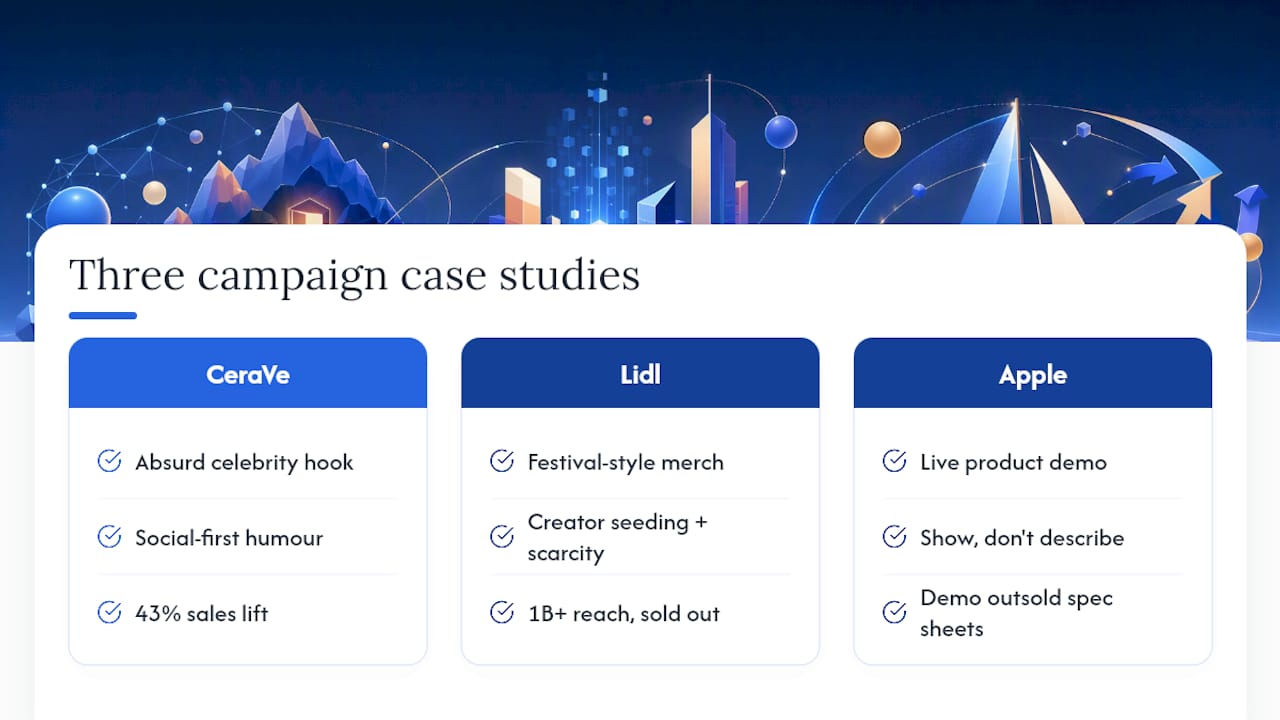
CeraVe's "new face of legs" campaign paired Kevin Durant with a slightly absurd skincare pitch and let it ride on social. The result: a reported 43% sales lift, billions of PR impressions, and tens of millions of organic video views, all from a campaign that leaned on cultural humour rather than a traditional beauty spot. The lesson isn't "hire an NBA star." It's that a genuinely funny, slightly self-aware hook outperforms a polished, humourless ad every time.
Lidl's "Lidl by Lidl" fashion drop hijacked the Oasis reunion tour buzz by launching merch that looked suspiciously like festival fashion. It landed over a billion in reach and nearly two hundred thousand purchase attempts, selling out very quickly. The replication note here matters more than the number: Lidl pre-seeded trusted creators and kept a tiny press list before launch, then made stock deliberately scarce to manufacture urgency. You don't need Lidl's supply chain to run this playbook. You need restraint and a genuine cultural moment to attach to.
Apple's first iPhone launch proved that a live product demonstration, watching Steve Jobs actually use the thing on stage, can outsell any spec sheet. If your product does something visually obvious and good, show it doing that thing. Don't describe it.
Your 4-week campaign checklist and 7 tactical playbooks
Before launch, nail down five things: your audience, your unique value proposition, one creative concept, one primary channel, and how you'll measure success. Skip any of these and you're improvising with money.
Seven playbooks to run this quarter:
- Paid social starter — one audience, one ad set, $20/day for two weeks, kill or scale based on cost-per-result.
- Content hub MVP — five articles on one topic, published across four weeks, tracked for rank movement. Our content marketing archive has format ideas if you're stuck.
- Influencer seeding — five micro-influencers, free product, no script, track referral traffic.
- Referral loop — build the double-sided incentive, launch to your top 10% of customers first.
- Email nurture — three-email welcome sequence, measure open and click rate weekly.
- SEO pillar and cluster — one pillar page, three supporting pieces, review rankings at day 90.
- Guerrilla/local stunt — one low-cost, high-visibility local activation, measure foot traffic or social mentions.
Pro Tip: Check results at 30, 90, and 180 days, not daily. Daily checking just gives you anxiety and bad decisions. Thirty days shows early signal. Ninety shows a trend. One hundred and eighty shows whether it's a real channel.
When to keep it in-house vs when to call in reinforcements
Here's the honest verdict: hire out when you need speed, scale, or technical ad ops you don't have time to learn from scratch. Keep it in-house when you're still running small, scrappy tests where the learning matters more than the volume.
Three signals it's time to bring in a partner: you're running ads across more than two platforms and losing track of what's working, you don't have anyone dedicated to campaign optimisation, or you want to scale fast without spending six months on trial and error.
Adsdaddy exists for exactly that gap, managing paid campaigns across Facebook, Instagram, Google, YouTube, Microsoft Bing, and LinkedIn, with creative development and performance optimisation baked in rather than bolted on.
— Adrian
Ready to stop guessing and start scaling?
Everything above works. It also takes time, testing, and someone watching the numbers daily, which most business owners simply don't have. That's the actual execution gap: knowing 12 solid examples of market strategies is one thing, running them across six ad platforms while managing creative, budget, and optimisation is a full-time job on its own.

Adsdaddy runs that job for you. Instead of you learning Meta for Business, Klaviyo, and ad ops on the fly, our team handles campaign creation, multi-platform management, and ongoing optimisation while you run the business. A first conversation typically starts with a quick audit of what's working and what's bleeding budget, then a small pilot before anything scales. If you're ready to turn one of these examples into an actual campaign, book a strategy call with Adsdaddy and let's build the pilot.
Selected reading and sources used in this article
- Marketing Brew on CeraVe's Kevin Durant campaign and its reported sales lift.
- The Drum case study on Lidl's Oasis-hijacking fashion launch.
- Coursera and AMA guides on marketing strategy frameworks and taxonomies.
- Further organic growth tactics from Baby Love Growth's guide to developing an organic marketing strategy and small-business content plays from Moderate Murmurations' content strategy examples.
FAQ
What are the 5 main marketing strategies?
Most breakdowns centre on content marketing, social media marketing, email marketing, paid advertising (search and social), and influencer marketing, with brand marketing often added as a sixth.
What are some examples of marketing strategies?
McDonald's "I'm Lovin' It" (penetration), Apple's first iPhone launch (diversification), CeraVe's Kevin Durant campaign, Duolingo's TikTok humour, and Nike's identity-led brand marketing are all real, documented examples.
What are the 7 main types of marketing strategies?
A common seven-type list includes content, social media, SEO, email, paid search, influencer, and experiential marketing, each targeting a different stage of the buyer journey.
What are 10 marketing strategies?
Beyond the core seven, add referral/word-of-mouth, loyalty/retention programs, and omnichannel experiences like Sephora's AR-enabled app to round out a ten-strategy toolkit.
How do I know which strategy to try first?
Start with your goal (awareness, acquisition, or retention), then match it to a strategy your resources can sustain for at least 90 days. If you'd rather skip the trial-and-error phase, Adsdaddy runs paid diagnostics to identify the fastest-working channel for your specific budget.