30 Day Email Marketing Plan to Drive Revenue for Small Businesses
. By Ads Daddy.

Pick a platform, authenticate your domain, and build three automated flows: welcome, abandoned cart (or lead nurture), and a re-engagement campaign. Do that first, before you touch a single newsletter. Give it 60 to 90 days and industry data suggests you'll see solid returns, though the eye-watering "$36 for every $1" headlines are a ceiling, not guarantees.
TL;DR:
- Setting up automated welcome, abandoned cart, and re-engagement flows within 60 to 90 days can generate high returns, but expect a ceiling of around $36 profit per dollar spent.
- Using simple, targeted lead captures like exit-intent pop-ups or gated resources tailored to buyer intent enhances list growth and quality without overcomplicating segmentation.
- Authentic domain authentication, list hygiene, and slow domain warming are critical to avoid deliverability issues and ensure campaigns reach inboxes consistently.
- Focus on three key metrics—revenue per send, list growth rate, and spam complaint rate—while avoiding vanity metrics like open rates inflated by privacy features.
- Building these automations and segmentation by week four enables meaningful data collection and scalable growth, whether managing in-house or outsourcing to platforms like Adsdaddy.
Table of Contents
- Quick 7-point checklist you can run in a week
- Grow your list: capture points, incentives and legal basics
- Campaign types and the four automations every small business should build
- Segmentation that actually moves the needle (three segments to start)
- Deliverability essentials: authentication, list hygiene and warm-up
- What to measure and how to interpret results (metrics that matter)
- How to choose an email service provider (practical criteria, not feature overwhelm)
- A 30-day starter plan: week-by-week actions to ship results
- How Adsdaddy helps small businesses scale email plus proof points
- Author's take: the mindset shift that turns a newsletter into a revenue engine
- Want Adsdaddy to build and run it for you?
- Selected sources and further reading
- FAQ
Quick 7-point checklist you can run in a week
Forget the 40-page email strategy document. Here's what actually moves revenue, in the order you should do it.
- Pick your platform and don't overthink it. You can switch later.
- Authenticate your domain (SPF, DKIM, DMARC) before you send anything.
- Install two capture points — a website pop-up and a checkout field.
- Build one lead magnet that solves a specific, immediate problem.
- Set up your welcome sequence so new subscribers hear from you within minutes.
- Build one revenue flow — abandoned cart for ecommerce, lead nurture for services.
- Send one campaign to your engaged segment, then commit to monthly list cleaning.
That's it. Seven moves, one week, zero fluff. Everything else in this guide is detail on how to do each one properly.
Grow your list: capture points, incentives and legal basics
Your list is the asset. Everything else is rental property.
Where you ask for the email matters as much as what you offer. Ecommerce brands win with exit-intent pop-ups, a spin-to-win discount wheel, and a mandatory email field at checkout (obviously). Service businesses do better with a gated resource: a pricing guide, a checklist, or a "book a free audit" form that captures the email before the call even happens.
Your lead magnet has to match buyer intent, not just look impressive:
- Ecommerce: 10% off first order, free shipping code, or a "build your kit" quiz that ends in a discount.
- Services: a downloadable checklist, a cost calculator, or a short diagnostic quiz.
- Content-led businesses: a template, swipe file, or mini-course delivered by email.
Checkout and post-purchase moments are underused. Add an email opt-in at checkout (separate from marketing consent where required), and follow every purchase with a "did it arrive okay" email that quietly builds the relationship. For more channel-specific tactics, this guide to growing an email list covers proven approaches worth stealing.
One rule you cannot break: permission first, always. Buying a list is the email equivalent of turning up to a first date with someone else's engagement ring. It ruins your sender reputation instantly, and once your domain gets flagged, everything you send afterward lands in spam, even to people who did opt in.
Pro Tip: Ask for the email before you ask for the sale. A quiz, calculator, or quick quote form collects the address as a side effect of giving value, which converts far better than a bare "subscribe to our newsletter" box.
Campaign types and the four automations every small business should build
Scheduled newsletters feel productive. Automations make money. Set-and-forget flows tend to generate a disproportionate share of email revenue because they catch people at the exact moment they're deciding whether to buy.
- Welcome series (3 to 5 emails): triggered the second someone subscribes. Introduce yourself, deliver the lead magnet, share your best content, then make a soft offer. This is your first impression, don't waste it on a generic "thanks for subscribing."
- Abandoned cart (2 to 3 emails): send the first within an hour, a reminder at 24 hours, and a final nudge with an incentive at 48 to 72 hours. Recovery rates vary by industry, but even modest recovery on this flow alone often outperforms a month of newsletters.
- Post-purchase and review flow: thank them, help them use the product, then ask for a review once they've had time to actually experience it. Rushing the review ask kills response rates.
- Re-engagement flow: target subscribers who haven't opened or clicked in 60 to 90 days. Give them one strong "we miss you" offer, then suppress anyone who still doesn't respond.
Build these four before you write another scheduled campaign. For structural inspiration, browse these marketing automation examples built for lead generation.
Segmentation that actually moves the needle (three segments to start)
Marketers love overcomplicating segmentation. Don't. Three groups is the sweet spot for a small list, and anything more usually gets abandoned within a few months because nobody has time to maintain twelve tags.
- Engaged subscribers: opened or clicked in the last 30 to 60 days. Send them everything, including your riskier or more frequent content.
- Customers vs prospects: customers get post-purchase, upsell, and loyalty content. Prospects get education and social proof designed to get that first sale.
- Repeat buyers: your highest-value group. They get early access, loyalty perks, and referral asks, not generic promo blasts.
Tagging this is simpler than it sounds: most platforms let you auto-tag based on purchase history or click behaviour, so the segment updates itself. Set the automation once, then leave it alone.
Pro Tip: If you're tempted to build a fourth or fifth segment "just in case," don't. The maintenance cost outweighs the marginal targeting benefit for lists under 10,000 subscribers.
Deliverability essentials: authentication, list hygiene and warm-up
This is the unglamorous part nobody talks about at marketing conferences, and it's the reason half of small business emails never get seen.
SPF, DKIM, and DMARC are authentication records that prove to Gmail, Outlook, and Yahoo that you are who you say you are. Set them up before your first send, not after you notice your open rates cratering. Skip this step and you're sending mail with no return address, and inboxes treat you accordingly.
- Suppress subscribers who haven't opened in 90 to 120 days, don't just keep mailing dead weight.
- Clean hard bounces immediately and review soft bounces monthly.
- Warm up a new domain slowly: start with your most engaged segment, then expand volume over two to three weeks.
- Before every send, check your subject line for spam trigger words, confirm your unsubscribe link works, and send yourself a test.
Get this right once and it protects every campaign you send after it.
What to measure and how to interpret results (metrics that matter)
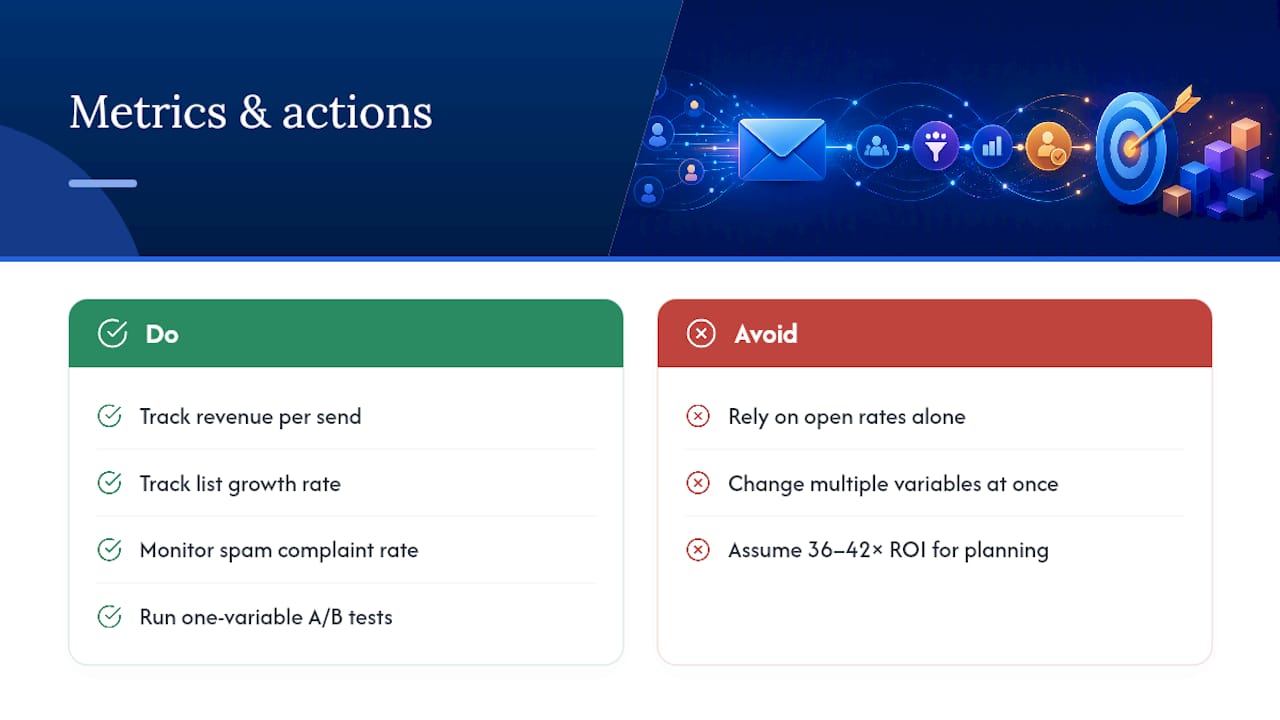
Ignore vanity metrics. Track three numbers: revenue per send, list growth rate, and spam complaint rate. Everything else is noise dressed up as insight.
The real number to watch: industry surveys report brands seeing at least $10 back for every $1 spent on email, with some reporting figures as high as $36 to $42. Treat the higher end as an aspirational ceiling, not a planning assumption, and budget conservatively around 5 to 10x while you build your own benchmark.
Open rates are close to useless as a standalone metric since Apple's Mail Privacy Protection and similar features started inflating them artificially across the board. Click-through rate and revenue per send tell you the truth; open rate mostly tells you how many people have an iPhone.
Run simple A/B tests to nudge these numbers: test subject lines for open rate proxy signals, test call-to-action placement and button copy for click-through, and test send time for engagement. Change one variable at a time, or you'll never know what actually worked. For a broader view of how email fits your overall paid and organic mix, this ROI playbook for small business ads is worth a read.
How to choose an email service provider (practical criteria, not feature overwhelm)
Every platform will show you a demo full of features you'll never touch. Cut through it with five questions.
- Deliverability support: does it help with authentication setup and warn you about spam risk?
- Automation templates: can you launch a welcome and abandoned cart flow without hiring a developer?
- Ease of use: could someone on your team learn it in an afternoon?
- Pricing model: does it scale with subscriber count or send volume, and does that suit your growth curve?
- Integration: does it talk to your ecommerce platform or CRM without duct tape and a workaround?
Ignore advanced predictive analytics, AI subject-line generators, and SMS bundles when you're starting out. They're nice later, not now. Broadly, think in three categories: budget-friendly tools for solo operators, ecommerce-first platforms built around cart and product data, and CRM-native tools for service businesses running long sales cycles. Compare your shortlist against this marketing automation tools list before you commit to a contract.
A 30-day starter plan: week-by-week actions to ship results
Paralysis by analysis kills more email programs than bad copywriting ever will. Here's your month, mapped out.
- Week 1: choose your platform, set up SPF, DKIM and DMARC, and install two capture points on your site or checkout.
- Week 2: build your welcome series (3 to 5 emails) and set up your three segments: engaged, customers vs prospects, repeat buyers.
- Week 3: build your highest-value automation, abandoned cart for ecommerce or a lead-nurture sequence for services, and send your first campaign to the engaged segment only.
- Week 4: review revenue per send and list growth, suppress inactive addresses, and lock in a monthly routine: one cleaning session, one new test, one campaign minimum.
By day 30 you'll have live data instead of guesses. That's the whole game.
How Adsdaddy helps small businesses scale email plus proof points
Building this yourself is entirely doable, this guide proves it. But if you'd rather have someone else run the automations while you run the business, that's where Adsdaddy fits in.
This service specializes in integrated customer engagement using platforms like Klaviyo alongside paid campaigns across various major ad platforms, aiming to align email flows with advertising spend. Typical delivery looks like:
- Full platform setup and domain authentication done properly the first time.
- Welcome, abandoned cart, and re-engagement automations built and tested.
- Ongoing optimisation of segments, cadence, and campaign performance.
Run through the 10-step email marketing checklist to see how the fundamentals in this guide translate into an execution list Adsdaddy uses with clients.
Author's take: the mindset shift that turns a newsletter into a revenue engine
Here's the rule most small businesses get backwards: relationship first, revenue second. Chase the sale in every email and subscribers unsubscribe faster than you can say "limited time offer." Build trust like you're dating, not proposing on the first message, and the sales follow because people buy from senders they actually want to hear from.
Start the 30-day plan this week. Momentum beats perfection every time.
— Adrian
Want Adsdaddy to build and run it for you?
Most small business owners don't have a spare 20 hours a month to babysit flows, test subject lines, and clean lists. Adsdaddy is the alternative to hiring an in-house marketer or wrestling with DIY software. We set up the platform, wire in the automations, and keep optimising while you run the business.

The typical engagement starts with an audit of your current setup (or a build from scratch if you're starting cold), followed by domain authentication, flow builds, and your first 30 days of campaign management. Adsdaddy also runs lead generation services for businesses that want qualified leads flowing into those email sequences from day one, and finance brokers can compare buying enquiries per lead with owning the engine on the pay per lead page. If you want a team that treats your inbox like a revenue channel instead of a chore, book a call and get a straight answer on what your first 30 days would look like.
Selected sources and further reading
Statista tracks global email user numbers and email marketing revenue, useful for reach and market-size context. Litmus publishes ROI benchmark data and segmentation guidance grounding the figures in this piece. Coursera's inbox marketing course is a solid-structured option if you want to go deeper on fundamentals.
FAQ
What is the best email marketing platform for a small business?
There's no single best platform, it depends on whether you're ecommerce-first, service-based, or CRM-heavy. Match the provider to your primary sales channel, prioritise built-in automation templates and deliverability support, and confirm pricing scales sensibly with your list size.
What is the 3-3-3 rule in marketing?
Definitions vary depending on the source, but the version most relevant to email is keeping things simple: three core segments, three to five welcome emails, and a handful of automated flows rather than dozens of one-off campaigns. Treat it as a simplicity principle, not a rigid formula.
Is email marketing still worth it in 2026?
Yes. With more than 4 billion email users worldwide, it remains one of the largest reach channels available, and brands commonly report returns of at least $10 for every $1 spent. Treat higher figures as a ceiling and build your own benchmark using revenue per send.
What is the 80/20 rule in email marketing?
The common interpretation is that roughly 80% of your content should deliver value, education, or entertainment, while only 20% should be direct promotion. Some operators use a slightly tighter 2 to 3 value emails per promotional send, but the principle is the same: earn attention before you ask for the sale.
How much does email marketing management cost with Adsdaddy?
Adsdaddy's email and lead-generation pricing depends on the scope of the project and is named on a call, never on the website. Finance enquiries bought per lead are sold through OptiCheck, our own loan marketplace, which sets its own pricing.