5 Portfolio Projects Employers Want: Digital Marketing Analyst Roadmap
. By Ads Daddy.

A digital marketing analyst is the person who turns campaign noise into decisions: what to scale, what to kill, what to fix. Yes, it's a growth career in 2026. The fastest way in isn't a fancy degree. It's GA4, SQL, and one portfolio project that proves you can read data and act on it. Junior to senior to manager is the well worn path, and it starts the moment you stop guessing and start querying.
TL;DR:
- Building a strong portfolio with real projects like SQL queries, dashboards, and case studies accelerates hiring prospects within six to nine months.
- Mastery of GA4 fundamentals is essential, with certification significantly increasing visibility to recruiters.
- Entry-level candidates should focus on Excel, GA4, and basic SQL, while mid-level and senior roles demand advanced skills in BI tools, automation, and modeling.
- In-house analysts handle single brands, whereas agency analysts juggle multiple clients with faster reporting demands, valuing practical multi-client experience.
Table of Contents
- What does a digital marketing analyst actually do all day?
- Skill stack and tools to prioritise in 2026
- What does a digital marketing analyst earn, and is demand actually growing?
- How to become a digital marketing analyst: your fast, practical roadmap
- Job description bullets and interview prep that actually work
- Where does the career actually go?
- How agencies use analyst skills: a practical reality check
- Employer perspective: what actually gets you hired
- Further reading to back up the numbers
- FAQ
What does a digital marketing analyst actually do all day?
Forget the job title fluff. A digital marketing analyst is a data-driven professional who lives inside four functional zones, and most roles blend at least two of them.
- Paid media analytics — tracking spend, CPA, ROAS across Google Ads, Meta, LinkedIn.
- Web analytics and conversion — GA4 dashboards, funnel drop-off, landing page performance.
- Email and lifecycle — open rates, flow performance, segmentation logic.
- SEO analytics — organic traffic trends, keyword rank shifts, content ROI.
A typical week looks like this: Monday is reporting day (pulling last week's numbers into a dashboard), Wednesday is deep-dive day (why did conversion rate drop 8% on mobile?), and Friday is test review (did that new ad creative actually beat the control?).
You're not working in isolation. You report to a marketing manager or director, but you'll spend just as much time in Slack threads with product and engineering, especially when tracking breaks or a new feature changes user behaviour. Analysts who can't explain a tracking bug to an engineer in plain English get ignored. That's a real skill gap, not a technical one.
Skill stack and tools to prioritise in 2026
Here's the mistake most beginners make: they try to learn everything at once and end up mediocre at all of it. Don't. Learn in this order, because the data on what employers actually pay for is blunt about priorities.
Entry level (get hired):
- Excel or Google Sheets (pivot tables, VLOOKUP, basic modelling)
- GA4 fundamentals (events, conversions, exploration reports)
- Basic SQL (SELECT, WHERE, JOIN)
Mid level (get promoted):
- SQL fluency, not just basics
- BI tools: Tableau, Power BI, or Looker
- A/B testing and attribution modelling
Senior level (get paid):
- Python or R for automation and modelling
- Marketing Mix Modelling (MMM)
- Leadership and data storytelling to non-technical stakeholders
📊 Statistic Callout: GA4 appears in a large majority of marketing analyst job listings in 2026, showing strong growth from the previous year. SQL is listed in most marketing analyst job requirements and its demand is growing significantly. Skip either one and you're filtering yourself out of most of the shortlist before you even apply.
Pro Tip: Don't just learn GA4 buttons. Learn to explain what a metric means for the business, because CareerFoundry's analysis is right: technical skill without marketing fundamentals is a car with no steering wheel.
Your tool checklist for job applications: GA4, BigQuery, a SQL client (DBeaver or similar), Tableau or Power BI, Google Ads and Meta Ads Manager, and at least one marketing automation platform like Klaviyo. If your resume doesn't mention at least four of these, it's getting skipped.
What does a digital marketing analyst earn, and is demand actually growing?
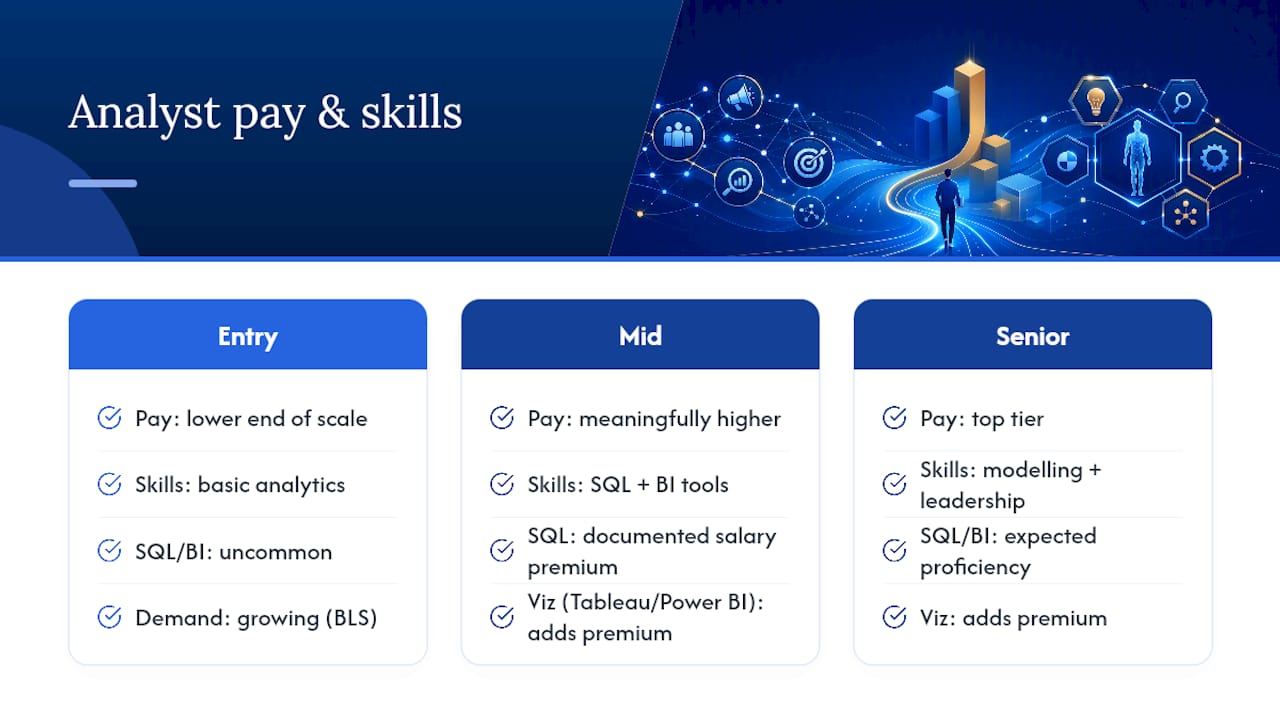
Pay bands vary by market, but the trend is consistent: entry-level roles sit at the lower end of the analyst pay scale, mid-level analysts earn meaningfully more once SQL and BI tools are solid, and senior analysts with modelling and leadership chops command the top tier.
📈 Statistic Callout: The Bureau of Labor Statistics projects faster-than-average growth for market research analyst and marketing specialist roles, meaning demand for analytics talent isn't slowing down this decade. SQL alone carries a documented salary premium, and data visualisation skills like Tableau and Power BI add another.
How to become a digital marketing analyst: your fast, practical roadmap
Skip the four-year degree debate. A degree helps if you're starting from zero, but a focused bootcamp or self-study plan gets you hired just as fast if you build real proof of skill.
- Months 1 to 2: Nail GA4. Do the free GA4 Skillshop certification. It's free, it's fast, and recruiters scan for it.
- Months 2 to 4: Learn SQL properly. Not just syntax, practise on real messy marketing data.
- Months 3 to 5: Learn one BI tool. Tableau or Power BI, pick one and go deep, not both shallow.
- Months 4 to 6: Build five portfolio projects. An attribution analysis, a funnel drop-off SQL query, a GA4 e-commerce report, an A/B test writeup, and a full campaign performance dashboard.
- Months 6 to 9: Package and apply. Turn every project into a one-page case study with a before/after result.
Understanding how customer journey data shapes ad targeting is a smart addition to your funnel project, because employers want to see you connect data to strategy, not just data to charts.
Job description bullets and interview prep that actually work
Recruiters skim. Metric-first resume bullets get read; task lists get binned.
- "Reduced cost per lead by 22% by rebuilding attribution model in GA4."
- "Built automated SQL query saving 6 hours of weekly manual reporting."
- "Identified funnel leak costing $14K/month in lost conversions."
- "Ran A/B test increasing landing page conversion rate by 9%."
- "Delivered weekly dashboard used by 3 department heads for budget decisions."
Interviews test three things: a take-home SQL challenge (can you actually query, not just talk about querying), a live dashboard walkthrough (can you explain a chart to someone who's never seen it), and a hypothesis question (how would you test if a new ad creative is actually working?). Package your portfolio projects as one-pagers: problem, method, result. Nothing kills momentum in an interview faster than "let me pull that up" turning into five minutes of scrolling.
Where does the career actually go?
The standard path: junior analyst → senior analyst → analytics manager → director. Nobody skips steps by being clever, they skip steps by being visible.
Three accelerators that actually move the needle: owning one project end to end (not a shared dashboard, your dashboard), writing briefs so clear a stakeholder doesn't need a follow-up meeting, and building relationships outside your own team, because promotions come from people who've seen your work, not just heard about it.
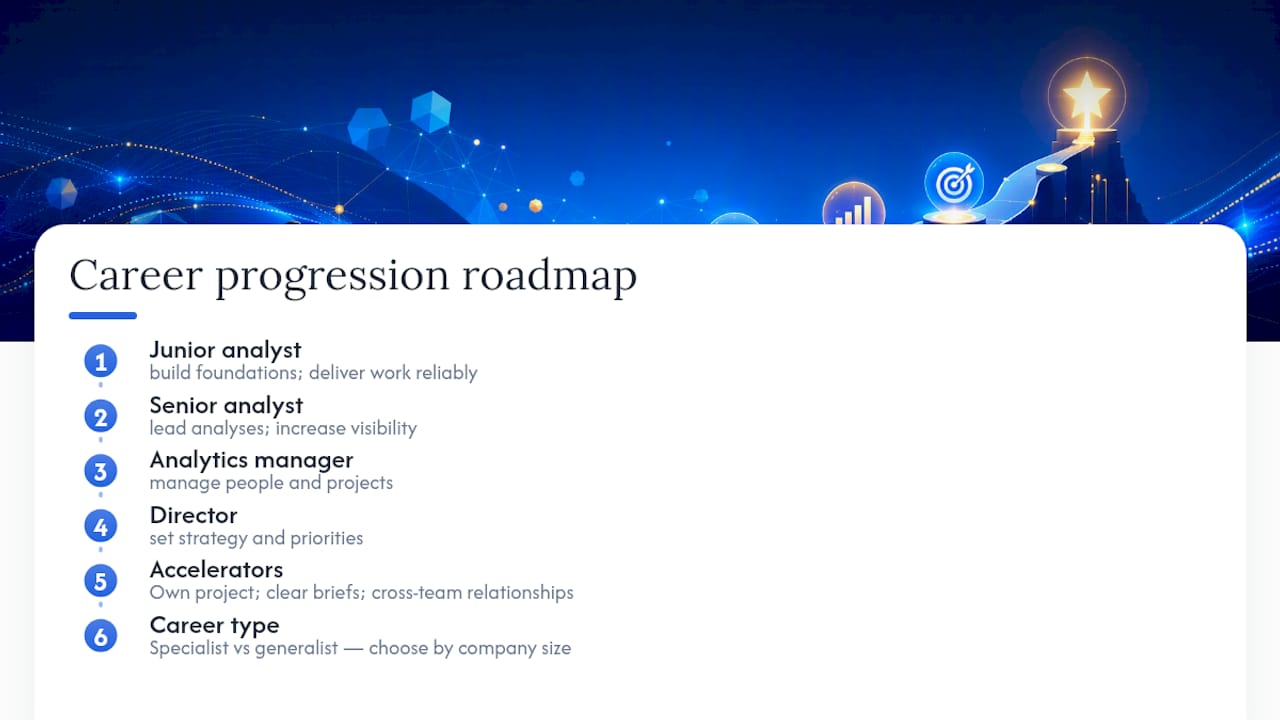
Specialist or generalist? Specialising in SEO analytics or paid media analytics pays off in larger companies with dedicated teams. Generalists thrive in smaller businesses where you're the entire analytics function. Neither is wrong, but pick based on the size of company you actually want to work in, not what sounds more impressive on LinkedIn.
How agencies use analyst skills: a practical reality check
In-house analysts usually own one brand's data end to end. Agency analysts juggle multiple clients, tighter reporting cadences, and messier tracking setups they didn't build themselves.
An agency team pulling GA4, BigQuery, and ad platform data into one dashboard for a client isn't doing theory. It's translating raw ad spend into leads a business owner can actually act on, fast, and under deadline pressure that in-house roles rarely see.
If you've freelanced or interned managing client reporting, say so explicitly in interviews. Agency-style multi-client reporting experience signals you can hit the ground running on day one.
Employer perspective: what actually gets you hired
What I look for: a metric-first resume, a real SQL sample, a live dashboard link. Red flags: vague bullet points, no numbers, zero portfolio. Build one solid project this month and send it to a hiring manager. That's the move.
— Adrian
If you're running the ad side rather than analysing it, Adsdaddy manages Meta, Google, YouTube, LinkedIn, and Microsoft campaigns end to end, so you're not stuck reading dashboards nobody built properly. Adsdaddy's Lead Generation service also builds a complete enquiry engine in your own accounts for businesses wanting exclusive, pre-qualified leads without hiring an internal analytics team from scratch.
Further reading to back up the numbers
For deeper skill-frequency data and career roadmaps, look at BLS growth projections for market research analysts, CareerFoundry's skills breakdowns, and analytics ROI research from Baby Love Growth, which unpacks how analytics-driven reporting improves marketing ROI.
FAQ
What does a digital marketing analyst actually measure?
A digital marketing analyst tracks campaign performance metrics like conversion rate, CPA, ROAS, and funnel drop-off across paid, organic, and email channels. The goal is turning that data into decisions marketing managers can act on, not just producing reports nobody reads.
Is SQL mandatory for a digital marketing analyst role?
SQL appears in roughly 71% of marketing analyst job listings in 2026, making it close to essential rather than optional. Candidates without it are filtered out of most serious shortlists before the interview stage.
How long does it take to become job-ready as an analyst?
Most people can build fundamentals in 2 to 6 months, then spend another 1 to 3 months on portfolio projects like a GA4 e-commerce report or an A/B test analysis. Total timeline to first application is roughly 6 to 9 months for someone starting from zero.
What's the difference between a digital marketing analyst and a digital marketing manager?
An analyst measures and interprets performance data; a manager sets strategy, budgets, and campaign direction based on that data. Many analysts move into manager roles once they've proven they can turn numbers into decisions that stick.
Do I need a degree to become a digital marketing analyst?
No. A degree helps if you're starting with zero marketing or data background, but a focused self-study plan plus real portfolio projects gets most candidates hired just as fast. Employers care more about a working SQL sample and dashboard than a transcript.