5 Stage Digital Marketing Agency Workflow That Ends Scope Creep
. By Ads Daddy.

A digital marketing agency workflow is the repeatable, signed process that moves a client deliverable from brief to live, with one owner per step and no mystery reviewers. Get it right and you kill bottlenecks, launch on time, and stop reinventing the wheel every single account. This guide maps the whole thing, phase by phase, channel by channel, so you can fix the one part that's currently bleeding you dry.
TL;DR:
- Most agencies lack a formal workflow, relying instead on informal communication, which leads to missed approvals, delays, and inconsistent quality.
- Implementing a standardized, owner-specific process for each phase—intake, production, review, launch, and measurement—reduces bottlenecks and ensures accountability.
- Automating repetitive tasks, establishing clear sign-off procedures, and limiting review stages to two reviewers accelerates project turnaround times.
- Tailoring channel-specific micro-workflows and adjusting timeboxes and review counts based on client needs prevents burnout and inefficiency.
- Using templates, strict governance, and automated dashboards enhances consistency, data security, and continuous process improvement across campaigns.
Table of Contents
- What is a digital marketing agency workflow?
- The core agency workflow, phase by phase
- Channel-specific micro-workflows you can copy today
- Tools, automation and dashboards that actually reduce work
- Governance that stops handoffs from stalling
- Templates and the launch checklist that saves your ROI
- How Adsdaddy runs this without the chaos
- Data security and compliance in your workflow
- Building real feedback loops, not just "let's iterate"
- Communication protocols that keep everyone aligned
- Scaling the workflow for different agency sizes and clients
- The experiment worth running this quarter
- Get Adsdaddy to audit or build your workflow
- Worth reading next
- Sources
- FAQ
What is a digital marketing agency workflow?
Strip away the jargon and a workflow is just a chain: trigger → input → process → output → owner → handoff. A client signs a brief (trigger), your team gets the assets and access (input), someone builds the thing (process), it gets reviewed and shipped (output), and it lands with a named owner who's accountable if it's late or wrong.
That's it. That's the whole magic trick.
Most agencies don't have a workflow. They have vibes. A Slack message here, a "can you just quickly" there, and suddenly, nobody knows who approved the ad copy that just got flagged for a policy violation. A proper workflow removes the guesswork by defining, in advance:
- Who owns each step (not a team, a person)
- What "done" looks like before anyone starts
- When handoffs happen and who gets notified
- Where delays typically creep in (usually the review stage, always the review stage)
The ROI here isn't theoretical. Standardised processes give you predictability, tighter quality control, and faster launches, because nobody's waiting three days for someone to "circle back." Think of it like a relay race. If the baton handoff isn't rehearsed, you don't lose the race in the final sprint. You lose it in the changeover, every time.
The core agency workflow, phase by phase
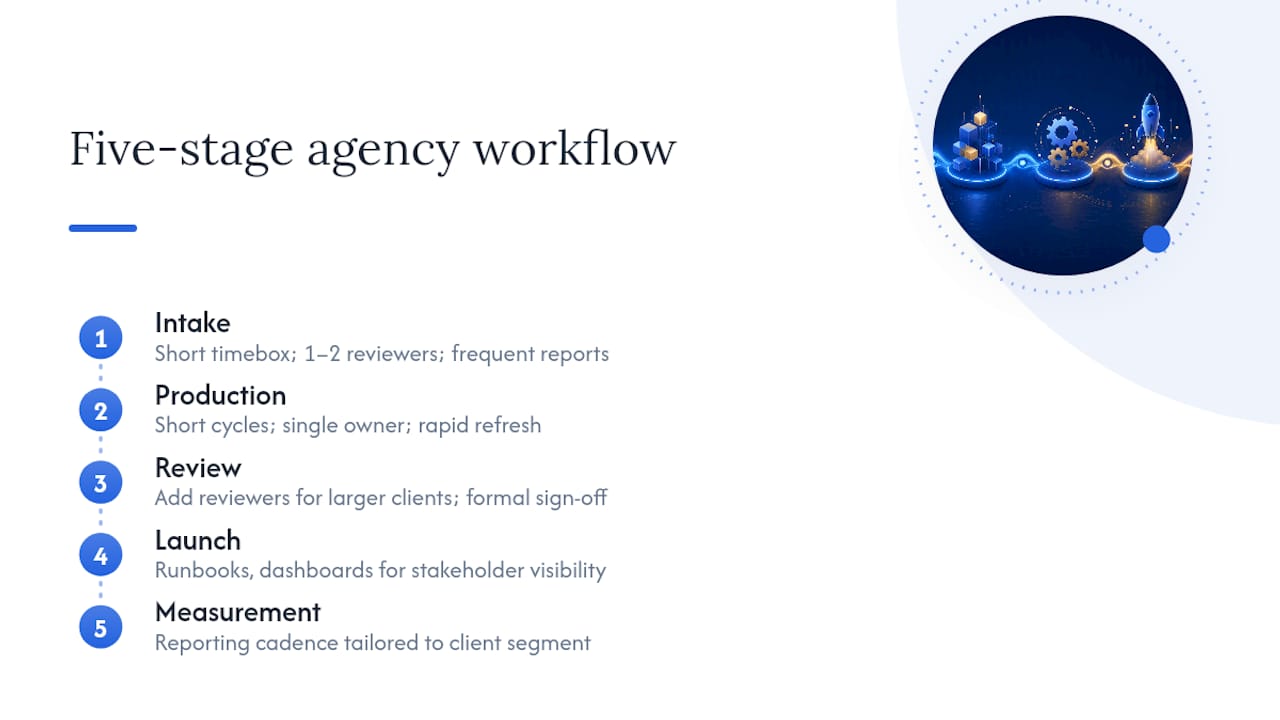
Five stages run the show for almost every deliverable: intake, production, review, launch, measurement. Skip one and you're not saving time, you're just moving the pain further downstream.
- Intake and brief. Owner: account manager. Output: a signed brief with objectives, budget, deadline, and approval process spelled out. Timebox: a short, defined timeframe. Definition of done: the client has signed off in writing, not "sounded keen on a call." This is where scope creep dies or thrives, so build a lead generation workflow with the sign-off baked in from day one.
- Production. Owner: the creative or media lead assigned to the account. Output: draft assets matching the brief exactly. Timebox: set per deliverable, not "whenever." Definition of done: assets match the brief, not the producer's personal taste.
- Review. Owner: one internal reviewer, maximum two. Output: approved or annotated feedback. Timebox: a fixed review period with strict deadlines. This is where agencies implode. Everyone and their dog wants a "quick look," and suddenly a two-day review becomes a two-week fight.
- Launch. Owner: campaign manager. Output: live asset, tracking confirmed, checklist completed. Timebox: same day as sign-off.
- Measurement. Owner: analyst or account lead. Output: first-week check-in, then a monthly report against agreed KPIs.
Pro Tip: Cap your review stage at two named people. Every extra reviewer you add doesn't add quality, it adds days. Unlimited reviewers is the single biggest killer of agency turnaround times.
The fix for pitfalls at every phase is boring but effective: name the owner, set the deadline, and put the sign-off in writing. Verbal approval is not approval. It’s a rumour.
Channel-specific micro-workflows you can copy today
Every channel needs its own rhythm, but the DNA is the same: brief, build, check, ship.
- Content: brief → draft → SEO QA → client review → publish → repurpose. Handoff points sit between writer and editor, then editor and publisher. Budget several business days for a standard blog post, with a shorter timeframe for social copy.
- Paid campaigns: strategy brief → creative build → tracking QA → internal approval → launch → daily monitoring. This is the channel where a missed pixel or wrong budget cap costs real money fast, so the paid campaign workflow needs its own launch checklist, not a borrowed one from content.
- Social: monthly content calendar → asset batching → scheduling → community monitoring handoff to a named responder. A solid social advertising checklist keeps the scheduling and moderation split clean so nothing falls through the cracks over a weekend.
- SEO: audit → content refresh brief → writer or optimiser → technical QA → republish → re-index check. This runs on a slower cadence, usually quarterly reviews with monthly spot checks, and a structured SEO content update workflow stops "refresh" from meaning "randomly edit the intro."
Copy these, adjust the timeboxes to your team's real capacity, and stop building bespoke processes for every single client. That's how agencies burn out.
Tools, automation and dashboards that actually reduce work
Automate the boring stuff. Protect human judgement for the creative calls. That's the whole filter.
Tool categories worth knowing:
- Project management platforms (Airtable, ClickUp, Process Street) centralise the whole workflow so nobody's hunting through five Slack channels for the current brief version.
- Asset libraries stop the "which version is final" disaster that's happened to literally every agency at least once.
- Scheduling tools handle publishing across social and content without a human clicking "post" at 6am.
- Analytics and connectors pull data automatically instead of someone copy-pasting numbers into a spreadsheet every Friday at 4pm.
Automation use cases worth setting up immediately: scheduled report generation, QA checklist triggers before launch, access provisioning for new team members, and routing rules, so if a client sends feedback via a random text message instead of the approved channel, it gets auto-logged and redirected rather than lost.
Dashboards need three rules: unified KPI definitions across every account (no "engagement" meaning five different things), a scheduled first-week check-in as a proper workflow output rather than an afterthought, and a monthly deep-dive that actually gets read, not just generated.
Pro Tip: If a task is repeatable and rules-based, automate it. If it requires taste, a human makes the call. Automating creative judgement is how you end up with ads that technically work and emotionally flatline.
Governance that stops handoffs from stalling
One owner per step. No exceptions. Shared ownership means nobody's accountable, and "the team is on it" is corporate speak for "nobody's on it."
A compact RACI pattern fixes this fast:
- Responsible: the person doing the work
- Accountable: the person who answers for it
- Consulted: people who give input before it's done
- Informed: people who find out after
Most agencies could run this on one page per account. Enforce it by refusing to accept updates from anywhere else.
Templates and the launch checklist that saves your ROI
Five templates belong in every agency's library: intake brief, creative brief, report narrative, naming convention guide, release checklist. Build them once, reuse them forever. That's the entire scaling secret, and it's why a workflow built for ROI beats a bespoke process reinvented for every new client.
Your 10-point pre-launch checklist:
- Naming convention confirmed across all assets
- Budget and bid caps double-checked
- Tracking pixels and UTMs verified
- All creative variants uploaded and approved
- Landing page links tested (not assumed)
- Sign-off documented in writing
- Audience targeting reviewed against brief
- Compliance and platform policy check complete
- Reporting dashboard connected before go-live
- Launch owner confirmed and notified
Enforce sign-off ruthlessly. Redirect any feedback that arrives outside the approved channel, and log it so nothing gets "he said, she said" three weeks later.
How Adsdaddy runs this without the chaos
A specialist agency manages campaigns across Facebook, Instagram, Google, YouTube, Microsoft Bing, and LinkedIn using this template-first structure, paired with popular tools for engagement and lead follow-up. A typical paid campaign moves through a signed brief, creative build, internal QA, launch, and a first-week performance check before scaling spend, no guesswork, no fifteen rounds of "just one more tweak."
Data security and compliance in your workflow
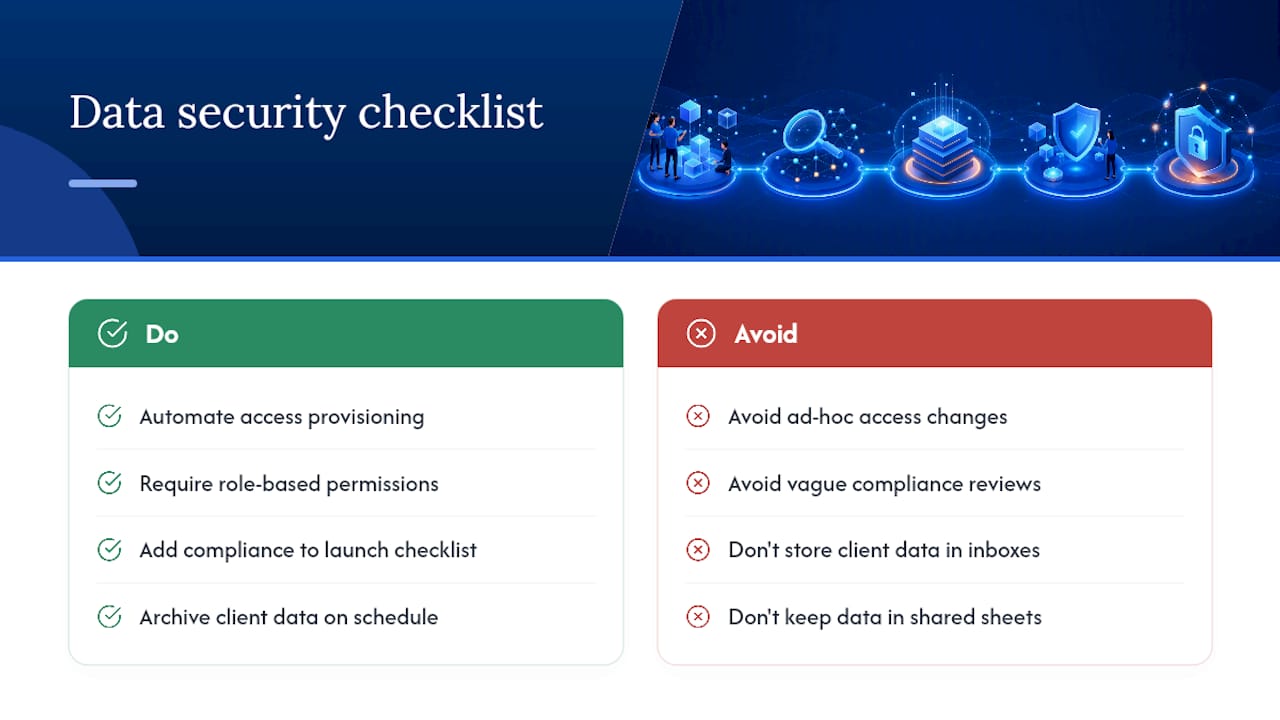
Every handoff point is a potential leak. Client login credentials, ad account access, customer data pulled into Klaviyo or your CRM, all of it moves through your workflow multiple times a week.
Lock down access provisioning as part of the workflow itself, not a separate IT afterthought. When someone joins or leaves a project, their access should update automatically, not "whenever someone remembers." Use role-based permissions in your project management and ad platforms so a junior designer isn't sitting on the same access level as the account director.
Platform policy compliance deserves its own checklist item, not a vague "make sure it's fine" review. Ad platforms suspend accounts over policy breaches constantly, and a rushed review stage is exactly when a compliance issue slips through. Build a compliance check into the launch checklist, not into someone's memory.
Data retention matters too. Client data sitting in shared spreadsheets forever is a liability, not a feature. Set a rule: client data lives in the approved system of record, gets archived on a schedule, and never lives permanently in someone's personal inbox or downloads folder. It's not glamorous work, but it's the difference between a minor hiccup and a client relationship ending over a preventable breach.
Building real feedback loops, not just "let's iterate"
Most agencies say "we'll iterate" and mean "we'll panic-fix it after the client complains." That's not a feedback loop. That's fire-fighting with extra steps.
A real feedback loop has three parts: a scheduled checkpoint, a defined format for capturing what went wrong, and a mechanism that actually changes the next brief. The first-week check-in isn't just a courtesy call, it's a structured moment to catch drift before it becomes a pattern across every account.
Build a lightweight retro after every campaign launch: what took longer than the timebox, where did reviewers stack up beyond the agreed two, and what part of the brief was vague enough to cause a revision round. Feed those answers straight back into your templates. If three campaigns in a row hit the same snag at the review stage, that's not bad luck, that's a broken step demanding a fix.
The mistake most teams make is treating feedback as something that happens at the end. Bake it into the workflow itself, so improvement isn't a quarterly initiative nobody has time for, it's just how Tuesday works.
Communication protocols that keep everyone aligned
Nobody should ever have to ask "wait, where are we at with this?" If they're asking, your communication protocol just failed.
Set the rules once: one approved channel per client (not email for some things and Slack for others), a standard update cadence (the first-week check-in, then whatever rhythm suits the account, weekly or fortnightly), and a clear escalation path when something's off track. Internal teams need the same clarity: who gets notified at each handoff, and what format that notification takes, a task update in the project tool, not a hallway conversation nobody else heard.
Transparency isn't a personality trait, it's a system. If a client feedback message lands somewhere outside the approved channel, auto-redirect it and log it, rather than letting it quietly influence work nobody else on the team knows about.
Scaling the workflow for different agency sizes and clients
A five-person agency and a fifty-person agency don't need different workflows. They need different levels of formality around the same structure.
Small teams can run the RACI pattern loosely, often with one person wearing two hats, but the one-owner-per-step rule matters even more here because there's nobody to quietly pick up the slack. Growing agencies need the template library locked down early, before the tenth account manager invents their own version of a creative brief. Larger agencies with enterprise clients need heavier compliance checks, more formal sign-off documentation, and dashboards built for stakeholders who never see the day-to-day work.
Client type matters just as much as agency size. A Shopify brand running always-on paid ads needs a workflow tuned for speed and constant creative refresh. A B2B client running quarterly campaigns needs a slower cadence with more strategic checkpoints. Forcing both through an identical template wastes time on one and rushes the other.
The fix scales with you: keep the five-stage structure (intake, production, review, launch, measurement) constant, and adjust the timeboxes, reviewer count, and reporting cadence per client segment. That's how you grow without every new account becoming a bespoke fire drill.
The experiment worth running this quarter
Standardise the brief, cap review at one internal reviewer, and run it across three campaigns. Measure launch time and revision rounds before and after.
— Adrian
Get Adsdaddy to audit or build your workflow
Reading about workflows is one thing. Having someone actually fix yours is another. Adsdaddy runs paid campaigns across Facebook, Google, Instagram, YouTube, Microsoft Bing, and LinkedIn using exactly the intake, build, QA, launch structure covered above, backed by reporting automation so you're not manually pulling numbers every Friday.

If your agency's launches are running late, your reviewers have multiplied past two, or your reporting is a copy-paste job nobody enjoys, that's a workflow problem, not a talent problem. Adsdaddy can run a short audit of your current campaign process, or step in and manage the ad accounts directly with the templates and checklists already built in. Head to the Adsdaddy landing page and book a call to find out where your process is bleeding time.
Worth reading next
- Wrike's workflow breakdown for the foundational definition and channel examples
- Kissflow's workflow guide for a deeper look at centralising platforms
- HubSpot's campaign management resource for the plan, launch, monitor, optimise, report loop
FAQ
What is a digital marketing agency workflow?
It's the repeatable, documented process that moves a deliverable from brief to live launch, with a named owner at every step and a signed brief locking the scope before production starts.
What are the steps to start a digital marketing agency?
Start by defining your service offering and target client type, then build your core workflow (intake, production, review, launch, measurement) before you take on your first client, so you're not inventing process under pressure. Agencies like Adsdaddy that specialise in specific channels, paid social and search in this case, often scale faster than generalists trying to do everything at once.
What is the 3-3-3 rule for marketing?
Definitions vary depending on the source, but a common version suggests testing three audiences, three creative variations, and three messaging angles before scaling a campaign.
What are the 7 C's of digital marketing?
The framework commonly cited includes content, context, connectivity, community, customisation, communication, and conversion, though different sources list slight variations on the exact seven terms.