Tactics First 6–12 Week Digital Engagement Strategy for Marketers
. By Ads Daddy.

A digital engagement strategy is the system that turns a scroll into a click, a click into a sale, and a sale into a repeat customer. It works when you can measure it. If you're not tracking behaviour, retention, and lifetime value, you're not running a strategy. You're just posting and praying. Start today by mapping one high-value customer journey. That's the whole game.
TL;DR:
- Mapping a high-value customer journey and tracking key behavior signals is essential before launching any engagement tactics.
- Personalising triggers using first-party data and deploying interactive content significantly improve intent surface and retention.
- Focusing on a handful of proven channel formats like short-form videos, segmented emails, and live events maximizes impact with weekly, sustainable content routines.
- Building a unified customer data profile and using AI for automation tasks helps scale personalisation without complicating compliance or data hygiene.
- Regular measurement of activity and outcome metrics, with cohort analysis, identifies weak points to improve and justifies ongoing investment.
Table of Contents
- What is a digital engagement strategy, really?
- Channels and formats: tactical execution across website, email, social and paid
- Data, personalisation and AI: practical setup and guardrails
- Measurement and KPIs: which metrics prove engagement and how to report them
- Implementation roadmap: a 3-step, 6–12-week plan to launch or improve engagement
- Tools and tech stack: capability categories and selection checklist
- Common mistakes and governance: simple rules that save reputation and results
- AdsDaddy practitioner perspective and proof points
- Author perspective: blunt rules seasoned strategists follow
- Get your engagement strategy built, not just planned
- Curated sources for verification and further reading
- FAQ
What is a digital engagement strategy, really?
Here's the bit most guides skip: engagement isn't a vibe. It's a system with a job to do.
The job is simple: interaction leads to action, and action builds affinity. Someone opens your email (interaction). They click through and buy (action). They come back next month without a discount code (affinity). That's the loop. If your strategy doesn't move people through all three stages, it's not a strategy. It's content for content's sake.
And the pressure to get this right is only going up, making innovative examples of omnichannel support to boost CX more essential than ever. A strong majority of customers now expect brands to understand their specific needs and tailor the experience across every channel they touch. That's not a nice-to-have anymore. Generic blasts to a generic list are the digital equivalent of a bad Tinder opener: "Hey."
Key engagement strategies: the tactical shortlist to test first
You don't need twenty tactics. You need three or four that actually fit your business, tested fast and killed quick if they flop. Here's the shortlist:
- Map the journey before you touch the tools. Pick your highest-value path (first purchase, renewal, upgrade) and document every touchpoint. You can't fix what you haven't mapped.
- Personalise with first-party data. Use your CRM to trigger emails and offers based on real behaviour, not guesswork. Abandoned cart? Trigger. Browsed three times, bought nothing? Trigger.
- Add interactive content. Quizzes, polls, calculators, live shopping events. These aren't gimmicks. They surface intent better than any passive scroll ever will.
- Use AI for the boring bits. Variable ad creative, subject line testing, send-time optimisation. Let the machine handle volume so your team can handle strategy.
- Activate your community. User-generated content and creator partnerships routinely outperform brand-only posts on reach and trust. People trust people, not logos.
Different business models need different weightings. A B2B software company should lean hard into webinars and gated content. A DTC brand should lean into short-form video and UGC. A subscription business should obsess over renewal-stage personalisation, because that's where the real money leaks out.
Pro Tip: Don't launch all four tactics at once. Pick two, run them for four weeks, and kill whichever one underperforms before adding a third. Speed beats scope every time.
Channels and formats: tactical execution across website, email, social and paid
Strategy is nothing without execution. Here's what "engaging" actually looks like, channel by channel:
- Short-form video: Hook in the first three seconds, deliver value by second ten, and design for saves and shares-to-chat, not just likes. Platforms weight watch-time and private shares far more heavily than a passive tap.
- Email: Segment by behaviour, not just demographics. A shopper who browsed shoes three times gets a different email than someone who just joined your list.
- Website: Chat prompts, quizzes, and calculator tools that answer a real question in under 30 seconds.
- Paid social: Carousel ads that teach one thing fast, plus retargeting sequences built around what someone actually did on your site.
- Live and interactive events: Webinars and live Q&As remain a genuinely high-impact format for B2B and enterprise audiences, especially when the follow-up sequence is as sharp as the event itself.
Repurpose ruthlessly. One webinar becomes five short clips, three carousel posts, and a follow-up email sequence. Every piece needs one clear CTA, aligned to where that person sits in the journey. Don't send a "buy now" CTA to someone who just discovered you exist.
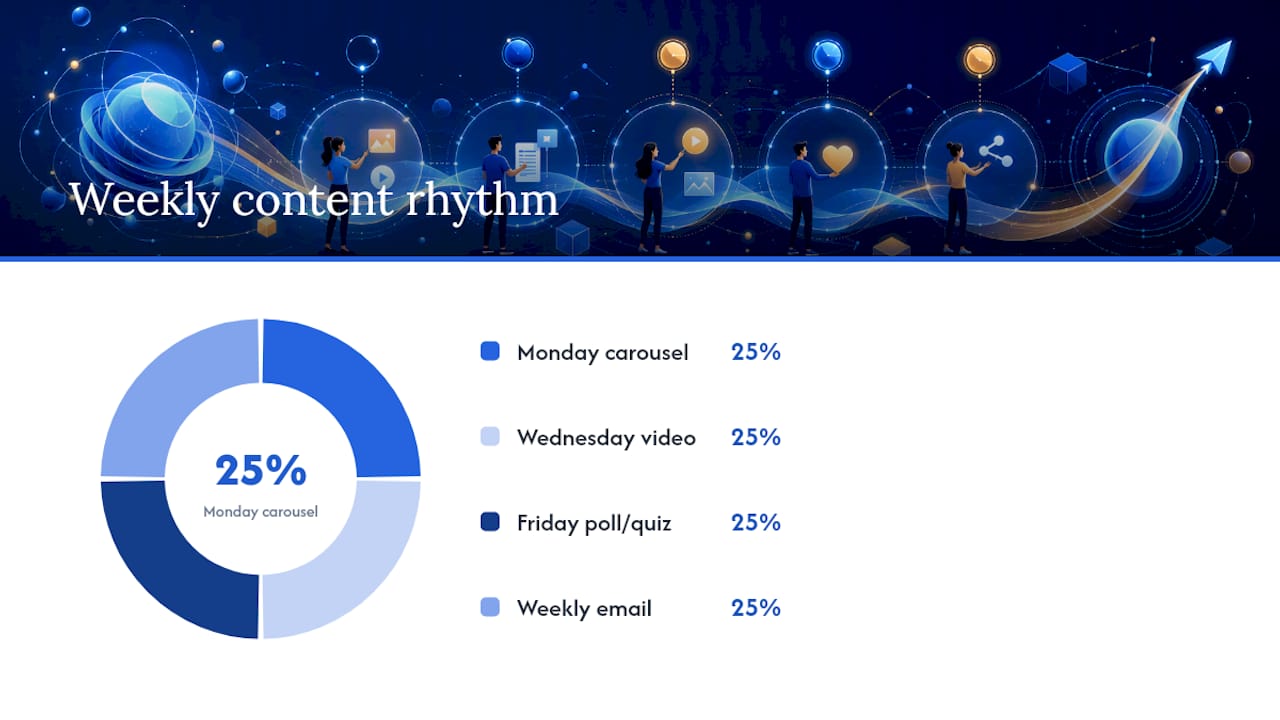
A lean weekly rhythm: Monday, one educational carousel. Wednesday, one short-form video. Friday, one interactive poll or quiz. One email send tied to whatever performed best that week. That's four assets, not forty, and it's sustainable.
Data, personalisation and AI: practical setup and guardrails
Third-party cookies are dying, and good riddance. Third-party data was always someone else's list, rented at a premium. First-party data, the stuff you collect directly, is the actual backbone of personalisation that works.
Here's how to set it up without turning your marketing team into a compliance department:
- Identity stitching first. Connect email, on-site behaviour, and purchase history into one profile before you build a single segment.
- Use a CDP only when you need it. If you've got fewer than five data sources, a solid CRM does the job. A customer data platform earns its cost once you're juggling app data, POS, and multiple ad platforms.
- Let AI handle scale, not judgement. Variable creative testing, intent scoring, and send-time optimisation are perfect AI jobs. Brand tone and sensitive messaging still need a human set of eyes before they go live.
- Make data capture low-friction. A one-click preference centre beats a ten-field signup form every time.
Pro Tip: Build your preference centre before your next campaign, not after your first mass unsubscribe. It's the cheapest insurance policy in marketing.
Measurement and KPIs: which metrics prove engagement and how to report them
If you can't put a number on it, you can't defend your budget in the next meeting. Full stop.
The strongest engagement measurement approaches track both activity and outcomes together, then segment by cohort to find exactly where things break down.
| KPI | What it tells you | How to track it |
|---|---|---|
| Engagement rate | Behavioural interest (opens, clicks, watch-time) | Platform analytics + email tool |
| Retention / churn | Whether the relationship survives past first purchase | CRM cohort reports |
| Conversion rate | Whether engagement turns into revenue | Funnel analytics |
| Customer lifetime value (CLV) | Long-term value of an engaged customer | CRM + revenue data |
| Response time | Speed of your service loop | Chat/helpdesk reporting |
Build cohorts by acquisition month or channel, then watch how each group's numbers diverge over time. That's where you'll find your weak link. Was it the onboarding email? The third-touch retargeting ad? Cross-channel attribution is messy, but a simple rule helps: credit the channel that triggered the next action, not just the last click before purchase.
Ask this every month: which cohort is underperforming, and what's the one variable we can test to fix it?
Implementation roadmap: a 3-step, 6–12-week plan to launch or improve engagement
Forget the 40-page strategy deck nobody reads. The most repeatable pattern advertisers use to actually ship engagement programs is three steps: map, test, scale.
- Weeks 1 to 2: Map and collect. Pick one high-value journey (first purchase, renewal, whatever moves revenue) and document every touchpoint. Pull whatever behavioural signals you already have.
- Weeks 3 to 8: Launch three tactics. Pick your top three from the shortlist earlier, build templates and workflows, and go live. Don't overthink the creative. Ship it.
- Weeks 9 to 12: Measure, iterate, scale. A/B test your best-performing tactic, kill the worst, and set operational service-level agreements (like "respond to chat within five minutes") so quality doesn't slip as you scale.
Pro Tip: Set your SLA before you scale, not after complaints roll in. A great engagement tactic run badly at volume is worse than no tactic at all.
Tools and tech stack: capability categories and selection checklist
You don't need every tool on the market. You need five capability categories filled properly:
- CRM/CDP: For unifying customer data and triggering personalisation.
- Marketing automation: For running email and lifecycle sequences without manual sends.
- Analytics/BI: For turning raw activity into cohort reports you can act on.
- Chat and conversational tools: For real-time engagement on-site and in-app.
- Production tooling: For creative, video, and content at the volume your calendar demands.
Before you sign a contract, check integration (does it talk to your existing stack?), identity resolution (can it match a customer across devices?), ease of use (will your team actually adopt it?), privacy compliance, and total cost including implementation. Run a 30-day proof-of-fit test with real data before committing to a year-long contract. Migration between platforms is expensive and slow. Get it right the first time.
If you want a deeper breakdown of tool categories for smaller teams, check this marketing automation tools list for SMBs.
Common mistakes and governance: simple rules that save reputation and results
Most engagement disasters aren't strategy failures. They're governance failures.
- Automation without a human check sends the wrong message to the wrong person at the worst time. Always review triggered sequences monthly.
- Poor data hygiene breaks journeys silently. A dead field or duplicate record can quietly tank your personalisation.
- Siloed teams mean nobody owns the customer journey end to end. Assign one owner and one SLA template per journey, full stop.
- Privacy missteps cost trust fast. A simple preference centre prevents most mass unsubscribes before they happen.
Pro Tip: Appoint one journey owner per customer segment. If three teams can touch a journey but nobody owns it, it will break. Every time.
AdsDaddy practitioner perspective and proof points
Running managed campaigns across Meta, Google, and LinkedIn shows the same pattern again and again: teams that map one journey and personalise triggers off first-party data see real engagement lifts and stronger conversion, without touching creative budget. Adrian and the Adsdaddy team have written extensively on marketing automation examples that actually drive leads, drawing on real campaign structures rather than theory. Every client engagement starts with three deliverables: a journey map, a KPI dashboard, and a creative brief. Those three documents alone fix most of what goes wrong in a first engagement attempt.
Author perspective: blunt rules seasoned strategists follow
Three rules I'd bet the business on: start small, measure ruthlessly, protect customer trust above all else. Most brands do the opposite. They launch five tactics at once, measure vanity metrics, and treat data capture like a land grab.
Hire an agency when you've mapped your journey but lack the hands to execute three tactics well simultaneously. A good first month looks like: one journey mapped, three tactics live, and a dashboard you can actually read. If a first month delivers a 40-slide deck and nothing shipped, that's a red flag, not a strategy.
— Adrian
Get your engagement strategy built, not just planned
Most brands know exactly what they should be doing. Mapping the journey, personalising triggers, testing interactive formats. What they don't have is the hands, the ad accounts, and the reporting discipline to run it week after week without it quietly falling apart.

Adsdaddy is the alternative to hiring an in-house team from scratch. We build and manage the campaigns across Facebook, Instagram, Google, YouTube, Microsoft Bing and LinkedIn, connect them to tools like Klaviyo and newCustomer.io for lifecycle personalisation, and hand you a dashboard that actually tells you what's working. No guessing which tactic to try next. No twelve-week ramp-up before you see a result. If you want the map→test→scale roadmap run for you instead of by you, book a call with the Adsdaddy team and get a starter engagement plan built around your actual customer journey.
Curated sources for verification and further reading
- Salesforce's guide to digital engagement strategy framing
- ON24's research on interactive webinar engagement tactics
- Sprinklr's guide to omnichannel customer engagement
- Sprout Social's rules for winning social media interaction
FAQ
What are some examples of digital engagement?
Examples include personalised email triggers, live shopping events, interactive quizzes, short-form video with high completion rates, and community-driven user-generated content campaigns.
What are the 5 main strategies of digital marketing?
Most frameworks centre on content marketing, social media, email/lifecycle marketing, paid advertising, and search/SEO, each working together rather than in isolation.
What is a good CX strategy?
A good customer experience strategy maps the full journey across teams, uses first-party data for personalisation, and treats response time and retention as core KPIs, not afterthoughts.
What is an example of an engagement strategy?
A subscription brand triggering a personalised renewal email sequence based on usage data, paired with a loyalty reward for early renewal, is a clear example of a working engagement strategy.
How long does it take to see results from a digital engagement strategy?
Most teams following a map, test, and scale approach see measurable engagement shifts within 6 to 12 weeks, provided tactics are launched and reviewed on a consistent weekly rhythm.