Brand Lift: How It Drives E-Commerce Growth
. By Ads Daddy.

Over 60 percent of australian e-commerce owners struggle to connect marketing efforts with real sales results. Understanding brand lift gives small businesses a powerful way to see how their message changes customer perception and trust. Unlocking the secrets behind these metrics helps australian entrepreneurs measure what truly drives awareness, recall, and purchase intent, so every advertising dollar counts toward genuine growth.
Table of Contents
- Brand Lift Explained For Small Businesses
- Core Metrics: Awareness, Recall, Intent
- How Leading Platforms Measure Brand Lift
- Real-World Uses For Australian E-Commerce
- Common Pitfalls And How To Avoid Them
Key Takeaways
| Point | Details |
|---|---|
| Understanding Brand Lift | Brand lift measures the positive changes in consumer perception and purchase intent due to marketing efforts, crucial for small businesses in Australia. |
| Core Metrics for Success | Tracking brand awareness, recall, and purchase intent helps businesses gauge the effectiveness of their marketing strategies. |
| Utilising Digital Tools | Employ digital analytics and surveys to gain insights on brand performance, enhancing data-driven decision making. |
| Avoiding Measurement Pitfalls | Focus on meaningful metrics beyond vanity metrics to better understand the genuine impact of marketing activities. |
Brand Lift Explained For Small Businesses
Brand lift represents a critical metric for small businesses seeking growth in the competitive digital marketplace. Simply put, it measures how advertising and marketing efforts positively change consumer perception, awareness, and purchase intent towards a brand. For Australian small businesses, understanding brand lift means recognising how strategic marketing can transform audience engagement from passive awareness to active interest.
Measuring brand lift involves tracking key performance indicators that demonstrate shifts in customer sentiment. These typically include metrics like brand recall, consideration, and purchase intent. The Australian Government supports small businesses in this journey by providing resources that help entrepreneurs develop stronger brand strategies. By systematically evaluating these indicators, businesses can quantify the real-world impact of their marketing investments and make data-driven decisions about future campaigns.
Small businesses can track brand lift through various methods, including customer surveys, website analytics, and social media engagement rates. The goal is to understand how marketing efforts translate into tangible business outcomes. Government resources emphasize that establishing a strong digital presence can significantly enhance brand recognition and customer loyalty, particularly for enterprises competing in crowded markets.
Top Tip: Implement a simple quarterly brand perception survey to track your brand lift metrics systematically and identify trends in customer awareness and sentiment.
Core Metrics: Awareness, Recall, Intent
Brand awareness metrics form the cornerstone of understanding how consumers perceive and interact with a business. Brand awareness represents the fundamental first step in creating customer recognition, measuring how readily potential customers can identify and remember a specific brand in the marketplace. Comprehensive measurement approaches track multiple dimensions of brand recognition, including unaided recall, aided recognition, and overall market visibility.
Three critical metrics provide deeper insights into brand performance: awareness, recall, and intent. Awareness measures initial brand recognition, essentially answering whether consumers know the brand exists. Recall goes a step further, examining whether consumers can remember the brand without prompting. Purchase intent represents the crucial final stage, indicating the likelihood of consumers choosing the brand when making purchasing decisions. The Australian Centre for Evaluation highlights these metrics as essential for understanding campaign effectiveness, providing a structured approach to measuring marketing impact.
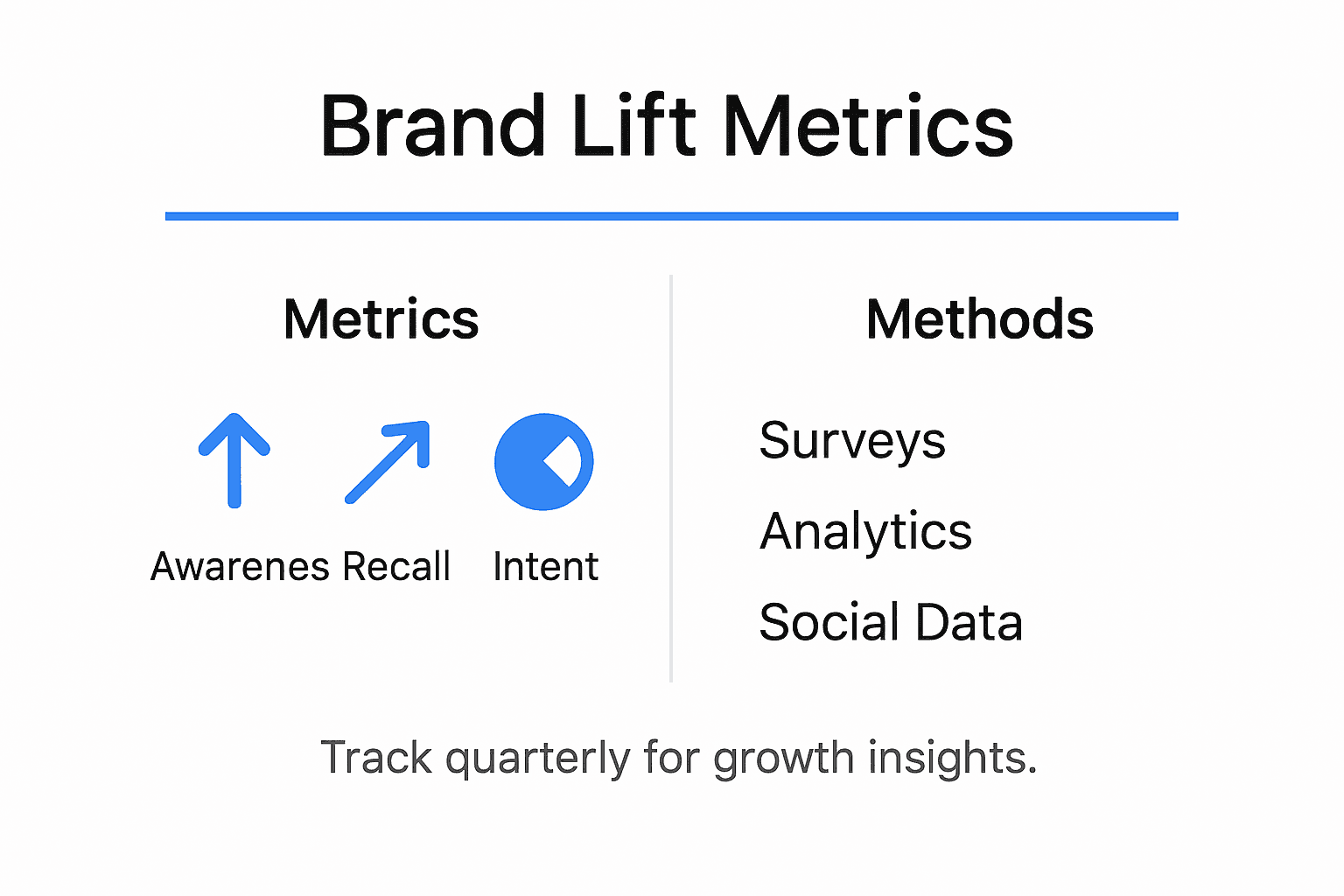
Small businesses can track these metrics through various methods, including customer surveys, digital analytics, and social media engagement tracking. Specific techniques like tracking search volume, monitoring social media mentions, and conducting periodic brand recognition surveys can provide valuable insights. By systematically measuring these metrics, businesses can understand their brand's market position, identify areas for improvement, and develop more targeted marketing strategies.
Here's a summary of how key brand lift metrics affect small business marketing outcomes:
| Metric | What It Measures | Typical Assessment Methods | Impact on Business Growth |
|---|---|---|---|
| Brand Awareness | Public recognition of brand | Surveys, search data | Increases top-of-mind recall |
| Brand Recall | Memory without prompting | Unaided recall surveys | Drives repeat consideration |
| Purchase Intent | Likelihood to buy | Intent surveys, conversion rate | Connects marketing to actual sales |
Pro Tip: Create a simple spreadsheet to track your brand metrics quarterly, comparing results over time to identify trends and measure the effectiveness of your marketing efforts.
How Leading Platforms Measure Brand Lift
Brand lift measurement has evolved into a sophisticated analytical process where digital platforms employ advanced techniques to understand marketing effectiveness. Leading digital platforms utilise comprehensive measurement strategies that go beyond traditional metrics, integrating complex data analysis to track consumer behaviour and campaign impact.

Digital platforms typically employ multiple measurement approaches to assess brand lift. These include experimental methods like A/B testing, user engagement tracking, and comprehensive survey analysis. MIT Sloan research highlights how platforms combine real-time data collection with strategic experimental designs to isolate the precise impact of marketing activities. Key metrics often include changes in brand awareness, consideration rates, purchase intent, and actual conversion performance.
The measurement process involves sophisticated attribution models that track consumer interactions across multiple touchpoints. Platforms analyse how different advertising exposures influence brand perception, using advanced analytics to understand the nuanced journey from initial brand awareness to final purchase decision. This approach allows businesses to understand not just whether their marketing is working, but exactly how and why it drives consumer behaviour.
Compare traditional vs. digital brand lift measurement approaches to clarify their strengths:
| Approach | Data Sources Used | Depth of Insights Provided | Typical Speed of Results |
|---|---|---|---|
| Traditional Surveys | In-person, phone, mail | Broad, slower to update | Weeks to months |
| Digital Analytics | Web, social, real-time | Detailed, rapid feedback | Days to weeks |
Pro Tip: Implement a standardised tracking system that captures multiple brand lift indicators, ensuring you can compare performance across different marketing campaigns and channels.
Real-World Uses For Australian E-Commerce
E-commerce businesses in Australia are increasingly leveraging brand lift measurement as a strategic tool to understand and improve their digital marketing performance. The Australian Bureau of Statistics highlights the critical role of digital activities in tracking marketing effectiveness, demonstrating how local businesses can use sophisticated analytical approaches to drive growth and customer engagement.
Australian online retailers are applying brand lift metrics across multiple dimensions of their business operations. These applications include optimising marketing spend, refining customer targeting strategies, and understanding the precise impact of advertising campaigns. Research from Amazon's Australian Small Business Empowerment Report shows that strategic brand store management can significantly enhance marketplace success, with sellers who carefully track brand lift metrics experiencing higher sales growth and improved customer engagement.
Key practical applications of brand lift measurement for Australian e-commerce include tracking customer acquisition costs, understanding audience demographics, measuring campaign effectiveness across different digital platforms, and identifying the most responsive customer segments. By systematically analysing these metrics, businesses can make data-driven decisions that directly impact revenue and market positioning.
Pro Tip: Create a monthly dashboard tracking your key brand lift metrics, comparing performance across different marketing channels and customer segments to identify your most effective strategies.
Common Pitfalls And How To Avoid Them
Brand lift measurement can quickly become a minefield of misleading data and ineffective strategies if businesses aren't careful. Common measurement approaches often fall into predictable traps that can skew understanding of actual marketing performance, with many organisations mistakenly relying on surface-level metrics that don't reflect genuine customer engagement.
One of the most significant pitfalls is over-relying on vanity metrics like total impressions or basic click-through rates. These numbers can create a false sense of success without revealing the actual impact on customer behaviour. Research highlights the importance of establishing robust evaluation frameworks that consider contextual factors and stakeholder perceptions, ensuring that measurement goes beyond simplistic numerical representations.
To effectively avoid these common measurement challenges, businesses should develop a comprehensive approach that includes multiple data points. This means integrating qualitative feedback, tracking meaningful conversion metrics, controlling for external variables, and maintaining a consistent measurement methodology. Successful brand lift measurement requires a holistic view that connects marketing activities directly to business outcomes, rather than treating metrics as isolated data points.
Pro Tip: Develop a multidimensional tracking system that combines quantitative metrics with qualitative insights, ensuring a more nuanced and accurate understanding of your brand's market performance.
Unlock the True Potential of Brand Lift to Accelerate Your E-Commerce Growth
Small businesses often struggle to connect brand lift metrics like awareness, recall and purchase intent directly to tangible sales outcomes. Without expert guidance, it can be overwhelming to design digital marketing campaigns that not only boost visibility but also drive meaningful customer engagement and conversions. If you want to turn raw data into clear growth opportunities, AdsDaddy.com specialises in crafting targeted advertising strategies across platforms including Facebook, Instagram and Google that maximise your brand lift impact.
Key benefits of working with AdsDaddy.com:
- Expert optimisation of image, video and carousel ads tailored to your unique audience
- Integration of advanced tools such as Meta for Business and Klaviyo for seamless customer engagement
- Data-driven campaign management that tracks brand lift indicators to boost purchase intent

Don’t let your e-commerce business miss out on the transformational benefits of effective brand lift measurement. Visit AdsDaddy.com today to discover how our proven ad solutions can turn awareness into increased sales and sustained growth. Embrace a smarter way to advertise and start scaling your brand presence with confidence now.
Frequently Asked Questions
What is brand lift and why is it important for e-commerce growth?
Brand lift measures how advertising impacts consumer perception, awareness, and purchase intent. For e-commerce businesses, understanding brand lift is vital for improving engagement and driving sales.
How can small businesses measure brand lift effectively?
Small businesses can measure brand lift through customer surveys, website analytics, and social media engagement. These methods help gauge shifts in customer sentiment and brand recognition.
What are the core metrics involved in brand lift measurement?
The core metrics include brand awareness (public recognition), brand recall (memory without prompting), and purchase intent (likelihood to buy). These metrics provide insights into how consumers interact with a brand.
What common pitfalls should businesses avoid when measuring brand lift?
Businesses should avoid over-relying on vanity metrics like total impressions or basic click-through rates. Instead, they should use a combination of quantitative and qualitative data to gain a more accurate understanding of marketing effectiveness.