The real benefits of digital marketing images (and how to prove it)
. By Ads Daddy.

Images aren't decoration. They're the fastest lever you have for grabbing attention, sticking in memory, and closing the deal. That's the AMA and Nature-published research talking, not marketing hype. Adsdaddy sees the same pattern across client accounts: the ad creative moves the needle faster than almost any bid or targeting tweak.
The move? Stop treating images as "the pretty bit." Start treating them like a lever you pull and measure.
- Attention: the brain processes visuals faster than text, so the right image stops the scroll before your headline even loads.
- Recall: consistent, distinctive imagery burns into memory. That's what brand recognition actually is.
- Conversion: the right product shot or social card turns a scroller into a clicker into a customer.
Key Takeaways
Digital marketing images work because they capture attention faster than text, lift brand recall through consistency, and convert better when tested and optimised by category and channel.
| Point | Details |
|---|---|
| Match image to funnel stage | Use hero shots for awareness, product photos for conversion, and UGC for trust. |
| Optimised visuals lift CTR | Deep-learning testing recorded a substantial CTR increase from visual-design changes alone. |
| Test one variable at a time | Isolate subject, composition or colour so you know exactly what moved the metric. |
| Faces aren't universal winners | Human imagery helps some product categories and hurts others, so test by category. |
| Adsdaddy manages this end to end | Creative production, testing and analytics are handled together across major ad platforms. |
Table of Contents
- Benefits of digital marketing images: the format you choose matters
- How images drive engagement, brand impact and ROI
- Your image optimisation checklist (creative and technical)
- Testing images like a scientist, not a guesser
- Which images go where: a channel-by-channel cheat sheet
- Why we treat every image as a campaign asset, not a nice-to-have
- How Adsdaddy turns your images into a growth lever
- Sources worth your time
- FAQ
Benefits of digital marketing images: the format you choose matters
Here's the mistake most businesses make: they pick one hero image, slap it everywhere, and pray. Different funnel stages need different visual jobs. Match the image to the moment.
- Hero and brand shots — big, bold, aspirational. These live at the top of the funnel, doing the awareness heavy lifting.
- Product and detail photos — clean, well lit, zero clutter. This is where conversion happens, because shoppers need to see exactly what they're buying.
- Infographics and social cards — built for sharing. These carry your message when someone else does the talking for you.
- User-generated content (UGC) — real customers, real context. Nothing builds trust faster because it doesn't look like an ad.
Budget-wise, you've got three lanes: bespoke shoots (best fit, highest cost), templated design systems (fast, on-brand, scalable), and stock imagery (cheap, generic, and increasingly obvious to audiences who've seen that same stock photo eleven times this week). Pick the lane that matches the funnel stage, not just the budget line.
How images drive engagement, brand impact and ROI

This is where the "images are nice to have" crowd gets proven wrong. Visuals aren't a vibe. They're a measurable input with a measurable output.
Separately, practitioner reporting across the industry consistently shows double-digit engagement and conversion gains when brands swap generic stock photos for bespoke or data-tailored imagery.
Why does a picture move a percentage? Three mechanisms, all psychological:
- Attention capture — the eye locks onto contrast, colour and faces before it processes any copy.
- Emotional resonance — an image that triggers a feeling (belonging, desire, relief) shortcuts the decision-making process.
- Cognitive shortcuts — a clear product shot answers "what is this and will it work for me?" before the reader has to think about it.
Translate that into business terms: higher CTR means cheaper clicks. Better brand recognition means people recognise your ads in a crowded feed, which lowers the cost of every future impression. Higher engagement uplifts on-page performance too, where visual content reportedly drives significantly more views than text alone. None of that is magic. It's optimisation, and it compounds.
Your image optimisation checklist (creative and technical)
Great creative that loads slowly, gets flagged by an ad platform, or ignores accessibility is creative that's leaving money on the table. Cover both sides.
Composition rules:
- One clear focal point. If the eye doesn't know where to land, it moves on.
- Visual hierarchy that guides the eye toward your CTA, not away from it.
- A consistent brand palette across every asset, so recognition compounds instead of resetting each time.
Technical SEO and delivery:
- Descriptive alt text and filenames (skip "IMG_4021.jpg" — it tells Google and screen readers nothing).
- Responsive srcset so mobile users aren't downloading a desktop-sized file.
- WebP or AVIF formats with fallbacks, compressed properly, served with lazy loading.
Platform notes: ad platforms increasingly factor visual clarity and policy-safety into delivery cost. Cluttered, text-heavy, or policy-risky images can push your CPMs up before you even launch. Clean composition isn't just aesthetic. It's a cost lever. For deeper specs on this, our banner advertising guide breaks down platform-safe creative sizing.
Pro Tip: Before you brief a new visual, check it against your last three winning ads. If it doesn't share at least one visual trait with your top performer, you're not iterating, you're gambling.
Testing images like a scientist, not a guesser
Guessing which image wins is like ordering off a menu with your eyes closed. Sometimes you get lucky. Mostly you don't. Here's the disciplined version:
- Test one variable at a time — subject, composition, or colour palette. Never all three at once, or you won't know what actually caused the shift.
- Track more than clicks — CTR matters, but so does conversion rate, CPM, CPA, dwell time and engagement rate. Optimising for clicks alone can quietly inflate your cost per acquisition.
- Use image analytics to scale winners — modern frameworks measure colour distribution, contrast, object presence and even perceived emotion, letting you quantify why an image worked instead of shrugging and hoping it happens again.
Human faces in your creative aren't a universal win. Research analysing many product pages found that the relationship between human imagery and consumer satisfaction varies by category, helping in some and hurting in others. Test by category. Don't assume.
AI-driven image tools, including platforms like the AI image automation covered by Sonance AI, are accelerating this kind of testing by generating and scoring variants faster than a human designer can brief them.
Which images go where: a channel-by-channel cheat sheet
Same image, wrong channel, wasted budget. Match the asset to the platform's actual behaviour.
- Social feeds: short loops, authentic UGC, bold thumbnails that survive a thumb-scroll at 200km/h.
- Paid social and display: tight product shots with a CTA the eye can't miss, because you're paying for every impression.
- Email and landing pages: contextual images that back up your claim right where the reader is deciding, cutting friction at the exact moment of doubt.
- Product pages: multi-angle shots, zoom capability, and lifestyle scenes that answer "will this fit my life?" without the shopper asking.
Nail this and your social media ad campaigns stop competing with themselves across channels.
Why we treat every image as a campaign asset, not a nice-to-have
Most agencies pick a photo because it "feels right." That's a coin toss with your ad spend. Adsdaddy tests visuals the way it tests bids and audiences, because the data backs it: swap a weak hero image for a tested one, and CTR and CPA move together, not against each other.
Run one A/B test on your highest-traffic ad this week. Change the image. Nothing else. Watch what happens.
— Adrian
How Adsdaddy turns your images into a growth lever
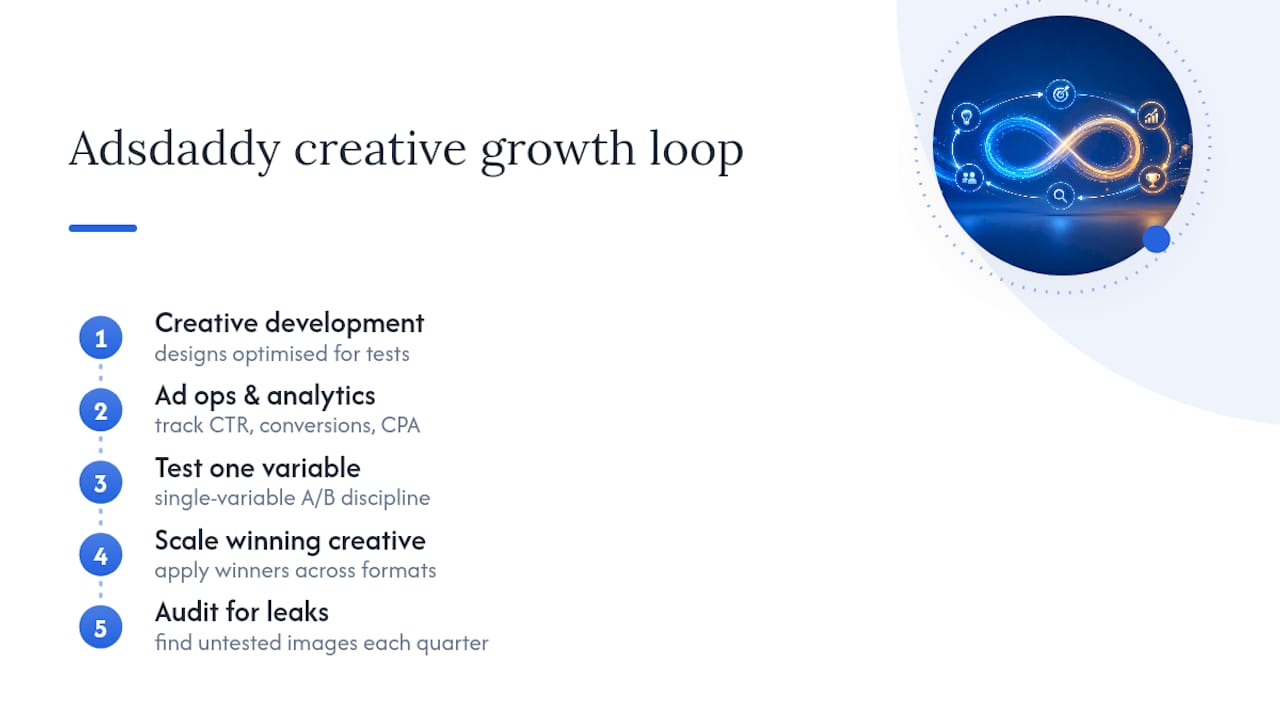
Most businesses treat creative as a one-off task. Get a designer, make a graphic, hope for the best. Adsdaddy treats it as an ongoing performance system, because that's what the data demands.

Our team handles creative development, ad ops and performance analytics across Facebook, Instagram, Google, YouTube, Microsoft Bing and LinkedIn, so your visuals aren't just on brand, they're measured against CTR, conversion and CPA from day one. We run the same test-one-variable discipline covered above, then scale whatever wins across your creative ad formats and channels. No guessing, no "let's just try this and see."
If your current ad images haven't been tested in the last quarter, that's budget quietly leaking. Book an audit with Adsdaddy and find out exactly which visuals are costing you clicks.
Sources worth your time
The claims in this piece lean on research from the American Marketing Association, whose image-analytics framework explains how to quantify colour, contrast and emotion in creative. The Scientific Reports (Nature) study on deep-learning visual optimisation supplies the CTR and brand-recognition figures used above. MDPI's consumer satisfaction study across 1,500 product pages backs the caution on human imagery, and Shopify's visual marketing guidance informs the funnel-stage and consistency advice. Each source ties a specific claim to real data rather than a hunch.
FAQ
Why is digital marketing important for images specifically?
Images process faster in the brain than text, which means they capture attention and build brand recall before your copy even gets read, directly influencing click-through and conversion.
What are the main benefits of digital marketing images?
The core benefits are stronger engagement, wider shareability, better brand recall and measurable conversion uplift, particularly when the image is tested and optimised rather than chosen on gut feel.
What are the advantages of using images over text alone?
Images convey emotion and context instantly, cut through cluttered feeds faster, and can lift CTR by over 30% in controlled testing, something plain text struggles to replicate.
What are the 5 P's of digital marketing?
Definitions vary slightly across sources, but the commonly cited version is Product, Price, Place, Promotion and People, with visuals sitting squarely inside Promotion as the primary tool for grabbing and holding attention.
How does Adsdaddy help improve image performance?
Adsdaddy pairs creative production with ongoing A/B testing and performance analytics across major ad platforms, so every image is judged on CTR, conversion and cost, not just how it looks.