In 90 Days: Local Business Promotion Strategies Pay for Themselves
. By Ads Daddy.

Five moves matter more than the rest: claim and optimise your Google Business Profile, systemise reviews, build local SEO pages, run one or two social channels with intent, and put a small paid budget behind Meta or Google to fill the gaps. Budget for weeks, not days, on GBP and reviews, and months on SEO. Everything else in this guide is detail. Scroll for the 90 day plan.
TL;DR:
- Prioritise optimizing your Google Business Profile and systematically collecting reviews, as they deliver the highest organic ROI and influence local search rankings.
- Focus on building local SEO pages with service-specific content, FAQs, and embedded maps that answer precise local questions and improve visibility via AI and voice search.
- Run one or two social channels with consistent, authentic content and engage in local community activities to foster trust and word-of-mouth referrals.
- Use small, targeted paid ads on Google and Meta to generate immediate leads and test creative variations for 14 to 21 days, adjusting based on cost per lead and conversion metrics.
- Maintain a regular review and attribution system, tracking key KPIs over 90 days to decide whether to scale, tweak, or cut paid campaigns and organic efforts.
Table of Contents
- Why these local business promotion strategies work as a system
- Claim, complete and convert with Google Business Profile
- Social media and community engagement, minus the vanity metrics
- Local pages and blog content that win searches and AI answers
- Where to spend on paid local ads: Google, Meta and geotargeting
- Systemise reviews: ask, respond, amplify
- Partnerships, events and old school offline tactics
- Simple KPIs, attribution and your 90 day decision plan
- AdsDaddy's practical playbook for local visibility
- Leveraging local influencer marketing
- Utilising email marketing tailored to local audiences
- Mobile marketing strategies specific to local users
- Creating and promoting local promotions or offers
- Optimising for voice search with local intent
- The blunt reality about local marketing
- Get AdsDaddy to run your local campaigns while you run your business
- Sources
- FAQ
Why these local business promotion strategies work as a system
Most business owners treat marketing like a buffet. Bit of Instagram, bit of flyers, bit of "we should really do SEO." That's how you end up busy and broke.
The winning approach is a flywheel, not a shopping list. Each piece feeds the next:
- Google Business Profile gets you found.
- Reviews make people trust what they found.
- Local content keeps you found for more searches.
- Social media turns fans into free advertising.
- Paid ads fill the gap while the organic stuff compounds.
Skip step one and steps three to five are wasted spend. Australia has hundreds of thousands of actively trading small businesses competing for the same searches, according to the Australian Bureau of Statistics business counts. You're not just marketing, you're fighting for a park in a full car park.
Prioritise by business type. Service businesses (plumbers, electricians, cleaners) live and die by GBP and reviews. Retail lives on social and foot traffic tactics. Appointment based businesses (clinics, salons, studios) need booking links front and centre everywhere.
Weeks 1 to 4: GBP overhaul, review system live, first local page published. Weeks 5 to 12: content cadence, social posting rhythm, first paid test. Checkpoints: review count and star average, map pack ranking, cost per lead.
Claim, complete and convert with Google Business Profile
Your Google Business Profile is the digital shopfront most owners forget to sweep. Optimised profiles and steady review volume are consistently the highest ROI free channel a local business has, and it costs nothing but your time.
Here's what actually needs doing, not what you think you already did:
- Complete every field: hours (including holiday hours), services list, booking link, messaging turned on.
- Upload fresh photos monthly, not once when you set it up in 2022.
- Post updates weekly: offers, new stock, events, anything.
- Answer every question already sitting unanswered on your listing.
- Match your business name, address and phone number (NAP) exactly across your website, GBP, and every directory.
On your website, build dedicated location pages if you serve more than one suburb, and add Schema markup for areaServed and hasMap so search engines know exactly where you operate. Target local keyword phrases like "electrician [suburb]" rather than generic terms nobody's suburb-searching for.
Pro Tip: Update your GBP photos and posts every single week for a month straight. Google rewards active profiles with better map pack placement, and it costs you fifteen minutes, not a marketing budget.
Timeline check: GBP improvements show up in 2 to 8 weeks. On-site local SEO takes 3 to 6 months to properly bite. Don't panic and pull the plug on SEO in week three, it's not supposed to work yet.
For a deeper tactical rundown, this local business marketing checklist covers the exact fields worth prioritising first.
Social media and community engagement, minus the vanity metrics
Nobody's buying your product because you hit 10,000 followers. They're buying because your neighbour tagged you in a story. Social media reaches a huge slice of the population in Australia, and picking the right one or two platforms beats being mediocre on five.
Pick your lane:
- Visual retail, hospitality, beauty: Instagram and TikTok. Short video wins, always.
- B2B and trade services: LinkedIn and Facebook. People research trades on Facebook more than they'll ever admit.
Content that works locally isn't polished, it's real:
- Behind the scenes clips (the mess, the process, the "how we actually made this").
- User generated content, reposted with credit, always.
- Event promos with geo tags so locals see you in their feed.
- Quick wins: join local Facebook Groups and answer questions without pitching, that's the whole strategy.
- Team up with a local micro creator for a content swap instead of a flat fee.
- Use community hashtags tied to your suburb or region, not generic industry tags nobody local searches.
None of this needs a production budget. It needs consistency and a phone camera.
Local pages and blog content that win searches and AI answers
Search intent locally is brutally specific: "best [service] near me," "[service] cost [suburb]." Build pages that answer that exact question, not vague "About Us" fluff.
Every location or service page needs:
- The specific services offered at that location.
- FAQs answering the actual questions customers ask on the phone.
- An embedded map and directions.
- Recent reviews pulled through, not buried on a separate page.
Blog topics that pull local traffic:
- "How much does [service] cost in [suburb/region]?"
- Neighbourhood guides: "Best [category] spots in [suburb]" that mention your business naturally.
- Seasonal or event tie ins specific to your area.
Modern local marketing also means writing for AI overviews and answer engines, not just Google's blue links. Structured content, clear schema markup, and concise direct answers increase your odds of being the source an AI assistant quotes when someone asks a local question. Keep answers short, use lists, mark up your data properly, and you're playing the same game twice with one piece of content.
Where to spend on paid local ads: Google, Meta and geotargeting
Organic takes months. Paid ads buy you leads this week. Here's how to pick the right channel and not torch your budget figuring it out:
- High purchase intent, someone actively searching: Google Search ads. They're already looking, you're just answering the call.
- Building awareness, capturing leads before they know they need you: Meta lead ads. Think home services, local events, seasonal offers.
- Filling a specific radius (say, a 10 to 15 kilometre catchment around your store): local display and geotargeted Meta campaigns.
A small, focused test budget on Meta lead ads reliably produces local leads while your organic channels catch up, and industry guidance suggests a modest monthly budget in the lower hundreds is a realistic starting range once you add GBP work into the mix. Don't launch one ad and call it a test. Run 2 to 3 creatives simultaneously, measure cost per lead, and give it 14 to 21 days before you touch anything.
Pro Tip: Kill your worst performing creative at day 14, not day 3. Facebook's algorithm needs time to find its audience, pulling the plug too early just wastes your learning phase.
Want real examples of what a working local ad actually looks like? Check these targeted advertising examples for small businesses before you brief your next creative.
Systemise reviews: ask, respond, amplify
Reviews aren't a nice to have, they're your second website. Most customers check them before they check your prices.
- Ask within 2 hours of service, via SMS if you have their number, it converts better than email.
- Follow up once by email within 48 hours if no response.
- Use a simple script: "Thanks for choosing us today! Mind leaving a quick review? Takes 30 seconds: [link]."
- Respond to every negative review within 24 hours, calmly, and take the resolution offline.
- Never argue publicly. Ever. Screenshots live forever.
Review velocity, meaning a steady drip of new reviews each month, matters as much as your total count for both local search visibility and AI generated answers about your business. One burst of 20 reviews in a week then silence for a year looks suspicious to both customers and algorithms. For a structured approach to handling the tricky ones, this guide to managing online reputation is worth bookmarking.
Partnerships, events and old school offline tactics
Digital gets the headlines, but a good local partnership still punches above its weight.
- Find complementary businesses (a gym and a physio, a cafe and a bookshop) and run a joint offer, split the promo cost, double the reach.
- Pitch your local paper or community newsletter with a genuine story angle, not a press release about your logo refresh.
- Sponsor or show up at community events where your actual customers already gather.
- Use trackable QR codes and unique short links on every flyer, sponsorship banner and event offer so you know what actually drove a lead.
Community mentions in local press, podcasts and creator content increasingly feed into what AI tools cite as local authority, so that newsletter mention is doing double duty as SEO and AI signal building, not just a nice writeup.
Simple KPIs, attribution and your 90 day decision plan
You don't need a data analyst. You need four numbers and the discipline to check them monthly.
- Cost per lead (CPL) across each channel, tracked separately.
- Conversion rate from lead to paying customer.
- Call-to-book rate if you're appointment based.
- LTV to CAC ratio as a rough heuristic, aim for at least 3:1.
Tag every source with UTM parameters, use a dedicated tracking phone number for offline campaigns, and route booking links through trackable URLs. After 90 days, apply the rule: keep what's under target CPL and improving, tweak what's close but underperforming, cut what's burning budget with no movement.
AdsDaddy's practical playbook for local visibility
Adsdaddy manages campaigns across Google, Meta, YouTube, Microsoft Bing and LinkedIn for small and local businesses that would rather run their shop than learn ad platforms. That's the whole pitch: hands-on setup, ongoing optimisation, and lead delivery without you touching an ads dashboard.
Here's a six point checklist you can run yourself or hand straight to an agency:
- GBP fully completed and posting weekly.
- Review request system automated within 2 hours of service.
- One local service page per suburb or category served.
- One paid test running with 2 to 3 creatives, minimum 14 days.
- UTM tagging on every campaign link.
- Monthly review of CPL and conversion rate against the 3:1 LTV to CAC benchmark.
Leveraging local influencer marketing
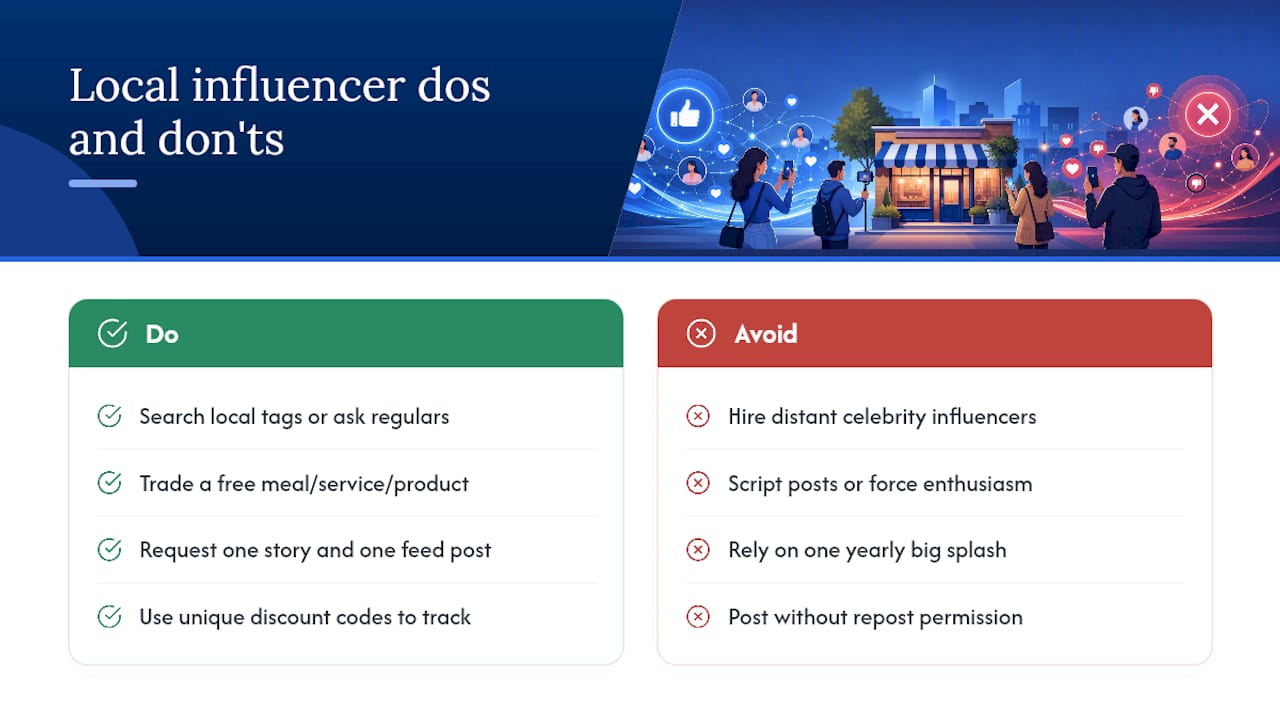
Forget the celebrity influencer fantasy. A creator with 3,000 followers in your suburb beats a lifestyle influencer with 300,000 followers spread across a continent. Local relevance crushes raw reach every time, because their audience actually lives near your shopfront.
Find them the low effort way: search location tags and local hashtags on Instagram and TikTok, or just ask your regulars if anyone they know creates content. Most local creators will happily trade a free meal, service or product for an honest post, no five figure contract required.
Structure the deal simply. Give them a genuine experience, not a script. Audiences smell scripted enthusiasm from a mile off, and it kills trust faster than no post at all. Ask for one story, one feed post, and permission to repost their content on your own channels, that's fair value for most small local trades.
Track it properly. Give each creator a unique discount code or trackable link so you know exactly what business they drove, not just vibes. Run three or four of these a quarter rather than one big splash a year, consistency beats a single viral moment that fades in 48 hours.
Utilising email marketing tailored to local audiences
Email gets written off as old news, but it still delivers strong returns for businesses with repeat customers, and segmentation is the difference between a newsletter people open and one they delete on sight.
Build your list from every touchpoint: in-store sign up sheets, booking confirmations, receipt footers, GBP messaging. Then segment by suburb, service type or purchase history rather than blasting one generic email to everyone.
Localise the subject line and the offer. "Weekend special for [suburb] locals" outperforms "Our Latest Newsletter" because it signals relevance before the email's even opened. Reported best practice guidance backs this: localised subject lines and segmented sends consistently lift engagement over generic broadcast emails.
Keep the cadence realistic, monthly for most local businesses, weekly only if you genuinely have weekly news worth sharing. An empty inbox promise beats an over-promised one you can't sustain past month two.
Mobile marketing strategies specific to local users
Your customer is standing outside a competitor's shop, phone in hand, deciding where to go. That's the moment mobile marketing wins or loses.
Make your site load fast on mobile data, not just fast on your office wifi. A slow loading location page loses the customer to whoever loads first, it's that simple.
Click to call buttons matter more locally than almost anywhere else. Put your phone number as a tap to dial button on every mobile page, not buried in a footer.
Use it sparingly though, nobody wants five texts a week from their local cafe.
Geofenced push notifications and location based offers through your GBP messaging feature let you reach someone within walking distance right when they're deciding. Combine that with mobile optimised booking links so the whole path from notification to appointment happens in under sixty seconds.
Creating and promoting local promotions or offers
A promotion tied to something local, specific and time bound does.
Tie offers to the calendar your community actually cares about: local footy grand finals, school holidays, a nearby festival weekend. Relevance beats generosity, a smaller discount tied to a moment people are already talking about outperforms a bigger discount nobody notices.
Make the offer suburb specific where you can. "First 50 customers from [suburb] get X" creates urgency and flatters the exact audience you're chasing.
Promote it everywhere at once, not one channel at a time: GBP post, social story, email blast, and a physical sign if you've got a shopfront. The overlap is what creates the feeling that "everyone's talking about this," even when it's really just four coordinated touchpoints.
Track redemption with a unique code every time. If a promo doesn't move the needle on foot traffic or bookings within its run, don't repeat it next quarter, adjust the offer or the timing instead.
Optimising for voice search with local intent
"Hey Google, find a plumber near me open now" is a completely different search behaviour to typing the same query, and most local businesses haven't adjusted for it.
Voice queries are longer, more conversational, and almost always carry local intent baked in. Structure your content to answer full questions directly: "Are you open on Sundays?" gets answered better by an FAQ that states your Sunday hours plainly than by a vague "contact us for hours."
Structured content and clear schema markup increase your odds of being the source a voice assistant or AI overview actually reads aloud, so the same FAQ and schema work you did for local SEO does double duty here. Keep answers short, direct, and phrased the way a person would actually ask the question out loud, not the way you'd write ad copy.
Your GBP hours, phone number and address need to be bulletproof accurate, because voice assistants pull straight from that listing with zero human fact checking in between.
The blunt reality about local marketing
Most local businesses fail here because they spread thin. Five channels done badly beats zero channels done well, or so they think. It doesn't.
The real priority order is boring: fix reviews, run one small paid test, then expand. Everything else is noise until those two things are humming.
Here's the counterintuitive bit. A phone photo of your actual product beats a polished stock style post almost every time locally. People trust what looks real more than what looks like an ad, because it doesn't look like an ad.
— Adrian
Get AdsDaddy to run your local campaigns while you run your business
You've now got the full playbook. Running it yourself takes hours you probably don't have. Adsdaddy is the alternative to hiring a full agency team: hands-on management of your Google, Meta, YouTube, Bing and LinkedIn campaigns, with integrated tracking so leads land straight in your inbox instead of vanishing into an ads dashboard you never check.
If leads are the bottleneck, not traffic, the pay per lead guide compares buying single finance enquiries through OptiCheck, our own loan marketplace, with an enquiry engine of your own that answers every enquiry within 60 seconds. Want a fully built system instead of one-off leads? Ads Daddy builds that system in your own accounts as a 90-day program, with the fee named on the call. For ongoing Meta and Google campaign management tailored to your local market, the Adsdaddy homepage has the full service breakdown. Book a call, tell us your suburb and your goal, and we'll tell you honestly whether paid ads make sense yet or whether you need the review system fixed first.
FAQ
What are 5 promotional strategies for a local business?
The five highest-impact moves are optimising your Google Business Profile, systemising review requests, building local SEO pages, running one or two focused social channels, and testing a small paid budget on Meta or Google. Run them in that order, not all at once, and each one strengthens the next.
What is the best way to promote my business locally?
Start with your Google Business Profile, since optimised profiles and steady review volume are the highest ROI free channel available to local businesses. From there, layer in local content and a modest paid test once your profile and reviews are solid.
What is the 3-3-3 rule in marketing?
Definitions vary depending on who's teaching it, but a common version suggests testing 3 audiences, 3 creatives and 3 offers before scaling a paid campaign. It's a useful discipline for the paid ads test cadence covered above, run several variables at once rather than guessing with one.
What are some examples of promotional strategies?
Common examples include local promotions tied to community events, review request campaigns, geotargeted Meta ads, local influencer partnerships, and email offers segmented by suburb. Adsdaddy's pay-per-lead services cover the paid side of this if you'd rather outsource the setup and testing.